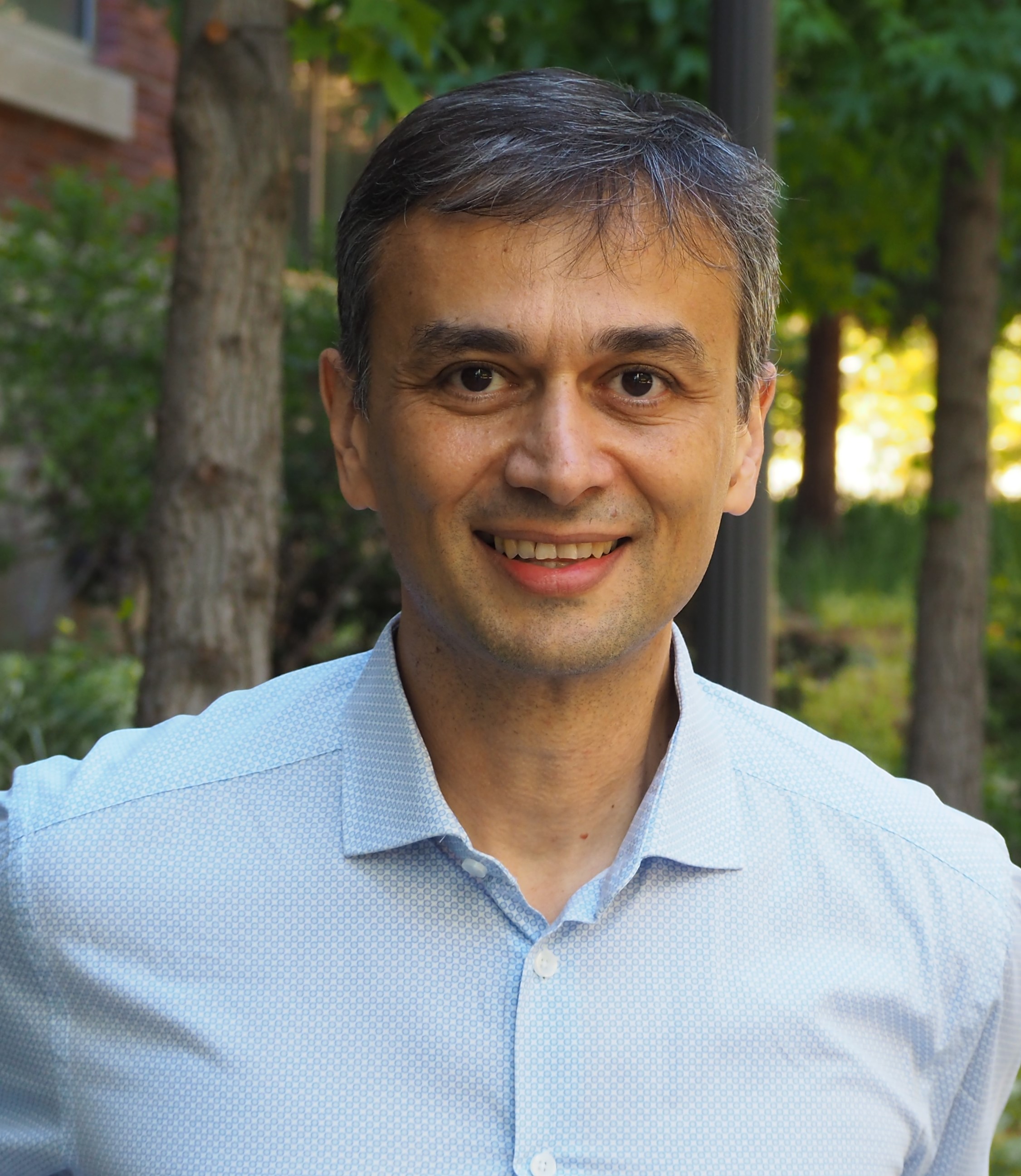
Prof. Oliver Bräunling is a full professor at the Department of Mathematics, Albert-Ludwigs-Universität Freiburg, leading the Chair of Algebra and Geometry (Lehrstuhl für Algebra und Geometrie). His research focuses on algebraic K-theory, algebraic number theory, and representation theory, with significant contributions to homological algebra and category theory. He earned his PhD in Mathematics from the same university in 2012 and completed his habilitation in 2018. Bräunling actively advises three PhD students: Julius Giesler, Lennart Gehrmann, and Tobias Columbus. He received the prestigious DFG Heisenberg Fellowship in 2022. His research explores intricate connections between algebraic structures and geometric/topological concepts, with recent work emphasizing derived categories, model categories, and Langlands program aspects. Over 15 key publications from 2009–2023 reflect his expertise in advanced algebraic methodologies. Bräunling teaches graduate courses in algebra and co-organizes the university's algebra seminar. He collaborates with international research networks and serves on editorial boards for specialized journals.
Alastair King is a Professor in the Department of Mathematical Sciences at the University of Bath. His research spans algebra, geometry, and theoretical physics, with primary affiliations in mathematical sciences. His research focuses on non-commutative algebraic geometry, particularly moduli spaces of coherent sheaves, derived equivalences, cluster algebras, and their connections to dimer models in string theory. Key areas include: Non-commutative Algebraic Geometry Cluster Algebras and Categories Dimer Models and Theoretical Physics Moduli Spaces and Representation Theory Recent publications (2020-2024) reveal strong trends in cluster algebra applications, mirror symmetry for Grassmannians, and dimer partition functions. His work consistently bridges abstract algebra with theoretical physics, particularly through string theory frameworks and geometric representation theory. Scientific contributions include: 32 research outputs (29 articles, 2 preprints, 1 book chapter) Supervision of 8 research students Active collaborations across international networks His advising record shows consistent mentorship of graduate researchers, with recent supervised work focusing on categorification, quantum Grassmannians, and cluster exchange groupoids. While specific grants aren't detailed, his international collaborations indicate significant research funding support. His work maintains strong connections to both pure mathematics and theoretical physics communities through ongoing projects in non-commutative geometry.
Asilata Bapat is a Senior Lecturer and ARC DECRA Fellow at the Mathematical Sciences Institute of the Australian National University, where she also holds a Tuckwell Fellowship. Her research bridges representation theory, algebraic geometry, and topology, with particular focus on geometric structures arising from categorical frameworks. Her educational background includes a PhD (2016) and Master's (2012) from the University of Chicago under Victor Ginzburg, and a Bachelor's in Mathematics with Computer Science (2010) from MIT. Prior to ANU, she was a postdoctoral researcher at the University of Georgia with William Graham. Dr. Bapat's research centers on the topology and geometry of algebraic varieties in representation-theoretic contexts. She investigates Bridgeland stability conditions, braid group actions on triangulated categories, perverse sheaves, quiver varieties, and Bernstein--Sato polynomials. Her recent work shows increasing engagement with computational topology through collaborations in persistence module theory. Her publication record reveals a consistent trajectory from foundational representation theory toward geometric and topological applications, with significant recent contributions to stability conditions (2023-2024) and computational topology (2022). The 2024 papers on Burau representations and Wigglyhedra demonstrate expansion into geometric group theory and combinatorial geometry. Award highlights include: Australian Research Council Discovery Early Career Researcher Award (DECRA) Prestigious Tuckwell Fellowship for academic leadership She actively supervises honors students (including Yangda Bei and Leonardo Maltoni in 2025) and coordinates the Simon Marais Mathematics Competition at ANU. Her current ARC-funded project 'Stability conditions: their topology and applications' (2024-2026) examines categorical braid group actions with collaborators Anthony Licata and Anand Deopurkar. Through her cobracat GitHub repository, she maintains computational tools for categorical braid group actions, implementing algorithms for zigzag algebras and spherical twists. Her upcoming activities include presentations at major international venues: Centre de Recerca Matemàtica (Barcelona, Nov 2025), ICTS Bengaluru (Feb 2026), and University of Cambridge (Apr 2026).
Diego Borro is a Full Professor (Catedrático) in Computer Science and Artificial Intelligence at TECNUN, Technological Campus of the University of Navarra , where he has been part of the faculty since 2004. He is a leading researcher at CEIT since 2003, focusing on Robotics, Virtual/Augmented Reality, Computer Vision, and Artificial Intelligence. His academic credentials include a PhD in Computer Science (2003) and an MS in Computer Science (2000) from the University of Navarra and University of Basque Country respectively. His research spans from 3D tracking and haptics to industry 4.0 applications and medical robotics, with over 34 journal papers and 65 conference articles. He has supervised 14 doctoral theses and participated in 55+ research projects. His leadership roles include heading CEIT's Simulation Unit (2012-2016) and Vision and Robotics (V&R) research line (2016-2022), currently serving as main researcher at Intelligent Systems for Industry 4.0 group (SS4I4). Accredited as Full Professor (Catedrático) by ANECA (3 sexenios) Member of IEEE, ACM, and Eurographics societies Key projects: STEPbySTEP exoskeleton benchmark, WARM AR maintenance systems, and inner ear drug delivery research
Liran Shaul is an Associate Professor at the Department of Algebra, Faculty of Mathematics and Physics, Charles University in Prague. His research focuses on commutative algebra, homological algebra, and their applications in higher algebra and topology. Shaul completed his PhD at Ben-Gurion University in 2013 under the supervision of Prof. Amnon Yekutieli. He held postdoctoral positions at Bielefeld University (hosted by Prof. Henning Krause), University of Antwerp (hosted by Prof. Wendy Lowen), the Weizmann Institute, and Ben-Gurion University before joining Charles University. In 2025, he completed his habilitation thesis titled "Differential graded rings and their applications." His research interests span commutative algebra, homological algebra, derived categories, Cohen-Macaulay rings, DG-rings, and homotopical algebra. Shaul has made significant contributions to understanding the connections between commutative algebra and derived categories, particularly in the context of DG-rings and finitistic dimensions. Shaul's recent publications demonstrate a strong focus on DG-rings, finitistic dimensions, and the Cohen-Macaulay property in derived commutative algebra. His work bridges classical commutative algebra with modern homotopical methods, providing new insights into longstanding problems in the field. Principal investigator for the grant "Cohen-Macaulay rings and their applications in higher algebra and topology" Organized the "Derived Categories" conference in Prague, February 2020 Shaul has supervised several students, including Edward Young and Emil Čuřín (Bachelor's theses), and Enrico Sabatini and Jindřich Novák (Master's theses). In the 2024/2025 winter semester, he teaches courses on Homological Algebra and Algebraic Geometry.
David A Jorgensen is a Professor of Mathematics at the University of Texas at Arlington. His academic career includes extensive research in algebra, homological algebra, and commutative algebra. He holds a PhD from the University of Nebraska-Lincoln (1996) and has been a member of the American Mathematical Society since 1990. Education PhD in Mathematics, University of Nebraska-Lincoln, 1996 MS in Mathematics, University of Nebraska-Lincoln, 1991 BS in Mathematics, San Diego State University, 1989 Research Interests Dr. Jorgensen focuses on homological properties of modules over local rings, vanishing theorems, complete intersections, Gorenstein rings, and triangulated categories. His work bridges commutative algebra with representation theory and category theory, emphasizing structural and categorical approaches to algebraic problems. Grants & Awards Recipient of the Excellence in Doctoral Student Mentoring Award (UT Arlington, 2015) Principal Investigator/Co-PI on multiple NSF and DoE-funded grants, including GAANN Fellowships and initiatives promoting doctoral mentorship Organizer of the Southwest Local Algebra Meetings (2011–2026), fostering regional collaboration Advising & Service He has advised numerous PhD, master's, and undergraduate students, overseeing over 30 advisees. His service includes roles as Associate Chair of the Department of Mathematics and membership in the Graduate Assembly. Labs/Teams Core contributor to the Algebra and Representation Theory group at UTA, leading research on homological algebra and categorical structures.
Petter Andreas Bergh is a Professor at the Department of Mathematical Sciences, Norwegian University of Science and Technology (NTNU). He holds a Cand.scient and PhD in mathematics from NTNU. His research focuses on algebraic structures, homological algebra, representation theory, and noncommutative geometry. He is a core member of the algebra group at NTNU and has contributed extensively to areas such as triangulated categories, support varieties, and quantum complete intersections. His academic work includes over 50 peer-reviewed publications in journals like Journal of Noncommutative Geometry , Arkiv för Matematik , and Advances in Mathematics . Recent research explores separable equivalences, matrix factorizations, and categorical structures in finite tensor categories. He has also authored doctoral and master’s theses and supervised academic reports, including contributions to the Fremtidens teknologistudier (FTS) project. Bergh teaches advanced courses such as MA8202—Commutative Algebra and MA3202—Galois Theory. His work emphasizes theoretical foundations and their applications in modern algebraic frameworks.
Josh Pollitz is an Assistant Professor in the Department of Mathematics at Syracuse University, joining in Fall 2023. His research focuses on commutative algebra with homological aspects, including cohomological support, triangulated categories, and connections to representation theory and homotopy theory. He holds a PhD from the University of Nebraska-Lincoln (2019) and was an NSF Postdoctoral Fellow at the University of Utah (2019–2023). Education: PhD in Mathematics, University of Nebraska-Lincoln, 2019 MS in Mathematics, University of Nebraska-Lincoln, 2015 MS in Mathematics, Oregon State University, 2013 BS in Mathematics, California Polytechnic State University, 2010 Research Interests: Homological aspects of commutative algebra Cohomological support and triangulated categories Applications of homotopy theory and representation theory Awards & Honors: NSF Postdoctoral Research Fellowship (2020) Outstanding Postdoc Award, University of Utah (2021) Don H. Tucker Postdoctoral Fellowship (2022) Special Trimester Participant, Hausdorff Research Institute for Mathematics (2022) Teaching & Service: Co-organizer of the Syracuse University Algebra Seminar NSF Panelist (2024) Recent talks include roles at MSRI, Cornell, and Oberwolfach Grants: "Homotopical methods and cohomological supports in local algebra" (NSF, 2023–2026)
David Bachman is a Professor of Mathematics at Pitzer College , part of the Claremont Colleges consortium. Since joining in 2004, he has contributed extensively to low-dimensional topology, particularly in knot theory, 3-manifold topology, and Heegaard splittings. His work bridges geometric and topological concepts, including studies of hyperbolic geometry, minimal surfaces, and contact structures. Educational Background : PhD in Mathematics from the University of Texas at Austin BS in Mathematics from the State University of New York at Binghamton His research interests focus on the interplay between topological and geometric properties of 3-manifolds, with a strong emphasis on Heegaard splittings, thin position, Dehn surgery, and their applications. He has developed theories linking topological index to minimal surfaces and explored algorithmic aspects of Heegaard genus computation. Dr. Bachman’s recent publications highlight the complexity of Heegaard splittings in 3-manifolds, including destabilization phenomena, almost normal surfaces, and connections to computational hardness (NP-Hardness of Heegaard genus). His work often involves collaborations with researchers like Ryan Derby-Talbot and Eric Sedgwick. Scientific Awards and Grants : NSF Research Grant (PI, DMS–1207804), 'Applications of Topologically Minimal Surfaces', 2012-15 MAA Tensor-SUMMA grant for the Claremont Colleges' Gateway to the Mathematical Sciences program, 2010-11 He has also contributed to pedagogy through books like Advanced Calculus Demystified (2007) and A Geometric Approach to Differential Forms (2nd edition, 2012), which are widely used in undergraduate and graduate mathematics education.
Peter Lewintan is a researcher in the Institute of Applied and Numerical Mathematics at Karlsruhe Institute of Technology (KIT), focusing on partial differential equations, functional analysis, and mechanics of deformable solids. His work bridges mathematical theory with applied continuum mechanics, particularly in Korn-type inequalities and micromorphic models. Current research includes generalized Korn inequalities for incompatible tensor fields and numerical methods for micromorphic continua Recent publications analyze wave propagation in metamaterials, boundary conditions in generalized continua, and optimal Sobolev estimates Collaborators include Patrizio Neff, Adam Sky, and Ionel-Dumitrel Ghiba. His work has been cited 128 times in 56 documents, primarily in journals like Journal of Elasticity and Computer Methods in Applied Mechanics and Engineering .
Professor Michael S. Floater is affiliated with the Department of Mathematics at the University of Oslo , specializing in Differential Equations and Computational Mathematics . His research spans approximation theory, numerical analysis, and geometric modeling, with a focus on polynomial and spline-based data approximation, recursive subdivision techniques, and optimal function spaces. Fields of Interest: Approximation Theory, Numerical Analysis, Geometric Modelling, Computational Mathematics, Differential Equations Recent publications address B-spline properties, supersmoothness in Alfeld splits, and advanced polynomial interpolation methods. His work often intersects with applications in computer-aided geometric design (CAGD) and numerical solutions to partial differential equations. He serves on the editorial boards of Computer Aided Geometric Design (CAGD) and BIT Numerical Mathematics , and has supervised technical reports and collaborative projects in computational methods.
Michael Prest is an Emeritus Professor of Pure Mathematics at the University of Manchester. His research focuses on the category of modules over rings and associated algebraic, logical, topological, and geometric structures. He has supervised 19 PhD and 22 MSc students, currently mentoring two mathematics students. His work examines module categories through model-theoretic perspectives, including Ziegler spectra, abelian/triangulated categories, geometric representation theory, and non-commutative geometry. Recent publications explore purity in sheaf categories (2020), tensor structures for Nori motives (2020), and model theory for sheaves of modules (2019). Prest has taught courses spanning model theory through representation theory to category theory. His educational contributions include ten years as editorial adviser for London Mathematical Society journals and organizing the Greater Manchester Mathematics Challenge. Academic service includes LMS regional organizer for Northern England.
Paul Balmer is a Professor of Mathematics at the University of California, Los Angeles (UCLA), specializing in Algebra, Algebraic Geometry, and Representation Theory. He has held this position since 2008, following roles at ETH Zürich and other institutions. His research focuses on tensor triangular geometry, modular representation theory, homotopy theory, and Witt groups, with significant contributions to the field through over 70 publications. Education: Ph.D. in Mathematics from the University of Lausanne (1998), supervised by Manuel Ojanguren. Postdoctoral positions at the University of Western Ontario, Rutgers University, and the University of Münster. Research interests include tensor triangulated categories, algebraic K-theory, and geometric approaches to representation theory. He serves on the editorial board of the Annals of K-Theory and actively participates in conferences worldwide, including events in Ascona, Banff, Oberwolfach, and upcoming talks in Linz, Osaka, and Edinburgh. Teaching: Extensive experience in graduate and undergraduate courses at UCLA, including Algebra, Linear Algebra, Homological Algebra, and Complex Analysis. Current courses include Spring 2026 Graduate Algebra (Math 210C). Awards: Humboldt Research Award (2015-2016), Fellow of the American Mathematical Society (2012). Active in professional service, including organizing workshops and serving on academic committees.
Sanjeev Bedi is a Professor in the Department of Mechanical and Mechatronics Engineering at the University of Waterloo, holding the position of NSERC Design Chair and serving as Director of the IDEAs Clinic. He founded both the Engineering IDEAs Clinic and the NSERC Chair in Immersive Design Engineering Activities (IDEAs). Bedi leads the 5-Axis Surface Machining Lab and previously served as Director of Mechatronics Engineering from 2006 to 2012. He is also a founding faculty member of the Mechatronics Engineering Program at Waterloo. Education: Doctorate in Engineering (1987), University of Victoria, Victoria, BC Master's in Mechanical Engineering (1984), University of British Columbia, Vancouver, BC Bachelor's in Mechanical Engineering (1982), Indian Institute of Technology, Kanpur Professor Bedi's research focuses on advanced manufacturing techniques, particularly 5-axis machining, tool path strategies, NC controller design, and surface machining methods. His expertise spans flank milling, gouge detection and avoidance mechanisms, automated polishing, complex curve machining methods (including Principle Axis Method and Multi-Point Method), machined surface evaluation, and surface finish estimation. He has developed innovative approaches like the Drop and Tilt Method for tool positioning in 5-axis machining. His research bridges theoretical computational geometry with practical manufacturing applications, addressing challenges in precision machining of complex surfaces. Analysis of his recent publications reveals a strong focus on computational methods for 5-axis machining, particularly for tensor product surfaces and triangulated models. His work consistently addresses practical manufacturing challenges while developing novel geometric algorithms. In recent years, he has expanded his research scope to include engineering education, developing innovative approaches to design education and multidisciplinary teamwork training. As Director of the IDEAs Clinic, Bedi has overseen significant educational initiatives with over 24,000 student contacts and employment of more than 100 co-op students, 10+ research assistants, and 5 sessional lecturers. The clinic has sponsored five courses including engineering and art, experiential engineering modules for MEng students, and practical FEA courses for graduate students. Professor Bedi has taught several courses in recent years including MTE 100 (Mechatronics Engineering, 2020-2024), MTE 380 (Mechatronics Engineering Design Workshop, 2024), and MTE 481 (Mechatronics Engineering Design Project, 2022-2023), demonstrating his ongoing commitment to engineering education and student development.
Prof. Dr. Henning Krause is a faculty member at the Faculty of Mathematics, Bielefeld University , Germany. His research bridges representation theory, triangulated categories, and algebraic geometry, with a focus on homological methods and categorical structures. Email: hkrause@math.uni-bielefeld.de In his work, Krause explores Auslander-Reiten theory, local duality, and support varieties in triangulated and module categories. Recent projects include studying derived splinters, exceptional collections, and cohomological properties of categories over noetherian rings. His 15 most recent publications (2025–2020) span topics like Matlis reflexivity, Stone duality via support, and classification of subcategories. These articles emphasize applications of triangulated category theory to algebraic structures and cohomology. Funded Projects: SFB TRR 358/1, Subprojects C06 & C07 (2023–2026), funded by the German Research Foundation Krause has contributed to cohomology theory for finite groups, stable homotopy categories, and axiomatic approaches to duality. He also investigates the interplay between representation type and module categories.