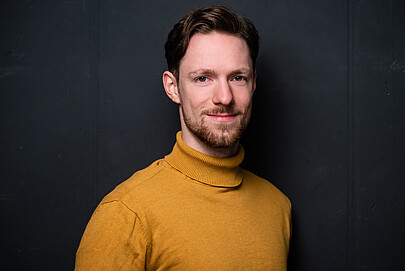
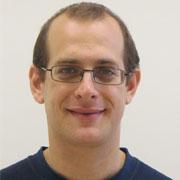
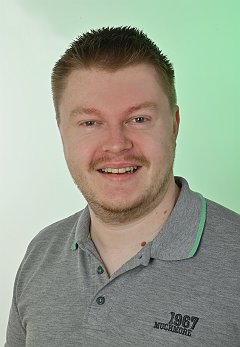
Patrick Gelß is a Postdoctoral Researcher at Zuse Institute Berlin, working in the AI in Society, Science, and Technology department. He leads the iol.QUANT research group focused on quantum-inspired and tensor-based methods, with affiliations to Freie Universität Berlin and collaborative projects like MATH+ Cluster of Excellence. Diploma in Mathematics/Physics (2013, Freie Universität Berlin) PhD in Mathematics (2017, summa cum laude, Freie Universität Berlin) Postdoctoral roles at Zuse Institute Berlin (2020-present) and CRC 1114 (2017-2022) His research bridges tensor decompositions, quantum computing, and dynamical systems, with notable contributions to: Graph Isomorphism: Continuous optimization approaches via doubly stochastic matrices and Frank-Wolfe algorithms Quantum Simulation: Tensor network representations for quantum circuits and the open-source WaveTrain package KvN Mechanics: Mathematical analysis of existence/uniqueness solutions for bounded domains Fredholm Networks: Novel training paradigms for neural networks using integral equations Scientific achievements include: Developing Scikit-TT for tensor-train computations Organizing major workshops (QML@SC2024, TMQS 2024) Leading the Thematic Einstein Semester 2024 on Mathematics for Quantum Technologies His work spans chemical kinetics, quantum dynamics, and quantum machine learning, with applications to CO oxidation models, exciton-phonon systems, and mutational hierarchies in medicine.
Hanne Hardering is a postdoctoral researcher at the Institute of Numerical Mathematics, Dresden University of Technology, and a principal investigator in the DFG Research Unit 3013 Vector-and Tensor-Valued Surface PDEs . Her work bridges numerical analysis, differential geometry, and partial differential equations, focusing on finite element methods for surfaces and Riemannian manifolds. Education: Dr. rer. nat. in Mathematics, Freie Universität Berlin (2015) Dipl.-Math. in Mathematics, Freie Universität Berlin (2010) Her research emphasizes intrinsic discretization error bounds, symmetry constraints, and applications to tensor-valued surface PDEs. Recent publications highlight error analysis for surface Stokes equations, tangential constraints in finite elements, and geometric data approximation. Grants & Projects: Principal Investigator, DFG Research Unit 3013 (2023–present)
Lennart Risthaus serves as a Researcher at the Department of Engineering Mathematics within the School of Civil Engineering at the University of Duisburg-Essen, Germany. He joined the university in September 2023 after previously working as a Researcher at the Institute of Engineering Mechanics, Continuum Mechanics Division at the Karlsruhe Institute of Technology (KIT) from February 2021 to August 2023. His academic appointments demonstrate a consistent trajectory in computational mechanics research within German technical universities. Dr. Risthaus completed his Bachelor's degree in Mechanical Engineering with a focus on Continuum Mechanics (2014-2018) and Master's degree in Mechanical Engineering with majors in Medical Technology and Applied Mechanics (2018-2021), both from the Karlsruhe Institute of Technology. His educational journey included an Erasmus exchange semester at the Royal Institute of Technology (KTH) in Stockholm and practical experience through internships at Reden B.V. in the Netherlands and Admedes GmbH in Germany, where he worked on finite element simulations and material testing. His research specializes in advanced computational techniques for material science, particularly FFT-based homogenization methods in micromechanics. Risthaus has developed innovative approaches for implementing Dirichlet boundary conditions in FFT-based computational frameworks and pioneered applications of tensor-train formats to enhance computational efficiency. His work bridges theoretical mathematics with practical engineering applications, focusing on solving complex boundary value problems in material behavior analysis. An analysis of his publication record reveals a clear research trajectory toward increasingly sophisticated computational methods for micromechanical simulations. His recent work demonstrates growing expertise in thermal homogenization problems and the integration of tensor-train methods with traditional FFT approaches. The consistent publication in high-impact journals like Computational Mechanics and International Journal for Numerical Methods in Engineering indicates recognition within the computational mechanics community. Risthaus actively contributes to the academic community through presentations at major international conferences including the GAMM Annual Meetings, ECCOMAS Young Investigators Conference, and the International Conference on Computational Plasticity (COMPLAS). His teaching responsibilities include leading exercises and tutorials for Mathematics courses for Civil Engineering students at both undergraduate and graduate levels, demonstrating his commitment to engineering education alongside his research activities.
Lennart Binkowski is a doctoral candidate and scientific staff member at the Institute of Theoretical Physics , part of the Faculty of Mathematics and Physics at Leibniz University Hannover. His research focuses on quantum computing, particularly quantum algorithms and combinatorial optimization. University: Leibniz University Hannover School: Faculty of Mathematics and Physics Department: Institute of Theoretical Physics Email: lennart.binkowski@itp.uni-hannover.de Lennart's research interests span quantum algorithms, quantum walks, and optimization frameworks. His work explores quantum programming languages, Pauli transfer matrices, and hybrid quantum-classical systems. Recent publications highlight advancements in QAOA, quantum permutation generation, and tensor network applications. Lennart's 15 most recent articles focus on quantum computing trends, including algorithm design, constraint handling, and tensor structures. No scientific awards are mentioned in the provided data. Contact details: Schneiderberg 32, 30167 Hanover, Germany (Building 3702, Room 013).
Prof. Dr. Hendrik Weimer is a Group Leader at the Institute of Theoretical Physics within the Faculty of Mathematics and Physics at Leibniz University Hannover. His research focuses on quantum simulation, entanglement, and topological quantum phenomena. Position: Professor Institution: Leibniz University Hannover Department: Institute of Theoretical Physics His work explores quantum phase transitions , multipartite entanglement , and topological order in driven-dissipative systems. Recent studies emphasize error correction for quantum simulations and dissipative state preparation using Rydberg atoms. Key trends in his publications include quantum computing , topological materials , and non-equilibrium quantum dynamics . His research often bridges quantum information theory with condensed matter physics .
Dr. Peter Lewintan is a researcher at the Faculty of Mathematics, Universität Duisburg-Essen. His work focuses on partial differential equations, Korn inequalities, elasticity theory, and mathematical analysis. He has contributed extensively to the study of continuum mechanics and applied mathematics, with a particular emphasis on foundational inequalities and their applications in material science. Research Interests: Partial Differential Equations Korn Inequalities and Functional Analysis Elasticity Theory and Nonlinear Mechanics Continuum Mechanics and Micromorphic Models Teaching and Academic Contributions: Lewintan has taught supplementary lectures for Analysis I and II courses, emphasizing rigorous mathematical foundations. His pedagogical approach includes detailed supplementary materials and live recordings for students. Key Publications: His recent work includes advancements in Korn-Maxwell-Sobolev inequalities, computational approaches to micromorphic models, and optimal inequality frameworks. These contributions highlight his expertise in both theoretical and applied mathematical research.
Prof. Dr. Willi Freeden is a renowned academic in mathematical geodesy and geophysics, affiliated with the University of Kaiserslautern's Faculty of Mathematics. He has held professorships since 1984 and transitioned to emeritus status in 2015. His research focuses on special functions, partial differential equations, and inverse problems with applications in geophysics and geothermal energy. Freeden has advised over 30 PhD students and authored/co-authored numerous books and papers. Educational Background: 1971: Diplom in Mathematics 1972: Staatsexamen 1975: PhD, RWTH Aachen 1979: Habilitation, RWTH Aachen Research Interests: His work bridges mathematics and geosciences, emphasizing constructive approximation methods (wavelets, splines), numerical geophysics, and satellite-based geodetic data analysis. Key areas include gravimetry, magnetometry, and geothermal resource modeling. Recent advancements include mollifier regularization and decorrelation techniques for geophysical data. Publications & Grants: Authored/co-authored 23 books and over 150 papers. Notable works include Metaharmonic Lattice Point Theory (2011) and Geomathematically Oriented Potential Theory (2013). Awarded the 2018 IPMS Award and 2020 Vening Meinesz Medal. Advising: Supervised 30+ PhD students (e.g., V. Michel on gravimetry, M. Schreiner on wavelet methods, I. Ostermann on geothermal modeling). Labs & Teams: Leads the Geomathematics Group at Kaiserslautern, collaborating on projects like satellite gravity gradiometry and geothermal reservoir modeling. Active in interdisciplinary initiatives such as the Handbuch Tiefe Geothermie (2014).
Dr. Moritz Cygorek is a researcher in the Department of Physics at the Technical University of Dortmund, affiliated with the Condensed Matter Theory (CMT) group. His research focuses on the theoretical and computational modeling of open quantum systems, particularly the development of advanced numerical methods to simulate non-Markovian dynamics in solid-state quantum emitters. His primary research interests include open quantum systems, non-Markovian dynamics, tensor networks, path integrals, quantum simulation, and quantum information processing. He develops methods such as the Automated Compression of Environments (ACE) and process tensor techniques to simulate quantum systems coupled to arbitrary environments with high accuracy. His recent publications reveal a strong trend in simulating complex quantum dynamics beyond conventional approximations, with applications in quantum dots, quantum light sources, entanglement generation, and phonon-assisted quantum control. His work bridges condensed matter physics, quantum optics, and quantum information science. Nature Physics (2022) : Lead developer of the ACE method for simulating arbitrary environments using tensor networks. Phys. Rev. Lett. and Phys. Rev. B : Contributions to phonon-assisted state preparation, single-photon sources, and entanglement enhancement. Dr. Cygorek has been supported by funding from EPSRC (EP/T01377X/1) and has collaborated extensively with researchers at Heriot-Watt University, the University of St Andrews, and Universität Bayreuth. He has contributed to multiple high-impact publications as a key theorist and algorithm developer. He is part of the CMT research group at TU Dortmund, which investigates quantum coherence, dissipation, and control in solid-state systems. The group emphasizes theoretical modeling and computational simulation of quantum phenomena in nanostructures and photonic environments.
João Carvalho is a Postdoctoral Researcher at the Intelligent Autonomous Systems (IAS) group within the Technische Universität Darmstadt . He obtained his PhD in Computer Science from TU Darmstadt in 2025, advised by Jan Peters, following a MSc in Computer Science from Albert-Ludwigs-Universität Freiburg and a Master's in Electrical and Computer Engineering from Instituto Superior Técnico (University of Lisbon). His work focuses on developing machine learning and reinforcement learning algorithms for robot manipulation, particularly in motion planning, grasping, and contact-rich tasks like insertions. Education: PhD in Computer Science, TU Darmstadt (2025) MSc in Computer Science, Albert-Ludwigs-Universität Freiburg Master's in Electrical and Computer Engineering, Instituto Superior Técnico (University of Lisbon) His research integrates generative models for motion planning and grasping, reinforcement learning for contact-rich tasks, and policy gradient methods with variance reduction. Recent publications highlight applications of diffusion models and tensor planning in robotics, with a focus on spatial symmetry and efficient policy generation. Key contributions include work on Motion Planning Diffusion , Grasp Diffusion Networks , and Model Tensor Planning . He actively supervises thesis students in areas related to robot learning , generative models , and residual reinforcement learning .
Prof. Dr. Tobias J. Osborne is a Professor at the Institute of Theoretical Physics within the Faculty of Mathematics and Physics at Leibniz University Hannover. His research group focuses on the intersection of quantum information theory, solid-state physics, and quantum field theory. He is an active member of both the Institute of Theoretical Physics and the Riemann Center for Geometry and Physics. Dr. Osborne's research interests span quantum information theory , quantum field theory , and solid-state physics . His group specializes in quantum information methods, particularly tensor network states and entanglement theory, which they apply to study complex quantum systems. Two major research areas include the dynamics of correlated quantum fields and the development of effective theories for quantum systems. The group's work bridges theoretical physics with practical quantum computing applications, developing novel quantum algorithms and exploring fundamental limitations in quantum information processing. Analysis of Dr. Osborne's recent publications reveals a strong focus on quantum algorithms, quantum information theory, and quantum computing applications. His work spans theoretical foundations of quantum information, practical quantum algorithm design, and applications to quantum simulation and optimization. There is a clear trend toward addressing near-term quantum computing challenges, including error mitigation, state preparation, and hybrid quantum-classical algorithms. His research increasingly intersects with machine learning techniques applied to quantum systems, particularly in quantum control and experimental optimization. Dr. Osborne actively supervises a large research group consisting of postdocs, doctoral students, and research assistants. His group includes Dr. René Schwonnek and Dr. Henrik Wilming as postdocs, and numerous doctoral students working on various aspects of quantum computing and information theory. He also serves on the Academic Advisory Service for Physics at the university. The Osborne research group operates within the Institute of Theoretical Physics at Leibniz University Hannover, with facilities located at Schneiderberg 32 in Hannover. The group maintains close collaborations with other researchers in quantum information science both within Germany and internationally, as evidenced by the co-authorship patterns in recent publications.
Haim Avron is a Professor in the Department of Applied Mathematics at Tel Aviv University's School of Mathematical Sciences, where he has been employed since 2015. His research focuses on numerical computing, high-performance computing, and their applications in scientific computing and machine learning. Education: Completed PhD in Computer Science at Tel Aviv University under Prof. Sivan Toledo, followed by postdoctoral research at IBM T.J. Watson Research Center. Research interests: Foundations of numerical linear algebra and randomized algorithms Tensor-tensor algebra for multiway data representation High-performance computational methods for machine learning Optimization techniques for large-scale systems Recent publications demonstrate strong focus on tensor algebra, randomized numerical methods, and machine learning optimization, with applications ranging from quantum computing to deep learning architectures. Awards: SIAM Activity Group on Computational Science and Engineering Best Paper Prize 2025 Software contributions include development of numerical libraries such as libSkylark for matrix sketching and Blendenpik for least-squares problems.
Patrick Kürschner is an Associate Professor for Numerical Mathematics and Linear Algebra at Leipzig University of Applied Sciences (HTWK Leipzig) . He previously held postdoctoral positions at the Max Planck Institute for Dynamics of Complex Technical Systems and KU Leuven's Kulak Kortrijk Campus. His work focuses on computational methods in systems and control theory. PhD in Mathematics (Otto-von-Guericke University, 2015) MSc in Mathematics (Chemnitz University of Technology, 2010) BSc in Financial Mathematics (Chemnitz University of Technology, 2008) His research interests span numerical linear algebra, matrix equations and functions, eigenvalue problems, preconditioning, model order reduction, tensor methods, and numerical algorithms for digital signal processing. He develops efficient computational techniques for large-scale systems in control theory and data science applications. Recent publications include advancements in low-rank ADI iteration, time-limited balanced truncation, inexact linear solvers, and tensor decompositions for polynomial systems. His work addresses challenges in computational neuroscience, mechanical simulations, and optimal control.
Dr. Stefan Keppeler is a researcher at the Department of Mathematics, University of Tübingen, within the Faculty of Mathematics and Natural Sciences. His work bridges mathematical physics, differential geometry, and quantum field theory with specific applications in quantum chromodynamics and semiclassical methods. Equal Opportunities Officer Research interests include: Semiclassical quantization Trace formulae with spin Geometric phases in quantum systems Color decomposition in particle physics Applications of differential geometry to quantum chaos Recent publications focus on: Wigner 6j symbols for SU(N) Tensor decomposition in gauge theories Spin network formalisms Spectral statistics in quantum systems Mathematical methods in particle physics Teaching includes advanced courses in Mathematical Physics and Quantum Theory.
Thomas Bock is a Post-doctoral researcher at the Software and Societal Systems Department (S3D) within the School of Computer Science at Carnegie Mellon University. He completed his Ph.D. in Computer Science from Saarland University, Germany in 2024, with a dissertation focusing on organizational patterns in open-source software projects. Dr. Bock's educational background includes a Ph.D. in Computer Science from Saarland University (2024) and a Master's degree in Informatics and Mathematics from the University of Passau (2016). His academic journey reflects a strong foundation in both theoretical computer science and empirical research methods. His research program centers on empirical software engineering, with particular emphasis on understanding coordination and communication dynamics in open-source software ecosystems. Dr. Bock investigates organizational structures, developer networks, and role evolution in large-scale software projects, employing sophisticated analytical methods including tensor decomposition for modeling group dynamics. He also explores the intersection of software engineering and scientific computing, examining how software is developed and used in scientific contexts, especially with the rise of machine learning and AI systems. His work bridges technical and social dimensions of software development, offering insights into both the engineering practices and human factors that shape successful software projects. Dr. Bock's publication trajectory reveals a consistent focus on empirical analysis of open-source development processes, with increasing sophistication in methodological approaches. His recent work on aggressiveness perception in the Linux Kernel Mailing List demonstrates his ability to tackle complex social phenomena in software engineering contexts, revealing significant challenges in human agreement about communication behaviors. This research exemplifies his broader interest in the social aspects of software engineering and the application of rigorous empirical methods to understand developer interactions. Program Committee Member, IEEE/ACM International Conference on Automated Software Engineering (ASE), Research Papers track (2025) Program Committee Member, International Conference on Mining Software Repositories (MSR), Technical Papers track (2026) Reviewer for Empirical Software Engineering (EMSE), Transactions on Software Engineering and Methodology (TOSEM), ACM Transactions on Software Engineering (TSE), and other leading software engineering venues Dr. Bock has extensive teaching experience, having served as chief organizer of the Software Engineering Lab (a 7-week block course for approximately 200 students) at Saarland University from 2019-2022, and as a reviewer through 2023. His teaching portfolio also includes seminars on Software Analytics, Software Engineering Research in the Neuroage, and supervision of software engineering projects at both Saarland University and the University of Passau. His educational contributions span multiple institutions and demonstrate his commitment to training the next generation of software engineers through both large-scale courses and specialized seminars.
Hanne Hardering is a researcher at the Department of Numerical Mathematics, Faculty of Mathematics, Technische Universität Dresden. She holds a PhD (Dr. rer. nat.) from Freie Universität Berlin (2015) and a Diplom in Mathematics (2010). Her research focuses on the numerical analysis of partial differential equations on surfaces and Riemannian manifolds, with expertise in finite element methods, geometric numerical techniques, and error analysis. Her doctoral work, supervised by Prof. Ralf Kornhuber and Prof. Klaus Ecker, centered on discretization error bounds for geodesic finite elements. Current research includes subproject leadership in DFG Research Unit 3013 on vector/tensor-valued surface PDEs, focusing on symmetry, length, and tangential constraints. Key contributions span surface Stokes equations, geometric finite elements, and manifold-valued spline approximations. Publications emphasize rigorous mathematical analysis of numerical methods, with applications in geometric modeling and differential geometry. Collaborations include work with renowned institutions and researchers such as SIAM, Oberwolfach Reports, and Springer’s Handbook of Variational Methods. Her work bridges numerical analysis with geometric theory, advancing computational tools for complex PDE systems.