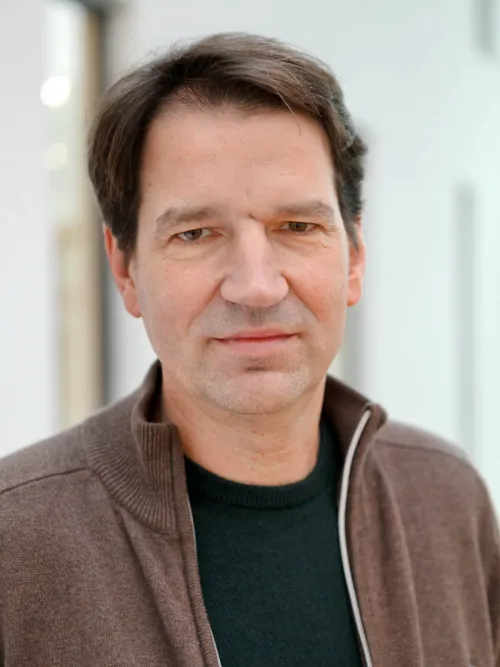
Professor Winfried Gerling at University of Applied Sciences Potsdam's Design Department specializes in Concept and Aesthetics of New Media. His research explores photography theory and practice, digital media environments, and intermedial design through projects like the Volkswagen Stiftung-funded research college SENSING: Zum Wissen sensibler Medien . As former Dean of the Design Department (2012-2014) and DFG Research Training Group member, he bridges academic leadership with media innovation. Education: Master of Fine Arts (Installation/Photography), Berlin University of the Arts (1994) Research: Screen image analysis, companion technologies, media forensics His publications since 2015 examine digital photography's epistemology, including Environmental Selfies (2022) and Screen-Images (2022). Current work focuses on: Post-photography screen image practices Automated visual documentation Media precarity and paradoxes Companion technology aesthetics Digital spatiality and temporality Self-documentation in crisis contexts Notable award: 1998 Europrix-Multimedia-Art nomination for Martin Luther CD-ROM . He co-founded multimedia produktionen in berlin (1996) and directed 30+ international exhibitions since 1991.
Anis Bawarshi is Professor and Thomas L. & Margo G. Wyckoff Endowed Chair in the University of Washington's Department of English, where he previously directed the Program in Writing and Rhetoric for ten years and chaired the English department for six years. His career bridges administrative leadership with foundational scholarship in writing studies. His academic preparation includes: B.A. in English from California State University, Northridge (1992) M.A. in English from the University of Kansas (1995) Ph.D. in English from the University of Kansas (1999) Bawarshi's research centers on rhetorical genre theory as a framework for understanding writing's social functions. He investigates how genres serve as sites of invention, mediate knowledge transfer across contexts, and shape identity formation through writing practices. His work challenges traditional dichotomies in composition studies by emphasizing writing's role in everyday social participation and organization, with recent focus on translingual approaches and anti-racist pedagogy. Analysis of his 15 most recent publications reveals three dominant trajectories: (1) Genre theory's application to public discourse (climate petitions, Israel-Palestine debates), (2) Writing knowledge transfer across disciplines and linguistic boundaries, and (3) Critical examinations of uptake mechanisms in writing ecologies. His scholarship increasingly integrates social justice frameworks with genre studies, particularly through translingual and anti-racist lenses. His honors include: Karen Shabetai Distinguished Undergraduate Teaching Award Bawarshi has mentored 18 doctoral students whose dissertations explore writing transfer, translingualism, and genre theory across diverse contexts. Recent graduates include Hunter Little (2025) on mental disability knowledge, Joseph Anthony Wilson (2023) on transnational writing, and Sumyat Thu (2020) on raciolinguistic ideologies. He contributed to the English department's $150,000 College Spark Washington grant (2017) supporting writing initiatives. He leads the Program in Writing and Rhetoric as its former director, fostering collaborative research on writing pedagogy, and co-edits the Reference Guides to Rhetoric and Composition series, shaping national scholarship in the field through sustained editorial stewardship.
Andreas Langenohl serves as Professor of Sociology at Justus Liebig University Giessen's Department of Social and Cultural Sciences since 2010 and holds an Extra-ordinary Professorship in Political Studies at South Africa's North-West University since 2021. He leads Subproject C05 on Political Security and Economized Infrastructures and acts as Spokesperson for the university's Integrated Graduate School. His academic credentials include a PhD in Social Sciences (summa cum laude, 1999) and an M.A. in Sociology and Slavic Philology with highest honors (1996), both from JLU Giessen, complemented by studies at Kazan State University and the University of Simferopol. His scholarly trajectory spans research fellowships at Cornell University, Konstanz University's Center of Excellence, and Freiburg's Collaborative Research Center. Langenohl's research critically examines Security Studies through the lens of financial infrastructures, with pioneering work on the temporal dimensions of financial markets and the securitization of economic systems. His scholarship bridges Economic Sociology and Political Sociology, analyzing how security practices manifest in financial pricing, pandemic responses, and geo-economic conflicts, while maintaining strong engagement with Cultural Sociology and European integration dynamics. His publication trends reveal evolving focus from memory studies toward infrastructural security, with recent work dissecting ambivalence in security practices, algorithmic accountability, and non-Western epistemologies. Key themes include the weaponization of financial systems, micro-processes of market security, and the reconfiguration of sovereignty through infrastructural imaginaries. His scientific recognition includes: Karl-Polanyj-Award (2010) for 'Finanzmarkt und Temporalität' Wolfgang-Mittermaier-Award (2007) for teaching excellence Langenohl directs substantial research funding including DFG grants for 'Economic Agnosticism' (2024-2026) and 'Financial Infrastructures and Geo-economic Security' (2022-2025), supervising doctoral researchers through the Integrated Graduate School. His collaborative projects with scholars like Carola Westermeier and Kirsten von Hagen examine security across financial, pandemic, and geopolitical contexts. He anchors his research within the Collaborative Research Centre/Transregio 138 'Dynamics of Security', leading interdisciplinary teams that investigate security beyond traditional state-centric frameworks through financial infrastructures, temporal dimensions, and infrastructural ambivalence.
Bjørn Normann Sandaker serves as Professor in the Department of Architecture at Oslo School of Architecture and Design (AHO), where his work bridges architectural design and structural engineering principles. His academic position reflects deep integration between theoretical knowledge and practical application in building design. Professor Sandaker's research centers on architectural structures, with particular emphasis on the relationship between structural systems and spatial organization. His expertise spans building materials, multistory construction, and the theoretical foundations of architectural structures. Through publications like The Structural Basis of Architecture and On Span and Space , he has developed frameworks for understanding how structural decisions shape architectural experience and spatial quality. Analysis of his recent publications reveals consistent focus on structure-space relationships in multistory buildings, architectural education methodologies, and material properties. His work examines how structural typologies influence spatial organization while maintaining attention to practical construction considerations. The recurring theme across his scholarship involves reconciling engineering precision with architectural expression. Professor Sandaker maintains active research collaborations with colleagues including Bente Kleven and Astrid Rohde Wang, particularly through the Multistory Buildings publication series. His educational contributions include developing curriculum materials and teaching structures in architectural education, as evidenced by his STRUMA compendium publications. His work with Bendik Manum on bridge design demonstrates interest in interdisciplinary professional practice. His research extends to sustainable building practices, as seen in works examining solar integration and material properties. The professor maintains strong connections between theoretical architectural concepts and practical construction knowledge, emphasizing how material understanding informs design decisions.
Dr. Raquel Campos Valverde serves as a Postdoctoral Research Fellow at the School of Media and Communication, University of Leeds, where she investigates digital music cultures through the MUSICSTREAM project. Her work bridges Popular Music studies, Ethnomusicology, and Internet Research with a focus on user experiences in streaming ecosystems and social media environments, particularly within Spanish cultural contexts. Her academic foundation includes: PhD in Arts and Creative Industries from London South Bank University (2019) MMus in Ethnomusicology from SOAS, University of London BHons in Sociology from Universidad de Granada, Spain Campos Valverde's research critically examines how digital infrastructures shape musical experiences, with current emphasis on cultural inequality in streaming taxonomies and algorithmic recommenders. She employs digital ethnography to analyze music circulation across social platforms, exploring moral economies of sharing and imagined listening communities. Her scholarship reveals persistent tensions between platform design and cultural diversity, highlighting how technical architectures reinforce systemic biases in music discovery and consumption. Analysis of her publication trajectory shows evolving focus from social media musicking (2018-2022) toward critical platform studies (2023-2025), with consistent attention to ethical implications of digital music environments. Recent work demonstrates sophisticated interdisciplinary methodology combining interface analysis, ethnographic observation, and critical algorithm studies. Her recognition includes: 2019 Andrew Goodwin Memorial Postgraduate Prize from IASPM UK/Ireland Campos Valverde maintains active engagement with academic communities through editorial contributions to the Open Encyclopedia of Anthropology and IASPM Journal. Her prior teaching role at King's College London demonstrates commitment to knowledge dissemination, while her current research directly addresses urgent questions about equity in digital cultural infrastructure. The MUSICSTREAM project positions her at the forefront of critical platform studies within music scholarship. As core researcher in the MUSICSTREAM initiative, she collaborates with interdisciplinary teams to deconstruct streaming platform architectures, producing actionable insights for more inclusive music technology design through rigorous ethnographic and critical technical approaches.
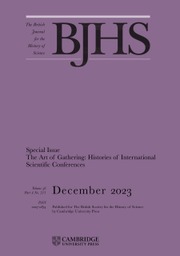
Luís Miguel Carolino is an Associate Professor at ISCTE - Lisbon University Institute, Portugal, affiliated with the Department of History in the School of Social Sciences and Humanities. He is also an Integrated Researcher at CIES-Iscte, contributing to the research group on Historical Dynamics and Global Integration of the World. Carolino has held visiting positions at the University of California, Berkeley (2019) and the Federal University of Rio de Janeiro (2007), and previously held research roles at institutions in Italy, Brazil, and Portugal. PhD in History, University of Évora (2001) Agregação in Modern and Contemporary History, ISCTE-IUL (2020) His research centers on the History of Science , particularly Early Modern Natural Philosophy, Cosmology, Astronomy, and Jesuit scientific networks . He explores how science intersected with religion, education, and political power in early modern Portugal and its empire. His work often examines scientific patronage, academic institutions, and the transmission of knowledge across Europe and the Atlantic. Carolino's recent publications span topics from the 1919 solar eclipse and Portuguese-Brazilian scientific collaboration to Jesuit cosmology, Tycho Brahe's reception, and the role of astrology. His work appears in leading journals such as History of Science , Galilaeana , and Annals of Science , reflecting a strong focus on transnational scientific exchange, institutional history, and the cultural dimensions of astronomy. He has no listed scientific awards in the provided text. Carolino has contributed to academic leadership through editorial work, including special issues on the history of science and co-editing volumes on science, technology, and empire in the Lusophone world. He has not supervised any named students in the provided data. He is affiliated with research networks such as the International Commission of the History of Universities. He is associated with research teams at CIES-Iscte and has contributed to institutional histories of scientific education in Lisbon. His ongoing work includes studies on global eclipse observations and geo-heliocentric controversies in 17th-century Lisbon.
Irene Bavuso is an Assistant Professor at the Department of History and Art History within the College of Humanities at Utrecht University. Her research focuses on early medieval networks of trade, production, and mobility, alongside interdisciplinary studies of technical knowledge and material culture in post-Roman northwestern Europe. She holds a D.Phil. in History from the University of Oxford and has held post-doctoral positions at institutions including the Institute of Historical Research (London), Université libre de Bruxelles, and Aarhus University’s Centre for Urban Network Evolutions (UrbNet). Her work aligns with Utrecht’s research themes Institutions for Open Societies (IOS) and Pathways to Sustainability (PtS). Research Trends: Her 15 publications (2017–2024) explore economic circularity, occupational mobility, and post-Roman societal structures through archaeological and historical lenses. Scientific Awards: No specific awards mentioned in available texts. Teaching: Involved in courses like Honours Research Seminar and Material Culture of the Middle Ages .
Marco Tamborini is a historian and philosopher of science and technology currently serving as a substitute full professor at the University of Regensburg for the summer semester of 2025. He is based at the Technical University of Darmstadt where he holds the position of Privatdozent and serves as Principal Investigator for a German Research Foundation (DFG) project on 'Hybrid Systems, Bionics, and the Circulation of Morphological Knowledge.' Tamborini is also a member of the Junge Akademie | Mainz, a fellow of the Johanna Quandt Young Academy, and an associate member at the Cluster of Excellence »Matters of Activity«. Tamborini completed his Habilitation (venia legendi for 'Philosophy') at the Technical University of Darmstadt in 2022. He earned his Ph.D. in philosophy from Ruprecht-Karls-Universität, Heidelberg in 2015, following pre-doctoral work at the Max Planck Institute for the History of Science. He also holds the Italian National Habilitation in Science (Abilitazione Scientifica Nazionale) for both full professorship in philosophy of science and associate professorship in theoretical philosophy. Dr. Tamborini's research lies at the intersection of (bio)science, technology and ethics, with particular focus on life sciences and bio-inspired engineering disciplines including AI, robotics, biorobotics, biofabrication, synthetic biology, bionics, and bio-inspired architecture. He also works extensively on classical philosophical topics from the 18th to 21st century, with special attention to Kant, Herbart, Lotze, Husserl, Neo-Kantianism, Phenomenology, Neo-Empiricism, philosophy of culture, and philosophical anthropology. His recent publications demonstrate a consistent focus on the dissolution of boundaries between biology and technology, examining how morphological knowledge circulates between scientific disciplines and informs bio-inspired engineering. Tamborini's work bridges historical analysis with philosophical reflection, particularly in exploring how concepts of form, structure, and function evolve across biological and technical domains. Dr. Tamborini has received several prestigious awards for his scholarship and teaching: Athene Preis Gute Lehre 2022 - Prize for outstanding teaching at TU Darmstadt Everett Mendelsohn Prize (2017) - For the best article published in Journal of the History of Biology Honorable mention from Italian Society of the History of Science (2020) As Principal Investigator for the DFG-funded project 'Hybrid Systems, Bionics, and the Circulation of Morphological Knowledge,' Tamborini leads research examining how morphological knowledge circulates between biological sciences and engineering disciplines. His work has been supported by various institutions including the Ernst Ludwig Mobility Grant that facilitated his visiting fellowship at Clare Hall, Cambridge. Tamborini has supervised numerous students through his teaching positions at multiple institutions and has been an active mentor in the Junge Akademie | Mainz. Dr. Tamborini collaborates with several research groups including the Cluster of Excellence »Matters of Activity« and has worked with the Biorobotics Laboratory at EPFL. His DFG project involves interdisciplinary teams examining the historical and philosophical dimensions of bio-technical systems. Tamborini has also been affiliated with the Cluster of Excellence Living, Adaptive and Energy-autonomous Materials Systems (liv MatS) at the University of Freiburg, contributing philosophical perspectives to their bio-inspired materials research.
Sebastian Felten is Tenure Track Professor of Early Modern History of Science at the Department of History, Faculty of Historical and Cultural Studies, University of Vienna. He previously held positions as Universitätsassistent (Postdoc) at the University of Vienna (2019-2023), Visiting Postdoctoral Fellow at Stanford University's Europe Center (2022), and Research Fellow at the Max Planck Institute for the History of Science Berlin (2015-2018). His educational background includes: PhD in History from King's College London (2011-2015) M.A. in Early Modern History from King's College London (2010-2011) B.A. in History and German Literature and Linguistics from Humboldt-Universität Berlin (2005-2009) Professor Felten's research focuses on the history of earth sciences, history of technical sciences, historical epistemology, history of knowledge, sustainability, resources, bureaucracy, and financial history. His work bridges the history of science with social, cultural, and economic history, particularly examining knowledge about nature through mineral resources in metallurgy, mineralogy, economics, and ergonomics. His research explores how early modern resource extraction in Central Europe developed contradictory rationalities that continue to influence modern approaches to resource management. His recent publications demonstrate a growing focus on administrative practices in mineral resource extraction, bureaucratic knowledge systems, and the history of money. The trend shows increasing engagement with sustainability issues, resource management, and the intersection of scientific knowledge with bureaucratic and administrative practices in early modern Europe, connecting historical analysis to contemporary environmental challenges. Scientific awards and recognition: King's College London, Jinty Nelson Prize King's College London, Early Modern History Prize Professor Felten serves as Principal Investigator for the ERC Starting Grant "Sustained Concerns: Administration of Mineral Resource Extraction in Central Europe, 1550-1850" (SCARCE, 2023-2028), which explores historical approaches to resource management to inform contemporary debates on environmental sustainability. He co-convenes the Forschungsschwerpunkt Wissenschaftsgeschichte and the AG Wissenschaftsgeschichte, a monthly colloquium on the history of science, and has received funding from various sources including the Zukunftsfonds of the Republic of Austria. Professor Felten is actively involved in the Key Research Area History of Science at the University of Vienna and serves as a reviewer for prominent journals including History of Science, Nuncius, and Isis. He is also a remote referee for the European Research Council and maintains affiliations with professional organizations including the History of Science Society and Renaissance Society of America.
Catherine Rideau-Kikuchi is a Lecturer in Medieval History at the University of Versailles Saint-Quentin-en-Yvelines (UVSQ), which is part of Paris-Saclay University. She works within the Institute of Cultural and International Studies (IECI) in the Department of History. Her teaching spans multiple levels including L1, L2, L3, and Master's programs, covering subjects such as Medieval History, Documentary Research, Cultural History of the Middle Ages, and Cultures of Writing. Dr. Rideau-Kikuchi's educational background includes: Doctorate in Medieval History from Paris-Sorbonne University (2016), with a thesis on "Venice and the world of books (1469–1530)" supervised by Élisabeth Crouzet-Pavan History Aggregation (2012), ranked 8th Master's degrees in History from Paris-Sorbonne University Student at the École Normale Supérieure, Paris (2008-2012) Preparatory class at Lycée Henri IV, Paris (2006-2008) Her research focuses on the economic and social history of the late Middle Ages, particularly examining the paper industry, early printing history, and urban economic and social dynamics in medieval Italy. Dr. Rideau-Kikuchi investigates the development of the paper industry and its relationship with various trades and consumers, with special attention to book trades and administration. She also studies the history of early printing in Italy and Europe, analyzing the circulation of objects, texts, and actors that shaped this new cultural industry at the end of the 15th and beginning of the 16th centuries from an economic and social history perspective. Dr. Rideau-Kikuchi's publications reveal a consistent focus on Venetian book history, particularly examining printing networks, commercial relationships, and the economic structures of the early printing industry. Her work often employs comparative approaches to understand printing contracts and cross-cultural influences in European printing. She has made significant contributions to understanding German printers in early European printing contexts and the geographical diffusion of humanist literature. Her scientific achievements have been recognized with notable awards: Monseigneur Marcel Prize from the French Academy (2019) for her monograph "La Venise des livres, 1469-1530" Young Researcher Grant from the Fondation des Treilles (2015) Dr. Rideau-Kikuchi actively contributes to academic dissemination through multiple channels. She serves on the editorial board of the prestigious journal Annales HSS and is a member of the team behind the Twitch channel "Ca coule de sources." Previously, she co-founded and participated in the "Actuel Moyen Âge" collective until 2018, contributing articles to The Conversation. She has organized numerous academic events including workshops on documentary concordance, Franco-German online seminars on medieval history, and conferences on trade regulations and diaspora studies. Her professional journey includes membership at the French School of Rome (2017-2018) and temporary teaching and research positions (ATER) at both Paris-Sorbonne University and University of Versailles Saint-Quentin before securing her current lecturer position in 2018.
Jenny Eklöf serves as Associate Professor in the Department of Historical, Philosophical and Religious Studies at Umeå University, specializing in History of Science and Ideas. Based at Humanisthuset (Room HUM.K.129) in Umeå, she functions as student counsellor while maintaining active research and teaching responsibilities within Sweden's academic landscape. Her educational credentials include achieving Docent qualification—a Swedish academic title signifying independent research capability—and recognition as Distinguished University Teacher for pedagogical excellence. These qualifications underpin her dual commitment to scholarly rigor and innovative teaching practices. Eklöf's research critically examines the contested terrain where scientific knowledge interfaces with political agendas and media representations. She investigates how fields like genetics, biofuels, and mindfulness become embedded in public discourse through historical analysis of media coverage, policy debates, and scientific controversies. Her work reveals how scientific authority is constructed, challenged, and reshaped in societal contexts—particularly through studies of early genetic engineering debates in Swedish media and the scientization of mindfulness practices. Analysis of her publication trajectory shows sustained focus on science-media-politics entanglements with evolving methodological sophistication. Recent work increasingly incorporates digital humanities approaches while maintaining historical grounding, demonstrating consistent attention to how scientific narratives are framed across different media landscapes and historical periods. Her scientific recognition includes: Distinguished University Teacher award Eklöf actively mentors students through her student counsellor role and contributes to interdisciplinary knowledge production as Health Humanities research group member. While specific grant details aren't publicized, her extensive publication record across three decades indicates successful research continuity. Her teaching innovations in digital humanities pedagogy demonstrate commitment to evolving academic practices. As core member of Umeå University's Health Humanities research group, she bridges historical analysis with contemporary health discourse, examining how historical perspectives illuminate current debates about neuroscience, mindfulness, and medicalization within societal contexts.
Susanne Koch is a Postdoc Principal Investigator at the Technical University of Munich (TUM), leading research on science and sustainability governance. She holds a habilitation in Sociology (2024) and a PhD in Sociology from Bielefeld University (2015, with distinction). Her work focuses on gender- and geography-related inequalities in science, particularly in forest research and development aid. She leads the DFG-funded In-Forest project examining epistemic effects of inequalities in forest science, collaborating with institutions like Stellenbosch University and Leiden University. She has held roles at TUM’s Chair of Forest and Environmental Policy (2016–2021) and was a DAAD-funded visiting scholar at CWTS, Leiden University. Her research integrates science studies and environmental governance, addressing knowledge diversity and societal transformation. Awards include the DAAD postdoc fellowship and recognition for her PhD thesis on foreign experts’ impact on policymaking in South Africa and Tanzania. Key research themes: science-policy interfaces, epistemic justice, global sustainability transformations. She is a Research Fellow at CREST (Stellenbosch) and affiliated with the Global Research Programme on Inequality (GRIP). Recent work critiques conference representation as constitutive of scientific fields and advocates for cognitive justice in academic spaces.
Hans Andersson is a Lecturer in Business Administration at Linköping University's Department of Economic and Industrial Development (IEI). He is actively involved in the Biogas Solutions Research Center (BSRC), a national competence center for biogas research administered by LiU since 2015, where he contributes to the development of innovative and resource-efficient biogas solutions with positive local and regional impacts on the environment and economy. His research focuses on organizational and strategic aspects of environmental issues, particularly how organizations can develop strategies for sustainable solutions. His current research projects include "New business models for digestate value extraction and nutrient circulation," funded by the Kamprad Family Foundation, and studies on the management of "fines" (waste from recycling processes), strategies for recyclable residual flows, and industrial symbiosis. His work demonstrates a consistent trajectory from his doctoral thesis "Organizing for individuality – transparent and opaque aspects in development processes" (2002), which examined product development processes at Orrefors Kosta Boda, to his current focus on sustainable business models and circular economy initiatives. Andersson's publication record shows a strong focus on sustainability transitions, particularly in the biogas sector and waste management. His research reveals how sustainable markets are formed through complex interactions between policy frameworks, organizational practices, and technological development. His work on shredder fines management and biogas market formation demonstrates how niche sustainable innovations gradually become qualified and integrated into broader economic systems through strategic business model development and organizational change. He teaches primarily in strategy and organization, serving as course responsible and examiner for "Strategy – Classic and Contemporary Views" at the advanced level, where he has integrated sustainability aspects in recent years. Previously, he has taught financial accounting and supervised numerous theses, primarily at the advanced level using qualitative methods. Andersson is part of the Business Administration division (FEK) within IEI, which educates highly sought-after economists through civil engineering programs and researches organizations and businesses. His work connects closely with the department's mission to strengthen and develop future industry, business, and society through leading research, education, and new innovations.
Maaike van der Lugt is a distinguished University Professor of Medieval History at the University of Versailles Saint-Quentin-en-Yvelines, where she serves as Director of the Heritage and Cultural Dynamics Laboratory (DYPAC) and Deputy Director of the Institute of Cultural and International Studies (IECI). Her academic career spans from doctoral work at both the Ecole des Hautes Etudes en Sciences Sociales in Paris and the University of Utrecht, to becoming a lecturer at Paris Diderot University in 1999, followed by her professorship at Versailles Saint-Quentin since 2017. She was also a junior member of the prestigious Institut universitaire de France from 2007 to 2013. Her educational background includes a doctorate completed jointly at the Ecole des Hautes Etudes en Sciences Sociales (Paris) and the University of Utrecht (Netherlands), followed by a postdoctoral contract before her academic appointment in Paris. This strong foundation across French and Dutch academic traditions has informed her interdisciplinary approach to medieval studies. Professor van der Lugt's research focuses on the history of knowledge, particularly medicine and the life sciences from the 12th to the 15th century. She combines textual analysis of works produced in urban schools and universities with examination of less technical sources, practical documents, and images. Her work explores the material and social dimensions of knowledge construction, circulation, and dissemination, with particular attention to access to knowledge and the relationship between bookish knowledge, practical know-how, and experience—especially women's experience. She actively engages with specialists in epistemology, philosophy, and the history of science in a comparative perspective that extends to contemporary issues. Her extensive publication record reveals consistent themes in medieval medical theory, particularly concerning concepts of complexion, heredity, fetal development, and the relationship between nature, medicine, and ethics. Her work demonstrates a sophisticated interdisciplinary approach that bridges historical, philosophical, and scientific perspectives on medieval thought. The publications show a clear progression from foundational work on extraordinary generation to increasingly nuanced explorations of how medieval thinkers conceptualized biological processes within moral, legal, and theological frameworks. Erasmus Prize (Netherlands) Professor van der Lugt has supervised numerous research projects, including pioneering work on medieval heredity concepts and the normative implications of nature in medieval thought. Her leadership of the DYPAC laboratory demonstrates her commitment to interdisciplinary research that connects historical scholarship with contemporary cultural dynamics. She has developed significant collaborative networks across Europe, evidenced by her co-authored works with international scholars in the history of science and medicine. As Director of the DYPAC Laboratory, Professor van der Lugt leads research on heritage and cultural dynamics, creating an intellectual environment that bridges historical scholarship with contemporary cultural analysis. Her work in this capacity connects medieval studies with broader questions about cultural transmission and the evolution of knowledge systems across centuries.
Marie Bouhaïk-Gironès is a CNRS Research Director at the Centre de Recherches Historiques (CRH) within EHESS-CNRS. She specializes in 15th-16th century French theatrical practices, focusing on their social/technical history, actor studies, and rhetoric. Her work extends to comparative analysis with Iranian Ta'zieh and Japanese theatrical traditions . Co-director of Medieval History Studies collection (Éditions Honoré Champion, since 2020) Member of Revue d'Histoire du Théâtre Scientific Committee (since 2018) Key research themes: Social/cultural history of late Middle Ages History of shows (13th-16th centuries) Law-theatre intersections Digital humanities applications Her recent publications and ANR THETA / ANR MELPONUM projects examine theatrical practices across Europe, while her editorial roles advance medieval theatre historiography. She works with the AHLoMA research group on long-term historical anthropology. Professional affiliations include: International Society for the Study of Medieval Theatre (SITM) Society of Medieval Historians of Public Education (SHMESP)