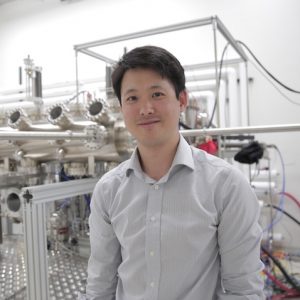
Clifton Forlines is a Research Professor at Northeastern University’s Portland campus, specializing in Human-Computer Interaction (HCI), Data Visualization, and Multi-touch Interfaces. He has extensive experience in user interface design and collaborative computing, holding leadership roles at Tactual Labs and Draper Laboratory. He earned a PhD in Computer Science from the University of Toronto, and dual Masters degrees in Human-Computer Interaction and Entertainment Technology from Carnegie Mellon University. His research focuses on optimizing touch and stylus interfaces, multi-user tabletop systems, and spatial-temporal data visualization. His recent publications explore advancements in low-latency touch sensing, collaborative visual exploration, and tactile feedback efficiency. While no scientific awards are listed, his work includes 15+ patents in multi-user interactive systems and display technology. Clifton currently advises PhD student Timothy Yim and has contributed to projects like Alice—a 3D programming environment for education. He can be contacted via cforlines@gmail.com or c.forlines@northeastern.edu.
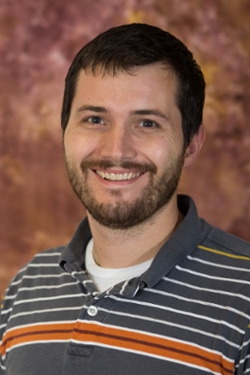
Benedikt Etzold is a Researcher at the Professorship of Media Informatics , part of the Faculty of Computer Science at Chemnitz University of Technology , Germany. His work focuses on bridging virtual and physical environments through human-computer interaction, with particular emphasis on multi-device systems and collaborative interfaces. Research Interests: Human-Computer Interaction Multi-screen and multi-device applications Visualization and user interfaces Multi-user scenarios Mobile devices Tabletops and public displays Etzold is actively involved in the DFG-funded research training group CrossWorlds , which investigates the integration of virtual and real social worlds. His dissertation project titled "Digital Tangibles – Connecting Multitouch Tabletops to Physical Environments" explores hybrid communication systems.
Kalja Kanellopoulos serves as a Researcher at the Institute for Media Research within the Faculty of Philosophy at Chemnitz University of Technology. Since April 2012, she has been integral to the DFG-funded Research Training Group 'CrossWorlds' (Connecting Virtual and Real Social Worlds), conducting interdisciplinary work at the intersection of social sciences and computer science to overcome constraints in media-mediated communication through studies of communication, emotions, sensomotorics, and learning. Her academic foundation includes a Magister degree (Master's equivalent) in Sociology, General Rhetoric, and Modern German Literature (2004-2011), featuring an international semester at the National and Kapodistrian University of Athens (2007-2008). Prior professional experience encompasses research assistance for the 'Historical Dictionary of Rhetoric' at Tübingen University (2010-2012) and industry work at CeveyConsulting GmbH (2006-2010). Kanellopoulos specializes in Qualitative Social Research, Science and Technology Studies, and Human-Computer Interaction, with concentrated focus on museum contexts. Her ethnographic doctoral project examines innovative communication at interactive museum interfaces under Prof. Claudia Fraas' supervision. She develops frameworks merging design thinking with social inquiry to investigate materialities and aesthetics of digital systems, emphasizing playful interaction and user experience in cultural spaces. Her 2012-2014 publications reveal strong thematic cohesion around interactive museum technologies, particularly multitouch and tabletop systems. These works demonstrate consistent application of Human-Computer Interaction principles to cultural education, with recurring emphasis on collaborative interfaces, visitor experience optimization, and interdisciplinary co-design. The research consistently emerges from CrossWorlds' collaborative environment, reflecting integration of social science methodologies with technical development. As an active member of ACM, Deutsche Gesellschaft für Soziologie (including its Qualitative Methods section), European Sociological Association, and Gesellschaft für Informatik (including Human-Computer Interaction groups), she bridges computational and social domains. Her DFG-funded CrossWorlds work (2012-2018) established platforms for examining virtual-real social connections through interdisciplinary teamwork. Kanellopoulos operates within CrossWorlds' interdisciplinary network of computer scientists and social scientists, contributing to projects that analyze communication constraints across virtual-real boundaries. Her team develops methodological approaches for studying interaction in cultural contexts, producing collaborative outputs for ACM conferences and INTERACT, while advancing understanding of digital systems in educational and heritage settings through materiality-focused investigations.
Jaakko Kemppainen is a Lecturer at Aalto University's Department of Art and Media within the School of Arts, Design and Architecture. His work focuses on game design, gamification, and interactive media. Research Interests Kemppainen specializes in applying game mechanics to educational contexts and project management frameworks, with a focus on: Gamification of educational processes Game-based learning systems Digital media research Interactive design methodologies Scientific Recognition Bit1 Student Game Competition Winner (May 2024) for ODDLI project Academic Contributions His research spans 2014-2018 with publications in Simulation and Gaming and the GamiFIN Conference proceedings , covering gameplay analysis, gamified project planning, and player experience assessment.
Erik van der Spek is an Assistant Professor at Eindhoven University of Technology (TU/e) in the Industrial Design department. He serves as the research director of the TU/e Game/Play Lab and holds leadership roles in the IFIP Technical Committee on Entertainment Computing (TC14). Research Focus: Designing games and play experiences for entertainment, learning, vitality, and empathy Leadership: Steering Committee Member of ICEC, former Program Chair of ICEC, Student Game Competition Chair for CHI Play and ICEC His work explores the intersection of playful interaction and immersive technologies, particularly AR. He investigates how fantasy elements and magic circles create cathartic mediated presence experiences and stimulate novel worldviews. Recent studies examine AR tabletop gaming perspectives, fantasy's cognitive impact, and pedagogical framework development. Key publication trends include: Augmented Reality integration in game design Fantasy's role in educational contexts Player journey analysis Cross-cultural and age-adaptive learning systems Second-person perspective mechanics Immersive educational experiences He supervises over 60 student games annually and teaches courses like 'Design for Games & Play I/II' and 'Project 2 Design'. His research has received funding from the China Scholarship Council (grant ID: 201806790091).
Lengyelné Szilágyi Szilvia is affiliated with the University of Miskolc , currently working at the Institute of Mathematics (ME/GIK MI) since 2013. Previously, she was part of the Department of Analysis (ME/GIK AT) from 2006 to 2013. Her research focuses on mathematics education , educational robotics , and game-based learning for engineering and computer science students. Key Research Areas: Educational Robotics Game-Based Learning in Mathematics STEAM Education Kinematic Model Implementation Selected Publications (2024-2025): Analyzed effectiveness of non-digital games for improper integrals, designed card games for determinants, and integrated robotics for teaching cycloidal curves. Keywords span Education , Mathematics , Robotics , and Game-Based Learning .
Prof. Diler Öner is a Professor at Bogazici University's School of Education, Department of Computer Education and Educational Technology. He holds leadership roles including Director of the Center for Teaching and Learning (2020-2023) and Chair of the Computer Education and Educational Technology Department (2022-2024). His education includes a Ph.D. in Curriculum and Instruction with a focus on Educational Technology from the University of Wisconsin-Madison. Research interests span AI literacy, technology-enhanced learning environments, CSCL, teacher professional development, and mixed-methods research. He has led projects like 'Virtual Internship for Preservice Teachers' (TUBITAK) and 'Computational Techniques for Tabletop Games Heritage' (COST). Key contributions include publications on AI integration in education, computational thinking development, and collaborative learning in dynamic geometry environments. His work explores both theoretical frameworks like TPACK and practical tools like web-based portfolios and epistemic games. Projects : Principal Investigator on multiple BAP and TUBITAK grants, co-developed the CoLearn EU project. Labs/Teams : Directs the Center for Teaching and Learning and contributes to the Epistemic Analytics Lab through NSF collaborations. Advising : Supervised 15+ theses focusing on technology integration, teacher training, and student learning analytics.
Mario Pitschmann is a Senior Scientist at Vienna University of Technology (TU Wien), affiliated with the Neutron and Quantum Physics Research Area within the Institute of Atomic and Subatomic Physics (E141). He serves as Principal Investigator for the project "Die Suche nach Dunkler Energie mit Tabletop Experimenten" (Search for Dark Energy with Tabletop Experiments), leading experimental investigations using gravitational resonance spectroscopy. His research spans experimental neutron physics, quantum field theory, and dark energy detection. Key interests include precision measurements of neutron properties in gravitational fields, quantum dynamics in dilaton environments, symmetron field theories as dark energy candidates, and theoretical frameworks for open quantum systems. His work bridges tabletop laboratory experiments with fundamental questions in cosmology and quantum gravity. Recent publications (2021-2023) demonstrate a cohesive research trajectory focused on quantum-gravity interfaces. The qBOUNCE collaboration dominates his experimental output, featuring gravitational resonance spectroscopy with ultracold neutrons to probe dark energy signatures and measure neutron electric charge. Theoretical contributions include novel density matrix formalisms, solutions to nonlinear symmetron equations, and Casimir effect analyses connecting vacuum energy to potential modifications of gravity. No scientific awards were documented in the available sources. Dr. Pitschmann has supervised multiple graduate theses including Caroline Voith's 2023 work on open quantum dynamics in dilaton environments, Liliana Melanie Schwarz's 2021 study of Dirac equation approximations in Earth's gravity, and Markus Wellenzohn's 2008 research on radiation reaction in classical electrodynamics. His primary grant leadership involves the dark energy tabletop experiments project at TU Wien. He is a core member of the qBOUNCE collaboration, which operates advanced gravitational resonance spectroscopy setups using ultracold neutrons. This international team develops Ramsey-type measurement techniques to test fundamental physics, including searches for fifth forces and symmetron-mediated interactions. Current efforts focus on next-generation Cannex experiment designs for enhanced Casimir force measurements.
Jason K Kawasaki is an Affiliated Professor in the Department of Physics at the University of Wisconsin–Madison. His research focuses on quantum materials, epitaxy techniques, and strain engineering, with a particular emphasis on exploring novel electronic and magnetic properties in thin films and nanomaterials. He investigates phenomena such as flexomagnetism, superconductivity, and surface-mediated reactions in systems like Heusler compounds and graphene-based heterostructures. Key research areas include: Design and synthesis of epitaxial quantum materials using advanced growth techniques Strain-driven phase transitions and property modifications in thin films Development of novel instrumentation like the X-FAST spectroscopy platform Interfacial effects in heterostructures and nanomembranes His work spans applications in energy materials (e.g., electrocatalysis), topological materials, and nanoelectronics. He has pioneered methods for controlled synthesis of graphene nanoribbons and freestanding nanomembranes, enabling exploration of emergent phenomena at mesoscale dimensions. Recent studies highlight strain-gradient-induced superconductivity in GdAuGe membranes and flexomagnetism in Heusler compounds. He also investigates oxygen vacancy effects in BiVO₄ for catalytic applications. His research integrates experimental techniques with computational modeling to achieve atomic-scale understanding of material behavior. Notable contributions include the development of remote epitaxy strategies for complex oxides and the discovery of tunable magnetic properties in engineered Heusler systems. His work bridges fundamental physics with practical material design, addressing challenges in energy storage and quantum technologies.
Magdalena Wróbel-Lachowska is a researcher at the Institute of Applied Computer Science within Łódź University of Technology's Faculty of Electrical, Electronic, Computer and Control Engineering. Her interdisciplinary work bridges human-computer interaction, ergonomics, and industrial logistics. Research domains include: Wearable technology for health monitoring and sensory augmentation Ergonomic workplace design and assessment methodologies HCI innovations for neurodiverse populations Logistics education in Industry 4.0 contexts Recent publications demonstrate: Expanding focus on health technologies (2021-2023) Sustained engagement with ergonomic principles Consistent interdisciplinary approach across domains Laboratory work involves developing interactive systems and sensor technologies with applications in healthcare, accessibility, and industrial settings.
Ian Turner is a Senior Lecturer in Biomedical and Forensic Science at Leeds Beckett University's College of Science and Engineering. His work bridges forensic science and educational innovation, focusing on gamification, culturally sensitive curricula, and pandemic-responsive teaching strategies. Research Focus: Gamification for employability skills, practical pedagogy in post-pandemic education, and forensic science outreach. Key Contributions: Development of tabletop games for conservation and mental health, cultural curriculum toolkits, and international collaboration frameworks. His recent publications highlight trends in playful learning (e.g., LEGO-based tutorials) and adaptive teaching methods during global crises. He also explores forensic science applications in signature analysis and latent print detection, though scientific awards or student lists are not publicly detailed.
Dr. Paul Arpin is an Associate Professor in the Department of Physics at California State University, Chico. His research focuses on ultrafast optical spectroscopy, quantum optics, and nonlinear phenomena in molecular and condensed matter systems. He leads experimental and theoretical investigations into femtosecond coherence spectroscopy, high-harmonic generation, and light-matter interactions in biological systems like photosynthetic proteins. Key research areas include: Molecular aggregates and excitonic dynamics Ultrafast X-ray and soft X-ray generation Vibrational coherence and quantum beats Coherent multidimensional optical spectroscopy His work bridges theoretical modeling with advanced laser spectroscopy techniques, contributing to understanding energy transfer mechanisms in both synthetic and biological systems. Recent studies highlight advancements in femtosecond coherence spectroscopy for analyzing vibronic coupling and Duschinsky rotation effects. Dr. Arpin’s experimental setups involve cutting-edge ultrafast laser systems and parametric amplifiers, enabling exploration of attosecond-to-femtosecond timescales. His lab collaborates on projects related to tabletop X-ray sources and phase-matched high-harmonic generation.
Akhil Rao is an Assistant Professor of Economics at Middlebury College, specializing in environmental and computational economics with a focus on outer space and simulation modeling. He joined Middlebury in 2019 and teaches courses in economic statistics, environmental economics, and space economics. His research examines orbital resource management, policy design, and integrated assessment models for space industries. Rao holds a PhD from the University of Colorado Boulder and a BS in Business Administration from the University of California, Riverside. His dissertation explored the economic dynamics of orbit use and policy frameworks for sustainable space utilization. His research interests emphasize orbital debris governance, satellite market competition, and the economic implications of space exploration. Recent work includes analyzing spillover effects in automated orbital traffic systems and designing tabletop games to simulate business strategies in the satellite communications sector. Rao advises students through courses like ECON 0111 (Economic Statistics) and ECON 0488 (Space Economics), and contributes to interdisciplinary programs such as ENVS 0700 (Senior Independent Study). He has collaborated on projects like the OPUS integrated assessment model and the CENKI space economic simulator.
Martin Schedlbauer is a Teaching Professor and Director of Online Faculty and Programs at Northeastern University, based in Boston, MA. He specializes in designing and delivering courses in data science, information systems analysis, web development, and data analytics. His research focuses on learning analytics, educational data mining, and innovative online teaching methodologies. Dr. Schedlbauer holds a Ph.D. in Computer Science and certifications including CBAP, OCUP, CSM, PSM, and CSTE. His work emphasizes improving educational technologies and online learning experiences, particularly in higher education environments. He actively contributes to the field through publications on human-computer interaction and instructional design. Notable research explores input device comparisons in medical scenarios, mobile interaction challenges, and ergonomic design for educational tools. He maintains an online presence via his personal website and Google Scholar profile.
Rens Kortmann is an Assistant Professor at Delft University of Technology, affiliated with the Faculty of Technology, Policy and Management and the Multi-Actor Systems department. He operates within the Policy Analysis group, focusing on systems modeling and simulation to address societal challenges like energy transitions. Education: MSc in Cognitive Science (University of Groningen), PhD in Computer Science (Maastricht University), with research experience at Edinburgh's Artificial Intelligence department His research emphasizes simulation gaming as a primary method, complemented by discrete event simulation, agent-based models, and cybernetics. He investigates games' potential to drive cultural change through embodied experiences and ludic performances, collaborating on projects like: ROTBEESTEN?! – a motivator game for forensic mental healthcare training Talk that Talk – persuasive card game against sexually transgressive behavior Veerkracht series – servant-leadership development games Parsifal Game Opera – performance-art-meets-game cultural experiments Key trends in his publications include: 2023-2021: Forensic vigilance training, sexually transgressive behavior interventions 2019-2018: Contextual game design principles, urban canal logistics 2016-2014: Ludic performances, servant-leadership simulations Scientific recognition includes: Mekel Prize for sustainable innovation (2017) from TU Delft Organized ISAGA game design summer school (2014) and served as ISAGA conference chair (2017) He contributes to academic governance as a reviewer for journals/conferences and through collaborative works with researchers like Vincent Peters, Alexander Verbraeck, and Gwendolen Bekebrede. His 2024-2026 secondary affiliation includes the Macromechanic Laboratory in Civil Engineering and Geosciences.