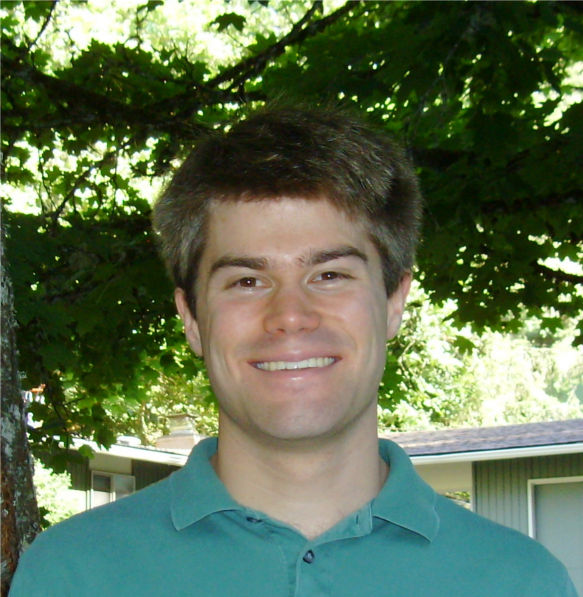
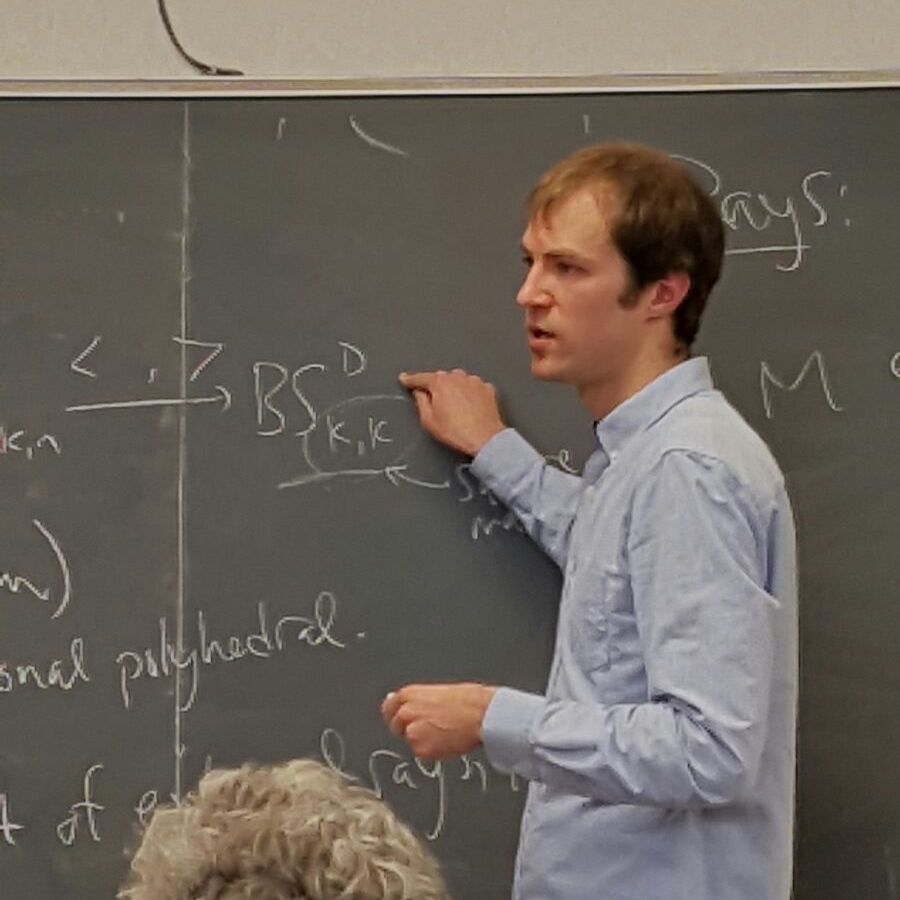
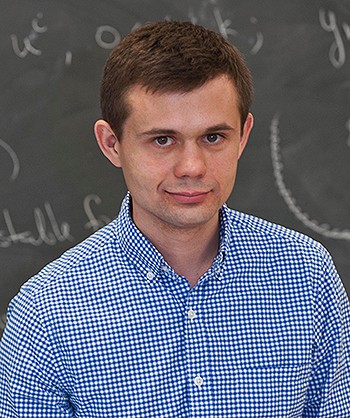
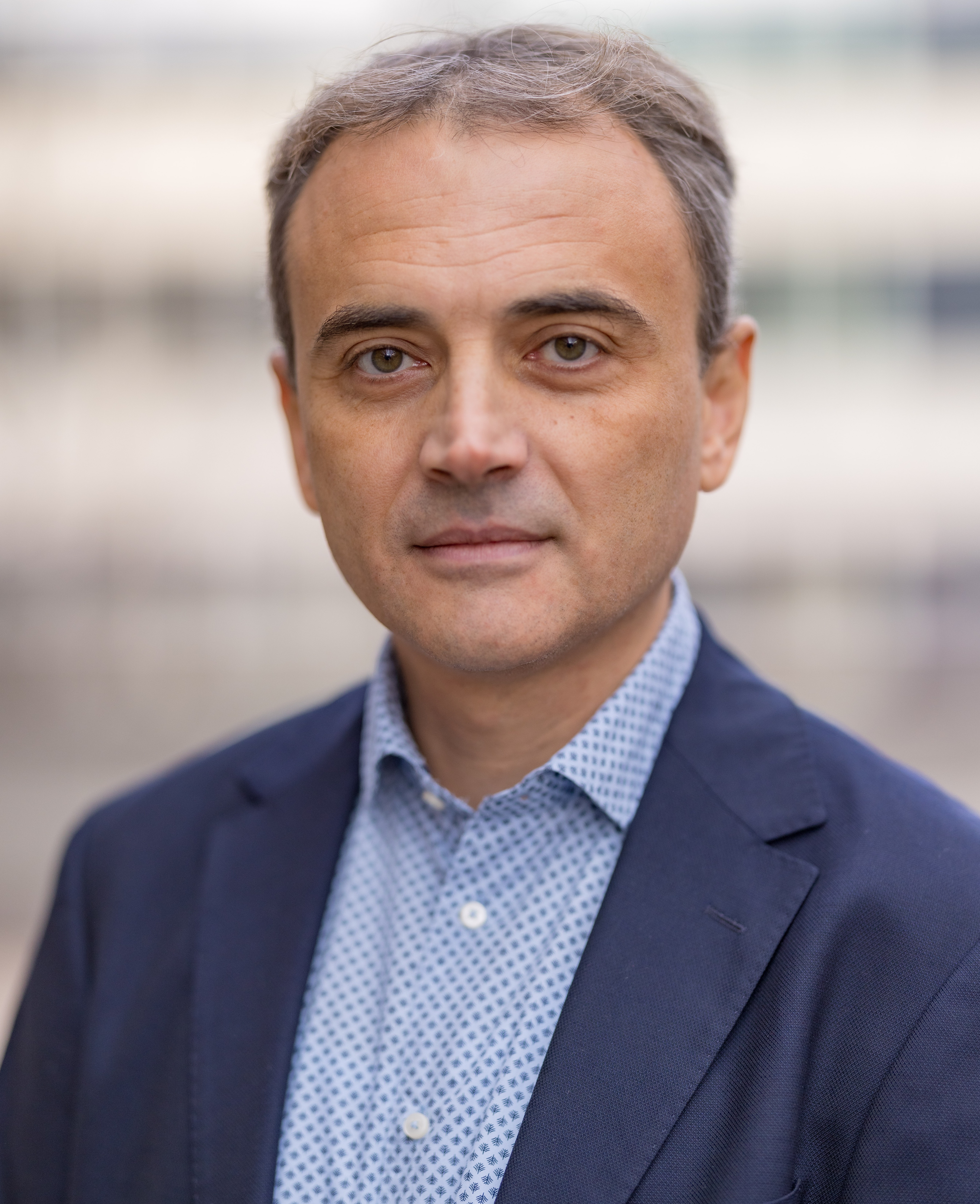
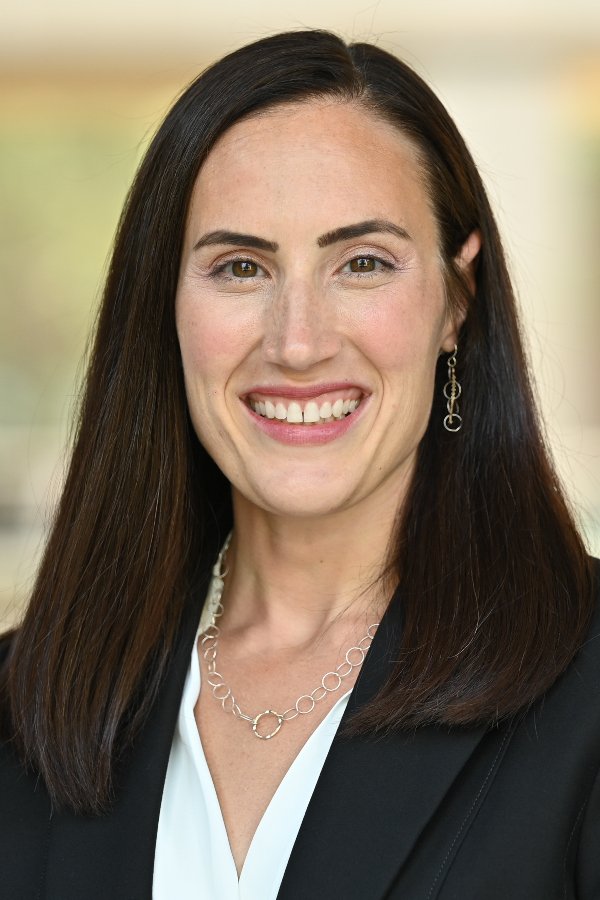
Eric Larson is an Associate Professor at Brown University's Department of Mathematics, specializing in algebraic geometry. His research focuses on moduli spaces, Brill-Noether theory, and algebraic curves. He collaborates with notable mathematicians such as Isabel Vogt and Izzet Coskun on topics like normal bundles, Chow rings, and stability conditions. Larson actively engages in academic outreach, organizing Putnam competition practices and undergraduate colloquia. He has developed computational tools for studying elliptic curves' Galois representations and contributed to expository works on interpolation problems and LaTeX accessibility.
Max Planck Institute for Mathematics in the SciencesGermany
Jinhyung Park is an Associate Professor in the Department of Mathematical Sciences at KAIST, Daejeon, Korea. He obtained his Ph.D. from KAIST in 2014 under Prof. Sijong Kwak and was mentored as a CMC Fellow at KIAS (2014–2019). His research focuses on Algebraic Geometry , particularly syzygies of algebraic varieties , secant varieties , and positivity of line bundles . Education: Ph.D., KAIST (2014); MS/BS, KAIST and University of Chicago (2002/2001). Research Interests: His work explores geometric properties of projective manifolds, singularities in algebraic geometry, and applications of Okounkov bodies to divisors and syzygies. Recent trends include Castelnuovo-Mumford regularity bounds (e.g., for threefolds with rational singularities) and subadditivity of Okounkov bodies in fiber spaces. Teaching: Courses include Matrix Groups, Algebraic Geometry, and Calculus. He previously taught at Sogang University and Purdue University. Professional Affiliations: Member of the Korean Mathematical Society, American Mathematical Society, and other international societies. Organized the 8th East Asia Number Theory Conference at KAIST (2019).
Osamu Iyama is a Professor at the Graduate School of Mathematical Sciences, University of Tokyo. He leads research in algebra and representation theory while mentoring PhD and Master's students. Previously affiliated with Nagoya University, he maintains editorial roles for Mathematische Zeitschrift , Nagoya Mathematical Journal , and other journals. His research focuses on representation theory of orders, categorical structures (module categories, derived categories, cluster categories), and applications to cluster algebras and noncommutative resolutions of singularities. Key areas include higher-dimensional Auslander-Reiten theory, tilting theory, and Cohen-Macaulay representations. His recent publications (2016–2020) explore triangulated categories, noncommutative resolutions, Auslander-Gorenstein algebras, and combinatorial aspects of representation theory, demonstrating consistent innovation in homological algebra and singularity theory. Awards and honors: 2019 Inoue Prize for Science 2011 JSPS Prize 2010 Spring Prize of the Mathematical Society of Japan 2008 Algebra Prize of the Mathematical Society of Japan 2007 ICRA Award 2001 Takebe Katahiro Prize He leads an active research group, organizes international conferences (e.g., Oberwolfach workshops, China-Japan-Korea symposia), and directs the Tokyo-Nagoya algebra seminar.
Jake Levinson is an Assistant Professor in the Department of Mathematics and Statistics at Université de Montréal. His research focuses on algebraic geometry and algebraic combinatorics, with particular interests in moduli spaces, Schubert calculus, toric varieties, and equivariant free resolutions. He previously held positions at Simon Fraser University (2020–2023), the University of Washington (2017–2020), and completed a postdoctoral fellowship at LaCIM (UQAM). His Ph.D. from the University of Michigan (2017) was advised by David Speyer. Research Interests: - Algebraic Geometry: Moduli spaces, Schubert calculus, toric varieties, homological algebra. - Algebraic Combinatorics: Crystal graphs, Young tableaux, representation theory, combinatorial aspects of algebraic geometry. - Recent work includes studies on Schubert curves, Springer fibers, and applications of algebraic methods to problems in combinatorics and theoretical computer science. Teaching: - Taught MAT 6620 (Algebraic Geometry: Schemes) at Université de Montréal (Winter 2024). - Previously taught courses on intersection theory, representation theory, and Lean formal proof systems. Key Contributions: - Developed combinatorial models for Schubert curves using crystals and tableaux. - Contributed to Boij-Söderberg theory for Grassmannians and studies of class groups in algebraic geometry. - Collaborated on projects linking algebraic geometry to neural networks and random matrix theory.
Dr. Sofia Tirabassi is a Full Professor in the Department of Mathematics at Stockholm University, where she has been affiliated since 2019. She leads the research group 'Algebra, Geometry, Topology, and Combinatorics' and directs projects funded by the Knut and Alice Wallenberg Foundation and the Swedish Research Council (VR). Her work bridges algebraic geometry, derived categories, and arithmetic geometry, with emphasis on positive characteristic and birational classification. She holds a Ph.D. from Università degli Studi Roma Tre (2012), an M.Sc. and B.Sc. from the University of Bologna. Previously, she held positions at the University of Bergen, University of Utah, and University of Warsaw as a Marie Curie Fellow. Her research explores two primary areas: (1) Derived categories in positive characteristic , investigating invariants of algebraic varieties, and (2) Birational characterization of semiabelian varieties , developing tools for effective classification. Her publications frequently address geometric structures like abelian surfaces, Enriques surfaces, and cohomological properties. Tirabassi's recent articles (2020-2024) demonstrate a focus on surfaces in positive characteristic, derived equivalences, and quasi-abelian varieties. Common themes include Fourier-Mukai transforms, Brauer groups, and log-canonical thresholds, reflecting interdisciplinary engagement with combinatorics and topology. Awards & Fellowships: Marie Curie Fellowship (European Commission) International Postdoctoral Scholarship (Knut and Alice Wallenberg Foundation) Young Research Talents Grant (Research Council of Norway) Grants & Projects: She currently leads 'Generic Vanishing and Characterization of Semiabelian Varieties' (VR-funded) and hosts a guest professorship for Rita Pardini. Past projects include 'Derived Categories in Positive Characteristic' (KAW Foundation) and 'The Arithmetic of Derived Categories' (Norway). Teaching: In 2024/2025, she instructs courses in Galois Theory, Combinatorics, Abstract Algebra, and Topology, and is developing a master's course in Algebraic Geometry.
Prof. Dr. Isabel Stenger is an Assistant Professor at the Institute of Algebraic Geometry, Faculty of Mathematics and Physics, Leibniz University Hannover. She holds a Junior Professorship and is a member of the Riemann Center for Geometry and Physics. Her research focuses on advanced topics in algebraic geometry, including birational geometry, Calabi-Yau manifolds, and the Morrison-Kawamata cone conjecture. She also explores experimental methods in algebraic geometry and commutative algebra, construction and moduli of surfaces, and syzygy-related constructions of algebraic varieties. Her work integrates theoretical and computational approaches to address foundational questions in geometry. Recent publications (2020–2024) reflect her contributions to understanding Godeaux surfaces, Calabi-Yau 3-folds, and divisor cones in algebraic varieties. She maintains an active research agenda with a focus on geometric structures and their numerical properties. Stenger’s academic profile includes affiliations with the Institute of Algebraic Geometry and Riemann Center, where she collaborates on interdisciplinary projects at the intersection of geometry and physics. Her contact details are available on her homepage .
Giulia Saccà is an Associate Professor in the Department of Mathematics at Columbia University. In Fall 2025 she will be on medical (maternity) leave. Previously, she spent 2019–2020 at the Collège de France, was an Assistant Professor at MIT (2017–2018), a J. H. Simons Instructor at Stony Brook University, and a Member of the School of Mathematics at the Institute for Advanced Study (IAS) in 2014–2015. Education: PhD, Princeton University, 2013 Research Interests lie in algebraic geometry, with a specific focus on hyper-Kähler and Calabi-Yau manifolds, K3 surfaces, moduli spaces of sheaves, families of abelian varieties and their degenerations, and symplectic resolutions. Her work intersects Hodge theory, derived categories, and enumerative aspects of these geometries. Her recent publications demonstrate a concentrated effort on understanding moduli spaces arising from Kuznetsov components, compactifications of Lagrangian fibrations, and the intricate geometry of O’Grady-type hyper-Kähler manifolds. A recurring theme is the interplay between derived categories and classical geometric constructions, often leveraging Bridgeland stability conditions and perverse sheaf techniques. Awards & Funding: NSF CAREER Award DMS-2144483 NSF FRG Grant DMS-2052750 “Derived Categories, Moduli Spaces, and Classical Algebraic Geometry” Member of the Simons Collaboration on Moduli of Varieties Previous NSF Grants DMS-1949812 and DMS-1801818 Graduate Advising & Service: Current PhD students: Anna Abasheva, Nicolás Vilches Reyes Organizer: Columbia Algebraic Geometry Seminar, FRG workshop “Hyperkähler Varieties, Derived Categories, and Moduli Spaces”, 2024 & 2025 GROW conferences, AMS Summer Research Institute 2025 session “Hyper-Kähler manifolds and derived categories” Former organizer: ZAG online seminar She maintains an active presence in the algebraic-geometry community through seminar organization, conference leadership, and collaborative grants that support graduate training and international workshops.
Maksym Fedorchuk is a Professor in the Department of Mathematics at Boston College. He holds a S.B. from MIT and a Ph.D. from Harvard University. His research focuses on algebraic geometry, particularly moduli problems and geometric invariant theory (GIT). He has contributed significantly to the Hassett-Keel program, exploring log canonical models of moduli spaces of curves, and has studied GIT stability of syzygies and Hilbert points of curves. His work often involves collaborations on topics like moduli spaces of weighted stable curves, Fano varieties, and the geometry of canonical curves. Key research themes include stability conditions in GIT, log minimal model programs for moduli spaces, and the interplay between algebraic geometry and combinatorial structures. Fedorchuk has published extensively in top journals such as Inventiones mathematicae , Compositio Mathematica , and Duke Math. J. . His recent work addresses K-moduli of Fano varieties and the symmetric F-conjecture. He has also developed computational tools, including a Macaulay2 package for analyzing direct sum decomposability of polynomials. Professional activities include organizing workshops such as AGNES@BC 2024 and maintaining an active research page with preprints and lecture notes. His contributions bridge foundational theory with computational methods, influencing both pure algebraic geometry and adjacent fields like quantum information through moduli of qubit states.
Prof. Dr. Gavril Farkas is a Full Professor (W3) and the Director of the Institute of Mathematics at Humboldt-Universität zu Berlin, where he leads the Algebraic Geometry I research group and serves as Chair of the Berlin Mathematical School. His academic career spans prestigious institutions including Princeton University and the University of Texas at Austin before joining Humboldt University in 2007. Professor Farkas completed his PhD at the Universiteit van Amsterdam in 2000 under Gerard van der Geer with a thesis titled "The birational geometry of the moduli space of curves." His academic journey began with studies at Babes-Bolyai University, followed by a Master's program in the Netherlands, and postdoctoral work at the University of Michigan. His research focuses on algebraic geometry, particularly the geometry and topology of moduli spaces. His work spans multiple interconnected areas including moduli of curves, enumerative geometry, syzygies, vector bundles on curves, abelian varieties, Prym varieties, K3 surfaces, and Brill-Noether theory. Professor Farkas employs sophisticated techniques from commutative algebra, topology, and combinatorics to address fundamental questions in algebraic geometry. His recent publications demonstrate a continued focus on the interplay between syzygies, moduli spaces, and topological invariants. The 15 most recent papers reveal a strong emphasis on Koszul modules, resonance varieties, and their applications to classical problems in algebraic geometry, with frequent collaborations with leading mathematicians across Europe and the United States. Member of Berlin-Brandenburgische Akademie der Wissenschaften (2022) Member of Academia Europaea (2023) ERC Advanced Grant "SYZYGY: Syzgies, moduli and topological invariants of groups" (2020-2026) DFG Research Training Group Berlin-Hannover "From geometry to numbers" (2024-2029) As a dedicated educator, Professor Farkas has supervised over 15 PhD students whose work spans various aspects of algebraic geometry. He is Managing Editor of "Algebraic Geometry" and serves on editorial boards of several prestigious mathematics journals. He regularly organizes international conferences including upcoming events "Two centuries of moduli" in Berlin (2026) and "Algebraic curves: moduli and syzygies" in Cetraro (2026), demonstrating his continued leadership in the field.
Daniele Faenzi is a Professor and Deputy Director at the Institute of Mathematics of Burgundy (IMB) , University of Burgundy. He specializes in algebraic geometry, vector bundles, moduli spaces, and related areas. Leadership: Deputy Director of IMB, responsible for ANR Fano-HK (2021-2026), EUR SupToPhAG (2021-2025), and BRIDGES (2022-2026). Collaborations: GDR GAGC (France), CAPES-COFECUB (Brazil), and Sino-French projects. Research focuses on vector bundles, moduli spaces, Fano and Hyperkähler varieties, logarithmic sheaves, and Cohen-Macaulay modules. His work connects algebraic geometry with commutative algebra, topology, and geometric invariant theory. Students: Supervised 13 PhD/post-docs (2010–2026) including Vladimiro Benedetti, Alan Muniz, and Felipe Monteiro. Teaching: Courses in algebra, mathematics for general degrees, and financial mathematics. Activities: Organized workshops in France, China, Japan, Switzerland, and Brazil (2023–2025).
Paola Bonacini is an Associate Professor in Geometry at the Department of Mathematics and Computer Science, University of Catania, since June 2021. She teaches Linear Algebra and Geometry for undergraduate engineering programs, including Electronics Engineering and Industrial Engineering. Research Interests: Focus on Discrete Mathematics (Design Theory, Voloshin colorings, Blocking Sets) and Algebraic Geometry (Lifting Problems in Codimension 2, Zero-dimensional Schemes in P1 × P1, Hilbert Functions). Scientific Awards: None explicitly mentioned. Collaborations: Active in the MATITA project and tutoring/academic orientation initiatives at the University of Catania. Publications: Over 15 recent works in journals like Discrete Mathematics , Mathematics , and Applied Mathematical Sciences , emphasizing Design Theory and Algebraic Geometry. Notable trends include equitable colorings, balancing/blocking sets for hypergraphs, and minimal free resolutions of zero-dimensional schemes. Contact: Office hours on Mondays and Fridays from 15:00–16:00 (or by appointment via Microsoft Teams). Office: Studio 41, III blocco, Viale A. Doria, 6, Catania.
Christine Berkesch is a Professor in the School of Mathematics at the University of Minnesota, where she investigates homological structures arising from group actions on algebraic varieties. Her research leverages combinatorial properties of orbit structures and induced gradings to compute fundamental algebro-geometric invariants, bridging abstract algebra with geometric applications. Her core research areas include: Algebraic Geometry Commutative Algebra Homological Algebra Toric Varieties Hypergeometric Systems D-modules Combinatorial Commutative Algebra Analysis of her recent publications reveals a sustained focus on hypergeometric systems and D-modules, particularly examining rank bounds, holonomicity, and virtual resolutions in toric and combinatorial contexts. Her work consistently integrates combinatorial methods with deep algebraic techniques, often in collaboration with leading researchers across multiple institutions. No scientific awards were mentioned in the provided documentation. Berkesch actively mentors the next generation of mathematicians through direct supervision of postdoctoral researchers (Ayah Almousa, Michael Perlman, Monica Lewis, Patricia Klein, Jay Yang) and PhD students (Eduardo Davila Torres, Mahrud Sayrafi, Michael Loper). While specific grant details are absent from the source material, her prolific publication record and seminar leadership indicate robust research funding. She significantly contributes to the mathematical community through organizational leadership: Co-organizing the UMN Commutative Algebra and Algebraic Geometry seminar Founding the CA+ Roots of Unity Workshop Organizing the Macaulay2 Workshop and Mini-school Co-organizing Open Problems in Algebraic Combinatorics 2022 Contributing to the International Conference on Local Cohomology
Daniel Corey is an Assistant Professor in the Department of Mathematical Sciences at the University of Nevada, Las Vegas. His research focuses on algebraic geometry, tropical geometry, and matroid theory, with a particular emphasis on applying tropical techniques to study algebraic varieties such as Grassmannians, flag varieties, and moduli spaces. He integrates computational methods and software tools to explore hypotheses and prove new theorems, emphasizing the interplay between geometry, combinatorics, and topology. Corey's work bridges multiple disciplines, including graph theory, polyhedral geometry, and surface topology. His recent publications highlight advancements in tropical Abel-Jacobi theory, quantum automorphisms of matroids, and the study of Ceresa classes in both tropical and classical settings. He has also contributed to understanding initial degenerations of algebraic varieties and their connections to categorical limits and representation theory. While no awards are explicitly mentioned in the provided texts, his research trends reflect a focus on foundational questions in algebraic geometry with computational and combinatorial underpinnings. His work often involves collaborative efforts with computational tools to address complex problems in moduli spaces and matroid realizability. No advising or grant information is detailed here, though his active publication record suggests ongoing research endeavors.
Jason McCullough is an Associate Professor of Mathematics and co-director of the Postbaccalaureate Certificate Program at Iowa State University. He holds the Scott Hanna Faculty Fellow title. His research focuses on commutative algebra, computational algebra, and algebraic geometry, with notable work disproving the Eisenbud-Goto conjecture, a major breakthrough recognized in the Journal of the American Mathematical Society (2018). He co-organizes the CA+ conference series and leads initiatives to support non-traditional students in mathematics. Education: Ph.D., Mathematics, University of Illinois, 2009 M.S., Teaching of Mathematics, University of Illinois, 2008 B.S., Mathematics and Computer Science, Michigan State University, 2003 His research emphasizes algebraic structures and computational methods. Recent work includes studies on Rees-like algebras, matroid theory, and regularity in algebraic geometry. He actively participates in global conferences, such as the BIRS Workshop (2026) and SIAM Conference (2025), and advocates for open-access publishing, joining the Elsevier boycott in 2021. Awards: Scott Hanna Faculty Fellow, Iowa State University, 2020 He mentors the ISMaRT undergraduate research program and co-directs the postbaccalaureate certificate program, fostering diversity in mathematics. Leadership roles include organizing conferences like KUMUNU (2018) and CA+ (2025), emphasizing collaboration across institutions.
Ada Boralevi is an Associate Professor in the Department of Mathematical Sciences "G. L. Lagrange" (DISMA) at Politecnico di Torino, Italy. She is a prominent researcher in algebraic geometry, specializing in vector bundles, tensor decomposition, determinantal representations, and related algebraic structures. Her work bridges pure mathematics with applications in numerical analysis, mathematical physics, and computational algebra. PhD in Mathematics, University of Florence, 2008 MA in Mathematics, UCLA, 2006 Laurea in Mathematics, University of Florence, 2004 Her research interests lie at the intersection of algebraic geometry, commutative algebra, and multilinear algebra. She investigates homogeneous vector bundles, secant varieties, constant rank matrices, and tensor decompositions, with a focus on geometric and algebraic properties. Her work often involves moduli spaces, stability conditions, and equivariant constructions. She is particularly known for her contributions to the theory of instanton bundles and determinantal representations. The analysis of her recent publications reveals a sustained focus on algebraic structures derived from matrices and tensors. Her work spans from foundational algebraic geometry (e.g., sections of homogeneous bundles) to applied topics such as uniform determinantal representations and tensor decomposition. A recurring theme is the interplay between geometry and linear algebra, especially in the context of rank constraints and symmetry. Her collaborations with leading mathematicians highlight her active role in the international research community. She is actively involved in the mathematical community through service and leadership. She is a member of the European Women in Mathematics and the Unione Matematica Italiana. She has organized numerous conferences and summer schools, including the TAGSS series, which promotes women in mathematics. She has also served on organizing committees for MEGA 2017, Vector Bundles Days, and several workshops on tensors and algebraic geometry. Ada Boralevi mentors PhD students, including Stefano Canino, and participates in the doctoral college in Pure and Applied Mathematics at Politecnico di Torino. She has secured research contracts with institutions such as SISSA, TU Eindhoven, and IMPAN. Her teaching includes undergraduate courses in linear algebra and geometry, as well as advanced PhD-level topics on spaces of matrices and their applications. She is a key organizer of algebraic geometry activities in Turin, jointly between Politecnico di Torino and the University of Turin. She co-founded the TAGSS (Trieste Algebraic Geometry Summer School) with Valentina Beorchia and Barbara Fantechi, a series of schools taught by outstanding women mathematicians. Her leadership in these initiatives underscores her commitment to education and gender equity in mathematics.