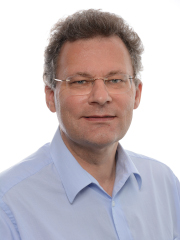
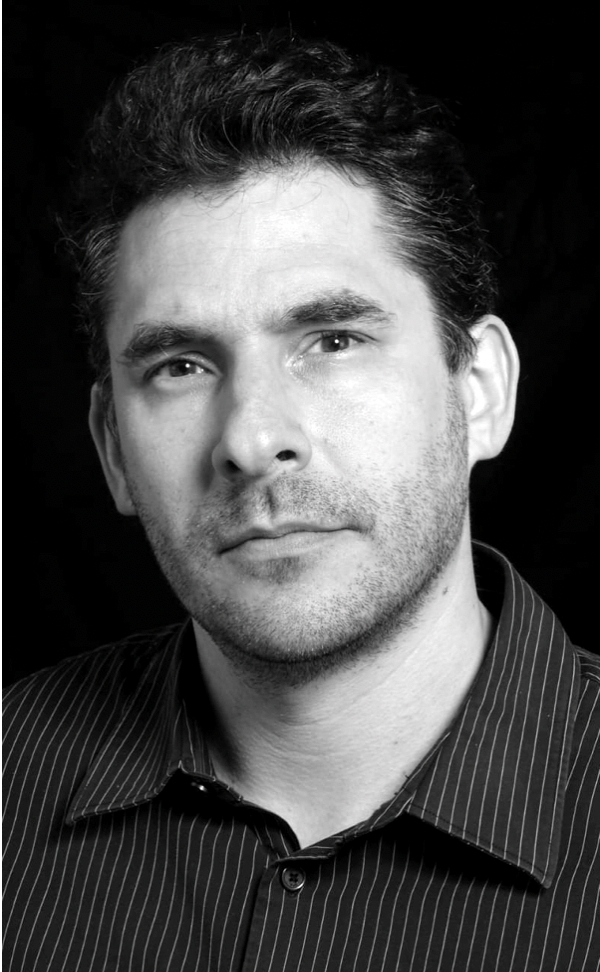
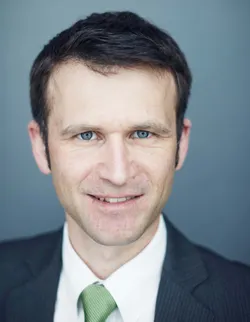
Prof. Dr. Matthias Armgardt holds the Nucleus Professorship for Global Legal History and Civil Law as well as Computational Legal Theory at the Faculty of Law, University of Hamburg . His work focuses on interdisciplinary fundamental research at the intersection of history, logic, philosophy, and legal reasoning. Historical perspective: Comparative study of ancient Jewish, Greek-Hellenistic, and Roman law Logical perspective: Development of computational legal theory using formal logic and AI Philosophical perspective: Analysis of Leibniz's legal philosophy Legal perspective: Critique of German civil law with comparative methods His research includes collaborations with Harvard Law School, European University Institute, and University of Bologna. Key projects: CISAL (Center for Ancient Legal History) and LLCA (Legal Logic, Computational Law, and AI project). He organizes summer schools on Law and Logic with institutions like the European University Institute.
Prof. Florian Zaussinger is a faculty member at the Faculty of Applied Computer and Life Sciences at Mittweida University of Applied Sciences. His research focuses on thermal convection, fluid dynamics, and numerical simulations in both geophysical and astrophysical contexts. He has contributed extensively to studies on microgravity experiments, including the GeoFlow and AtmoFlow projects conducted on the International Space Station (ISS). University: Mittweida University of Applied Sciences Faculty: Applied Computer and Life Sciences Department: Mathematics Contact: +49 3727 58-1381 | florian.zaussinger@hs-mittweida.de | Building 6, Room 6-131 His research involves advanced numerical modeling of complex fluid systems, including spherical convection, dielectric heating, and double-diffusive processes. He has developed and applied computational tools like the ANTARES code to simulate convection in DA white dwarfs, planetary atmospheres, and Earth's mantle. His work bridges theoretical fluid mechanics with experimental validation in space-based microgravity environments. Recent publications highlight his expertise in thermo-electrohydrodynamic convection, planetary fluid flow analysis, and microgravity-induced instabilities. While the scraped data does not list scientific awards or students directly, his academic profile emphasizes interdisciplinary collaboration with engineering and life sciences, particularly in applied mathematics for fluid dynamics and experimental data processing.
Lionel C. Briand is a Professor of Software Engineering with shared appointments at the University of Luxembourg's SnT Centre for Security, Reliability, and Trust and the School of Electrical Engineering and Computer Science at the University of Ottawa. He holds a Canada Research Chair (Tier 1) in Intelligent Software Dependability and Compliance and serves as Director of Lero, Ireland's national software research center. His academic leadership spans over 25 years of collaborative research with industry partners across automotive, aerospace, energy, financial, and legal domains. Professor Briand's research focuses on software verification and validation, trustworthy AI systems, model-driven engineering, and empirical software engineering methodologies. His work bridges theoretical foundations with industrial applications, particularly in cyber-physical systems where machine learning components interact with safety-critical control systems. He has pioneered techniques for testing AI-enabled systems, GDPR compliance automation, and mutation analysis for space systems. His publication portfolio demonstrates consistent innovation in software testing, with recent emphasis on large language models for test generation, automated compliance checking, and safety analysis of deep neural networks. Key trends include black-box testing methodologies, metamorphic testing for security, and search-based approaches for DNN validation. IEEE Fellow and ACM Fellow IEEE Computer Society Harlan Mills Award (2012) ACM SIGSOFT Outstanding Research Award (2022) IEEE Reliability Society Engineer-of-the-Year Award (2013) ERC Advanced Grant recipient (2016) Fellow of the Academy of Science, Royal Society of Canada (2023) ICSE 2011 Most Influential Paper Award As Director of Lero and holder of a Canada Research Chair, Professor Briand leads major research initiatives including an ERC Advanced Grant on cyber-physical system modeling and testing. His industrial collaborations generate substantial grant funding, particularly in automotive safety validation and regulatory compliance automation. He mentors numerous researchers through his dual appointments and serves on program committees for top software engineering conferences. Professor Briand directs research activities at the SnT Centre's SVV department, focusing on software verification and validation. His team develops practical tools like MASS for space system mutation analysis and COREQQA for compliance requirements understanding, with strong industry adoption in automotive and aerospace sectors.
Thomas Pany serves as Professor for Satellite Navigation (LRT-9.2) at Bundeswehr University Munich, based in Building 61, Room 061/1111. His contact details include telephone +49 89 6004-4152 and email thomas.pany@unibw.de, confirming active institutional engagement. His research centers on satellite-based positioning systems, with expertise spanning: Global Navigation Satellite Systems (GNSS) Precise navigation system design Signal processing for positioning Geodetic applications of satellite data Navigation algorithm development No scientific awards were documented in the provided materials. Information regarding student supervision, research grants, or laboratory affiliations was not included in the source text.
Dr. Christoph Trinkl serves as Head of the Institute of new Energy Systems (InES) at Technische Hochschule Ingolstadt, a position he has held since 2008. His work focuses on renewable energy technologies and sustainable energy systems development, with particular expertise in solar thermal applications and system integration. His research interests include: Green Technologies Renewable Energy Technologies Solar Energy Engineering Solar Heating and Cooling Renewable Energy Systems for Industrial, Domestic and Mobility Applications Technology Transfer and Network Management Dr. Trinkl's educational background includes a PhD in Engineering from De Montfort University Leicester's Institute of Energy and Sustainable Development (UK) in 2007, following his work as a researcher at Technische Hochschule Ingolstadt from 2001-2007. His degree course in Mechanical Engineering and Business (1997-2001) provided the foundation for his interdisciplinary approach to energy systems. His recent publications demonstrate a strong focus on practical applications of renewable energy technologies, particularly in solar thermal systems, heat pump integration, and district heating networks. His research spans from fundamental engineering analysis of collector technologies to large-scale system integration and optimization, with increasing emphasis on real-world implementation challenges and optimization techniques including AI-driven approaches. Dr. Trinkl's extensive publication record spanning over two decades shows an evolution from fundamental collector technology research to broader energy system integration, addressing both technical and practical implementation considerations across diverse contexts from industrial applications to rural energy access solutions.
Dr. Eric T. Reifenstein is a neuroscience researcher at Humboldt-Universität zu Berlin's Faculty of Life Sciences, Institute of Biology, specializing in neural mechanisms of spatial navigation and memory. As a key contributor to SFB 1315 (Entorhinal Cortex as Interface between Memory and Space), his work bridges computational modeling and human electrophysiology. His research focuses on egocentric spatial mapping and sequence learning mechanisms , with particular expertise in human single-neuron recordings during virtual navigation tasks. Reifenstein investigates how the brain encodes self-centered spatial representations and how synaptic learning rules enable temporal sequence memorization. His publication trends reveal a strong emphasis on translational neuroscience , connecting rodent studies to human cognition through innovative virtual reality paradigms. Key methodological approaches include single-neuron recordings, computational modeling of neural networks, and behavioral analysis of spatial memory. Scientific contributions include: Identification of egocentric bearing cells in human parahippocampal cortex Mathematical analysis of phase precession in sequence learning Vectorial representation models of egocentric space Reifenstein actively collaborates with leading researchers including Prof. Richard Kempter and Joshua Jacobs, contributing to major neuroscience journals like Neuron and eLife. His work has implications for understanding memory disorders and developing neural prosthetics.
Tej Chajed is an Assistant Professor in the Department of Computer Science at the University of Wisconsin-Madison, where he conducts research in formal verification of systems software. His work focuses on building and proving the correctness of critical systems, particularly file systems and concurrent software. Dr. Chajed earned his PhD from MIT in the PDOS group, followed by a one-year postdoc at VMware Research before joining UW-Madison. His academic journey reflects a strong commitment to bridging theoretical formal methods with practical systems implementation. Chajed's research centers on formal verification techniques for systems software, with particular emphasis on concurrent and crash-safe systems . His work aims to eliminate bugs in critical software through mathematical proofs of correctness. Key contributions include DaisyNFS (a verified concurrent file system), the Perennial framework for reasoning about crash safety, and Goose for connecting proofs to Go code. His research spans the intersection of programming languages, operating systems, and formal methods, developing practical tools that bring verification to real-world systems. His recent publications demonstrate a consistent trajectory toward more practical and scalable verification techniques for increasingly complex systems. The research shows progression from foundational verification frameworks to applied work on specific systems like file systems, journaling, and distributed protocols. A notable trend is the focus on making verification more accessible and practical for systems developers, bridging the gap between theoretical formal methods and real-world software engineering. Dr. Chajed serves on numerous program committees including OSDI 2025 PC, PLDI 2024 PC, SySDW 2023 PC, ECOOP 2023 ERC, CPP 2023 PC, POPL 2023 PC, PLDI 2022 PC, POPL 2022 AEC, EuroDW 2021 PC, POPL 2021 AEC, PLDI 2020 AEC, POPL 2020 AEC, and SOSP 2019 AEC, reflecting his standing in the systems and programming languages research community. In teaching, Chajed has developed and instructed courses on systems verification, operating systems, and protocol verification. He previously helped create MIT's 6.826 (Principles of Computer Systems) during his PhD. His passion for technical communication was cultivated during his time as a Communication Fellow in the EECS Communication Lab at MIT, where he continues to offer guidance to students on writing and presentation skills. His research group at UW-Madison focuses on advancing the state of the art in systems verification, with current projects centered around practical verification frameworks for concurrent and crash-safe systems.
Jie M. Zhang is an Assistant Professor in the Department of Informatics at King's College London, specializing in the intersection of software engineering and artificial intelligence. Her research focuses on two main directions: AI for Software Engineering (leveraging AI technologies to automate software tasks) and Software Engineering for AI (applying SE principles to enhance AI system trustworthiness). Her educational background includes a PhD in Computer Science from Peking University, where she was supervised by Professors Lu Zhang and Dan Hao. Prior to joining King's College London, she was a Research Fellow at University College London working with Professor Mark Harman and Professor Federica Sarro. Dr. Zhang's research interests center on software testing, machine learning trustworthiness, fairness testing, bias mitigation in AI systems, and program analysis. Her work particularly examines how large language models can be utilized for code generation, test case creation, and program repair, while also developing techniques to detect and fix issues within AI models. Her recent publications demonstrate strong trends in evaluating and enhancing the trustworthiness of AI-generated code, with specific emphasis on fairness testing across various domains including autonomous driving systems, machine translation, and decision-making software. Her research increasingly focuses on the efficiency of generated code and detecting hallucinations in large language models. 2025 ACM Sigsoft Early Career Researcher Award for pioneering contributions to software engineering for AI IEEE TSE 2024 Best Paper Award for 'Stealthy Backdoor Attack for Code Models' FSE 2025 Distinguished Paper Award Royal Society International Exchange Grant recipient NMES Enterprise & Engagement Partnerships Fund recipient Dr. Zhang has served in numerous leadership roles across major software engineering conferences including as General Chair for AIware 2025, Area Chair for ASE 2025, and Steering Committee Member for ICST. She has advised multiple PhD students and received significant research funding for her work on LLMs and software engineering. Her research group collaborates with industry partners including Huawei and Facebook, and she leads projects such as ITEA GENIUS and ITEA GreenCode. She is actively involved with King's College London research hubs including the Trusted Autonomous Systems Hub, Security Hub, and Software Systems group, where her work contributes to developing trustworthy AI systems across multiple domains.
Dana Schmalz is a Senior Research Fellow at the Max Planck Institute for Comparative Public Law and International Law in Heidelberg, Germany, and currently serves as a visiting scholar at Columbia Law School and a fellow at the Columbia Center for Contemporary Critical Thought in New York. Funded by an Alexander von Humboldt Foundation fellowship, she pursues a two-year research project examining critical dimensions of international refugee law and migration governance. Her academic profile combines rigorous legal scholarship with theoretical engagement across international law, political philosophy, and migration studies. Dr. Schmalz earned her doctorate from the University of Frankfurt in 2017 with a dissertation on democratic theoretical issues in refugee law, followed by an LL.M. in Comparative Legal Thought from Cardozo Law School, New York, in the same year. She serves as an editor for the journal Kritische Justiz (KJ), contributing to critical legal scholarship in German-speaking academic circles. Her research centers on the intersection of refugee law and democratic theory, examining how political rights are secured for those without voice in democratic processes. She critically investigates population discourse and its relationship to migration governance, exploring how demographic projections shape perceptions of 'too many' migrants. Her scholarship analyzes the language and power structures of international law, examining how legal frameworks construct hierarchies and influence global governance. She has published extensively on European border policies, refugee protection mechanisms, and the theoretical foundations of international legal order. Dr. Schmalz's recent publications reveal a sophisticated analysis of migration governance that connects historical developments with contemporary challenges. She examines how legal concepts like responsibility-sharing function in practice, investigating the role of geopolitical proximity in determining state obligations toward refugees. Her work consistently combines rigorous legal analysis with critical theoretical perspectives, often challenging conventional understandings of migration governance. She explores the internalization of borders in demographic thinking and the ways legal frameworks contribute to perceptions of migration as 'excess.' Alexander von Humboldt Foundation fellowship supporting current research As an active contributor to Völkerrechtsblog, Dr. Schmalz helps shape digital infrastructure for global legal scholarship. Her work connects with broader academic communities through collaborations with scholars across international law and refugee studies. While specific grant details beyond the Humboldt fellowship aren't provided in the source material, her extensive publication record indicates sustained research activity across multiple funding cycles. She engages with practical policy challenges through her analysis of European migration governance and refugee protection mechanisms. Dr. Schmalz's research connects with multiple academic networks through her work at the Max Planck Institute, Columbia University, and her editorial role at Kritische Justiz. Her scholarship bridges German and Anglo-American academic traditions, contributing to transnational legal discourse on migration and refugee protection. She participates in interdisciplinary conversations that connect legal scholarship with political theory, philosophy, and migration studies.
Prof. Dr. Jens Eisert is a Professor at the Free University of Berlin, where he leads the Quantum Many-Body Theory, Quantum Information Theory, and Quantum Optics research group (Eisert AG) within the Institute of Theoretical Physics at the Dahlem Center for Complex Quantum Systems. His office is located at Arnimallee 14, Room 1.3.06 in Berlin-Dahlem. His research focuses on the intersection of quantum information theory and condensed matter physics, specifically exploring what information processing tasks are possible using individual quantum systems as information carriers. His group develops mathematical-theoretical foundations of quantum information, particularly in entanglement theory and tomography, while also investigating quantum optical implementations using light modes or cold atoms in optical lattices. A major emphasis of their work is on quantum many-body systems, including static properties, efficient numerical simulation methods like tensor networks, and non-equilibrium quantum dynamics. Recent publications highlight significant contributions in thermalization of quantum systems (Communications Physics 2025), quantum thermodynamics (Nature Physics 2025), and quantum error correction (PRX Quantum 2025). The group's work is characterized by combining the rigor of mathematical physics with physically motivated applicability, frequently leading to direct collaborations with experimental groups. Quantum Information Theory Quantum Many-Body Theory Quantum Optics Entanglement Theory Tensor Networks Quantum Error Correction Prof. Eisert maintains active supervision of numerous PhD students and postdoctoral researchers, with research positions regularly available in areas including quantum error correction, quantum information theory, tensor networks, and quantum simulation. His group has published extensively in top journals including Nature Physics, PRX Quantum, and Physical Review series.
Allison Sullivan is an Assistant Professor of Computer Science at the University of Texas at Arlington (UTA), where she also serves as the Undergraduate Software Engineering Program Director. She is a member of the Software Engineering Research Center (SERC) at UTA and serves as faculty advisor for UTA's Society of Women Engineers (SWE) club. Dr. Sullivan received her PhD in Software Verification, Validation and Testing (SVVAT) from the University of Texas at Austin in 2017 under Sarfraz Khurshid. Her educational background includes: PhD in Software Verification, Validation and Testing, University of Texas at Austin (2017) M.S. in Software Engineering, University of Texas at Austin (2014) B.S. in Software Engineering, University of Texas at Dallas (2012) Dr. Sullivan's research focuses on two primary areas: Automated Software Engineering : Test/Oracle Generation, Automated Bug Localization and Repair, Mutation Testing, and Regression Testing Formal Methods and Programming Languages : Abstractions, Finite Model Finders, Program Synthesis, and SAT/SMT Solvers She leads the SCOPE lab which focuses on 'showing the correctness of all program executions' and has published extensively on Alloy modeling language applications. Her recent publications demonstrate a strong focus on applying formal methods to software engineering problems, with a growing emphasis on the intersection of large language models and software development practices. Her work spans theoretical foundations, tool development, and empirical studies of how developers use modeling languages. Her scientific achievements have been recognized with: NSF CAREER Award (2024) UTA CSE department Rising Star Research Award (2024) UTA College of Engineering Outstanding Early Career Faculty Award (2025) NSF grant for building an educational tool for software modeling ($400k) Dr. Sullivan has successfully advised two PhD students to completion: Dr. Ana Jovanovic (defended November 2024) and Dr. Anahita Samadi (defended February 2025). She actively mentors undergraduate researchers and has secured significant research funding including the NSF CAREER grant. Her service includes committee roles for major conferences including ASE, ISSRE, and FormaliSE. She leads the SCOPE lab at UTA, which brings together graduate and undergraduate researchers to develop techniques for improving software verification and validation, with particular emphasis on making formal methods more accessible to practitioners.
Juan Zhai is an Assistant Professor in the Manning College of Information & Computer Sciences (CICS) at University of Massachusetts Amherst, where she co-directs the Laboratory for Advanced Software Engineering Research (LASER) and participates in the UMass NLP group. Her academic career spans over 7 years of active service including program committee roles at top-tier conferences like ICSE, FSE, and ASE. Her research focuses on Software-AI Synergy with core areas including: Formal Specification Synthesis for precise software behavior definition Comment Generation and Maintenance using LLMs Trustworthy AI through bias detection and framework testing Deep Learning Infrastructure Reliability Recent work demonstrates strong emphasis on practical tools for AI safety and software dependability. Her publication trends show consistent output in top software engineering venues (ASE, ICSE, FSE) with increasing focus on AI/ML conferences (ACL, CVPR, ICLR). Key themes include metamorphic testing for deep learning frameworks, bias analysis in LLMs, and formal methods for specification synthesis. She actively serves the community through: Program committees for 13 major conferences Reviewing for 5 top journals including TOSEM and TSE 40+ total reviews across SE and AI venues Juan mentors PhD students including Gehao Zhang (research focus: Software Engineering, AI Safety) and teaches graduate courses like CS520 (Theory and Practice of Software Engineering) and CS692P (Hot Topics in SE Research). She leads the LASER lab which develops tools like C2S, CPC, and DevMuT for software reasoning and AI infrastructure testing.
Professor Phil King leads a research group within the School of Physics and Astronomy at the University of St Andrews, where he is part of the Centre for Designer Quantum Materials. His research focuses on the electronic structure and many-body interactions of quantum materials using electron spectroscopy, particularly angle-resolved photoemission (ARPES), and creating new designer quantum materials through atomic layer-by-layer growth. King's research interests center on quantum materials, with particular emphasis on topological matter, transition-metal oxides, and 2D quantum materials. His group investigates strain and pressure tuning of quantum materials, photoemission spectroscopy of correlated systems, and engineering band structures in 2D conductors. They develop methods to exploit strong electronic interactions in 2D systems to create new functional materials with tunable properties. Their approach combines experimental screening of candidate materials, bottom-up atomic assembly of custom heterostructures, and advanced spectroscopic feedback. Analysis of King's recent publications reveals a strong focus on the electronic structure of quantum materials, particularly transition metal dichalcogenides, delafossite metals, and topological systems. His work frequently examines charge density waves, spin-orbit coupling effects, Van Hove singularities, and quantum phase transitions. A notable trend is the integration of materials synthesis with advanced spectroscopic characterization, enabling precise control over electronic properties through strain engineering, doping, and heterostructure formation. King actively supervises PhD students on projects related to quantum materials, including probing elastic coupling in exotic magnets, angle-resolved photoemission from tailored mesostructures, thermodynamics and spectroscopy, oxide metals, and gate tuning of 2D quantum materials. His research is supported by major funding sources that enable access to cutting-edge equipment and international facilities. The King Group operates advanced experimental facilities including a high-resolution lab-based ARPES system with multiple light sources, and two DCA R450 molecular-beam epitaxy systems optimized for transition-metal oxides and chalcogenides. They are developing the UK's first spin-resolved ARPES capability. The group regularly utilizes major international facilities including Diamond Light Source, Elettra, SOLEIL, and HiSOR synchrotrons, as well as the ARTEMIS facility for time-resolved studies.
Dr. Shahin Ghaziani is affiliated with the University of Hohenheim, serving in dual roles across two departments. As a researcher in the Department of Agricultural Business Administration (410b), he contributes to the EDIF and NOcsPS projects, focusing on agricultural policy and public relations. Concurrently, he supports the Department of Societal Transaction and Agriculture (430b) as an IT specialist and webmaster. His work bridges technical support, policy analysis, and research in food systems sustainability. Research interests include food loss/waste reduction, agricultural data systems, refugee nutrition, and policy-driven interventions. Notable projects address digital maturity in food certification and value stream mapping for wheat lifecycle analysis in Iran. Publications span 2014-2025, emphasizing cross-sector collaboration in policy design and quantitative methods for food waste mitigation. His work highlights gaps in household self-reporting and advocates for hybrid data approaches. Shahin collaborates with organizations like Caritas on asylum seeker nutrition and explores livestock sustainability in tropical regions. Though no awards are listed, his interdisciplinary projects reflect impactful contributions to food systems and refugee welfare.
Professor Saman Amarasinghe is a full Professor in the Department of Electrical Engineering and Computer Science (EECS) at the Massachusetts Institute of Technology (MIT), and Principal Investigator at MIT's Computer Science and Artificial Intelligence Laboratory (CSAIL). He leads the Commit compiler research group, which focuses on programming languages and compilers that maximize application performance on modern computing platforms. His work spans multiple academic departments and research centers, with strong affiliations to both MIT's School of Engineering and CSAIL. Professor Amarasinghe's research interests center around high-performance domain-specific languages and compiler technology . His work combines language design with sophisticated compilation techniques to deliver unprecedented performance for targeted application domains. His research spans multiple areas including image processing (Halide), sparse tensor algebra (TACO), graph analytics (GraphIt), stream computations (StreamIt), and bioinformatics (Seq). A significant thread throughout his work is the application of machine learning for compiler optimizations, from Meta optimization in 2003 to the OpenTuner autotuner framework. Analysis of Professor Amarasinghe's recent publications reveals a strong focus on sparse computing , compiler vectorization , and domain-specific language implementation . His work consistently bridges theoretical compiler concepts with practical performance gains across diverse application domains. The progression from earlier work on StreamIt and Halide to more recent projects like GraphIt and TACO shows an evolution toward more specialized, high-performance DSLs targeting specific computational patterns. His 2020-2025 publications particularly emphasize sparse tensor operations, GPU acceleration, and machine learning integration with compiler technology. ACM Fellow (2019) Professor Amarasinghe has made significant contributions to academic entrepreneurship and student development. He founded Determina, Inc. (acquired by VMware) based on security research from his MIT lab and co-founded Lanka Internet Services, Ltd., Sri Lanka's first ISP. As faculty director of MIT Global Startup Labs, his programs across 17 countries have helped create over 20 successful startups. His teaching includes the popular Performance Engineering of Software Systems (6.172) course with Professor Charles Leiserson, as well as innovative project-based courses like the Open Source Software Project Lab and Bring Your Own Software Project Lab. His educational approach emphasizes hands-on experience with compiler and language design concepts. Professor Amarasinghe leads the Commit compiler research group at MIT CSAIL, which has produced numerous influential domain-specific languages and compilers including Halide, TACO, Simit, StreamIt, and GraphIt. The lab maintains strong industry connections through projects like OpenTuner and Determina, and collaborates with researchers worldwide on compiler technology. The group's work spans both theoretical compiler research and practical implementation, with a consistent focus on bridging the performance gap between high-level programming abstractions and hardware capabilities.