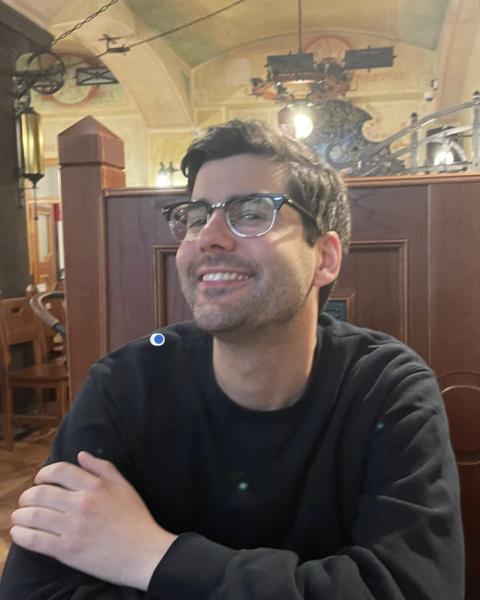
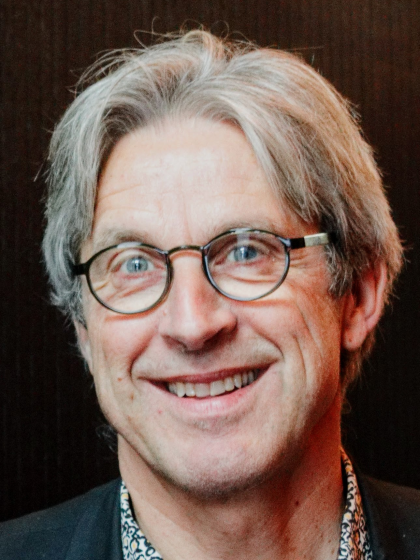
Valentin Ivanov Vulchanov is a Researcher at the Department of Language and Literature, Norwegian University of Science and Technology (NTNU). His research focuses on language development, autism spectrum disorders, bilingualism, and gesture-language interaction. He has collaborated with institutions globally, contributing to over 50 peer-reviewed publications since 2000. Key research themes include figurative language processing in ASD, statistical learning mechanisms in children, and cross-linguistic spatial communication systems. His work bridges cognitive linguistics, neuropsychology, and developmental psycholinguistics, with notable contributions to understanding sensory and motor correlates of language acquisition. Recent studies highlight spatial language deficits in autism, gesture's role in early communication, and bilingualism effects on deictic systems. Vulchanov has co-edited volumes on native speaker variability and served on editorial boards for journals like Journal of Cultural Cognitive Science . His research has been supported by grants exploring language disorders in multilingual contexts and neurocognitive foundations of metaphor comprehension. Collaborations include projects with the University of Oslo, University of Edinburgh, and institutions in Bulgaria and Spain.
Gulshen Sakhatova serves as Assistant Professor in the Department of Turkish and Middle Eastern Studies at the University of Cyprus, with prior academic appointments spanning eight institutions across Germany, Greece, and Turkmenistan. Her international career includes professorships at Georg-August University Göttingen (2017-2020), Aristotle University Thessaloniki (2015), and multiple German universities, alongside repeated visiting positions at the University of Cyprus since 2007. Her academic foundation includes an MA in Philology (German, English and World Literature) from Magtymguly Turkmen State University and a PhD in Turkology/Linguistics from Friedrich Wilhelm University Bonn (2004). This dual expertise enables sophisticated cross-linguistic analysis between Germanic and Turkic language families. Sakhatova's research centers on the structural intricacies of Turkic languages, particularly verb systems and modality phenomena in Turkish, Turkmen, and Cypriot Turkish variants. She investigates linguistic contact effects in multilingual environments, Turkmen's status as a 'degraded' Turkic language, and pedagogical challenges in teaching Turkish to Greek speakers. Her work bridges theoretical linguistics with practical language acquisition frameworks, emphasizing semantic-pragmatic interfaces and historical development pathways. Current research demonstrates strong productivity with 15+ publications since 2021, primarily in specialized linguistics journals and the Societas Uralo-Altaica series. Her output reveals consistent focus on modality systems (35%), dialectology (25%), and language pedagogy (20%), with growing emphasis on Greek-Turkish language contact phenomena through her two active research projects. She currently leads two major funded initiatives: 'A Manual for Language Instructors of Turkish to Greek L1 Learners' (2023-2025) and 'Teaching/Learning Turkish as SL/FL in Greek language classrooms' (2024-2025). These projects address critical gaps in pedagogical resources for Greek-speaking Turkish learners, examining interference patterns and developing context-specific teaching methodologies. Her international collaborations span institutions in Germany, Greece, Russia, and Turkey through co-authored publications and scholarly networks. Students benefit from engagement with active fieldwork projects, corpus development for endangered Turkic varieties, and participation in international academic exchanges. Her supervision emphasizes empirical research in Turkic linguistics with applications to language preservation and pedagogy, particularly relevant for scholars interested in Mediterranean language contact zones.
Evi Sifaki is an Assistant Professor in Applied Linguistics at the University of Warwick. She serves as the departmental Director of Student Experience, coordinating initiatives to enhance student participation and learning environments. Her research focuses on syntax-semantics interfaces, language change in Greek and English, and applied linguistics projects involving Cognitive Metaphor Theory in economic discourse. She has taught theoretical modules like Syntax, Morphology, and Sociolinguistics, alongside applied courses such as Qualitative Research Methods. Her research explores topics including null arbitrary subjects in Greek, preposition-drop phenomena, and the conceptual metaphors underlying economic terminology. She has investigated historical language shifts and EDI-related issues like employability skills in diverse student groups. Her work bridges formal linguistic theory with sociocultural applications, contributing to both Greek and English linguistics literature. Notable publications include analyses of Greek syntax structures (e.g., VOS orders, EPP-driven mechanisms) and collaborative studies on metaphorical framing in economic language. Her review of Parametric Variation: Null Subjects in Minimalist Theory highlights her engagement with foundational linguistic theory.
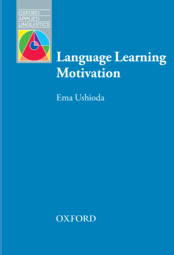
Ema Ushioda is a Professor in the Department of Applied Linguistics at the University of Warwick, part of the Faculty of Social Sciences. Born in Japan and raised in Ireland, her research focuses on language learning motivation, autonomy, and their implications for pedagogy. She holds a PhD from Trinity College Dublin and has taught in Japan, Ireland, and the UK. Her work emphasizes qualitative methodologies, particularly in exploring learners' self-perceptions and motivational dynamics. Since joining Warwick in 2002, she has led MA/PhD programs, served as Director of Graduate Studies (2013–2018), and Head of Department (2018–2023). Her research projects include investigations into syntactic priming, multilingual identity negotiation, and ethical dimensions of classroom research. Key grants include Leverhulme Trust funding for studies on generative AI in academic writing and syntactic priming mechanisms. Her recent publications analyze motivational ethics, modality effects in language learning, and multilingual self-concept in global contexts. She contributes to teacher education through works on autonomy promotion and pedagogical innovation. Her scholarship bridges motivational theory with practical classroom applications, emphasizing cultural and contextual factors in language education.
Liz Smeets is an Assistant Professor in the Department of Languages, Literatures and Linguistics at York University, affiliated with the Faculty of Liberal Arts & Professional Studies. She holds a PhD from McGill University (2020) and dual BAs in Linguistics and Italian from Utrecht University (2012). Her research focuses on second language acquisition, syntax-discourse interfaces, and bilingual populations’ language transfer. She collaborates with the University of Guelph to develop linguistically informed language learning modules for classrooms. Education: PhD in Linguistics, McGill University (2020) BAs (cum laude) in Linguistics and Italian Language & Culture, Utrecht University (2012) Research emphasizes syntax-semantics/discourse/prosody interfaces, particularly how bilingual learners integrate native and target language systems. She explores how prosody (e.g., stress) influences pronoun interpretation in L2 English and Italian. Applied work bridges linguistic theory with pedagogical tools for language instructors. Collaborations include projects with Alena Barysevich at U of Guelph to create online resources for language learners. Personal interests include yoga, travel, and nature, reflecting a balanced academic and creative lifestyle.
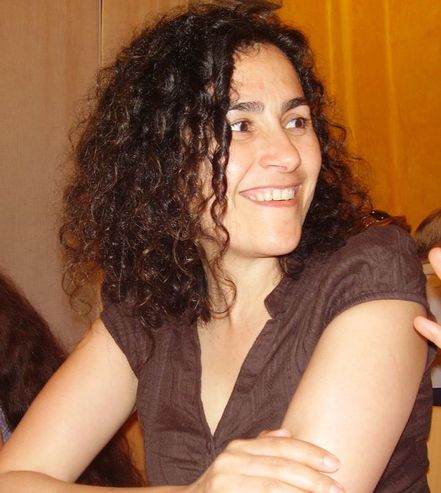
Mena Lafkioui is a Full Professor (Directeur d'études) in Berber linguistics at the Ecole des hautes études en sciences sociales (EHESS) in Paris, holding a concurrent position as Research Director at the Centre National de la Recherche Scientifique (CNRS). She has been affiliated with these institutions since 2018 and 2014 respectively, following previous academic positions at Università degli Studi di Milano-Bicocca, Università della Calabria, and Ghent University. Her educational background includes a Habilitation in 'Sciences du langage' from EHESS (2010), a Ph.D. in Linguistics from INALCO, Paris (1999), a Postgraduate degree in Linguistics from INALCO (1995), and a Master's in Oriental Languages and Cultures from Ghent University (1994). Lafkioui's research spans Berber linguistics, geolinguistics, sociolinguistics, Afroasiatic linguistics, Arabic dialectology, and negation typology. Her work integrates structural linguistic analysis with sociocultural contexts, particularly focusing on the Rif Berber language continuum, language contact phenomena, and the impact of digital communication on Amazigh identity construction. Analysis of her recent publications reveals a consistent focus on Berber language structures, particularly examining negation patterns, topicalization mechanisms, geolinguistic variation, and the impact of language contact with Arabic. Her methodological approaches blend traditional linguistic analysis with computational and algorithmic perspectives, reflecting an innovative approach to language documentation and analysis. Elected as Academician, Accademia Ambrosiana, Milan (2014) Elected as founding member of the 'Classe Africa' of the Accademia Ambrosiana, Milan (2014) Elected as founding member of the 'Section Berbero' of the Accademia Ambrosiana, Milan (2014) Lafkioui has supervised 10 PhD students and 55 Master's dissertations while securing competitive research grants across Europe. She serves on multiple editorial boards including the International Journal Dialectologia et Geolinguistica and Afrika Focus. Her institutional roles include membership on the Scientific Council of the Laboratoire d'excellence Empirical Foundations of Linguistics in Paris and participation in numerous academic committees overseeing PhD programs in African languages and cultures. She has organized 17 international scientific meetings and is an active member of 10 scientific societies, including the Société de Linguistique de Paris, demonstrating her significant contribution to the academic community in linguistics and African studies.
Vincent Rouillard is a Postdoctoral Fellow in Linguistics at Harvard University focusing on formal semantics, pragmatics, and their interfaces. His research examines temporal adverbial distributions, interrogative structures, and cross-linguistic semantics. Rouillard investigates how languages encode stativity and dynamicity, with empirical work on Georgian verb systems. His publications analyze uniqueness implications in wh-questions across languages including Spanish and Brazilian Portuguese. Current work develops maximal informativity accounts for temporal expressions and explores the syntax-semantics interface in question formation. His approach combines formal linguistic theory with cross-linguistic data analysis.
Natasha Thalluri is a Lecturer at Harvard University holding multiple academic support roles: Assistant Head Tutor Department Teaching Fellow Department Librarian Her research centers on the syntax-semantics interface, investigating how grammatical structures encode meaning across diverse languages. She also examines language typology to map universal patterns and variations, gesture semantics to analyze non-verbal communication systems, and pragmatics to study contextual language interpretation. Her work bridges theoretical linguistics with embodied cognition frameworks.
Dr. Bob de Jonge is an Associate Professor at the University of Groningen, affiliated with the Faculty of Arts and the Department of European Languages and Cultures. He holds a PhD in Spanish Language and Literature from Leiden University (1990) and has been active in academia since 1985. His research focuses on sociolinguistics, Romance language acquisition, and linguistic analysis, particularly in Spanish and Italian. He explores topics such as pronoun usage, language variation, and cognitive grammar frameworks. His work includes studies on variable pronoun use in Patagonian Spanish, sociocultural aspects of le and lo/la in Spanish, and the relevance of cognitive approaches to linguistic analysis. He has contributed to edited volumes on topics ranging from food terminology in Dutch to immigrant influences on language. His publications reflect a strong emphasis on empirical research and functional linguistics. De Jonge has organized international conferences and presented at events such as the 13th International Columbia School Conference. His research activities span collaboration with institutions in Argentina, Italy, and Mexico. He currently serves as Co-Director of the Faculty of Arts at Groningen and is actively involved in theoretical and empirical linguistics research groups.
Phaedra Royle is a Full Professor at the Université de Montréal's School of Speech-Language Pathology and Audiology, part of the Faculty of Medicine. She holds a PhD in Linguistics from the Université de Montréal and a postdoctoral fellowship from McGill University. Her research focuses on language acquisition, psycholinguistics, neurolinguistics, and developmental language disorders, particularly in French and multilingual populations. She leads the Language Acquisition and Processing Lab and collaborates with institutions like the CRBLM (Brain, Language, and Music Research Centre). Education: Postdoc at McGill University (Communication Sciences), PhD in Linguistics (Université de Montréal), Master's in Linguistics (McGill), and Bachelor's in Linguistics with a minor in Spanish (Concordia University). Research Interests : Morphology, neurolinguistic processing of language, bilingualism, aging effects on language, and clinical applications for language disorders. She uses ERPs (electrophysiological methods) to study syntactic and semantic processing in both typical and atypical populations. Grants & Collaborations : Principal investigator on multiple projects funded by FRQNT, CRSH, and CRSNG. Notable projects include Language Acquisition and Processing in Teen and Adult L1 and L2 and Aging and the Time-Course of Morphology for Reading in French . She co-leads teams like the REPAR network for rehabilitation research. Labs & Teams : Director of the Language Acquisition and Processing Lab (Laboratoire de recherche sur l’acquisition et le traitement du langage). Affiliated with CRBLM, CIRCA, and the Centre de réadaptation Marie-Enfant (CHU Sainte-Justine).
Dr. Anahi Alba de la Fuente serves as an Associate Professor at Université de Montréal's Department of Literatures and Languages of the World. Her research focuses on language acquisition patterns, particularly in Spanish as a first and second language, examining bilingualism through psycholinguistic and sociolinguistic frameworks. She investigates morphosyntactic development across learner profiles including heritage speakers and L2/L3 learners. Her work explores critical intersections between theoretical linguistics and applied pedagogy, addressing how linguistic risk perception influences language teaching methodologies. Research employs experimental and corpus-based approaches to analyze tense/aspect systems, gender assignment, and relative clause structures across Romance languages. Awarded the 2020 Teaching Excellence Prize, Dr. Alba de la Fuente maintains active collaborations through ResearchGate and Google Scholar. Current projects examine heritage language maintenance in Montreal's multilingual context and pedagogical interventions for advanced Spanish learners.
María Biezma is an Associate Professor in the Department of Linguistics at UMass Amherst. Her research examines how meaning is constructed through interactions of syntax, semantics, and pragmatic context. Current work investigates anchoring phenomena where syntactic structures condition pragmatic inferences. Her dissertation 'Anchoring Pragmatics in Syntax and Semantics' established frameworks for analyzing discourse particles and alternative questions. Ongoing projects explore formal representations of focus, presupposition, and information structure across languages. Prior to UMass, she held an assistant professorship at the University of Konstanz (2014-2019) where she maintains research collaborations.
Michael McCourt serves as a Visiting Assistant Professor of Honors at the University Honors Program (UHP). He joined UHP in Spring 2024 and teaches courses such as the first-year seminar Origins and Evolution of Modern Thought . In Spring 2025, he will introduce an upper-level course in Arts and Humanities for Honors students. His affiliation is explicitly with UHP, though the overarching university is not named in the text. Education: BA in Philosophy and English, University of Massachusetts, Amherst MA in Philosophy, Northern Illinois University PhD in Philosophy, University of Maryland, College Park Research interests span the individuation of word meaning, language’s relationship with thought, psycholinguistic investigations of speech/text processing, and historical philosophical ideas about language and mind. His work integrates empirical methods (e.g., reading-time experiments) with theoretical frameworks in philosophy and linguistics, particularly focusing on Greek and Roman philosophy. Publications reflect interdisciplinary inquiry: recent work explores semantic internalism and anaphoric expressions, while earlier studies address structural processing mechanisms in language. The 2024 article (forthcoming) bridges philosophical and psycholinguistic perspectives, while the 2020 and 2015 articles emphasize experimental analyses of syntactic and semantic phenomena. Advising and grants: No specific advisees or grant details are provided in the text. His research includes projects on historical ideas about language and mind, though funding sources are unmentioned.
Letitia Naigles is a Professor in the Department of Psychological Sciences at the University of Connecticut. She serves as Vice President of the International Association for the Study of Child Language and leads the UConn Child Language Lab. Her research focuses on language acquisition across diverse populations, including typically developing children and those with autism spectrum disorders. She examines how linguistic input interacts with innate cognitive, neurological, and social factors to shape language development. Naigles holds a Ph.D. in Psychology from the University of Pennsylvania (1988). Her work spans theoretical and applied domains, addressing cross-linguistic variations in language acquisition and neurobiological underpinnings of developmental language disorders. She has held visiting appointments at the MIND Institute and Koç University, Turkey. Her awards include Fellow status in the Association for Psychological Science (2009). She has secured research funding from NIH, NSF, and other agencies, focusing on topics such as grammatical impairment in autism and longitudinal language profiles in developmental disorders. Her teaching includes courses on developmental psychology, language acquisition, and the neurobiology of language. Naigles’ research group, the UConn K.I.D.S. (Kids in Developmental Science), collaborates internationally to explore language mechanisms in diverse populations. Her publications bridge cognitive science, linguistics, and clinical applications, advancing understanding of both typical and atypical language development.
Carolina González is a full-time Professor at Florida State University's Department of Modern Languages and Linguistics, College of Arts and Sciences. Holding a Ph.D. in Linguistics from the University of Southern California, she specializes in Spanish phonetics, phonology, and prosody with particular focus on language invention and phonation patterns. Research Areas: Phonology, Phonetics, Prosody, Laboratory phonology, L2 phonological acquisition, Syntax-phonology interface, Morph-phonology, Language invention Her publication trends reveal sustained expertise in Spanish consonantal phenomena, intonation patterns, and prosody-conditioned alternations across Romance languages. Notably, she is collaborating with Lara Reglero on mirativity and developing a book on language invention with Cambridge University Press. While no formal scientific awards are mentioned in the available text, her laboratory phonology research integrates acoustic analysis with phonological theory. No graduate students are explicitly listed in the provided materials.