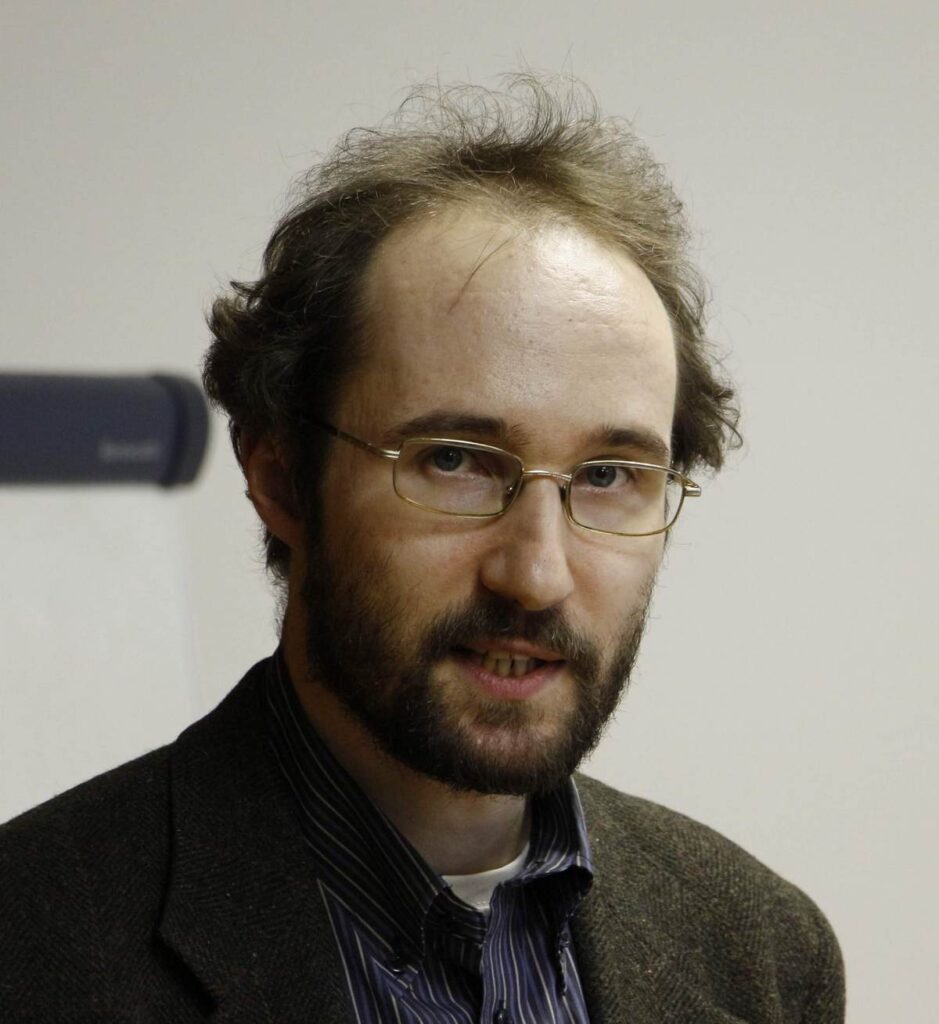
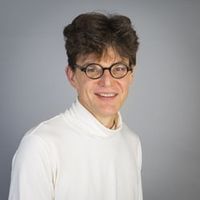
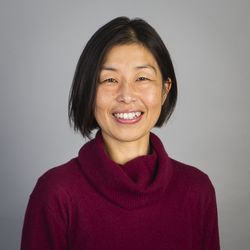
Marco Coniglio is a Professor of German Philology/Linguistics at the Department of German Philology, Georg-August-University Göttingen. His research spans historical grammar, syntactic theory, corpus linguistics, and digital humanities, with a focus on modal particles, information structure, and Germanic language interfaces. Key Research Areas: Historical Grammar, Modal Particles, Corpus Linguistics, Digital Humanities Projects: WiN-Korpus (Middle Low German Corpus), HIPKON (Historical Sermons Corpus), DFG Network on Subordinate Clauses Collaborations: Institute for Digital Humanities at Göttingen, Graduiertenkolleg 'Form-Meaning Mismatches' His 15 most recent publications (2021–2025) address Germanic syntax, modal particles, mood marking in subordinate clauses, and corpus-driven language change. Topics span grammaticalization of adverbs, information structure evolution, and comparative analysis across Old High German, Old Saxon, and Old English. Collaborative works include contributions to the 'Wörterbücher zur Sprach- und Kommunikationswissenschaft' project.
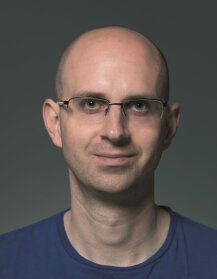
Christopher M. Hammerly is an Assistant Professor in the Department of Linguistics at the University of British Columbia and Director of the Experimental Linguistics and Fieldwork Lab (ELF-Lab). As a descendant of the White Earth Nation in Minnesota, much of his work focuses on documenting, analyzing, and revitalizing Anishinaabemowin (Ojibwe) through formal theories, computational models, and experimental methods. His research explores the cognitive foundations of morphosyntax, particularly person, number, and noun classification systems, and their role in linguistic phenomena like movement and agreement. Education: PhD in Linguistics (2020), UMass Amherst BA in Linguistics (2014), University of Minnesota BS in Psychology (2014), University of Minnesota Hammerly’s recent work includes developing speech synthesis systems, machine translation tools, and educational platforms for Ojibwe and other Indigenous languages. He advocates for community-driven language technologies and critical reflection on academic representation and ethics. Contact: chris.hammerly@ubc.ca
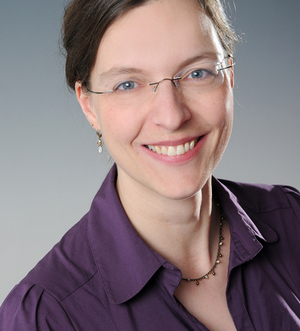
Dr. Luke Adamson is a tenure-track Researcher in Research Area 3 'Syntax and Lexicon' at the Leibniz-Zentrum Allgemeine Sprachwissenschaft (ZAS), Berlin. Previously, he held a Postdoctoral Fellowship at Harvard University (2020–2022) and served as Lecturer at Rutgers University (2022–2023). He earned his PhD in Linguistics from the University of Pennsylvania (2019) and holds dual degrees from Oberlin College: a Bachelor of Arts in Psychology and a Bachelor of Music in Cello Performance (2010–2014). His research focuses on nominal features, grammatical gender, and syntactic modularity, with notable projects exploring gender locality hypotheses, coordination resolution in three-gendered languages, and suppletion phenomena. Collaborators include prominent linguists such as Elena Anagnostopoulou (University of Crete), Ruth Kramer (Georgetown University), and Stanislao Zompì (Universität Potsdam). Key contributions include work on gender assignment constraints in languages like Greek, Swedish, and Lithuanian, as well as syntactic interfaces in Jarawara and Italian. Recent presentations include invited talks at the University of Geneva (June 2025), Yale University (October 2024), and the Brussels Conference on Generative Linguistics (December 2024). He co-edits Linguistic Inquiry Squibs & Discussion and organizes the ZAS Brown Bag Lunches. His work has been supported by grants from the National Science Foundation and the European Research Council. Adamson’s academic networks span formal linguistics and typological studies, with ongoing projects addressing politeness pronouns in Romance languages, emotive predicates in clausal complements, and allosemy in Greek gender systems.
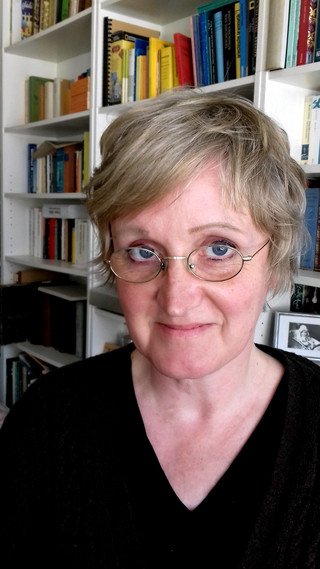
Dr. habil. Peter Arkadiev is a prominent linguist specializing in morphology, syntax, and typology, with a focus on Baltic, Slavic, and Northwest Caucasian languages. He holds a research position at the University of Potsdam, Institute of Slavistics, funded by the German Research Foundation (DFG) since December 2024. Previously, he held roles including Visiting Professor at the University of Mainz, Senior Fellow at the Freiburg Institute for Advanced Studies, and Marie Curie Senior Fellow. His academic credentials include a Habilitation in typological linguistics (2019) and a PhD from the Russian State University for the Humanities (2006). Research Interests: - Language Typology and Cross-Linguistic Comparison - Areal Linguistics and Language Contact - Case Systems and Argument Structure - Tense-Aspect-Actionality - Morphological Complexity and Polysynthesis - Baltic, Slavic, and Northwest Caucasian Languages Awards: Member of Academia Europaea (2023), Professor of the Russian Academy of Sciences (2022), Marie Curie Senior Fellowship (2023–2024), and multiple DFG-funded projects. His work bridges theoretical linguistics with empirical fieldwork, particularly in the North Caucasus. Publications span over 30 peer-reviewed articles and edited volumes, focusing on topics like prefixal perfectivization, applicative constructions, and morphological borrowing. Current research includes the DFG-funded project 'Typology and Diachrony of Ambifixation' (2024–2027).
Florian Haas is a Senior Lecturer in Linguistics at the Institute for English and American Studies , Friedrich Schiller University Jena , where he has taught since 2009 across BA, MA, and teacher training programs. His research focuses on recent morphosyntactic changes in English , contrastive linguistics , typology , and usage-based construction grammar , with a notable Habilitation thesis on the history of human impersonal pronouns in English. Education : PhD in Linguistics (2008, Free University of Berlin, summa cum laude), MA in European Master's Degree in Linguistics (2002), MA in English Studies (2002). His research interests span corpus-driven analysis of language change, cross-linguistic contrasts (particularly English-German), and cognitive approaches to grammar. His publications emphasize diachronic shifts in pronouns, genre-specific linguistic patterns, and constructionist analyses of syntax. He has supervised numerous student theses on topics like political framing, bilingualism, and sociolinguistic variation in English. Academic service includes roles as Erasmus coordinator, reviewer for journals like Journal of Pragmatics , and memberships in societies such as the Association for Linguistic Typology .
Dr. Claudia Wegener is a Researcher at the Department of Linguistics, University of Cologne, specializing in General Linguistics. Her work focuses on language documentation, speech-gesture interaction, and Papuan/Austronesian languages like Savosavo and Gela. She holds a PhD from Radboud University Nijmegen (2008) and has conducted extensive fieldwork in the Solomon Islands and Malaysia. Previous Positions: Research Assistant, University of Cologne (2017–present) Postdoctoral Researcher at MPI for Psycholinguistics, Radboud University (2002–2011) DoBeS Project Leader for Savosavo documentation Research Interests Her research spans: Socio-linguistic aspects of gesture systems Morphosyntactic typology of Papuan languages Lexical semantics and kinship terminology Documentation methodologies for endangered languages Publications Her work includes a landmark grammar of Savosavo (2012), co-edited volumes on language documentation (2011), and influential articles on gesture studies (2022) and motion event encoding (2022). Projects Leading the Savosavo-Gela Documentation Project (DoBeS-funded) Contributions to MPI's Endangered Languages Documentation Archive Collaborations with Australian National University and University of Manchester Her research bridges linguistic theory with applied documentation, emphasizing community-driven preservation strategies.
Dr. Carmen Scherer is a Senior Academic Councilor at the German Institute of Johannes Gutenberg University Mainz, specializing in German linguistics with a focus on descriptive and historical linguistics. Her academic journey includes a BA in Business Administration, followed by studies in German, French, philosophy, and German as a foreign language. She has held visiting professorships in Göttingen (Historical Linguistics) and Bonn (German Linguistics). Her research emphasizes word formation processes, language change dynamics, foreign word integration, and punctuation studies. Education highlights include degrees from universities in Marburg and Poitiers, followed by a doctorate on 'Word Formation Change and Productivity' (2004). She has authored/co-edited influential books like Introduction to Corpus Linguistics and The Interface of Morphology and Written Language . Key research interests involve morphological productivity, loanword adaptation, and the interplay between orthography and word structure. Her extensive publications (over 20 essays/reviews since 2003) explore topics such as the history of verb suffixes, apostrophe usage, and compound word spelling. She actively participates in international conferences, delivering lectures on linguistic topics like foreign word gender assignment and temporal prefixation in German. She also serves on academic boards and contributes to research projects focusing on language variation and corpus linguistics. Professional roles include leadership in the Mainz Linguistics Circle and collaborations across European academic networks. Her work bridges theoretical linguistics with practical applications in language teaching and normative standards, addressing contemporary issues in German language evolution and multilingual influences.
Barbara Meisterernst is an Honorary Professor at the Institute of Linguistics, National Tsing Hua University in Taiwan, specializing in Chinese historical syntax, morpho-syntax, syntax-semantic interfaces, and Buddhist Chinese linguistics. Her academic career spans prestigious institutions including Humboldt-University Berlin and the University of Ghent. Habilitation, University of Hamburg (2012) PhD in Chinese Studies, Münsterische Sinologische Mitteilungen (1998) MA in Chinese Studies, German and Linguistics (1992) Her research focuses on diachronic evolution of Chinese grammar, particularly tense-aspect-modality systems from Classical to Medieval Chinese. Key contributions include analyses of modal expressions, negation cycles, and syntactic changes in Buddhist Chinese texts. She employs formal syntactic frameworks to examine historical developments while integrating semantic and pragmatic dimensions. Her publications reveal strong trends in modality research (25% of output), diachronic syntax (30%), and Buddhist Chinese linguistics (15%). Recent work increasingly examines cross-linguistic comparisons with Vietnamese and Sogdian, reflecting broader typological interests. Methodologically, she combines corpus-based analysis with theoretical syntax to reconstruct historical grammatical systems. Meisterernst has presented at over 50 international conferences including IACL, EACL, and specialized workshops across Asia, Europe, and North America. Her extensive fieldwork includes collaborations with Academia Sinica, Tsing Hua University, and the International Dunhuang Project. She leads major research projects on pre-Tang Chinese verb phrase development and Silk Road linguistic interactions, securing continuous funding for collaborative work between European and Asian institutions since 2010.
Dr. Antje Casaretto is a researcher in Historical-Comparative Linguistics at the Department of Linguistics, University of Cologne. She maintains an office in Room 3.04 and can be contacted via email at antje.casaretto@uni-koeln.de or antje.casaretto@linguistik.uni-freiburg.de. Her research and teaching focus on Historical-Comparative Linguistics, Germanic and Indo-Iranian languages, with special expertise in Vedic Sanskrit and Gothic language. Her primary research interests include: Historical-Comparative Linguistics Germanic Linguistics Indo-European Linguistics Vedic Sanskrit Gothic Language Word Formation Language Contact Suppletion Local particles and adverbs Case syntax Dr. Casaretto's scholarly work demonstrates a consistent focus on the syntax and semantics of ancient languages, particularly examining how spatial concepts are encoded in Vedic Sanskrit through local particles. Her research bridges historical-comparative approaches with cognitive linguistics, analyzing how language structures evolve while maintaining functional relationships between form and meaning. She has made significant contributions to understanding grammaticalization processes, suppletion patterns, and language contact phenomena in Germanic and Indo-Iranian language families. Her current project, VedaWeb 2.0 (2022-2024), continues her investigation into Vedic language structures. Previously, she led major research initiatives including 'Agent prominence and the diachrony of predication in Indo-Aryan' (2017-2020) funded by CRC 1252 Prominence in Language, 'Multiheadedness in cross-categorial perspective' (2014-2016) supported by a UoC Postdoc Grant, and 'The Function and Development of Local Particles in Vedic' (2009-2014) funded by DFG.
Prof. Dr. Uli Sauerland is Deputy Director at the Leibniz Centre for General Linguistics (ZAS) in Berlin and Adjunct Professor at the University of Potsdam since 2018. He leads Research Area 4 'Semantics & Pragmatics' and oversees key projects including the ERC-funded Realizing Leibniz’s Dream , DFG-ANR Boolean Connectors , and CRC 1412 projects A05 and B06 . PhD in Linguistics (MIT, 1998) Habilitation (Tübingen, 2003) Rehabilitation (Potsdam, 2007) His research focuses on semantic-pragmatic interfaces , register variation , language acquisition , and cognitive modeling of linguistic phenomena . Recent work includes LMBayes (Bayesian language modeling), DUAL (semantic-pragmatic interactions), and studies on quantifier scope in children. Publications span formal grammar , cognitive development , and language processing . Notable scientific awards : CNRS Fellowship (2024) Academia Europea Membership (2019) ESF Community of Experts (2018) He contributes to editorial boards of First Language , Journal of Semantics , and Language Acquisition , and co-founded the CRC 1412 Register research program.
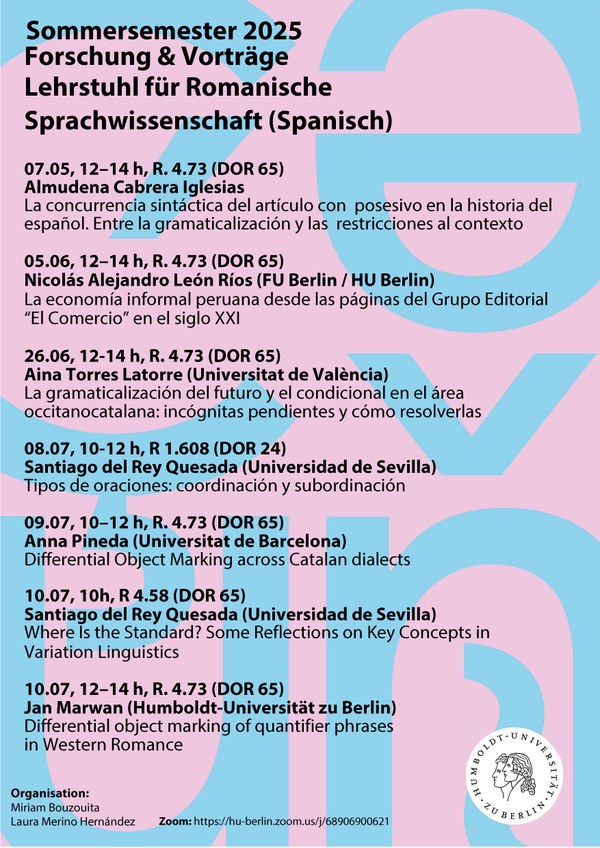
Prof. Dr. Miriam Bouzouita is a Professor of Romance Linguistics specializing in Spanish at the Humboldt University Berlin's Institute of Romance Studies, where she serves as Deputy Director of the Executive Directorate. Her research focuses on historical and comparative aspects of Romance languages, with particular emphasis on Spanish linguistic variation across time and space. She leads the Romance Varieties Lab and has established herself as a leading scholar in grammaticalization processes, syntactic variation, and possessive constructions within Ibero-Romance languages. Her research interests span historical linguistics, syntactic variation, grammaticalization processes, and corpus-based approaches to Romance languages. She has made significant contributions to understanding the development of future and conditional tenses in medieval Ibero-Romance, possessive constructions across Romance varieties, and syntactic archaisms in Atlantic Spanish dialects. Her work often bridges theoretical linguistics with practical applications through digital tools and corpus development, including the creation of the Spanish Dialects app for studying linguistic variation in the Hispanophone world. Analysis of her recent publications reveals a strong focus on grammaticalization phenomena in medieval Ibero-Romance languages, particularly the development of future and conditional constructions. She employs comparative methodologies across Spanish, Catalan, and Navarro-Aragonese, often using parallel biblical translations from the 14th century as data sources. Her work increasingly incorporates computational approaches, including Games With A Purpose (GWAPs) for linguistic annotation and corpus development, reflecting her commitment to methodological innovation in linguistic research. Prof. Bouzouita has successfully supervised numerous doctoral students to completion, including Daniel Eduard Bejarano Bejarano, Antoine Primerano, Johnatan Bonilla Huérfano, Rosa Lilia Segundo Díaz, Vanessa Casanova Romero, and Matti Marttinen Larsson. Her research has been supported through various projects, including the SFB Project 1412 at HU Berlin where former doctoral student Johnatan Bonilla Huérfano now works as a researcher. She leads the Romance Varieties Lab, which focuses on documenting and analyzing linguistic variation across Romance languages, with particular attention to Spanish dialects. The lab has developed digital tools for linguistic research, including the Spanish Dialects app, and has organized lecture series on research projects by participants and guests of the Department of Romance Linguistics. Prof. Bouzouita collaborates extensively with international researchers, as evidenced by her co-organized lecture series with Dr. Merino Hernández.
Kazuko Yatsushiro is a Senior Researcher at the Leibniz Centre for General Linguistics (ZAS) in Berlin, specializing in Language Development & Multilingualism. Her work focuses on theoretical investigations of language acquisition, particularly syntax (relative clauses, Wh-questions), semantics, and pragmatics interfaces. She explores how children process alternative expressions and constructions in language production and comprehension. Education: Doctorate in Linguistics, University of Connecticut, USA Key Research Themes: Her research examines cross-linguistic patterns in child language, including quantifier scope, negative concord, disjunction interpretation, and intonation effects. She investigates how pragmatic principles like Gricean maxims influence children’s language use, often showing children exhibit heightened pragmatic sensitivity compared to adults. Recent Work Trends: Publications analyze German-speaking children’s handling of negative indefinites, dual concepts’ phonological realization, and intonation-driven scope resolution. She collaborates internationally on projects like the DFG-ANR 'Boolean Connectors' and studies multilingual acquisition in Italian and Japanese. Grants & Collaborations: Principal investigator on DFG-ANR projects Marie-Curie Scholarship recipient (2004–2005) Lead in EU Cost Action A33 language acquisition studies Labs & Teams: Conducts research within ZAS’s Language Development team, collaborating with institutions like Humboldt University, University of Padua, and Nanzan University on experimental semantics/pragmatics and syntax-semantics interfaces.
Olga Steriopolo is a Senior Researcher at the Leibniz-Zentrum Allgemeine Sprachwissenschaft (ZAS) in Berlin, focusing on grammatical gender, sociolinguistics, and expressive morphology. She has held leadership roles as Principal Investigator in projects like 'The interrelation between social gender and grammatical gender' (2014–2019) and 'A typology of Gender' (2012–2014). Her research spans Russian dialects, German-Ukrainian language contact, and non-binary gender linguistics. Education: Ph.D. in Linguistics, University of British Columbia (UBC) Fulbright Scholar, University of Northern Colorado Post-graduate studies, St. Petersburg State University Research Interests include: Grammatical gender systems across languages Sociolinguistic variation and gender-neutral language Expressive morphology in Slavic and endangered languages Language contact in immigrant communities Syntax-morphology interfaces in multilingual contexts Scientific Awards: DAAD Scholar (Freie Universität Berlin) Fulbright Scholar (University of Northern Colorado) Teaching includes seminars at Humboldt University of Berlin on grammatical variation (SS 2024) and collaborative workshops on language and gender.
Prof. Theodoros Marinis is a Professor of Multilingualism at the University of Konstanz's Department of Linguistics. He directs the Center for Multilingualism and leads the EU 'MultiMind' project training early-stage researchers in multilingualism. His research focuses on language acquisition and processing in typically/atypically developing bilinguals, funded by DFG, ESRC, NWO, and others. He co-developed the LITMUS Sentence Repetition Tasks for multilingual children and serves on editorial boards of journals like Journal of Child Language and Applied Psycholinguistics . Research interests include bilingual syntax, heritage language maintenance, figurative language processing in ASD, and multilingual literacy. He investigates cross-linguistic effects in grammatical morphemes, rhetorical questions, and code-switching impacts on cognitive control. His work bridges psycholinguistics with education policy, addressing multilingualism benefits in diverse populations. Grants: DFG (Non-Canonical Questions in Bilingual Acquisition), ESRC (SLI in Bilingual Children), NWO (L2 Children vs. SLI) Projects: COST Action IS0804, EU MultiMind (2024), India literacy studies (2020) Labs/Teams: Center for Multilingualism (Konstanz), LITMUS Task Development Consortium Publications examine metaphor comprehension in ASD, attention networks in stuttering multilinguals, and longitudinal literacy development. He advocates for evidence-based multilingual education policies and has published over 100 peer-reviewed articles since 2017.
Peter Uhrig is a Professor at the Friedrich-Alexander-Universität Erlangen-Nürnberg (FAU), holding the Chair of Digital Linguistics with a Focus on Big Data within the Institute of English and American Studies. He is based in Erlangen, Germany, and actively contributes to research and teaching in computational and cognitive linguistics. His research interests lie at the intersection of linguistics, computation, and cognition, with a strong emphasis on corpus-based analysis , construction grammar , multimodal communication , and digital methods in language research . He investigates phenomena such as collocation, argument structure, creativity in language, and spoken word comprehension using large-scale datasets and advanced computational models. His recent publications reveal a clear trend toward interdisciplinary, data-intensive research. He frequently collaborates on projects involving multimodal corpora , gesture analysis , spoken language processing , and computational modeling , often in collaboration with researchers from computer science and cognitive neuroscience. His work is published in leading journals in linguistics and cognitive science. How Collostructional Analysis Contributes to the Description of Argument Structure Constructions with Slots for that-and Infinitive Clauses (2024) The pluralization palette: unveiling semantic clusters in English nominal pluralization through distributional semantics (2024) World Futures through RT’s Eyes: Multimodal Dataset and Methodology (2024) Prof. Uhrig has co-edited several academic volumes and plays a key role in developing research infrastructure, such as the Red Hen Protocol for anonymizing audiovisual data and tools for multimodal analysis. While specific grant funding is not detailed, his involvement in large collaborative projects indicates active grant-supported research. He also contributes to academic service through editorial work and conference organization. He is involved in building digital infrastructure for multimodal research, including work on gesture retrieval systems and data anonymization protocols. His lab or research group appears to focus on integrating computational tools with linguistic theory, particularly within the framework of construction grammar and cognitive linguistics.