معرفی
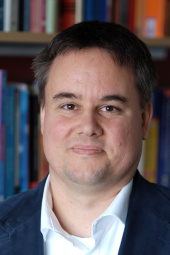
Peter Uhrig is a Professor at the Friedrich-Alexander-Universität Erlangen-Nürnberg (FAU), holding the Chair of Digital Linguistics with a Focus on Big Data within the Institute of English and American Studies. He is based in Erlangen, Germany, and actively contributes to research and teaching in computational and cognitive linguistics.
His research interests lie at the intersection of linguistics, computation, and cognition, with a strong emphasis on corpus-based analysis, construction grammar, multimodal communication, and digital methods in language research. He investigates phenomena such as collocation, argument structure, creativity in language, and spoken word comprehension using large-scale datasets and advanced computational models.
His recent publications reveal a clear trend toward interdisciplinary, data-intensive research. He frequently collaborates on projects involving multimodal corpora, gesture analysis, spoken language processing, and computational modeling, often in collaboration with researchers from computer science and cognitive neuroscience. His work is published in leading journals in linguistics and cognitive science.
- How Collostructional Analysis Contributes to the Description of Argument Structure Constructions with Slots for that-and Infinitive Clauses (2024)
- The pluralization palette: unveiling semantic clusters in English nominal pluralization through distributional semantics (2024)
- World Futures through RT’s Eyes: Multimodal Dataset and Methodology (2024)
Prof. Uhrig has co-edited several academic volumes and plays a key role in developing research infrastructure, such as the Red Hen Protocol for anonymizing audiovisual data and tools for multimodal analysis. While specific grant funding is not detailed, his involvement in large collaborative projects indicates active grant-supported research. He also contributes to academic service through editorial work and conference organization.
He is involved in building digital infrastructure for multimodal research, including work on gesture retrieval systems and data anonymization protocols. His lab or research group appears to focus on integrating computational tools with linguistic theory, particularly within the framework of construction grammar and cognitive linguistics.
حوزههای پژوهشی