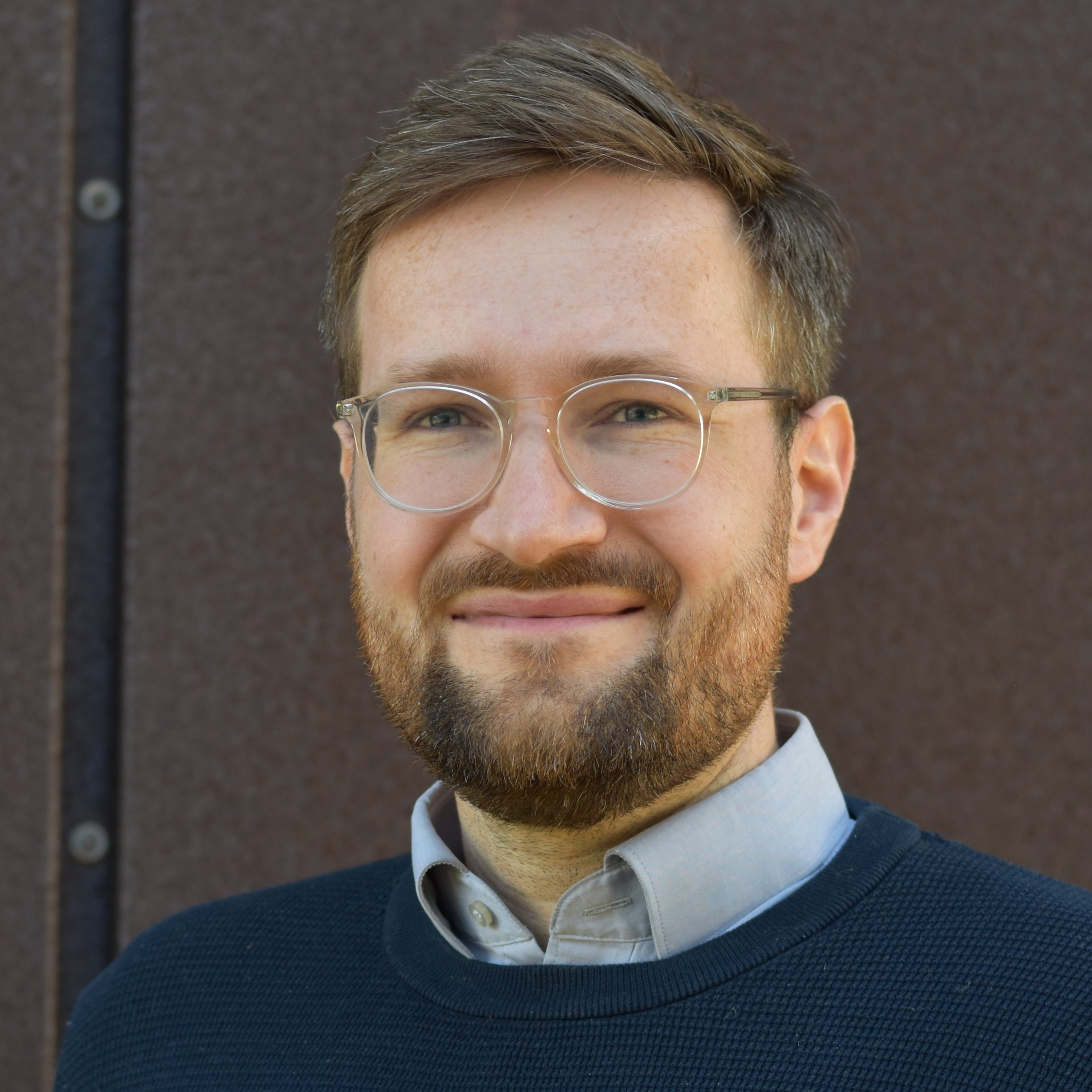
Lars Rohwedder is an Associate Professor in the Algorithms Group at the University of Southern Denmark (SDU) in Odense. He previously held positions as an Assistant Professor at Maastricht University (Netherlands) and postdoc researcher at EPFL, Lausanne (Switzerland). He earned his Ph.D. in Computer Science from CAU Kiel (Germany), advised by Klaus Jansen, and is a recipient of the 2019 PhD of the year award from Förderverein der TF of Kiel University. His research focuses on algorithms for combinatorial optimization, including approximation algorithms, online algorithms, parameterized algorithms, and integer programming. He has contributed to solving scheduling problems, resource allocation, and optimization under uncertainty. Rohwedder has served on program committees for conferences like MAPSP, SODA, STACS, and ICALP. He is funded by NWO's Open Competition M1 project on quasi-polynomial time algorithms. His teaching includes courses on advanced algorithms, operations management, and optimization at SDU and Maastricht University. Key achievements include a quasi-polynomial approximation for the restricted assignment problem, FPT algorithms for scheduling, and contributions to the Submodular Santa Claus problem. His work bridges theoretical foundations and practical applications, with a focus on algorithmic efficiency and robustness.
David Eppstein is a Distinguished Professor of Computer Science at the University of California, Irvine (UCI), affiliated with the Donald Bren School of Information & Computer Sciences. He holds academic leadership roles as director of the Center for Algorithms and Theory of Computation and associate director of the Center for Algorithms, Combinatorics, and Optimization. His research focuses on graph algorithms, computational geometry, discrete mathematics, and geometric graph theory. Eppstein earned a B.S. in Mathematics from Stanford University (1984) and a Ph.D. in Computer Science from Columbia University (1989). Research Interests: Graph drawing, information visualization, dynamic graph algorithms, mesh generation, optimal triangulation, K-shortest paths, subgraph isomorphism, data depth, exponential-time algorithms for NP-hard problems. Awards: ACM Fellow (2012), AAAS Fellow (2017), Distinguished Professor (2020), Best Paper Awards (2023, 2022), and SIAM recognition. Grants: Co-PI on a $1.2M NSF grant (2022) for geometric graph research, and previous NSF grants for algorithm studies (2016). His work bridges theoretical computer science and practical applications, including contributions to graph visualization, geometric algorithms, and combinatorial optimization. Notable recent achievements include resolving open questions in graph biplanarity and authoring the book Forbidden Configurations in Discrete Geometry (2018).
Giorgis Petridis is an Associate Professor at the University of Georgia, specializing in arithmetic combinatorics, a field rooted in combinatorial number theory with modern extensions into discrete analysis and finite field geometry. Born in Athens, Greece, he earned his PhD from the University of Cambridge under Tim Gowers and held a Visiting Assistant Professor position at the University of Rochester. He serves as an editor for Combinatorial Theory and is affiliated with the Number Theory and Arithmetic Geometry group, particularly its additive combinatorics and discrete analysis subgroup. Doctor of Philosophy (2011), University of Cambridge Certificate of Advanced Studies in Mathematics (2002), St John’s College, Cambridge BA (Hons) in Mathematics (2001), St John’s College, Cambridge His research focuses on additive combinatorics, exploring sumset estimates, polynomial configurations in prime lattices, and geometric incidence problems over finite fields. He investigates combinatorial geometry, including pinned distance problems and bisector arrangements, while also contributing to exponential sum bounds and expander graph theory. His work bridges theoretical mathematics with applications in pseudorandomness and discrete geometry. Recent publications highlight trends in finite field analysis, with 6 of 15 articles addressing arithmetic structures in prime-order fields. Key keywords include Combinatorics , Number Theory , and Finite Fields , with sub-fields spanning polynomial configurations, energy bounds, and geometric combinatorics. Scientific awards include the Creative Research Medal (2024) from the University of Georgia for mid-career research impact. Grants from the Simons Foundation (MPS-TSM-00007816) and multiple NSF DMS Awards (2054214, 1723016, 1500984, 1804049) support his work on discrete analysis and conferences. He co-advises five PhD students and has supervised multiple Master’s theses on topics like point-plane incidences and additive energy. Outreach includes leading high school math teams, organizing discrete analysis sessions, and contributing to public science communication guides.
Qiongxiu Li is a Tenure-Track Assistant Professor in the Cyber Security group at Aalborg University's Copenhagen campus, part of the Technical Faculty of IT and Design. Her research focuses on cybersecurity, distributed optimization, privacy/security, and federated learning. She has authored/co-authored 38 papers in top-tier venues including IEEE Transactions on Information Forensics and Security, ICLR, and EUSIPCO. Education: PhD in Privacy and Security from Aalborg University (2018-2021). Notable achievements include winning the EUSIPCO 2020 3MT Contest and co-delivering a tutorial on privacy-preserving distributed optimization at EUSIPCO 2024. She actively reviews for conferences like NeurIPS, ICLR, and journals such as TPAMI and TIFS. Research Themes: Privacy-preserving distributed algorithms, federated learning security, differential privacy, and adversarial machine learning. Recent Trends: Focus on securing AI systems (e.g., LLM vulnerabilities, federated clustering privacy), quantization for privacy, and theoretical bounds in decentralized learning. Awards: 2020 EUSIPCO 3MT Winner (outstanding finalist in EURASIP's annual doctoral research competition). Grants/Projects: Co-PI of the AI:SECURITY project (2025-2029) addressing AI security threats like phishing and malicious actors. Labs/Teams: Leads the Cyber Security group at Aalborg's Copenhagen campus, focusing on theoretical and applied research in secure distributed systems.
Aris T. Pagourtzis is a Professor of Computer Science at the School of Electrical and Computer Engineering of the National Technical University of Athens (NTUA), where he also serves as the Head of the Computer Science Division. He is additionally a Lead Researcher at the Archimedes Research Center, Athena RC. His academic career includes positions at the University of Ioannina, the University of Liverpool, the ETH Zuerich, the University of Athens, and the Athens University of Economics and Business. Education: Diploma in Electrical Engineering (1989) and Ph.D. in Electrical and Computer Engineering (1999), both from the National Technical University of Athens Professor Pagourtzis's research spans multiple areas of theoretical computer science, with particular emphasis on computational complexity, graph algorithms, distributed algorithms, approximation algorithms, network algorithms, cryptography, and counting complexity. His work often bridges theoretical foundations with practical applications in network design, security protocols, and optimization problems. He has developed novel algorithms for problems ranging from community detection in networks to Byzantine fault-tolerant protocols and privacy-preserving voting systems. His recent publications show a continued focus on fundamental algorithmic problems while expanding into newer areas like temporal graph analysis, blockchain applications, and privacy-preserving technologies. There's a clear trend toward addressing real-world challenges through rigorous theoretical frameworks, particularly in distributed systems, secure computation, and optimization under constraints. Professor Pagourtzis has served on program and organizing committees for numerous theoretical computer science and cryptography conferences, co-chairing CIAC 2017 and FCT 2021. His research has received funding from diverse sources including US, UK, French, EU, and Greek national resources. He is actively involved in teaching both undergraduate and graduate courses at NTUA, including Algorithms and Complexity, Foundations of Computer Science, Computational Cryptography, and Network Algorithms and Complexity. He leads the Computation and Reasoning Laboratory (corelab) at NTUA, which focuses on theoretical computer science research.
Chris Monico is an Associate Professor in the Department of Mathematics & Statistics at Texas Tech University . He has been a faculty member there since 2003, following post-doctoral research at the University of Notre Dame. Education B.S. in Mathematics – Monmouth University M.S. in Mathematics – University of Notre Dame Ph.D. in Mathematics – University of Notre Dame Research Focus Monico’s scholarship centers on the intersection of cryptology , computational algebra , and number theory . A significant recent thrust has been the application of machine-learning techniques to mathematical finance , evidenced by work on random-forest models for option pricing and high-frequency trading risk metrics. Parallel lines of inquiry include post-quantum cryptographic schemes built on tropical algebra and semigroup actions, as well as classical problems in Ramsey theory and combinatorial semigroups . Publication Trends Between 2015 and 2025 Monico has published prolifically, with a clear shift around 2020 toward mathematical finance and machine-learning applications , alongside continued output in algebraic cryptanalysis and combinatorics . His 2024–2025 articles emphasize data-driven models in trading, whereas 2020–2021 works concentrate on cryptanalyses of tropical and group-based key-exchange systems. Earlier contributions focus on computational number theory and semigroup-based cryptography. Contact Information Email: c.monico@ttu.edu Phone: 806-834-4144 Office: Department of Mathematics & Statistics, Texas Tech University, 1108 Memorial Circle, Lubbock, TX 79409-1042 Advising & Grants No specific doctoral or master’s students, funded grants, or named awards are detailed in the provided text. Laboratory or Research Group The text does not mention any dedicated laboratory or research group.
Adam Bouland is an Assistant Professor of Computer Science at Stanford University, affiliated with the CS Theory Group. He holds a Ph.D. from MIT (advised by Scott Aaronson), followed by postdoctoral research at UC Berkeley and the Simons Institute for the Theory of Computing (advised by Umesh Vazirani). His research focuses on quantum computing theory, computational complexity, and their connections to physics. He teaches courses such as Quantum Complexity Theory (CS 359D) and Quantum Computing (CS 259Q), and has advised numerous doctoral, master’s, and postdoctoral researchers. His research group includes Tamara Kohler (postdoc), Shaun Datta, Jack Zhou, Jordan Docter, and Chenyi Zhang (doctoral students), among others. Bouland’s work bridges quantum algorithms, entanglement theory, and complexity theory, with contributions to quantum supremacy, pseudorandomness, and holographic principles. Recent highlights include studies on BosonSampling hardness, AdS/CFT duality constraints, and efficient quantum compilation. He has served on program committees for FOCS 2019, QIP 2020, STOC 2023, and ITCS 2025. His research is supported by grants including the NSF CAREER Award for exploring quantum pseudorandomness and complexity frontiers.
Adam Bouland is an Assistant Professor of Computer Science at Stanford University, where he leads the CS Theory Group. His research focuses on quantum computation, computational complexity theory, and their connections to physics. He completed his Ph.D. at MIT under Scott Aaronson, followed by postdoctoral research at UC Berkeley and the Simons Institute under Umesh Vazirani. His research explores fundamental questions in quantum computing including quantum complexity classes, quantum supremacy demonstrations, pseudorandom quantum states, quantum algorithm design, and connections to high-energy physics through AdS/CFT correspondence. Recent work investigates computational aspects of quantum systems, quantum learning theory, and noise resilience in quantum devices. Professor Bouland leads an active research group including 6 PhD students and 1 postdoctoral researcher, with joint appointments across Computer Science, Physics, and ICME departments. He regularly teaches graduate courses on Quantum Computation (CS259Q) and Quantum Complexity Theory (CS359D). His service includes program committee membership for major theoretical computer science conferences including FOCS, STOC, ITCS, and QIP.
Julia Wolf is a Professor of Pure Mathematics at the University of Cambridge, affiliated with the Department of Pure Mathematics and Mathematical Statistics (DPMMS) and Trinity College. Her research focuses on arithmetic combinatorics, harmonic analysis, and analytic number theory, with interdisciplinary connections to model theory, discrete geometry, and theoretical computer science. She holds an EPSRC Open Fellowship and has organized events like the Warwick-Oxbridge-Manchester-Bristol-London (WOMBL) meetings. Wolf teaches advanced courses such as 'Higher-Order Uniformity' and 'Analytic Number Theory,' emphasizing structure and applications. Her work bridges combinatorial, analytic, and algebraic techniques, addressing problems like polynomial configurations in primes, extremal hypergraph theory, and Ramsey multiplicity. Recent research includes structural stability in finite abelian groups and applications of model theory to additive combinatorics. Wolf actively promotes open-access publishing and has mentored numerous postdoctoral researchers and students through initiatives like the Philippa Fawcett Internship Programme. She also contributes to academic equity efforts, such as gender-inclusive hiring in mathematics. Professional activities include editorial roles, conference organization (e.g., the Simons Institute's Pseudorandomness program), and leadership in collaborative projects like the 'Combinatorics Meets Model Theory' workshop. Her grants and fellowships underscore her contributions to advancing discrete mathematics and fostering international academic networks.
Lisa Sauermann is a Professor at the University of Bonn's Institute of Applied Mathematics, specializing in extremal and probabilistic combinatorics. She holds affiliations with the Institute of Mathematics and has been recognized with prestigious awards including the Richard-Rado Prize (2020), European Prize in Combinatorics (2021), and von Kaven Award (2023). PhD from Stanford University (2019), supervised by Jacob Fox Postdoc at Stanford University and Institute for Advanced Study (IAS), Princeton Assistant Professor at MIT (2021-2023) Her research focuses on additive combinatorics, discrete geometry, and polynomial methods, particularly the slice rank polynomial method. This technique was instrumental in deriving new bounds for three-term progression-free sets in F_pⁿ and solving problems like the Erdős-Ginzburg-Ziv conjecture in high dimensions. Her work bridges theoretical combinatorics with applications in finite field geometry and extremal set theory. The four lectures she presented at Collège de France in 2025 highlight her innovative use of the slice rank polynomial method to tackle longstanding problems in additive combinatorics, including three-term progression-free subsets and zero-sum configurations. Richard-Rado Prize (2020) European Prize in Combinatorics (2021) von Kaven Award (2023) Gauß Lectures (2024) Cours Peccot International laureate (2024-2025) Lisa Sauermann's career spans institutions like Stanford, MIT, and the IAS, with current leadership in advancing combinatorial methodologies at the University of Bonn. Her work continues to influence both theoretical and applied mathematical domains.
Aravindan Vijayaraghavan is an Associate Professor in the Department of Computer Science at Northwestern University (affiliated with McCormick School of Engineering). He also holds courtesy appointments in the Industrial Engineering and Management Sciences (IEMS) department. Research interests include theoretical computer science , machine learning algorithms , quantum information , and combinatorial optimization under non-worst-case paradigms. He leads IDEAL (Institute for Data, Economics, Algorithms and Learning) as Site Director at Northwestern and former Institute Director (2023-24). Academic Background : PhD in Computer Science from Princeton University (advisor: Moses Charikar ) Bachelor's Degree in Computer Science from Indian Institute of Technology Madras Postdoctoral work at Courant Institute (NYU) and Carnegie Mellon University via Simons Collaboration grants Research Contributions : Developed smoothed analysis frameworks for random matrices with dependent entries Created sum-of-squares certificates for anti-concentration beyond Gaussian distributions Advanced quantum entanglement certification algorithms for subspaces Improved weak-to-strong generalization theory with data distribution expansion properties Designed error-tolerant e-discovery protocols for legal document classification Scientific Recognition : NSF CAREER Award NSF AITF Award (CCF-1637585, CCF-2154100) Google Research Scholar Program grant Amazon Research Awards program support Simons Postdoctoral Fellowship Academic Leadership : General Chair for FOCS 2024 Co-organizer of Junior Theory Workshop and Northwestern QTW series Active in program committees for COLT , ICML , NeurIPS , and STOC conferences Teaching Portfolio : CS262: Mathematical Foundations of CS (Continuous Mathematics for Computer Science) CS212: Mathematical Foundations of Computer Science (multiple offerings since 2015) CS496: Graduate Algorithms (since 2016) CS396/496: Quantum Computation & Information (co-taught with S. Rao) CS497: Machine Learning Theory (Spring 2025 offering)
Gabriel Ciobanu is a Professor at Alexandru Ioan Cuza University of Iasi, Romania, and a Senior Researcher at the Romanian Academy, Iasi. He has held various academic positions internationally including as a Visiting Professor at Newcastle University (UK) from 2010-2015 and as a Research Fellow/Professor at the National University of Singapore (2000-2004). His educational background includes PhD studies at A.I.Cuza University and Edinburgh University (1990-1994) under the mentorship of Robin Milner, and his undergraduate studies in the Faculty of Mathematics and Computer Science at A.I.Cuza University of Iasi (1977-1982). Professor Ciobanu's research focuses on Membrane Computing and Natural Computing , Distributed Systems Models including process calculi with emphasis on semantics, behavioral equivalences, logics, and verification. He has made significant contributions to bridging membrane computing and process calculi, and to the Foundations of Mathematics and Computer Science through his work on Finitely Supported Mathematics. His research has applications in theoretical computer science, formal methods, and computational biology. His publication record shows a consistent research trajectory focusing on theoretical computer science with applications to natural computing, membrane systems, process calculi, and finitely supported structures. Recent work (2023-2025) continues to explore these areas with increasing focus on multi-agent systems, continuation semantics, and applications to medical systems and reaction systems. Scientific Awards and Recognition 2013 Grigore Moisil Award, Romanian Academy (as co-author of "Mobility in Process Calculi and Natural Computing", Springer) 2010-2013 Member of the National Research Council (CNCS) in Romania 2008-2010 Royal Society of London Joint International Project (Newcastle University, School of Computing) 2004 Octav Mayer Award for Scientific Achievements, Romanian Academy of Sciences, Iasi branch 2000 Grigore Moisil Award of the Romanian Academy of Sciences for results in Theoretical Computer Science 1995-1996 Japan Society for the Promotion of Science Fellowship (Tohoku University and Kyoto University) 1994 DAAD Research Fellowship (Institute of Computer Science, University of Kiel) 1991-1992 Royal Society of London and Romanian Academy Fellowship (University of Edinburgh) Professor Ciobanu has supervised 8 PhD students and numerous master's students. He has served as Editor-in-Chief of the Scientific Annals of Computer Science since 2006 and has been a guest editor for special issues of several international journals. He has collaborated with researchers from numerous countries including UK, France, Netherlands, Spain, Italy, Russia, China, Singapore, and India. He has been involved in various research projects and has spent research periods at prestigious institutions worldwide including Edinburgh University, Universite de Paris XI, CWI and VU Amsterdam, Tohoku and Kyoto University, National University of Singapore, and Newcastle University.
Andrew Winslow is a Part-time Lecturer in the Department of Computer Science at Tufts University, affiliated with the School of Engineering. Previously, he held positions as an Assistant Professor at the University of Texas Rio Grande Valley and worked as a software engineer at Google, Boeing, and Arizona State University. His research interests span computational geometry, algorithmic self-assembly, discrete geometry, computational complexity, and recreational mathematics. He has contributed to theoretical computer science, focusing on self-assembly systems, geometric algorithms, and puzzle complexity analysis. Winslow's work emphasizes algorithm design, with notable contributions to tile assembly models, motion planning, and geometric unfolding problems. His research bridges theoretical foundations with practical applications, such as molecular computing and game puzzle analysis. He has published extensively in venues like the Symposium on Theoretical Aspects of Computer Science (STACS) and the European Symposium on Algorithms (ESA). His academic journey includes roles in both academia and industry, reflecting a commitment to interdisciplinary problem-solving. While no formal awards are listed, his publications indicate recognition within computational geometry and self-assembly communities. Winslow’s advising and grant activities are not detailed in the provided texts, though his research collaborations suggest active participation in academic networks. He maintains a presence at Tufts University’s Department of Computer Science, contributing to education and research in theoretical computer science.
Alan Chang is an Assistant Professor of Mathematics at Washington University in St. Louis. His research focuses on geometric measure theory and harmonic analysis, exploring topics such as Nikodym sets, maximal functions, and fractal structures. He holds a Ph.D. in Mathematics from the University of Chicago (2020) and a B.A. from Princeton University (2014). Previously, he was an Instructor at Princeton University under Assaf Naor. Chang has been awarded the NSF Graduate Research Fellowship (2014) and the NSF Mathematical Sciences Postdoctoral Fellowship (2020, declined). His work includes grants like NSF Grant DMS-2247233 (2023–2026). His research interests span geometric measure theory, harmonic analysis, and fractal geometry. Notable contributions include studies on Besicovitch sets, decoupling theory, and the Whitney extension theorem. Chang’s publications address diverse areas such as analytic capacity, Minkowski sums, and Kakeya needle problems, reflecting his expertise in geometric and analytic methods. Grants: NSF Grant DMS-2247233 (2023–2026) Awards: NSF Graduate Research Fellowship (2014), NSF Postdoctoral Fellowship (2020, declined) Chang advises no listed students but has contributed to mentoring through his roles as an instructor and researcher. His work intersects with labs and teams focused on geometric analysis and harmonic functions.
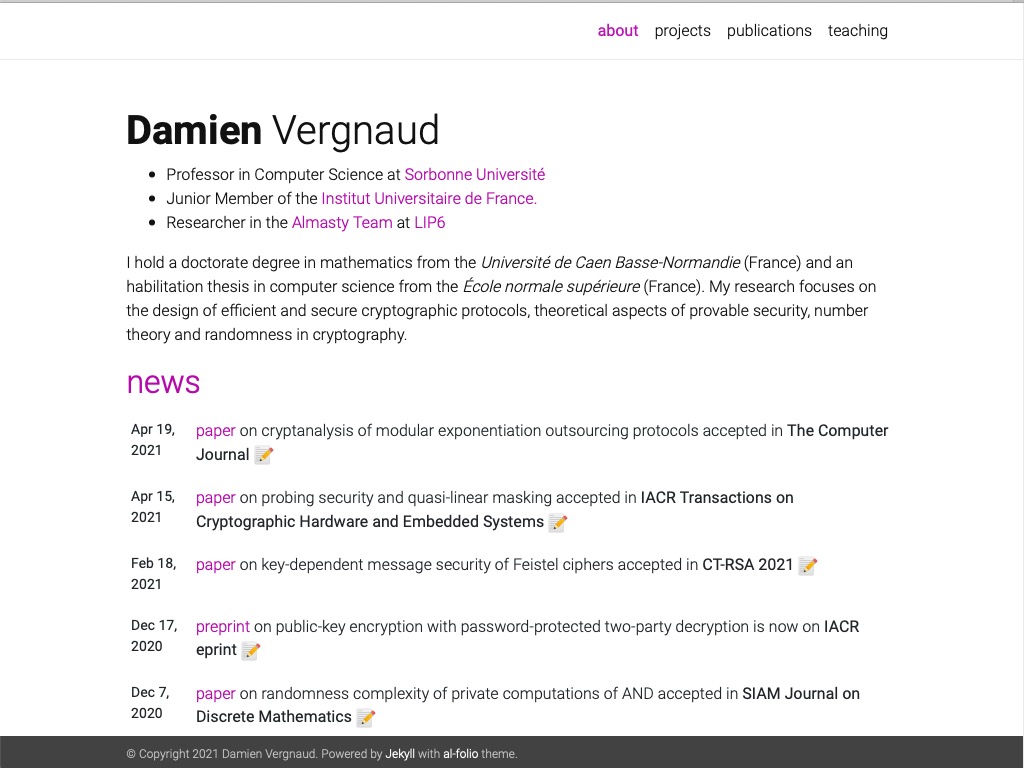
Dr. Damien Vergnaud is a Full Professor at Sorbonne University since September 2017, affiliated with the ALMASTY research team within LIP6 (Laboratoire d'Informatique de Paris 6), the Computer Science department of the Faculty of Science. His office is located at 4 place Jussieu, Paris, France, in Couloir 24-25, Étage 4, Bureau 412. Dr. Vergnaud holds a doctorate degree in mathematics from Université de Caen Basse-Normandie and an habilitation thesis in computer science from École normale supérieure. His research focuses on the design of efficient and secure cryptographic protocols, theoretical aspects of provable security, number theory, and randomness in cryptography. His work spans multiple domains including post-quantum cryptography, zero-knowledge proofs, secure implementation techniques against side-channel attacks, and cryptographic protocol analysis. He actively investigates how quantum computing impacts traditional cryptographic assumptions and protocols, as evidenced by his supervision of PhD students working on quantum-related cryptographic topics. Dr. Vergnaud's recent publications demonstrate a strong focus on post-quantum cryptographic techniques, zero-knowledge argument systems, and secure implementation methodologies. His research output shows consistent collaboration with both academic researchers and industry partners, particularly in practical cryptographic implementations. His work bridges theoretical foundations with practical security considerations, addressing challenges in modern cryptographic systems including resistance to quantum computing threats and side-channel analysis. Dr. Vergnaud actively supervises PhD students, currently mentoring three doctoral candidates and having successfully guided four students to completion in recent years. His supervision spans diverse topics within cryptography, including post-quantum cryptographic techniques, zero-knowledge arguments, secure implementations against physical attacks, and mathematical studies of pseudorandom number generators. He has served on numerous PhD defense committees, indicating his active role in the academic community. Dr. Vergnaud is a member of the ALMASTY research team at LIP6, which specializes in cryptographic algorithms and protocols. The team works on both theoretical foundations and practical implementations of cryptographic systems, with particular emphasis on security against various attack vectors including quantum computing threats and side-channel analysis.