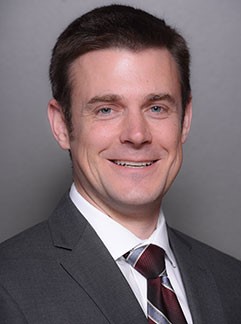
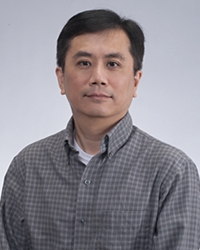
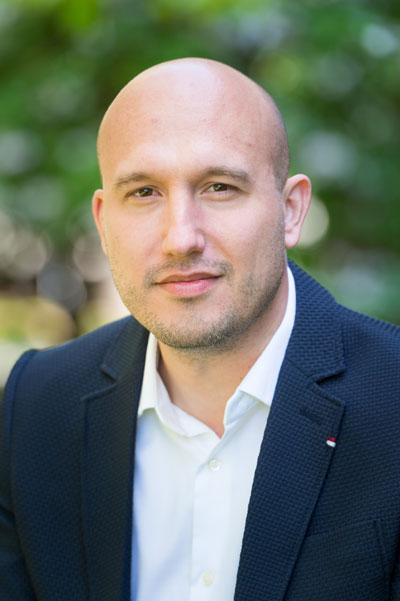
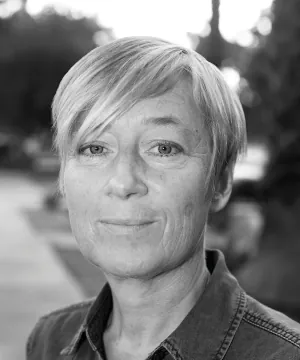
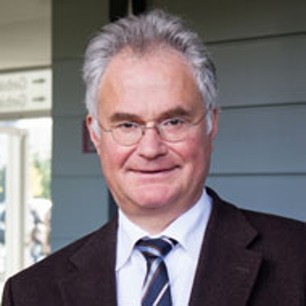
John A. Judge is an Associate Professor in the Department of Mechanical Engineering at the School of Engineering, Catholic University . He served as Dean of the School of Engineering from 2017 to 2025 and previously held a National Academy of Sciences Research Associateship at the Naval Research Laboratory in Washington, D.C. Education Ph.D., Mechanical Engineering, University of Michigan, 2002 M.S.E., Mechanical Engineering, University of Michigan, 1998 B.S., Mechanical & Aerospace Engineering, Cornell University, 1996 Research Interests : Judge specializes in the vibration and dynamics of complex structures, focusing on vibration localization, resonant MEMS/NEMS systems, nonlinear dynamics, laser vibrometry, and seismic/acoustic detection of explosives. His work bridges theoretical and applied mechanics, with applications in naval engineering, micro/nano-sensing, and structural acoustics. Publication Trends : His research spans vibration control in mechanical arrays, fluid-structure interactions in MEMS/NEMS, experimental methods for dynamic system characterization, and acoustic detection technologies. Key themes include optimizing damping mechanisms, analyzing hydrodynamic behavior, and advancing laser-based measurement techniques for non-planar surfaces. Contact Information : Email: judge@cua.edu Office: 101 Pangborn Hall Phone: 202-319-5160
Dr. Yogesh Pratap Singh is an Associate Professor of Engineering Instruction in the Department of Mechanical Engineering at the University of Akron's College of Engineering and Polymer Science. He joined the university in 2015 and brings over 15 years of combined teaching and research experience. His educational background includes a Ph.D. in Physics from Kent State University (2015), an M.Tech. in Materials Science from IIT Varanasi (2009), an M.Sc. in Physics from Banaras Hindu University (2003), and a B.Sc. from VBS Purvanchal University (2001). Teaching: Dr. Singh teaches undergraduate courses including: Dynamics Heat Transfer Thermodynamics Fluid Mechanics Materials Science Thermal Science Kinematics Engineering Drawing Manufacturing Processes Research Focus: His work centers on destructive and non-destructive evaluation of materials, with emphasis on ceramic/polymer matrix composites , structural health monitoring , and novel non-destructive testing techniques . Key methodologies include electric potential drop measurements, acoustic emission, and embedded sensor development for real-time damage assessment. Publications: Recent articles (2017-2022) focus on applied materials engineering , particularly non-destructive evaluation of composites using electrical and acoustic methods. Earlier works (2013-2016) explore fundamental physics topics including superconductivity , quantum criticality , and vortex dynamics in correlated electron systems, demonstrating interdisciplinary expertise.
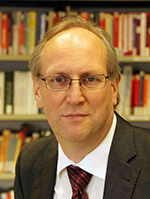
Univ.-Prof. Dr.-Ing. D. Söffker is a University Professor at the University of Duisburg-Essen, Faculty of Engineering, where he leads the Chair of Control, Regulation and System Dynamics since 2001. His work spans multiple institutions including visiting professorships at University of Maryland and Shanghai Maritime University. His educational background includes: 1988: Dipl.-Ing. Mechanical Engineering, Leibniz University Hannover, specialization in General Mechanical Engineering 1995: Dr.-Ing., Department of Safety Engineering, University of Wuppertal 2001: Habilitation in Security Technology/Automation Technology, University of Wuppertal Prof. Söffker's research focuses on modeling, diagnosis and control of elastic mechanical systems , with particular expertise in robust control theory, system diagnostics, and cognitive technical systems. His work bridges theoretical control systems with practical applications in industrial settings, emphasizing human-machine interaction and autonomous system design. He has developed innovative approaches for structural health monitoring and fault detection in complex mechanical systems. Analysis of his recent publications reveals a strong focus on human-centered automation, with increasing attention to cognitive technical systems and human decision-making processes. His work spans from fundamental control theory (robust observers, nonlinear systems) to practical applications in structural health monitoring, wear detection, and process supervision. The interdisciplinary nature of his research connects mechanical engineering, computer science, and cognitive systems. His research group is involved in several key projects: Structural Health Monitoring Security and reliability systems Methods for application in energy production and use Cognitive Technical Systems
Dr. Jae-Chun Jeon is a leading experimental physicist at the Max Planck Institute of Microstructure Physics in Halle, Germany, where he works within the NISE department (Nano-Systems from ions, spins and electrons). He joined the institute in 2018 after completing his postdoctoral fellowship at the University of Alberta, Canada. His research focuses on spintronics, unconventional computing devices, and cryogenic systems, with emphasis on developing novel memory and logic technologies for next-generation computing. Dr. Jeon earned his Ph.D. in condensed matter physics from the University of Alberta, Edmonton, Canada, in 2016. He continued his research as a postdoctoral fellow at the same institution, focusing on strongly correlated magnetic oxide materials for spintronic and neuromorphic applications before joining the Max Planck Institute. Dr. Jeon's research centers on unraveling the physics of complex systems including spintronics, correlated oxides, and atomically engineered materials to discover their advanced functionalities. He specializes in manipulating spin textures and states using spin electrons, with particular focus on current-induced domain wall motion and spin-orbit torque-induced magnetization switching for memory and logic applications. His work explores the potential of racetrack memory for both conventional binary memory and unconventional analogue systems such as probabilistic-bit and neuromorphic devices. His recent publications demonstrate a strong focus on advanced spintronic devices, particularly racetrack memory systems, domain wall logic, and Josephson junctions for quantum applications. The research spans fundamental physics of chiral domain walls, spin-orbit torque effects, and novel materials for spin-based computing. His work frequently appears in high-impact journals including Science, Nature family journals, and Advanced Materials, reflecting the significance of his contributions to the field. Dr. Jeon's research is supported by cutting-edge facilities including atomically thin film deposition systems, state-of-the-art electronics, and advanced device fabrication techniques such as electron beam lithography and ion beam etching/deposition. His work involves close collaboration with the research group led by Prof. Stuart Parkin, a director at the Max Planck Institute of Microstructure Physics.
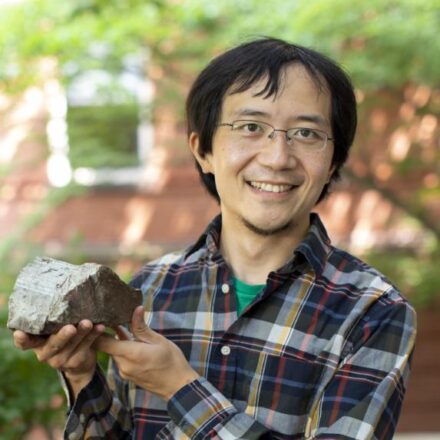
Roger Fu is a Professor of Earth and Planetary Sciences at Harvard University, leading the Paleomagnetics Lab since 2017. He holds a PhD in planetary sciences from MIT and specializes in paleomagnetism, studying planetary magnetism, tectonic reconstructions, and early Earth history. His research integrates geodynamical modeling with advanced tools like the quantum diamond microscope (QDM), enabling high-resolution magnetic imaging of geological samples. Education: BS from Harvard University (2009, Earth and Planetary Sciences & Astrophysics), PhD from MIT (planetary sciences). Post-PhD research included living with the Mapuche people of Chile to study traditional astronomy. His work focuses on Earth's geodynamo, Martian crustal magnetism, and the solar nebula's magnetic fields. Research interests span planetary formation, early Earth dynamics, and the application of QDM technology to study magnetic minerals. Notable contributions include detecting early plate motions and a reversing geodynamo by 3.5 Ga, and analyzing Martian meteorite magnetism to infer crustal cooling processes. His articles emphasize interdisciplinary approaches, linking paleomagnetic data with geodynamic models to address questions about planetary interiors and climate history. The QDM has been pivotal in visualizing magnetic mineral distributions, enhancing confidence in paleomagnetic interpretations. Labs/Teams: Director of Harvard's Paleomagnetics Lab. Collaborates with applied physics groups to advance QDM technology. Research group includes the Fu Group and the QDM development team.
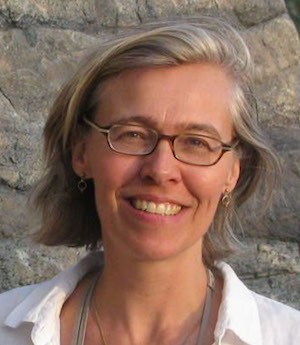
Suzanne M. Carbotte is the Bruce Heezen Lamont Research Professor of Marine and Polar Geophysics at the Lamont-Doherty Earth Observatory (LDEO) of Columbia University. Her work focuses on marine geophysics, particularly using seismic methods to study mid-ocean ridges, subduction zones, and ocean floor mapping. She has made significant contributions to our understanding of crustal evolution, tectonic processes, and the structure of the ocean floor. Dr. Carbotte received her academic training at prestigious institutions: 1982: H.B.Sc. in Geology and Physics, University of Toronto, Ontario 1986: M.Sc. in Geophysics, Queen's University, Kingston, Ontario 1992: Ph.D. in Marine Geophysics, University of California, Santa Barbara, CA Her research spans multiple areas of marine geophysics, with particular emphasis on the structure and evolution of mid-ocean ridges and subduction zones. She has pioneered the use of multi-channel seismic techniques to image the internal structure of the oceanic crust, revealing details about magma chambers, crustal formation processes, and the relationship between tectonic and magmatic processes at spreading centers. Her work on the East Pacific Rise has provided fundamental insights into how oceanic crust forms at fast-spreading ridges. Additionally, her research on the Cascadia subduction zone has advanced our understanding of how sediments and plate structure influence earthquake behavior. She has also contributed significantly to Hudson Estuary studies, examining sediment distribution and environmental changes. Her expertise in geoinformatics has led to important contributions to data synthesis and management for marine geoscience research. Analysis of Dr. Carbotte's recent publications reveals consistent focus on marine geophysical imaging techniques applied to key tectonic settings. Her work primarily centers on two major regions: the East Pacific Rise (a fast-spreading mid-ocean ridge) and the Cascadia subduction zone (where the Juan de Fuca plate subducts beneath North America). Her research employs advanced seismic methods to investigate magma systems beneath mid-ocean ridges, sediment properties along subduction margins, and the relationship between crustal structure and tectonic processes. A notable trend in her recent work is the integration of multiple geophysical datasets to build comprehensive 3D models of crustal structure, particularly focusing on how variations in magma supply, plate motion, and sediment properties influence the formation and evolution of oceanic crust. Dr. Carbotte's scientific achievements have been recognized with numerous prestigious awards: 2015: Elected as an AGU Fellow 2010: Ridge2000 Distinguished Lecturer 2008: Birch Lectureship and UCSB Distinguished Alumni Award 2007: Bruce C. Heezen Research Chair at LDEO, Columbia University 1993: LDEO Postdoctoral Fellow, Columbia University 1982: Governor General's Silver Medal, Trinity College, University of Toronto Throughout her career, Dr. Carbotte has been actively involved in major research initiatives and collaborative projects. She has served as principal investigator and co-investigator on numerous grants supporting marine geophysical expeditions and data analysis. Her leadership extends to data management initiatives, including contributions to the Global Multi-Resolution Topography Synthesis and the development of GeoMapApp. She has mentored numerous students and early-career scientists through her research projects and has been instrumental in training the next generation of marine geophysicists. Her work with the Ridge2000 program has fostered interdisciplinary collaboration across the geosciences. Dr. Carbotte is deeply involved with the Lamont-Doherty Earth Observatory's marine geophysics research group, where she leads projects focused on seismic imaging of oceanic crust. She has been instrumental in developing and utilizing the observatory's advanced seismic data processing capabilities. Her work often involves collaboration with the National Deep Submergence Facility and other major research institutions. She plays a key role in data synthesis initiatives like the Rolling Deck to Repository program, which ensures long-term preservation and accessibility of oceanographic research data. Her research frequently utilizes data from major research vessels and ocean bottom seismometer deployments, contributing to our understanding of fundamental Earth processes.
Annamaria Bartolotta is an Ordinary Professor at the Department of Humanities, University of Palermo. She serves as Research Delegate for the Humanities Area, supporting institutional research initiatives. Her office hours are Tuesdays from 11:30 a.m. to 1:30 p.m. at Building 12, 2nd floor. Academic Focus: Indo-European Linguistics Specialization: Cognitive Linguistics, Historical Linguistics Her research spans phonological, morphological, syntactic, and semantic reconstruction of Indo-European languages, with emphasis on Homeric Greek, Vedic Sanskrit, and Latin. She applies cognitive and generative models to classical language analysis, investigating verbal categories (tense, aspect), space-time deixis, and supplementivism. Key projects include: 2013-2015 FFR project: Morphology of compounds from Proto-Indo-European to Homeric Greek 2015-present: 'Group Aspect en Grec' collaboration with Sorbonne Paris Cité 2016-present: 'Charting the semantic space of Ancient Greek modality' with international institutions
Dino Huang is a Research Assistant Professor at the Bureau of Economic Geology, part of the Jackson School of Geosciences at the University of Texas at Austin. He serves as a Seismologist for the Texas Seismological Network and has been with the Bureau since June 2017. His expertise lies in earthquake seismology, seismic imaging, and seismotectonic studies, with a focus on both natural and induced seismicity across diverse geological settings from the Himalayas to Texas. His educational background includes: PhD in Geophysics, State University of New York at Binghamton, 2007; Thesis title: 3-D lithospheric structure and seismotectonics of the central Himalayan region Dr. Huang specializes in advanced seismic techniques for understanding Earth's structure and earthquake processes. His research focuses on 3D tomographic inversion, earthquake detection and location, and earthquake source characterization through moment tensor inversion. He conducts seismotectonic studies on both natural and induced seismicity, with particular interest in the processes and dynamics of inter- and intra-continental convergence. His work also involves seismic waveform modeling and the deployment of seismic instrumentation, including 3-component broadband sensors in field settings. Dr. Huang's publication record demonstrates a consistent focus on seismic imaging and earthquake source characterization across diverse geological settings. His work spans from the Himalayan region and Tibetan plateau to more recent studies on seismicity in Texas and western Alberta. A notable trend is the application of advanced seismic tomography techniques to understand lithospheric structure and earthquake mechanisms in continental collision zones. His more recent work shows increasing emphasis on induced seismicity related to energy development activities, particularly in the context of wastewater injection and hydraulic fracturing operations. Dr. Huang has mentored graduate students during his postdoctoral research at Rutgers University. He has secured funding for seismicity studies, including a comprehensive study of regional seismicity for western Alberta funded by Natural Resource Canada. His research has also been supported by NSF through the project "Strength of continental lithosphere in western China from seismic body wave studies," where he served as Postdoctoral co-PI. As part of the Texas Seismological Network at the Bureau of Economic Geology, Dr. Huang contributes to the Center for Injection and Seismicity Research (CISR), which focuses on understanding induced seismicity related to energy development activities. His work integrates field deployment, data analysis, and theoretical modeling to address fundamental questions in seismology while providing practical insights for seismic hazard assessment.
Markos Hadjioannou is an Associate Professor of Literature at Duke University's Trinity College of Arts & Sciences, with a joint appointment in Art, Art History & Visual Studies. His research explores cinema as a heterochronic composite, tracing intermedial transmutations and philosophical dimensions of film and digital media. Educated with a PhD from King's College London (2009) Director of Graduate Studies in the Program in Literature (2020–Present) Author of "From Light to Byte: Toward an Ethics of Digital Cinema" (2012) Research spans digital cinema's ontological shifts, intermediality in performance arts, and philosophical approaches to audio-visual media. His awards include the 2017 Richard K. Lublin Teaching Award. Professional activities include committee service for the "Film Philosophy" SIG (2018–2021) and editorial roles at Duke University Press (2017–2021).
Gwynn Elfring is an Associate Professor at the University of British Columbia's Faculty of Applied Science, Department of Mechanical Engineering. Holding a Ph.D. from the University of California, San Diego, and postdoctoral experience at the University of California, Santa Barbara, Elfring bridges applied mathematics with engineering through asymptotic analysis and numerical methods. Education : B.Eng/M.A.Sc. (University of Victoria), Ph.D. (UC San Diego), Postdoc (UC Santa Barbara) Research Focus : Biological fluid mechanics (cell locomotion, fluid-structure interactions), complex fluids (rheology in shear-thinning systems), capillary phenomena (surfactant-stabilized emulsions), and active matter (density gradient responses). Key themes include viscoelastic effects, microscale dynamics, and non-Newtonian fluid behavior. Publications span 2017–2024, with recent work analyzing swimming efficiency in viscosity gradients (2024), active particle motion in density gradients (2024), and rheological responses in micellar gels (2021). Collaborations include J.F. Brady (Caltech) and C. Datt (now at MIT). Awards : UBC Killam Accelerator Fellowship (2021), Dean’s Service Award (2017) Elfring's work combines theoretical modeling with experimental collaborations, emphasizing applications in biomedical engineering and industrial fluid dynamics.
Kathrin Burmester, an Assistant Professor in MFA Fine Arts at Otis College of Art and Design , is a German-born artist based in Los Angeles. With an MFA from Otis (2007) and a BFA in Film and Video from the School of Visual Arts, New York (2004), her practice spans video installations, photographic series, and conceptual projects. She has exhibited extensively since 2000, including at the MAK Center for Art and Architecture , UCLA Hammer Museum , and Highways Performance Space . Her research interests focus on urban visual culture , architectural documentation , and media-based art practices . By exploring everyday environments through video and print , her work investigates intersections of public space , material transformation , and temporal processes . Notable projects include: Since I'm Being Honest With You (2017): Installation examining personal and urban narratives Packing the Library (2014): Recontextualization of deaccessioned books News Collages (2007-2009): Composite images from online news photographs Scientific Awards : Otis Faculty Development Grants (2019, 2017, 2016)
Volkan Otugen is a Professor in the Department of Mechanical Engineering at the University of South Florida (USF), College of Engineering, where he serves as founding director of the Optical Sensors Laboratory. Holding a Ph.D. in Mechanical Engineering from Stanford University, his career spans advanced optical sensor development for aerospace and fluid mechanics applications. His research focuses on: Micro-optical sensors using whispering gallery mode (WGM) resonators Wall shear stress, pressure, acceleration, and electromagnetic field detection MEMS-based instrumentation for extreme environments Structural health monitoring systems Smart materials integration Aerospace fluid dynamics diagnostics Recent publications (2024-2014) demonstrate sustained innovation in WGM resonator applications, particularly for high-speed transient sensing and aerospace instrumentation like EDL air-speed sensors and cryogenic seismometers. This work bridges photonics, fluid dynamics, and MEMS engineering with emphasis on resolution, data rate, and environmental robustness. Scientific recognition includes: ASME Fellow designation Otugen has secured major research funding and mentored graduate students through projects with NASA and the National Science Foundation: Advising: Extensive mentorship of PhD/Master's candidates in optical sensor development Grants: NASA for atmospheric sensors, NSF for SGER projects on wall shear stress sensors The Optical Sensors Laboratory at USF specializes in designing and testing photonic sensors for propulsion systems, structural monitoring, and space exploration missions.
Rod E. Turochy is the James M. Hunnicutt Professor of Traffic Engineering in the Department of Civil and Environmental Engineering at Auburn University, part of the Samuel Ginn College of Engineering. He also serves as Associate Director for Outreach at the Auburn University Transportation Research Institute. He earned his Ph.D. in Civil Engineering from the University of Virginia in 2001, an M.S. from Virginia Tech in 1997, and a B.S. from the same institution in 1991. He has been licensed as a Professional Engineer in Alabama and Virginia. Ph.D., Civil Engineering, University of Virginia, 2001 M.S., Civil Engineering, Virginia Tech, 1997 B.S., Civil Engineering, Virginia Tech, 1991 Dr. Turochy's research focuses on traffic operations, road safety, and pedestrian safety, with additional work in work zone safety, freeway management, and pavement design. His current projects include improving pedestrian facilities in Alabama’s Black Belt region, analyzing queue warning systems, and enhancing work zone mobility. His work often emphasizes safety for vulnerable road users and historically underserved communities. His recent publications span topics such as breakdown probability models, calibration of traffic simulation tools, trip generation for student housing, and wrong-way driving analysis. The research reflects a strong integration of data analysis, simulation, and real-world application in transportation planning and safety. Dr. Turochy has received multiple teaching awards, including the James M. Robbins National Excellence in Teaching Award and Auburn’s Undergraduate Teaching Excellence Award. His contributions to transportation education are evident in his numerous publications on curriculum development and instructional practices. James M. Robbins National Excellence in Teaching Award from Chi Epsilon Auburn Alumni Association's Undergraduate Teaching Excellence Award Outstanding Faculty in Civil Engineering Excellence in Teaching Award for the Southern District of Chi Epsilon William F. Walker Award for Teaching Excellence from the Samuel Ginn College of Engineering He has advised numerous students and collaborated on federally and state-funded research projects through centers like STRIDE and the Alabama Transportation Assistance Program. His leadership in outreach includes directing ATAP from 2018 to 2022 and developing educational programs for K-12 students. He leads research teams focused on transportation safety, data analysis, and infrastructure resilience, often collaborating with state agencies and national research bodies.
Professor Mark Thompson is a distinguished academic in the Department of Mechanical & Aerospace Engineering at Monash University, Faculty of Engineering. He holds the rank of Professor and has been a key figure in fluid dynamics research and academic leadership since joining Monash in 1995. He previously worked at CSIRO for ten years and earned his PhD from Monash in 1985. He has served as Associate Dean of Research Training (2003–2007) and Head of Department (2008–2011). Research interests include theoretical, computational, and experimental fluid dynamics, with focus on flow stability, transition to turbulence, bluff body flows, wake dynamics, flow-induced vibration, aeroacoustics, and applications in bioengineering, turbomachinery, vehicle aerodynamics, and sports. His work contributes to sustainable engineering and aligns with UN Sustainable Development Goals. The recent publications highlight a consistent focus on complex fluid-structure interactions, bluff body aerodynamics, and computational/experimental modeling. Key themes include wake transitions, vortex instabilities, flow control via afterbody design, and environmental and industrial applications such as wind comfort and heat transfer. His research combines high-fidelity simulations with wind tunnel and water channel experiments. Scientific awards: Faculty Research Award (2015) Fellow of the Australasian Fluid Mechanics Society (2018) Advising and grants: Professor Thompson is currently accepting PhD students and has supervised numerous research projects. He has led multiple externally funded research initiatives, including ARC-funded projects on flapping aerodynamics and fluid-structure interactions. His consulting experience includes collaborations with AMIRA, CRA, and Ford Europe. He has also contributed to editorial boards of the International Journal of Fluid Dynamics and an Elsevier journal. Labs and teams: He is a core member of a multidisciplinary research group at Monash focusing on fluid dynamics, collaborating closely with Professors Hourigan, Sheridan, and Lo Jacono. The team operates advanced experimental facilities including wind tunnels and water channels, and develops custom CFD codes for simulating complex flows.
Prof. Dr.-Ing. Jürgen Bechtloff serves as Professor of Measurement, Control and Regulation Technology at the South Westphalia University of Applied Sciences since 1998. He has held significant administrative roles including Founding Dean of Mechanical and Industrial Economics (2002-2004), Dean of Engineering and Economics (2004-2012), and Head of Scientific Center for Dual Studies and Continuing Education (2012-2019). His academic career spans industrial experience at Klöckner-Moeller GmbH (1992-1998) and academic research at TU Braunschweig (1987-1992). Education: Diplom from TU Braunschweig (1987), Dr.-Ing. from TU Braunschweig (1992) Laboratory: Operates the TransferFactory Industry 4.0 demonstrator since 2013 Research Focus: Industrial automation systems, particularly in Industry 4.0 implementation, Digital Production methodologies, and Mechatronic Systems simulation. His work emphasizes practical solutions for real-world challenges in: IoT gateway and platform integration Feasibility studies and implementation support Control engineering and measurement technology Electronics cam systems for motion control Robotic programming and interpolation methods Publication Trends: 15 most recent publications (2000-2020) demonstrate consistent focus on Industry 4.0 implementation, Mechatronics , and Digital Production technologies. His work bridges theoretical concepts with practical applications through case studies and demonstrator projects like the TransferFactory system. Teaching Contributions: Coordinates courses in Mechatronic Systems and Simulation and Digital Production for both bachelor and master programs, with emphasis on project-oriented learning and practical implementation of automation concepts using modern tools like MATLAB/Simulink. Technology Transfer: Provides services in measurement technology (data processing/visualization), control engineering (simulation and implementation), and mechatronics (3D motion design, kinematic analysis). Operates with state-of-the-art equipment including Beckhoff TwinCAT, Siemens S7/TIA systems, ABB/Kuka robots, and MES platforms.