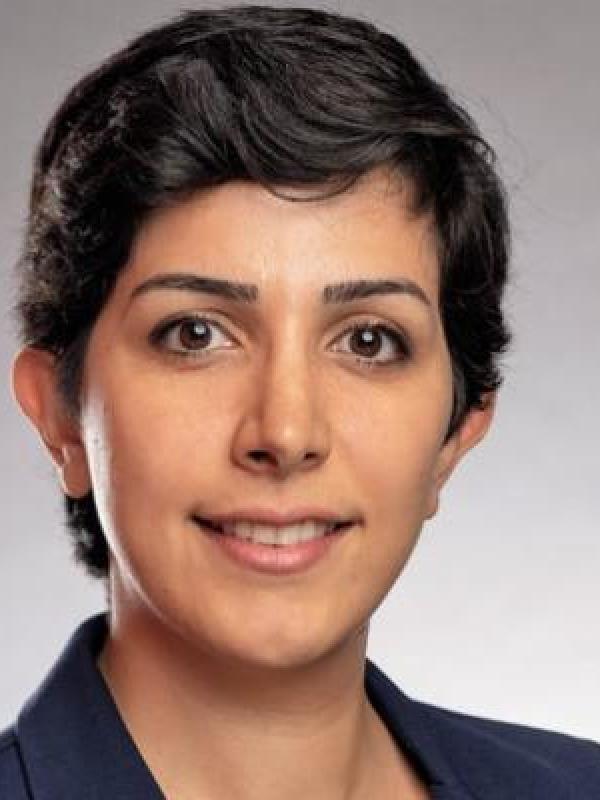
Sahar Heydari Fard is an Assistant Professor in the Department of Philosophy at The Ohio State University, affiliated with the College of Arts and Sciences. She holds a PhD in Philosophy from the University of Cincinnati and an MSc in Applied Economics. Her research explores the intersection of social sciences, political philosophy, and ethics, with particular focus on sustainable social change through social movements. Her research examines how complex social systems can achieve sustainable transformation, investigating moral implications of movements addressing racial and gender inequality. Primary interests include the role of social movements in systemic change, ethical frameworks for collective action, and applications of complexity theory to social dynamics. Professor Heydari Fard's publications demonstrate consistent focus on social transformation mechanisms, evolving from theoretical frameworks to empirical applications. Her work shows increasing engagement with computational models and historical case studies, particularly analyzing power dynamics in unjust social structures. No information about scientific awards is available in the provided materials. No specific information about students or research grants is provided in the source materials. No information about specific labs or research teams is available.
Elizabeth Ashford is Senior Lecturer in Philosophy at the University of St Andrews, specializing in moral and political philosophy with focus on human rights and global justice. Education: DPhil - University of Oxford MA - University of North Carolina Her research examines obligations to address severe poverty, utilitarian ethics, and human rights foundations. Key publications analyze subsistence rights violations as structural injustices demanding systemic reform. Awards: British Academy Award (1997) APA Foreign Scholar Travel Award (2000) Ashford serves on editorial boards of Journal of Moral Philosophy and The Philosophical Quarterly .
Prof Ali Watson is a Professor of International Relations at the University of St Andrews' School of International Relations, a position he has held since 2008. He serves as Managing Director of the award-winning Third Generation Project (TGP), which he co-founded in 2016 to advance social and climate justice education through community engagement initiatives. Watson's educational background includes: MA (Hons) in Economics and International Relations from the University of Aberdeen MSc in Economics from the University of Glasgow PhD in Economics from the University of Dundee His research focuses on the rights of marginalized actors and communities, with particular emphasis on children's place in the international system - work described as 'foundational' in the field. Watson examines education and child welfare practices, and has spent over a decade documenting the impact of historic injustices on marginalized communities. Since 2013, he has collaborated with Ben Collins (University of Aberdeen) on 'doing IR differently,' challenging how academia reinforces structural power relations through projects in North America and East Africa. His work has been funded by the British Academy, National Geographic, the Global Challenges Research Fund, and the Sir Halley Stewart Trust. Watson's publication record demonstrates a consistent focus on climate justice, children's rights, and critical approaches to international relations. His recent work shows increasing integration of climate justice with childhood studies and critical pedagogy, reflecting his commitment to reimagining educational spaces for marginalized communities. The publications reveal a methodological approach that combines critical theory with community-engaged research. His significant achievements include: UK Green Gown Awards 2021 (Student Engagement: Winner) International Green Gown Awards 2022 (Student Engagement: Highly Commended) MacJannet Prize for Global Citizenship 2021 (Finalist) MacJannet Prize for Global Citizenship 2024 (Honourable Mention) OBE for Services to Education (2019) Watson has supervised PhD students including Sagha Ahmed and has secured research funding from prestigious organizations. His Third Generation Project has developed innovative student community engagement initiatives recognized internationally. Growing up in an economically deprived area of Aberdeen, Watson maintains a strong commitment to creating inclusive learning environments and educational opportunities for all.
Truman Venters is a PhD Candidate in International Relations and a Research Fellow at the Centre for Global Law and Governance at the University of St Andrews. His research focuses on Political Justice in Information societies, recontextualizing concepts like consent, resistance, and digital governance. Supervised by Dr. Natasha Saunders (School of International Relations) and Dr. Ognjen Arandjelovic (School of Computer Science), his work spans Democracy, Constitutional Theory, AI ethics, and Digital Governance. Education: Political Science, University of Liège (Belgium) Science and Technology Studies (STS), University of Maastricht (Netherlands) Research Interests: Truman explores intersections of technology and politics, including algorithmic governance, post-colonialism, and ethical AI. He critiques modern digital systems through lenses like phenomenology and post-structuralism, advocating for equitable digital societies. Awards: Recipient of the AD Links Foundation Scholarship (2023). Teaching & Engagement: Served as a Graduate Teaching Assistant for courses like IR1005 (Global Politics Concepts) and IR1006 (Foreign Policy). Organized major academic events including the 12th and 13th International Political Theory Graduate Conferences (2024-2025). Collaborates on the Scotland’s Future Series project: The Role of the University in the Ethical Digital Nation (2024-2025). Labs/Teams: Affiliated with the Centre for Global Law and Governance and contributes to interdisciplinary initiatives like the University of St Andrews’ Digital Nation project.
Sam Adelman is a Professor at the School of Law, University of Warwick, specializing in climate change law, human rights, and international development law. He serves as a Library Liaison and focuses on the intersection of legal frameworks, environmental justice, and socio-economic development. His research emphasizes transformative legal responses to global challenges like climate change and systemic inequities. Adelman’s work critiques prevailing paradigms such as sustainable development and advocates for reimagined legal approaches grounded in principles like Ubuntu philosophy and interdisciplinary ethics. He engages in climate litigation studies, particularly regarding youth-led lawsuits and the role of courts in climate governance. His publications span over two decades, addressing topics like climate justice, human rights in environmental policymaking, and the Anthropocene epoch’s legal implications. Notable works include analyses of African climate litigation systems, critiques of neoliberal development models, and explorations of geoengineering ethics. Adelman’s scholarship bridges law, policy, and philosophy to address urgent global challenges. Despite extensive contributions to climate law and human rights, no specific awards are listed. He advises on research projects and teaches courses reflecting his expertise in environmental and development law.
Tawab Hlimi is an Associate Professor at the School of Architecture Planning and Landscape (SAPL) at the University of Calgary. He is a landscape architect specializing in environmental issues, social justice, and urban systems. His work challenges traditional boundaries of landscape architecture by integrating social justice concerns and political dynamics. He mentors students to critically engage with oppressive systems through design and education. Education: MLA in Landscape Architecture, University of Toronto (2009) BA (Hons) in Architectural Studies, Visual Studies, and Fine Art History, University of Toronto (2006) Research Interests: Hlimi’s work explores the intersection of environmental sustainability and social justice, particularly addressing racial and systemic inequities. He emphasizes humanistic approaches to design education, encouraging students to reflect on values influencing their practice. His projects focus on infrastructure, ecology, and urban systems while advocating for marginalized communities. Mentorship & Advocacy: As a leader, Hlimi uses his role to address systemic injustices and mentor students in navigating oppressive structures. He integrates social justice frameworks into curricula and supports student-driven initiatives aligned with equity goals. Affiliations: Located in Calgary, the University of Calgary acknowledges its presence on Treaty 7 lands and the traditional territories of Indigenous peoples, a context that informs Hlimi’s work.
Tamar Szabó Gendler is the Dean of the Faculty of Arts and Sciences at Yale University and holds the Vincent J. Scully Professorship in Philosophy. She also has secondary appointments in the Department of Psychology and in the Humanities and Cognitive Science Programs. Her academic leadership includes former roles as Chair of the Philosophy Department and Deputy Provost for Humanities and Initiatives at Yale. Education: BA summa cum laude, Yale University (1987), with Distinction in Humanities and in Mathematics & Philosophy PhD in Philosophy, Harvard University (1996) Gendler's research centers on philosophical methodology, epistemology, imagination, belief, and implicit bias. She is best known for introducing the concept of alief —a mental state distinct from belief that underlies automatic, habitual responses. Her work bridges philosophy with cognitive science, psychology, and education, exploring how imagination and intuition function in reasoning and moral judgment. She has made significant contributions to understanding thought experiments, self-deception, and imaginative resistance. Her recent publications reveal a consistent interdisciplinary focus on the cognitive mechanisms underlying philosophical intuition, moral psychology, and educational self-regulation. Themes include the limits of imagination in fiction, the epistemic harms of implicit bias, and the structure of self-control in children. Scientific Awards and Fellowships: Yale College-Sidonie Miskimin Clauss ’75 Prize for Excellence in Teaching in the Humanities Mellon New Directions Fellowship National Endowment for the Humanities Fellowship National Science Foundation Fellowship American Council of Learned Societies/Ryskamp Fellowship Collegium Budapest Institute for Advanced Studies Fellowship Selected by Philosopher’s Annual (2008) for 'Alief and Belief' Gendler has advised numerous students and contributed to academic service through co-editing Oxford Studies in Epistemology and authoring influential textbooks such as The Elements of Philosophy . She has received grant support from major institutions including the NSF and NEH. While not explicitly mentioning a lab, her work is deeply embedded in cognitive science and interdisciplinary research initiatives at Yale. She is actively engaged in public scholarship, with several courses and lectures available online, including her widely viewed freshman address 'Keeping Inconsistency in Your Pockets.'
Sandhya Drew is a Visiting Professor at the City Law School, City, University of London, where she teaches Labour Law, Judicial Review, and Employment Law across LLB and Bar Vocational Studies programs. She is also an Honorary Adjunct Professor at O.P. Jindal Global University and Visiting Professor at the University of Paris Nanterre. Her academic work is deeply informed by her two decades of practice as a barrister specializing in employment and public law, including appearances before the House of Lords and the European Court of Human Rights. University: City, University of London School: City Law School Department: Law Academic Rank: Visiting Professor Email: sandhya.drew@citystgeorges.ac.uk Her research focuses on employment law, human rights, modern slavery, and legal empowerment. She is co-author of Pitt's Employment Law (13th ed, 2024) and leads a long-term research project on the Legal Empowerment of the Poor with Jindal Global University. She is also collaborating with the University of Paris Dauphine on the Loi Devoir de Vigilance. Her expertise spans cross-jurisdictional legal issues, particularly in South Asia and Europe. Her recent publications, including articles in the Industrial Law Journal and Air and Space Law , analyze the intersection of low wages, forced labour, and human rights, advocating for legal reforms to close gaps in modern slavery identification. She emphasizes the role of economic coercion and structural injustice in undermining worker freedom. Fellow of the Higher Education Academy Peer reviewer for the Journal of Industrial Relations Evaluator for the Association of Commonwealth Universities Joint Blog Editor, Business and Human Rights Journal (2021–2023) Sandhya Drew supervises LLM dissertations and has led major teaching modules such as Advocacy Submissions (2019–2025). She is a CEDR Qualified Mediator with expertise in workplace and sports disputes. Her professional service includes membership on the Business School Research Ethics Committee and governance at St Georges NHS Trust. She is fluent in French, Italian, Hindi, and Spanish, supporting her international academic and legal engagements. She is actively involved in policy discussions, having spoken at numerous conferences on business and human rights, legal education, and labour rights. Her work bridges academic scholarship, legal practice, and global policy reform, particularly in combating forced labour and promoting decent work.
Rose McCabe is Professor of Clinical Communication at City, University of London , where she also co-directs the Centre for Mental Health Research . She holds honorary professorships at Queen Mary University of London , University of Exeter , and NHS Trusts including East London NHS Foundation Trust and Devon Partnership NHS Trust . Her academic work spans clinical communication, mental health services research, and patient involvement in care design. Her research focuses on improving patient-clinician communication, therapeutic relationships, and mental healthcare outcomes. Key themes include agency , epistemic injustice , trust , and coercion , particularly in contexts of psychosis, self-harm, depression, and dementia. She works across diverse settings such as emergency departments, primary care, and community mental health services, often collaborating with schools and community organizations. Rose McCabe leads major research initiatives such as the Assured Study and SASH Study , funded by NIHR, focusing on interventions for self-harm and suicide prevention. Her publications reveal a strong emphasis on qualitative and mixed-methods research, conversation analysis, and co-design with people with lived experience. Her recent articles highlight trends in perinatal mental health , crisis care communication , referral decision-making , and epistemic injustice in emergency settings . These works integrate clinical insight with social theory, advancing both practice and policy. Rose McCabe actively supervises research students and collaborates with national and international partners. She serves on editorial boards for BJPsych Advances and Research on Language and Social Interaction , and regularly delivers keynote lectures at major academic and clinical conferences. She has been involved in numerous research projects funded by NIHR, MRC, and charitable foundations, focusing on improving mental health services through structured communication, patient involvement, and innovative interventions. Her leadership in projects like CO-PACT , PAAM , and TACK underscores her commitment to equity, accessibility, and co-produced research. Rose McCabe is also engaged in public and media outreach, including appearances on BBC Radio, and leads initiatives to translate research into practice through webinars and stakeholder engagement.
Lambros Fatsis is a Senior Lecturer in Criminology at City St George's, University of London, within the School of Humanities and Social Sciences. He previously held academic positions at the University of Brighton, the University of Southampton, and the University of Sussex, where he earned multiple teaching and research awards. His work sits at the intersection of criminology, sociology, and Black radical thought, focusing on the criminalization of Black music cultures and police racism in Britain. PhD in Sociology, University of Sussex MSc in Sociology, London School of Economics and Political Science BA Hons in Sociology, Bangor University Postgraduate Certificate in Higher Education, University of Southampton Fellowship and Associate Fellowship, Higher Education Academy Dr Fatsis’ research centers on Cultural and Critical Criminology, with a specific focus on the policing of UK grime and drill music, the criminalisation of Black/Afro-diasporic music cultures, and the racial politics of law enforcement. His work draws on Black radical thought to critique how creative expression is pathologized and criminalized. He has published in top journals such as The Sociological Review , Crime, Media, Culture , and Popular Music , and co-authored books including Policing the Pandemic and The Public and Their Platforms . His forthcoming monograph, Policing the Beats , will be published by Manchester University Press in 2026. His recent publications reflect a consistent engagement with themes of racial injustice, digital surveillance, and the weaponization of music in legal contexts. Across these works, he examines how YouTube videos, media narratives, and judicial practices contribute to the discriminatory treatment of Black youth. The interdisciplinary nature of his scholarship spans criminology, sociology, music studies, and decolonial theory, with recurring sub-fields including police racism, youth criminalization, cultural resistance, and the sociopolitical dimensions of sound. Scientific awards and recognitions include: British Society of Criminology Blogger of the Year (2018) Outstanding Research & Enterprise Impact Award, University of Brighton (2021) Most Engaging Lecturer, University of Southampton (2019) Excellence in Teaching Award, University of Sussex (2016) Nominee for Vice-Chancellor’s Teaching Award and Students’ Union ‘Best Academic Support’ Dr Fatsis is actively involved in public sociology and advocacy. He supervises PhD students in his areas of expertise and welcomes proposals on cultural criminology, Black British subcultures, and the sociology of public life. He has served as an expert witness in criminal trials involving rap lyrics as evidence and is a member of the Prosecuting Rap Expert Network. He also advises the Art, Not Evidence campaign and was a Trustee and Advisor at AudioActive, a youth music charity. His media contributions appear in The Guardian , The Independent , BBC, RAI, and The Conversation , and he has been featured in documentaries on UK drill music. He is also a practicing DJ under the name Boulevard Soundsystem, performing all-vinyl sets and collaborating with prominent figures in the UK and European reggae and soundsystem scene, including MC Brother Culture, DJ Cut La Vis, and Roots Garden Records. This lived engagement with music culture deeply informs his academic and activist work.
Karl Mason is a Senior Lecturer in Social Work and Course Lead for the MSc Social Work at Royal Holloway, University of London, Department of Law and Criminology. He co-leads the department's Health and Social Care research cluster and teaches across BSc, MSc, and Advanced Practice programs, with leadership in modules on housing, law, and research methods. Education: Bachelor in Social Studies, Trinity College, University of Dublin (2002) National Qualification in Social Work (Ireland), National Social Work Qualification Board (2002) PG Cert Best Interests Assessor, Bournemouth University (2011) MSc Advanced Practice, Royal Holloway, University of London (2015) Fellow of the Higher Education Academy (2019) His research centers on how marginalized adults access social care, focusing on discriminatory abuse, safeguarding, homelessness, and human rights in care homes. He employs socio-legal and qualitative approaches to examine structural inequities and professional responses. Recent publications highlight trends in social work education, legal jurisdiction in adult safeguarding, and epistemic justice for homeless individuals. His work spans qualitative methods, socio-legal analysis, and policy evaluation, contributing to both academic discourse and practitioner guidance. Scientific Awards: Emerald Literati Award - Outstanding Paper (2019) Emerald Literati Award - Outstanding Reviewer (2019) LSS Excellence in Teaching and Student Support Award (2021) Karl Mason holds significant advisory and editorial roles: external examiner at University of Hull and Ulster University, editorial board member for 'Practice: Social Work in Action', and active contributor to national safeguarding policy via the Local Government Association. He leads research grants, conducts Safeguarding Adult Reviews as consultancy, and mentors peers. He has organized international conferences on sexuality and social work and frequently presents to academic and practitioner audiences. He is currently finalizing his PhD on the perspectives of homeless individuals regarding their support needs. His work contributes to UN Sustainable Development Goals, particularly in social justice and inclusive education.
Henrikke Sæthre Ellingsen serves as a Research Fellow at NTNU's Department of Sociology and Political Science within the Faculty of Social and Educational Sciences. Her doctoral research examines green colonialism in Norwegian wind power development through decolonial frameworks, focusing on temporal-political strategies and asymmetric power relations affecting Sámi communities during the energy transition. Her research spans Political Ecology, Environmental Policy, and Indigenous Rights with specific expertise in Wind Power Development and Decolonial Studies. She investigates how green energy projects like Fosen wind farms replicate colonial power structures through spatial reorganization, consent violations, and erasure of Sámi re-existence, framing energy transitions as sites of ongoing colonial injustice. Analysis of her publications reveals consistent engagement with structural violence in Norwegian wind policy, particularly examining how temporal dimensions (e.g., accelerated project timelines) intersect with political strategies to marginalize Indigenous rights. Her work demonstrates how green colonialism operates through bureaucratic mechanisms, strategic ignorance, and discursive erasure within ostensibly sustainable development frameworks. Ellingsen co-supervised Tina Andersen Vågnes' award-winning Master's thesis on green colonialism in Sámi herding areas and co-founded the nomadic Elsa Laula Renberg Institute during 2023 Fosen protests. The institute functions as knowledge-based resistance against colonial injustice through solidarity networks and public discourse interventions, including media appearances like NRK P1's Godt Selskap program.
Paul-Mikhail Catapang Podosky is a Research Fellow at Macquarie University's School of Humanities, affiliated with both the Ethics and Agency Research Centre and the Global Indigenous Futures Research Centre. Holding a PhD in Philosophy from the University of Melbourne (2021), his work bridges conceptual engineering with social justice frameworks. His research focuses on Conceptual Engineering , Metalinguistic Disagreement , and Social Justice Implementation , examining how linguistic frameworks perpetuate oppression and enable resistance. Key themes include structural injustice, gaslighting dynamics, and mixed-race identity ontology, with strong emphasis on epistemic agency within oppressive systems. Recent publications reveal increasing engagement with Indigenous epistemologies and decolonial frameworks , particularly through the Global Indigenous Futures Research Centre. His 2024-2025 work shows expansion into grief theory and capacities approaches, while maintaining core focus on conceptual resistance mechanisms. Active investigator on the ARC-funded project All Mixed Up: Making Sense of Mixed Race Identity (2022-present) ORCID: 0000-0001-5636-416X with 25+ publications and significant Scopus citations Former Global Perspectives on Society Postdoctoral Fellow at New York University Shanghai (2021-2022) His collaborative network spans 10+ international institutions, with research featured in Synthese , Philosophical Quarterly , and Hypatia . Current work integrates conceptual engineering with critical race theory and Indigenous knowledge systems through Macquarie's dual research centres.
Judith Schrempf-Stirling is an Associate Professor of Responsible Management at the Institute of Management, part of the Geneva School of Economics and Management (University of Geneva). She obtained her PhD in Management from HEC Lausanne in 2010. Prior to her current position, she held roles at the University of Richmond (USA) and the Paris School of Business, advancing from Assistant to Associate Professor. Her career includes industry experience in Hewlett-Packard's Global Citizenship Department. Her research focuses on corporate responsibility and human rights, exploring upstream/downstream accountability, historic injustices, and the 'political turn' in CSR. Notable areas include business and human trafficking, organizational repair for past wrongs, and state roles in corporate governance. Her 15 most recent articles include groundbreaking work on organizational legacies, human rights integration in management studies, and entrepreneurship as ethical responsibility. She has contributed to top journals like Academy of Management Review and Journal of Business Ethics. While no specific grants or awards are listed, her extensive publication record reflects sustained academic impact. She advises on courses such as Social, Ethical, and Legal Responsibilities of Business, and her work extends to multi-stakeholder initiatives in developing countries.
Kali Murray is a Professor of Law at Marquette University Law School, where she also serves as Co-Director of the Intellectual Property Program. Her scholarly work centers on the politics of participation in patent, property, and administrative law, with a strong emphasis on equity, social identity, and governance. Her research spans intellectual property, patent law, administrative law, and the intersection of race and property. She has published extensively on participatory models in patent systems, public rights in information, and the socio-cultural dimensions of property. Her interdisciplinary approach integrates legal theory, history, and political science. Professor Murray’s recent publications reflect a consistent focus on governance, participation, and equity in intellectual property and administrative systems. Her work explores infrastructure in patents, constitutional limits on gene patents, and the role of marginalized voices in innovation law. Themes of justice, inclusion, and institutional accountability recur across her scholarship. Co-Director, Intellectual Property Program, Marquette University Law School Faculty Adviser, Marquette Intellectual Property Law Review Mentor, Moot Court Competitions Organizer, Intellectual Property Colloquium Speaker Series She has been actively involved in national legal organizations, including leadership roles in the American Association of Law Schools (AALS), where she chaired the Property Section and served on the Intellectual Property Section Executive Committee. Her work with the Administrative Conference of the United States and amicus briefs before the Supreme Court underscores her impact on policy and constitutional discourse. Her educational background includes a B.A. and M.A. in History from Johns Hopkins University and a J.D. from Duke University School of Law, where she was Editor of the Duke Environmental Law and Policy Forum.