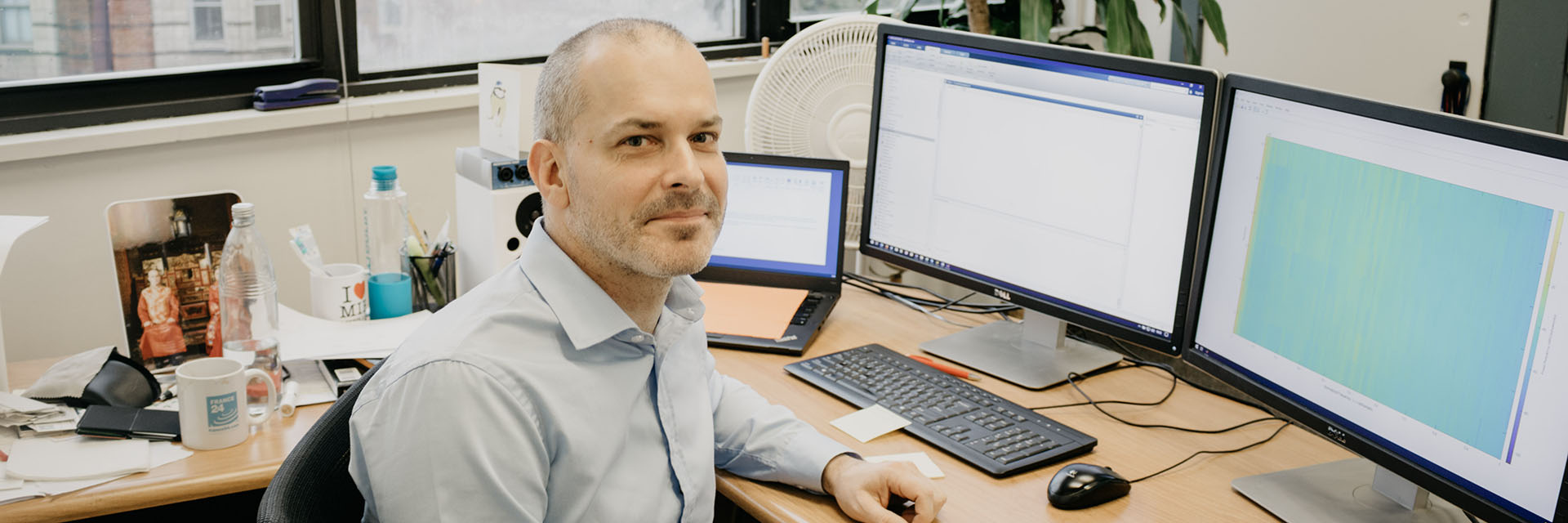
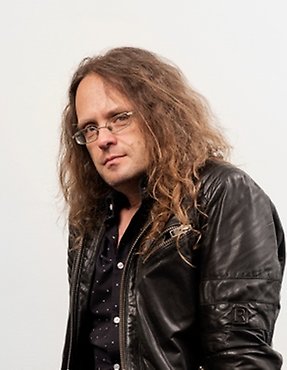
Alexander Lerch is an Associate Dean of Research and Creative Practice and Associate Professor at the School of Music, Georgia Institute of Technology. He joined Georgia Tech in 2013 and teaches courses in music signal processing, computational music analysis, audio technology, and software engineering. Previously, he was Head of Research at zplane.development, a music technology licensing company. His research focuses on Music Information Retrieval (MIR), blending signal processing, machine learning, music psychology, and systematic musicology. He leads the Music Informatics Group, developing AI-driven tools for music generation, production, and consumption. Lerch authored over 40 peer-reviewed papers and the textbook An Introduction to Audio Content Analysis , accompanied by open-source libraries like libACA and pyACA. Recent work emphasizes generative models, source separation, and audio quality assessment. He actively contributes to conferences such as ISMIR and presents keynote lectures on AI in music and creative expression.
Nathan Wendte is an Assistant Professor at the University of Virginia, specializing in Linguistic Anthropology. His research focuses on language and identity dynamics in Louisiana and the Gulf South, particularly among Creole and French-speaking communities. He holds a PhD in Anthropology from Tulane University (2020) with a concentration in Linguistic Anthropology. Wendte's work emphasizes ethnolinguistic labeling practices, language revitalization efforts for endangered languages like Tunica, and the intersection of music with linguistic identity, notably through analyses of Zydeco musician Clifton Chenier. He contributes to linguistic documentation projects, including the creation of learning materials for Louisiana Creole and collaborative work with the Tunica-Biloxi Tribe of Louisiana. His research spans sociolinguistics, nexus analysis, and historical language contact, addressing topics such as Creole diaspora identity in Texas, phonetic variation in Grand Isle French, and the role of Haiti in Louisiana Creole narratives. Wendte's publications engage with both academic and community-oriented audiences, aiming to center marginalized voices in language preservation and cultural reclamation.
Scott Smallwood is a Professor of Music Composition and Sonic Arts at the University of Alberta's Faculty of Arts, where he also directs the Sound Studies Institute. His roles include Director of the Sound Studies Institute and teaching courses in composition, electroacoustic music, and sound art. He holds degrees from Seattle Pacific University, Miami University, Peabody Conservatory, and Princeton University, where he served as a postdoctoral researcher with the Princeton Laptop Orchestra (PLOrk). Research focuses on sound art, acoustic ecology, field recording, and interactive technologies. Notable projects include the UNPOP Burning Man installation, audio game development (e.g., The Lost Garden ), and solar-powered sound installations like Coronium 3500 . Collaborations include work with artists like Stephan Moore (Evidence duo), Jen Mesch, and Vadim Bulitko. His work spans 8-channel electroacoustic compositions, site-specific installations, and audiovisual games. Recent exhibitions include Inter Mundos (2023-2024) and Held on for Dear Life (2024). Active in academic publishing, he explores topics like sonic interventions at Burning Man and ethical dimensions of digital identity in Your Data Body (2024). Education: PhD (Princeton), MMus (Peabody), MMus (Miami), BA (Seattle Pacific) Grants: Supported by Canada Council for the Arts, SSHRC, and Alberta Foundation for the Arts Labs/Teams: Audio Games Lab, Solarsonics Initiative
Dr. George Fazekas is a Senior Lecturer at Queen Mary University of London's School of Electronic Engineering and Computer Science. His research focuses on semantic audio, music information retrieval, and deep learning applications in music technology. He is affiliated with the Centre for Multimodal AI and contributes to advancing technologies like semantic web music, emotion recognition, and differentiable signal processing. His teaching includes modules on research methods, responsible innovation, and the Semantic Web. Research interests span semantic audio analysis, music ontology development, and AI-driven music production tools. He has collaborated on projects such as the Open Multitrack Testbed and the Audio Commons Ontology. Notable contributions include work on handwritten music synthesis, dynamic range compressor control, and adaptive music systems like Mood Conductor. Publications emphasize machine learning for music tasks, including few-shot learning for historical manuscripts and neural synthesis techniques. His work bridges theoretical research with practical applications in audio engineering and music technology.
Crystal Chang Din is an Associate Professor at the Department of Informatics, University of Bergen. Her research focuses on formal methods, software verification, and didactics. She has organized conferences such as the KeY Symposium 2023 and served as PC Chair for FTfJP 2025. Her work includes developing verification tools like KeY-ABS and exploring concurrency semantics in programming languages. She teaches courses including INF113 (Operating Systems) and INF100 (Introduction to Programming). Notable contributions include modular reasoning systems for code reuse and runtime enforcement frameworks. She advises master’s students such as Eirik Halvard Sæther and Ida Sandberg Motzfeldt. Her publications span topics like feature model evolution, deadlock detection, and concurrent programming semantics. She has contributed to international journals like Formal Aspects of Computing and conferences such as NWPT and iFM. Her research emphasizes practical applications in distributed systems and formal verification techniques.
Simon Perry is a Senior Lecturer at RMIT University's School of Art, specializing in public art and sculpture. He holds prestigious awards such as the Prix de Rome and Royal Academy Gold Medal for Sculpture. His research explores sculpture’s relationship with architecture, urban environments, and new technologies, including virtual collaboration projects like the International Virtual Studio (2005–2007). Perry’s major public art projects include installations in Federation Square and Melbourne City Square, emphasizing ecology and public engagement. He advises governments and organizations on public art strategies and has judged international competitions. His work bridges art, technology, and urban planning. Research Interests: Historical/contemporary links between sculpture and public/private spaces Studio practice in sculpture commissions Virtual spaces for international art collaboration Philosophy and cultural theory in art Art and environmental sustainability Representation of animals and organic forms Awards: Prix de Rome Royal Academy Gold Medal for Sculpture Advising/Grants: Open to PhD/Masters supervision in public art, sculpture, and art ecology. Active in advisory roles for public art boards and government projects. Labs/Teams: Engaged with RMIT’s 'Art in Public Space' and 'Art and Environmental Sustainability' clusters.
Amy Cimini is an Associate Professor of Music at UC San Diego’s Integrative Studies Area. She holds a Ph.D. in historical musicology from New York University and dual B.A./B.M. degrees from Oberlin College and Conservatory. Her research examines intersections of power, technology, and auditory culture in 20th-21st century experimental music. Current work centers composer Maryanne Amacher’s legacy, explored in her 2021 monograph Wild Sound and co-edited Maryanne Amacher: Selected Writings and Interviews . Cimini’s interdisciplinary methods blend archival research with performance practice, addressing how sound shapes collective knowledge and social value. She serves as Director of Graduate Studies in UCSD’s Music Department, and holds affiliate status in Critical Gender Studies. Her editorial roles include Women and Music journal and the AMS Music & Philosophy Study Group. Performance projects include the Architeuthis Walks on Land duo and live electronic works with Carrier Records. Education: Ph.D. Historical Musicology, New York University B.A. English & B.M. Viola Performance, Oberlin College/Conservatory Research focuses on: Technoscience and sound Gender/race/class in auditory culture Embodied performance practices Archival methodologies Teaching emphasizes critical analysis of power structures through courses like Gender and Experimental Music, Music and Biopolitics, and Arts of the Archive. Her work with the Maryanne Amacher Foundation and Supreme Connections Working Group extends scholarly impact into public sound art initiatives.
Mark Sandler is a Professor of Signal Processing and Director of the Centre for Digital Music at Queen Mary University of London. He leads the School of Electronic Engineering and Computer Science and contributes to the Centre for Multimodal AI. His work spans Digital Signal Processing, Machine Learning, and their applications in Audio and Music Technology, including source separation, neural audio synthesis, and physics-informed models. He has pioneered research in music informatics, sound synthesis, and AI-driven creativity. Awards include Fellowships from the Royal Academy of Engineering (FREng), IEEE (FIEEE), IET (FIET), and Audio Engineering Society (FAES). Research interests include audio segmentation, harmonic analysis, and interdisciplinary projects with computer vision. He has authored numerous publications on topics like neural synthesizers, knowledge distillation, and spatial audio systems. His contributions extend to semantic web technologies for music production and interactive audio applications. Current projects focus on low-latency synthesis, machine learning for music tagging, and adaptive audio systems. Awards and grants highlight leadership in digital music innovation. His academic roles include supervising research groups and directing interdisciplinary initiatives. The labs under his leadership include the Centre for Digital Music and collaborations with industry partners on audio engineering and immersive technologies.
Ilayda Altuntas is an Assistant Professor in the College of Fine Arts at the University of Arizona, affiliated with the Applied Intercultural Arts Research Graduate Interdisciplinary Degree Program (GIDP). She earned her Ph.D. in Art Education from Pennsylvania State University and holds an M.S. in Art & Design Education from Pratt Institute. Education: Ph.D. in Art Education (minor in Curriculum & Instruction), Pennsylvania State University M.S. in Art & Design Education, Pratt Institute B.F.A. in Plastic Arts and Fashion & Textile Design, Yeditepe University Altuntas' research focuses on sound pedagogy and sonic art practices, exploring how sound mediates identity, learning, and spatial experiences in educational environments. She developed the Sounding Art Practice as Research (SAPAR) methodology to investigate intersections of sound, place, and cultural memory through creative practice. Her pedagogical approach emphasizes sensory-based teaching methods and curriculum design for art education. She teaches undergraduate teacher-preparation courses and graduate-level arts-based research methods. Her collaborative work includes the Art & Soundscapes: Collective Senses course, which translates cultural and environmental soundscapes into visual works via printmaking, digital collage, and sculpture. Her scholarship has been published in NAEA News , International Review of Qualitative Research (IRQR) , and International Journal of Arts-Based Educational Research (iJABER) . Altuntas previously served as Program Coordinator for the Saturday Art School at the University of Arizona and chaired the Seminar for Research in Art Education (SRAE) at the National Art Education Association (2025-2027). She has extensive experience in K-12 art education, including roles at Pratt Institute's Saturday Art School and edTPA NY licensure processes. Her students' work has been exhibited at The Metropolitan Museum of Art, Manhattan Borough's Art Festival, and MoMA. She has also contributed to social justice initiatives through her master's thesis on art facilitators in NYC detention centers, focusing on The Drama Club NYC, and served on the New York State Juvenile Justice Coalition board.
Prof. Dr. Alexander Kukk is a full-time Professor of Planning and Law at the Hochschule für Wirtschaft und Umwelt Nürtingen-Geislingen (HfWU), Faculty of Architecture and Civil Engineering. He is actively engaged in research and publication in the fields of urban planning law, administrative law, and sustainable development. His work bridges legal frameworks with practical urban development challenges, particularly in climate resilience, renewable energy, and inclusive planning. His research interests focus on the legal dimensions of urban development, including building regulations, zoning law, environmental compliance, and the legal facilitation of energy transition. He explores how legal instruments can support densification, social housing, and climate adaptation in cities. His interdisciplinary approach integrates law, planning, and environmental policy. The recent articles reflect a strong trend toward addressing contemporary urban challenges through legal innovation. Key themes include digitalization of planning procedures, legal frameworks for renewable energy integration, urban densification, and social equity in housing. His publications span German legal journals and international contributions, showing both national impact and global relevance. Scientific Awards: Förderpreis der Stiftung 'Wissenschaft und Gesellschaft an der Universität Konstanz' (2000) Prof. Kukk has not publicly listed any doctoral or master’s students, grants, or formal advising roles. However, he is deeply involved in academic knowledge transfer through extensive legal commentaries, particularly on the German Building Code (BauGB) and the Building Regulations of Baden-Württemberg. He has co-authored chapters in leading legal handbooks and contributed to policy-oriented research, including feasibility studies for urban greening and mobility planning. His work is instrumental in shaping legal practices in urban development. He is affiliated with research initiatives related to sustainable urban development and has contributed to projects funded by federal agencies such as the Bundesamt für Bauwesen und Raumordnung. His collaborative work with Prof. Dr. Robin Ganser highlights an ongoing engagement with interdisciplinary research teams focused on environmental and planning law.
Isaac Salisbury is a Researcher at the School of Psychology, University of Queensland (UQ), specializing in human factors and ergonomics within healthcare and high-tempo environments. His work focuses on optimizing clinical monitoring systems through innovative display technologies and auditory interfaces. Research Highlights Human-computer interaction in clinical settings Medical sonification and auditory display design Head-worn display usability for patient monitoring Evaluation of medical device ergonomics Healthcare workflow optimization Key Collaborations Regularly collaborates with: Penelope M. Sanderson (UQ) Robert G. Loeb (UQ) Paul D. Schlosser (UQ) Ismail Mohamed (UQ) Publication Trends Recent scholarship demonstrates expertise in: Development of head-worn displays for clinical monitoring Comparative studies of tablet vs wearable devices in healthcare Optimization of auditory displays for critical care Human factors analysis in high-tempo environments (restaurants, EMS) Experimental evaluation of medical device interfaces through simulation
Helen Smith is an Associate Professor in Renewable Energy at the University of Exeter, within the College of Engineering, Mathematics and Physical Sciences. She serves as Director of Education and Student Experience for both undergraduate and postgraduate Renewable Energy programmes and is a Co-Investigator in the EPSRC and NERC Centre for Doctoral Training in Offshore Renewable Energy (IDCORE), where she leads the 'Marine Renewable Resource Assessment' module. Education: PhD in Earth Sciences, University of Exeter (Penryn Campus), title: 'Modelling for resource and environmental impact assessments of wave farms' MSc in Hydrography, University of Plymouth BA in Physics, University of Oxford Her research focuses on marine renewable energy, particularly wave and tidal energy, with emphasis on resource assessment, environmental impact modeling, and numerical simulation of wave-current interactions. She investigates the physical environmental impacts of offshore developments, including wave farms and tidal lagoons, and contributes to interdisciplinary work in offshore aquaculture and climate change implications. Her expertise spans hydrodynamics, fluid mechanics, coastal geomorphology, and sustainable marine development. The analysis of her recent publications reveals a strong focus on numerical modeling for marine energy applications, with recurring themes in tidal and wave energy resource characterization, environmental impact assessment, and offshore system interactions. Her work integrates field data with advanced simulations to support sustainable 'blue growth' in marine sectors. Scientific Awards: No awards explicitly mentioned in the provided text. Helen Smith leads multiple modules across BEng/MEng Renewable Energy Engineering, BSc Sustainable Energy Futures, and MSc Renewable Energy Engineering programmes. She is actively involved in research supervision and education leadership. Her collaborations span institutions such as the University of Plymouth, University of Edinburgh, and Deltares, and she has contributed to major research projects including MERiFIC and EquiMar. She has no listed grants in the text, but her involvement in CDTs and large consortia indicates significant research funding engagement. She is affiliated with the Offshore Renewable Energy research group at Exeter and contributes to the Exeter Marine initiative. Her work supports the development of sustainable marine technologies through rigorous scientific assessment and educational leadership.
Gemma King is a Senior Lecturer in French Studies and ARC DECRA Fellow in Screen Studies at the Australian National University, affiliated with the School of Literature, Languages & Linguistics. Her research spans contemporary screen and museum studies, with a focus on francophone and multilingual film, sign language representation, and disability on screen. She leads the ARC-funded project ‘Sign on Screen’ (2023–2026), exploring sign language in global cinema through Deaf-hearing collaboration. She holds a PhD from a cotutelle between the University of Melbourne and Université Sorbonne Nouvelle-Paris 3, and a Diploma in Auslan from Deaf Connect. Her key publications include Decentring France: Multilingualism and Power in Contemporary French Cinema (2017) and Jacques Audiard (2021). Her research interests include transnational cinema, multilingualism, Deaf studies, postcolonial representation, and language and power. Her recent articles reflect a strong trend in disability and screen studies, particularly the politics of sign language in film, Deaf empowerment, and the critique of linguistic hierarchies in Hollywood. She also publishes on French film, border narratives, and museum memory. Gemma King has received the ARC DECRA award and seven teaching awards. She is President of the Australian Society for French Studies and Editor of the Australian Journal of French Studies . She supervises multiple PhD and MPhil students on topics related to disability, film, and French cultural studies. She is actively involved in research leadership, serving on editorial boards for Contemporary French Civilization , New Directions in Francophone Studies , and French and Francophone Filmmakers . She also contributes to public scholarship through The Conversation and media engagement.
Dr. Peter C. van Wyck is a Professor in Communication Studies at Concordia University, Montreal. His interdisciplinary work bridges environmental humanities, nuclear history, and photographic theory, with a focus on monuments, memory, and the ethics of futurity. He is currently collaborating with Dr. Myra Hird on the SSHRC-funded project Greening the Atom , examining nuclear energy’s rebranding as 'green' and its implications. Education: PhD in Communication (McGill University, 1997) Postdoctoral Fellowships at Trent and Queen’s Universities (1997-2000) His research explores nuclear waste, critical topographies, and the semiotics of environmental memory. Current projects include a manuscript titled The Angel Turns: Memos for the End of the Holocene and ongoing collaborations with the Atomic Photographers Guild since 2019. Scientific Awards: 2011 Gertrude J. Robinson Book Prize Shortlisted for the 2012 Harold Adams Innis Award
Stefan Östersjö is Professor of Musical Performance and Head of Subject at Luleå University of Technology, Sweden, where he leads GEMM (Gesture, Embodiment and Machines in Music), an interdisciplinary research cluster. He holds a position within the Department of Music, Media and Theatre, part of the Department of Economics, Technology, Arts and Society. Östersjö's academic career spans both research and practical music performance, with significant contributions to artistic research methodology and transcultural musical practices. His research focuses on interdisciplinary collaboration, method development, and knowledge creation through the interaction between musicology, ethnomusicology, music psychology, music education, and computational approaches. Östersjö has been instrumental in developing the role of artistic research in method development, particularly through his work on transcultural musicianship and ecological sound practices. His research interests reveal a commitment to bridging academic inquiry with practical musical exploration. Analysis of his 15 most recent publications shows a consistent focus on artistic research methodologies, transcultural musical practices, sound ecology, and the relationship between gesture and sonic production. His work demonstrates a sophisticated integration of qualitative and quantitative approaches to understanding musical performance, with particular attention to the embodied and ecological dimensions of musical practice. Östersjö's publications span both scholarly journals and creative practice outputs, reflecting his dual commitment to academic rigor and artistic innovation. Östersjö has received significant research funding, including multiple projects from the Swedish Research Council, MAW, AHRC, and as a Research Fellow at the Orpheus Institute in Belgium (2009-2019). His current research continues to explore the intersections of artistic practice, interdisciplinary collaboration, and knowledge production in musical contexts. As a performer, Östersjö is a leading classical guitarist specializing in contemporary music, with over twenty CD releases and extensive international touring. He has collaborated with major composers and artists across disciplines, including choreographers, filmmakers, and visual artists. His performance career includes founding The Six Tones (2006-present), membership in the Landscape Quartet, and former leadership of Ensemble Ars Nova (1995-2012). Östersjö has worked with renowned conductors including Lothar Zagrosek, Peter Eötvös, Mario Venzago and Andrew Manze.