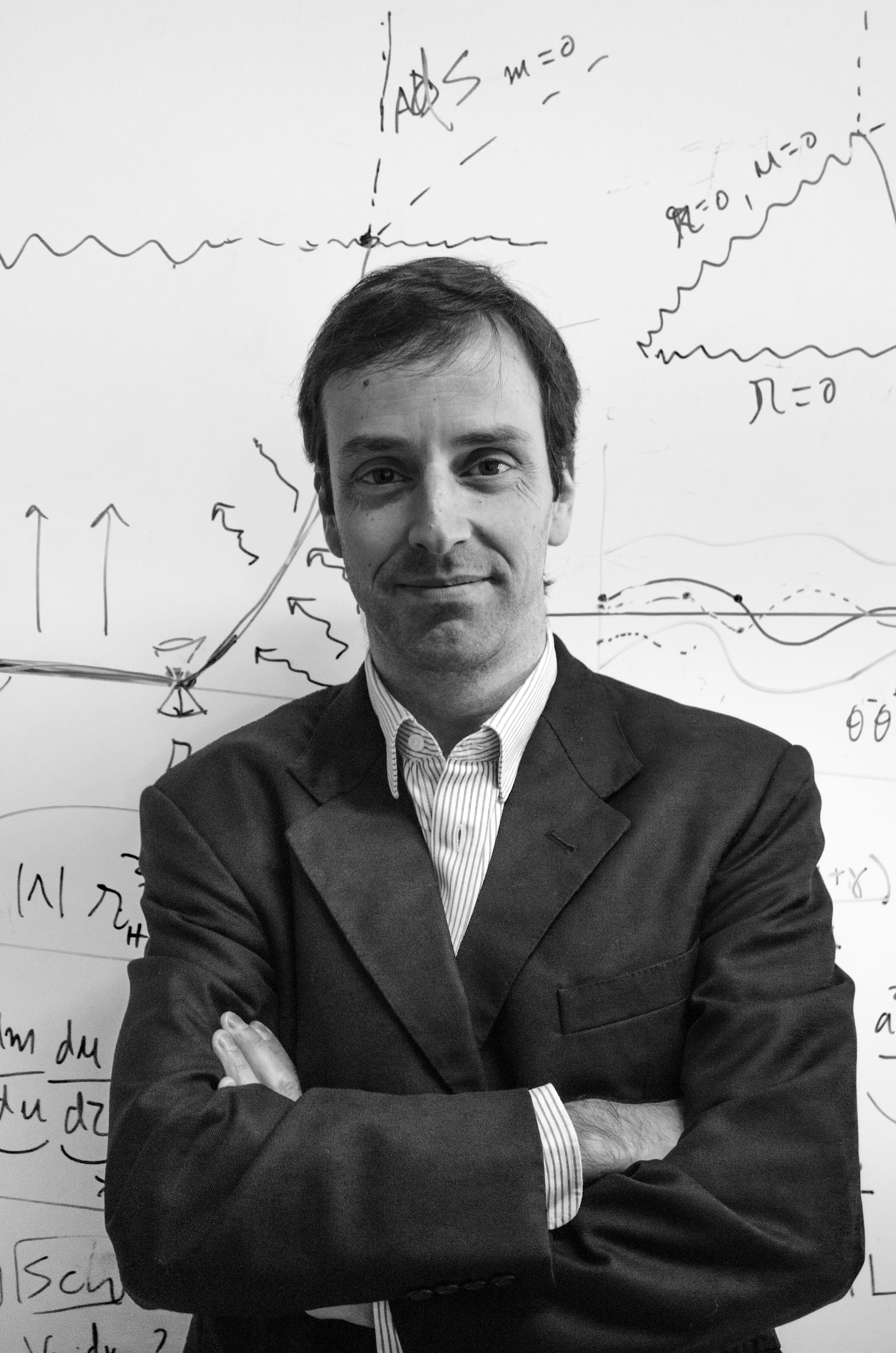
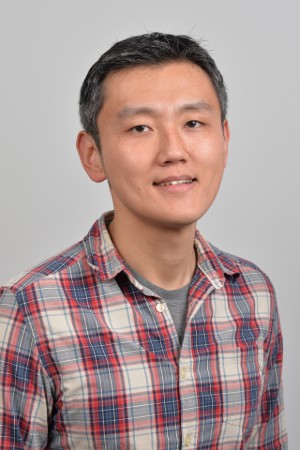
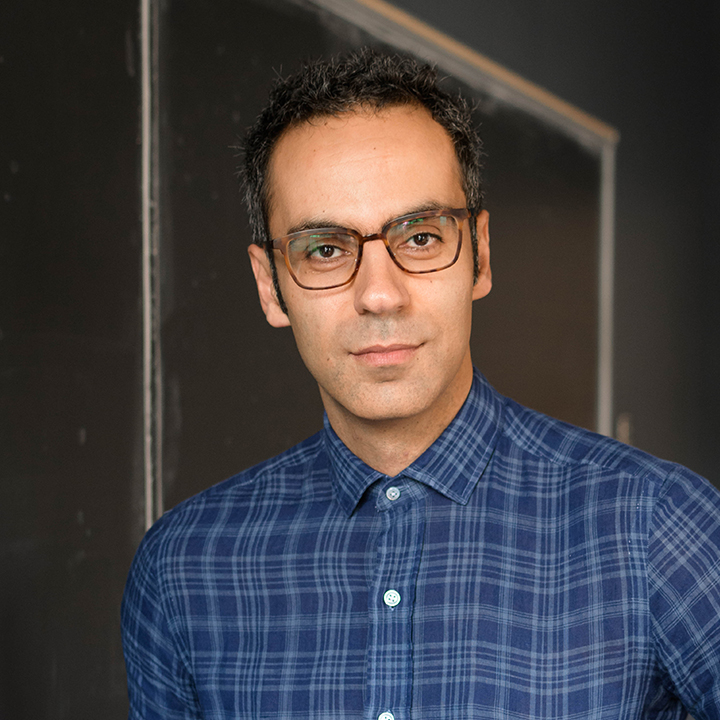
Filipe C. Mena is a Full Professor at the Department of Mathematics, Instituto Superior Técnico (IST), University of Lisbon, Portugal. He serves as the Coordinator of the Doctoral Program in Mathematics at IST and is an active member of the Center of Mathematical Analysis, Geometry and Dynamical Systems (IST). Additionally, he collaborates with the Center of Mathematics at the University of Minho. His research focuses on Mathematical Physics and General Relativity , with expertise in: Differential Equations Differential Geometry Cosmological modeling Gravitational collapse Black hole dynamics Professor Mena's recent publications (2019–2025) predominantly explore themes of spacetime stability , modified gravity theories , and mathematical cosmology , with frequent emphasis on spherical symmetry, asymptotic analysis, and singularity formation. His work demonstrates consistent engagement with Einstein field equations and geometric methods. He actively contributes to academic events, having recently organized the XVII Black Hole Workshop (2024) and XVII Iberian Cosmology Meeting (2023). Outreach initiatives include participation in the European Researchers' Night (2024) and the IST Open Day (2025).
Dr David Sloan is a Reader in the Department of Physics at Lancaster University. His research focuses on theoretical physics and cosmology, particularly on dynamical systems, scale symmetries, and singularity resolution in gravitational theories. Research Interests : Cosmology, quantum gravity, dynamical similarity, and inflationary models. Current Projects : "The Universe as an Open System" (2022-2024), "Lancaster-Manchester-Sheffield Consortium" (2020-2023), and FQXi-funded research (2019-2023). Students : PhD student Callum Bell. Contact : Office C057, C-Floor, Physics Building, d.sloan@lancaster.ac.uk. His recent publications address fundamental cosmological questions, including singularity resolution, inflationary dynamics, and the application of Herglotz actions to cosmology. These works explore scaling symmetries, dynamical similarity, and the interplay between quantum gravity and early universe phenomena.
Gonzalo Olmo Alba is an Associate Professor in the Department of Theoretical Physics at the Faculty of Physics, Universitat de València, and a researcher at the Institute of Corpuscular Physics (IFIC), a joint center of CSIC and the university. He leads the QBHSC (Quantum Black Holes, Supergravity and Cosmology) research group and is actively involved in international collaborations such as the COST Actions CosmoVerse (CA21136) and formerly CANTATA (CA15117). His educational background includes a PhD from the Universitat de València in 2005, supervised by Dr. José Navarro-Salas, with a thesis on quantum corrections in black holes and cosmology. Olmo Alba's research focuses on theoretical physics, particularly quantum gravity, black hole physics, cosmology, and alternative theories of gravity. He developed a novel formalism using correlation functions to study quantum radiation in curved spacetimes, applicable to black holes, cosmology, and wormholes. His work addresses the trans-Planckian problem, singularity avoidance, quasinormal modes, and shadows of compact objects. He has authored numerous influential papers, including highly cited reviews in Physics Reports , Universe , and International Journal of Modern Physics D . His recent publications highlight a strong trend in modified gravity, quantum effects in astrophysical systems, and mathematical methods in gravitational theories. The work spans foundational aspects of general relativity to observational implications in cosmology and black hole imaging. Scientific Awards and Honors: Outstanding Referee, American Physical Society (2014) Special Visiting Researcher, Brazilian Government (2014) Project of Excellence for Young Researchers, Generalitat Valenciana (2017) He has supervised 15 final degree projects, 19 MSc theses, 4 PhD students, and 5 postdoctoral researchers. He has been Principal Investigator of multiple national and international projects, including a PROMETEO project (GVA), three coordinated national projects, the Topical Network of Relativity and Gravitation, and four CSIC international projects (i-LINK and i-COOP). He serves as Associate Editor for General Relativity and Gravitation and Universe . Olmo Alba is a key member of the QBHSC research group at IFIC and plays a leadership role in the COST Action CosmoVerse. As Science Communication Manager of CANTATA, he produced two documentaries: G-Ambassadors and Challenging Einstein’s Legacy . He is also Vice-president of the Spanish Society of Gravitation and Relativity.
Berndt Mueller serves as the J. B. Duke Professor of Physics at Duke University, specializing in Theoretical Nuclear and Particle Physics. He leads the Hot and Dense QCD Matter research group as part of the Duke QCD Theory program. His research primarily focuses on nuclear matter at extreme energy density, investigating how Quantum Chromodynamics (QCD) predicts the dissolution of nuclear matter into quarks and gluons when critical energy density thresholds are exceeded. Professor Mueller develops theoretical frameworks for quark-gluon plasma formation, particularly addressing thermalization problems and detection methods in high-energy nuclear collisions. His recent publications reveal significant trends across multiple subfields of theoretical nuclear physics, including QCD phase transitions, quarkonium behavior in extreme conditions, and the search for the QCD critical point. These works connect fundamental theoretical concepts with experimental approaches at facilities like RHIC and CERN. His 2022 overview article provides a comprehensive introduction to relativistic heavy-ion physics His research on the hadrochemical horizon explores connections between chemical freeze-out and QCD phase boundaries His work on critical point search addresses challenges in identifying signatures of the QCD critical point Professor Mueller has mentored numerous graduate students who have gone on to successful careers in academia and industry, including Michael T. Strickland at Texas Tech University, Xiaojun Yao at MIT, and Chris Coleman-Smith. His teaching responsibilities include General Physics I and II courses. He maintains active connections with major research facilities including the Relativistic Heavy Ion Collider (RHIC), CERN, and the DOE/NSF Nuclear Science Advisory Committee, contributing to the broader nuclear physics community through the Triangle Nuclear Theory colloquium series.
Dr. Arick Shao is a Reader in the School of Mathematical Sciences at Queen Mary University of London, specializing in partial differential equations, mathematical analysis, differential geometry, and mathematical relativity. He is part of the Centre for Geometry, Analysis and Gravitation and co-organizes the London PDE Seminar. His research focuses on wave equations, control theory, and the Einstein equations in asymptotically Anti-de Sitter spacetimes. Education: PhD in Mathematics from Princeton University (2010), B.S. in Mathematics and Computer Science from the University of Texas at Austin (2004). Research Interests: Hyperbolic and dispersive PDEs, geometric PDEs, differential geometry, Lorentzian geometry, and applications to general relativity. His work includes unique continuation theorems, controllability of parabolic equations, and bulk-boundary correspondences in spacetime geometries. Awards and Grants: EPSRC Small Grant (2024), STFC Standard Grant (2023–2026), EPSRC First Grant (2018–2020), recognition for research contributions (2018), and teaching excellence awards (2015). He has secured funding totaling over £1.6 million for projects in relativity and geometric PDEs. Teaching and Mentoring: Supervised PhD students and postdoctoral researchers, taught courses in differential geometry, PDEs, and analysis. Organized seminars and workshops on geometric hyperbolic PDEs and mathematical relativity.
Amir Babak Aazami is an Associate Professor of Mathematics at Clark University. He holds a Ph.D. in Mathematics from Duke University (2011). His research focuses on differential geometry, particularly Lorentzian and Riemannian geometries, with applications to gravitational lensing and spacetime structures. He has developed courses on Quantitative Finance and the Mathematics of Voting and Social Choice, reflecting his interdisciplinary interests. His work delves into curvature properties of spacetimes, Petrov classification of metrics, and geometric limits. Recent contributions include studies on exact gravitational wave solutions, Kähler metrics in Lorentzian settings, and the Riemannian-to-Lorentzian bridge. He has presented on topics such as democracy's game theory and real-world applications of geometry. Prof. Aazami's research trends emphasize geometric analysis, spacetime topology, and algebraic classification of metrics. His publications span over a decade, with a focus on general relativity, differential geometry, and geometric mechanics.
Robert T.W. Martin is an Associate Professor in the Department of Mathematics at the University of Manitoba. His research focuses on extending classical Hardy space theory to multi-variable and non-commutative settings, including operator theory, functional analysis, and free analysis. He collaborates with researchers like Michael Jury and Eli Shamovich on topics such as non-commutative Clark measures, Hardy space extensions, and Lebesgue decomposition in non-commutative measure theory. His work bridges abstract operator theory with applications in mathematical physics, including studies on quantum uncertainty and spacetime cutoffs. Key contributions include extending Fatou's theorem to non-commutative measures and developing frameworks for non-commutative inner-outer factorizations. Martin's publications frequently appear in top journals like Advances in Mathematics and Journal of Functional Analysis .
Salvador Jose Robles Perez is an Assistant Professor in the Department of Mathematics at Carlos III University of Madrid. His research centers on Quantum Cosmology, Theoretical Physics, and Multiverse Theory. Robles Perez explores fundamental questions about universe creation, quantum entanglement in cosmological contexts, and the implications of multiverse dynamics. His work often bridges quantum mechanics and general relativity to address problems like initial conditions and cosmic inflation. Articles predominantly investigate quantum gravity effects, entanglement entropy, and observational signatures of multiverse interactions in cosmic microwave background data.
Juan A. Valiente Kroon is Professor in Applied Mathematics and Mathematical Physics and Director of Research at the School of Mathematical Sciences, Queen Mary University of London. He heads the Geometry and Analysis research group and is a key member of the Centre for Geometry, Analysis and Gravitation. He obtained his PhD from the University of London in 2000 and held postdoctoral positions at the Max Planck Institute for Gravitational Physics and University of Vienna before joining QMUL as an EPSRC Advanced Research Fellow. His research specializes in mathematical relativity, focusing on: Conformal methods for analyzing Einstein's field equations Spinorial techniques in spacetime geometry Asymptotic properties of gravitational fields Numerical and computer algebra approaches to relativity Black hole initial data and stability analysis Analysis of his 50+ publications shows consistent focus on spacetime asymptotics, black hole characterization, and conformal methods. Recent works demonstrate advanced applications to Kerr spacetime, null infinity structures, and cosmological stability using geometric PDE theory and innovative asymptotic expansions. Professor Valiente Kroon currently supervises five PhD students and has secured significant research funding: EPSRC grant: Geometric scattering methods for conformal Einstein equations (£80,353; 2023-2024) Royal Society grant: Intl. exchange with Chinese Academy of Sciences (£12,000; 2025-2026) STFC Astronomy Research grants (£1.6M+; 2020-2027) Gravity Theory Trust award for gravitational memory research (£10,750; 2023) He leads the Geometry and Analysis research group and collaborates extensively through the Centre for Geometry, Analysis and Gravitation, teaching advanced courses in PDEs and general relativity.
Sigbjørn Hervik is a Professor in the Department of Mathematics and Physics at the University of Stavanger, Faculty of Science and Technology. His research lies at the intersection of differential geometry, general relativity, and mathematical physics. His research interests include: Differential Geometry and Pseudo-Riemannian Metrics Universal Spacetimes and Black Holes Classification of Gravitational Fields via Curvature Invariants Exact Solutions in General Relativity and Higher Dimensions Anisotropic and Inhomogeneous Cosmological Models Applications of Lie Theory and Symmetry in Physics His recent publications reveal a consistent focus on universal spacetimes, CSI (Constant Scalar Invariant) metrics, Kundt geometries, and the algebraic classification of spacetimes using scalar invariants. He frequently explores higher-dimensional generalizations and connections with supergravity and modified gravity theories. His work often involves collaboration with leading researchers in mathematical relativity. Scientific contributions and collaborations include: Co-editor of conference proceedings on Geometry, Lie Theory and Applications (Abel Symposium 2019) Key contributions to the classification of Weyl tensors in higher dimensions Studies on tilted Bianchi cosmologies with diffusion and anisotropic inflation Work on LISA mission prospects for fundamental physics He has advised or collaborated with numerous researchers and students, though a formal list is not provided. He has also engaged in public outreach, including opinion pieces in the Stavanger Aftenblad . No formal scientific awards are listed in the available data.
Bankteshwar Tiwari is Professor in Mathematics at Banaras Hindu University, Varanasi, India, with additional affiliation at Slovakia's Lepage Research Institute. His academic profile centers on advanced geometric structures, particularly within Finsler geometry frameworks. Research focuses on Differential and Riemann-Finsler Geometry, specializing in Randers, Kropina, and Funk metric spaces. Key investigations include curvature properties, isoperimetric problems, geodesic behavior, and stability analysis. Recent work bridges pure geometry with biological modeling through predator-prey systems and cancer dynamics. Analysis of 2023-2025 publications reveals intensifying interdisciplinary applications: geometric methods now address ecological stability (Jacobi vs linear stability in predator-prey models) while maintaining core contributions to Finsler curvature theory, metric measure spaces, and homogeneous group inequalities. Collaborations span Czech, Slovak, Hungarian, Italian, Romanian, and Polish institutions through the International Visegrad Fund.
Jose Navarro Salas is a Professor in the Department of Theoretical Physics at the Faculty of Physics, University of Valencia. He is affiliated with the Institute of Corpuscular Physics (IFIC) and leads research in the QBHSC group focused on Quantum Black Holes, Supergravity, and Cosmology. His academic career is deeply rooted in mathematical and theoretical physics, with a PhD from the University of Valencia in 1989. His research interests span Theoretical Physics , Quantum Gravity , Black Hole Physics , Supergravity , Cosmology , and String Theory . His work often bridges quantum field theory in curved spacetime with gravitational phenomena, particularly in low-dimensional models and holography. The analysis of his recent publications reveals a strong focus on black hole thermodynamics, AdS/CFT correspondence, quantum anomalies, and the role of the Planck scale in gravitational phenomena. His work contributes significantly to understanding Hawking radiation, entropy, and quantum evolution in extremal and near-extremal black holes. He has received no explicitly mentioned scientific awards in the provided texts, but his extensive publication record in top journals like Nuclear Physics B , Classical and Quantum Gravity , and Physical Review Letters underscores his scholarly impact. Navarro Salas has collaborated with prominent physicists such as Iván Agulló, Alessandro Fabbri, Victor Aldaya, and Leonard Parker. While specific advisees are not listed, his long-standing position and research activity suggest mentorship roles. He has no known part-time appointments and is actively contributing to theoretical physics. He is a member of the QBHSC research group and affiliated with IFIC, a joint center of the University of Valencia and CSIC, indicating strong institutional support for collaborative and interdisciplinary research in fundamental physics.
Roman Buniy is an Associate Professor in the Department of Physics at Schmid College of Science and Technology , Chapman University. His research spans quantum mechanics, high-energy physics, and topology, with a focus on superoscillations, entanglement, and knot theory applications. Education : Diploma from Ivan Franko National University of Lviv; PhD from University of Kansas Research interests include: Quantum foundations and superoscillatory phenomena Topological structures in spacetime and QCD Entanglement classification and decoherence Publications highlight interdisciplinary work connecting quantum theory, cosmology, and mathematical physics. Collaborators include T. W. Kephart, S. D. H. Hsu, and international institutions like Politecnico di Milano.
Mustafa Azreg is an Associate Professor at the Department of Industrial Engineering, College of Engineering, Baskent University . His research focuses on General Relativity, Quantum Gravity, Black Holes, Wormholes, Gravitational Lensing, and Modified Gravity . He earned his PhD in Theoretical Physics from Nice-Sophia Antipolis in 1995. H-index: 22 Total Publications: 784 Citations: 4 Scientific Awards: 11 Recent work includes gravitational wave radiation from Schwarzschild-MOG black holes (2025) and observational tests of R2 gravity (2024). His research trends emphasize spacetime dynamics, quantum effects in gravity, and constraints from astrophysical observations . Editorial Roles: Reviewer for Annals of Physics , Classical and Quantum Gravity , and others (2022-2023). Labs: Mechanical Laboratory, Electrical Laboratory. Scientific Awards : IOP Trusted Reviewer Award (2023) Certificates of Reviewing (2022-2023) for journals including Physics of the Dark Universe and Classical and Quantum Gravity .
Prof. Dr. Sebastian Herr is a Professor at the Faculty of Mathematics, Bielefeld University, Germany, since 2018 (W3 position). His research focuses on nonlinear dispersive partial differential equations and Euclidean harmonic analysis , with significant contributions to wave maps, Dirac systems, and stochastic PDEs. He leads projects within Collaborative Research Center 1283 and the International Research Training Group 2235. Since 2018: Full Professor (W3), Bielefeld University 2023: Research Sabbatical, University of Paris-Saclay 2011–2018: Professor (W2), Bielefeld University 2008–2009: Charles B. Morrey Assistant Professor, UC Berkeley Current research investigates nonlinear interactions of rough waves under uncertainty, with applications to plasma physics, quantum field theory, and stochastic dynamics. Recent work includes global well-posedness results for energy-critical systems and development of new bilinear restriction estimates. Third-party funding includes: 2021–2025: Project Leader & Spokesperson, CRC 1283 2017–2021: Deputy Spokesperson, CRC 1283 2016–2025: Participating Scientist, RTG 2235 (Bielefeld-Seoul) He has made fundamental contributions to: Nonlinear Dirac equations Stochastic Zakharov systems Low regularity well-posedness Wave map problems Harmonic analysis applications