Professor Andrew J. McAllister holds the rank of Professor at the University of New Brunswick (UNB) within the Faculty of Computer Science . His academic credentials include a B.Sc. in Psychology from UNB, an M.Sc. in Computer Science from UNB, and a Ph.D. in Computer Science from the University of Saskatchewan. He has served in leadership roles such as Assistant Dean (Undergraduate Programs and Co-op) and Acting Dean at UNB. Research Focus: Legacy information system modernization, scalable source code processing (Programmars approach), and automated data flow analysis in multi-language systems. Industry Experience: Former Vice President at a legacy modernization firm in San Antonio (2006–2008) and Information Systems Consultant with an international firm in Montreal (1986–1990). Contact: Office ITC420, Tel: (506) 453-5084, Email: andrewm@unb.ca .
Dr. Shaoquan Jiang is an Assistant Professor at the University of Windsor's School of Computer Science. He holds a Ph.D. in Electrical & Computer Engineering from the University of Waterloo (2005). Research interests: His work spans network security architectures, cryptographic protocol design, blockchain implementations, quantum-resistant cryptography, and security education frameworks. Current projects focus on post-quantum security and authentication systems. Teaching: He instructs courses in cryptography, network security, and cyber security fundamentals at undergraduate and graduate levels.
Michael D. Kirkpatrick is Associate Professor in History at Memorial University, researching urban Guatemala City from the 1870s Liberal Reforms through the 1920s. His work combines social history, political economy, and gender analysis using archival sources including police records and street literature. Current SSHRC-funded research examines Guatemala's 1891 financial crisis involving treasury bills and its social impacts. Secondary project analyzes gender politics of women's mobility in urban spaces during export-oriented modernization. Publications address masculinity during economic crises, working-class consumption, and anarchist movements. Methodological innovation appears in using ephemera like hojas sueltas (pamphlets) to reconstruct everyday life. Supervises undergraduate and graduate projects on Guatemalan syphilis trials, colonial Belize, and Kansas populism. Teaches courses on imperialism, global history, and historical methods.
Terrence Tricco is an Assistant Professor in the Department of Computer Science at Memorial University of Newfoundland, cross-appointed with the Department of Physics and Physical Oceanography. He chairs the Master's of Data Science program and leads the Simulation, Modeling and Synthetic Data Lab. His research focuses on synthetic data generation using deep learning, astrophysical smoothed particle hydrodynamics (SPH), and high-performance computing. Tricco is a development lead for the Phantom SPH code and creator of the Sarracen Python analysis package. He is Principal Investigator of the Centre for Analytics, Informatics and Research (CAIR), managing a high-performance computing cluster. Collaborations include Verafin (financial synthetic data) and VBHC-NL (healthcare analytics). Key research areas include multi-physics SPH algorithms, parallel computing optimization, and numerical analysis of SPH convergence. Tricco's work bridges computational science with applications in astrophysics, healthcare, and finance. Notable software contributions include Phantom (astrophysical SPH simulations), Sarracen (SPH visualization), and Framalytics (FRAM modeling integration). His lab emphasizes synthetic data generation for sensitive domains like healthcare and finance. Recent work explores generative AI for data synthesis and improving SPH method scalability on modern architectures.
Yvan Labiche is a Professor at Carleton University's Department of Systems and Computer Engineering (SCE), part of the Faculty of Engineering and Design. He holds a Ph.D., P.Eng., and CTFL certifications. His research focuses on software verification/validation, UML-based model-driven engineering, and software quality assurance. Key areas include object-oriented systems, high-dependability systems, and applying AI/evolutionary methods to software testing. He leads research on UML consistency rules, state-based testing strategies, and automated model transformations. Recent work explores metamorphic relations in testing and cost reduction for 5G systems. He has organized workshops like WUCOR (UML Consistency Rules) and contributed to tools like aToucan for UML model derivation. His expertise spans empirical studies in traceability, test effectiveness, and integration testing methodologies.
Zadia Codabux is an Associate Professor at the University of Saskatchewan , Department of Computer Science. Her work focuses on Empirical Software Engineering , Technical Debt , and Software Security . Education: Ph.D. in Computer Science, Mississippi State University (USA) M.S. in Computer Science, University of Mauritius Her research explores technical debt in code reviews, predictive analytics for vulnerability detection, and the intersection of software metrics with security. Recent work includes serverless smell detection tools and studies on LLM impacts on programming platforms. Key publications span conferences like FSE , ESEM , and MSR , with trends showing increasing focus on Android security , code review civility , and developer support systems . Scientific Awards: NSERC Discovery Grant (PI 2021-2026, 2026-2027) IEEE Computer Society TCSE Distinguished Paper Award (SANER'22) SSHRC Insight Grant (collaborator 2024-2025) She supervises PhD and MSc students in software quality research and contributes to equity initiatives like CRA-WP and Grace Hopper Celebration.
Roberto Bittencourt is an Assistant Teaching Professor at the Department of Computer Science, University of Victoria (UVic), Canada. Previously, he served as a Professor at the State University of Feira de Santana (UEFS), Brazil from 2000 to 2023, where he founded the Computer Engineering Undergraduate Program (2003) and chaired the Computer Science Graduate Program (2018). His research focuses on computer science education and software engineering education, with a prior emphasis on social computing. He holds a Ph.D. from Federal University of Campina Grande (2012), M.Sc. from Linköping University (2000), and B.Sc. from Federal University of Paraíba (1996). His work emphasizes active learning methodologies, programming education, and computational thinking integration in K-12 curricula. He has developed educational tools like Python Enhanced Error Feedback and contributed to textbooks for computing education in Brazilian schools. His research also explores project-based learning (PBL), student motivation, and the role of open-source software in education. He remains an affiliated faculty member at UEFS, advising graduate students. Key contributions include founding academic programs, designing educational technologies, and publishing extensively on pedagogical strategies in computing education. His work bridges theory and practice, aiming to improve access and engagement in STEM fields through innovative teaching methods.
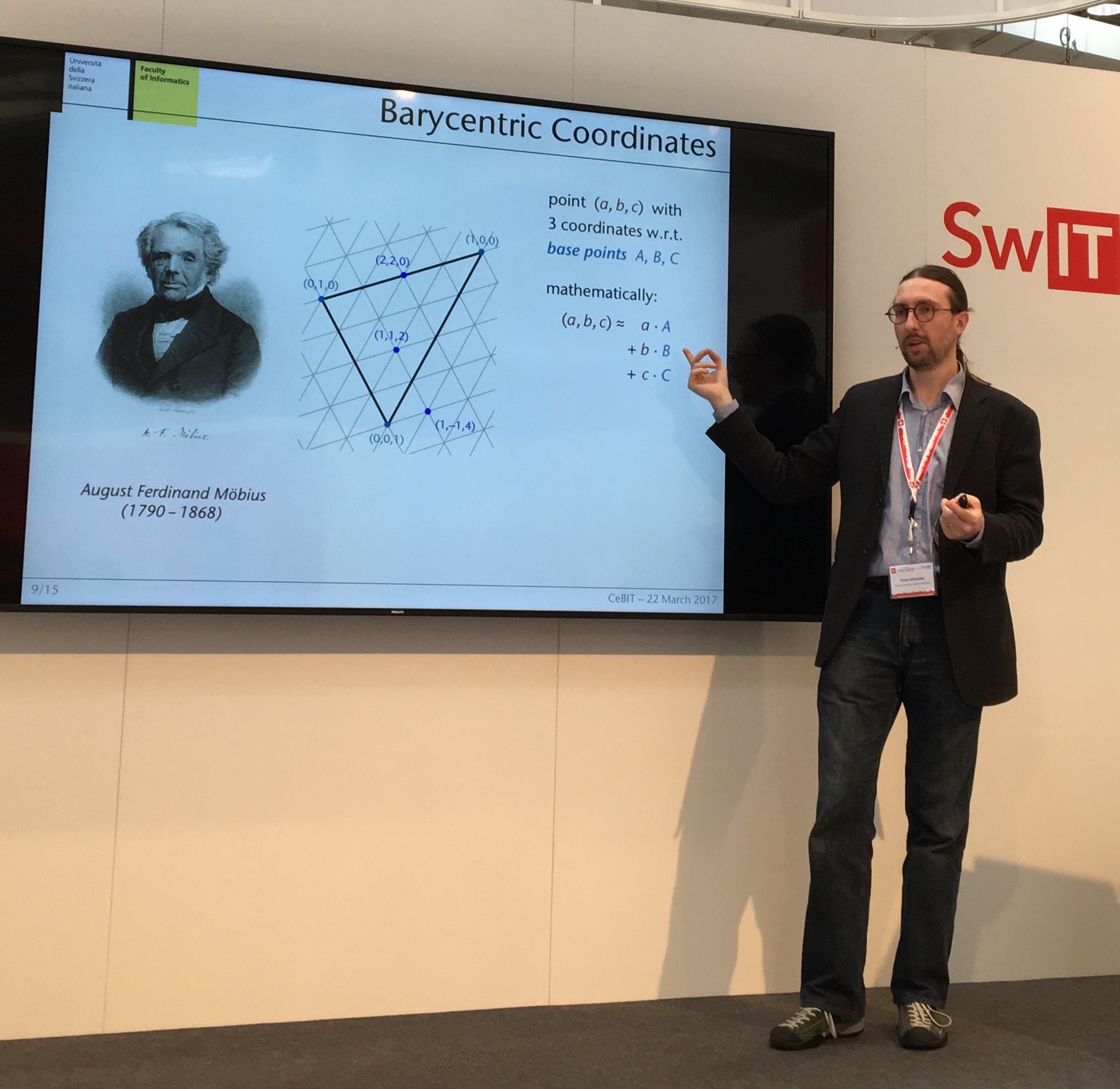
Teseo Schneider is an Assistant Professor in Computer Science at the University of Victoria, affiliated with the Faculty of Engineering and Computer Science. He holds a PhD from the University of Lugano (USI), where his thesis focused on bijective barycentric mappings. He completed a postdoctoral fellowship at New York University (NYU) under an SNF Early post-doc mobility grant. His research interests include geometry processing, computer graphics, numerical simulations, and differential geometry. Education: PhD in Informatics (2017, USI), MSc in Computer Science (2012, USI), BSc in Computer Science (2010, USI). Professional roles include lecturer for courses like Geometric Modeling and Computer Graphics , and co-supervisor for projects involving mesh generation and simulation. Research highlights include contributions to polyhedral finite elements, contact dynamics, and open-source libraries like PolyFEM and LibHip. His work bridges computational geometry with practical applications in biomechanics and engineering. Awards: SNF Early post-doc mobility fellowship (2017). Publications span high-impact venues such as SIGGRAPH, TOG, and Nano Letters, reflecting his expertise in simulation, meshing, and geometric algorithms.
Dr. Madeleine McPherson is an Associate Professor in the Department of Civil Engineering at the University of Victoria (UVic) and Principal Investigator of the Sustainable Energy Systems Integration & Transitions (SESIT) Group. She specializes in energy systems integration, decarbonization pathways, and multi-scale energy modeling. Her work focuses on coordinating infrastructure systems (transport, buildings, electricity, water) to achieve climate goals. Education: BASc in Engineering Science (University of Toronto, 2009) MEL in Clean Energy Engineering (UBC, 2010) PhD in Civil Engineering (University of Toronto, 2017) Research Interests: Variable renewable energy integration Energy systems modeling (CREST, SILVER) Electrification pathways for cities Decarbonization of Canada’s energy system through stakeholder engagement Her recent work explores 100% renewable city feasibility (e.g., Regina), grid flexibility requirements under high renewable penetration, and cross-sectoral decarbonization strategies. She collaborates with the Energy Modelling Hub to inform national policy dialogues. Advising & Grants: Actively recruiting graduate students/postdocs with backgrounds in engineering, computer science, or related fields. Funding available for MASc/PhD candidates. Her lab focuses on open-source modeling tools and capacity-building initiatives. Labs/Teams: SESIT Group (UVic) develops decision-support models for energy transitions, emphasizing participatory approaches with stakeholders and communities.
Mirco Ravanelli is an Assistant Professor at Concordia University (Gina Cody School of Engineering and Computer Science), specializing in deep learning for sequence processing with a focus on Conversational AI. He holds adjunct roles at Université de Montréal (DIRO) and is an Associate Member at Mila - Quebec AI Institute . He leads the SpeechBrain open-source project, a widely adopted toolkit for conversational AI. His academic journey includes a PhD (cum laude) from the University of Trento (2017) and a postdoc under Yoshua Bengio at Mila. He has published over 80 papers, focusing on self-supervised learning, cooperative deep learning, and speech/EEG signal processing. Key awards include the 2022 Amazon Research Award. Teaching involves machine learning courses for graduate and undergraduate students at Concordia. His research aims to bridge human-machine conversation through advanced neural models, emphasizing explainability and robustness in speech technologies. Key Projects: SpeechBrain, FocalCodec, Speech self-supervised benchmarking Labs: CRBLM Axis Leader (Center for Research on Brain, Language, and Music) Grants: Amazon Research Award, Others unlisted
Dr. Moshe Schwartz is a Professor in the Department of Electrical & Computer Engineering at McMaster University. His research focuses on error-correcting codes for improving digital communication and storage systems, particularly in storage technologies and their application in distributed systems. He specializes in coding theory, storage systems, and digital sequences, with a focus on resolving conflicts between storage density, reliability, and energy efficiency. He teaches courses such as 'Introduction to Digital Sequences' and 'Coding Theory,' emphasizing both theoretical foundations and practical applications. His work integrates hardware and software solutions to address challenges in non-volatile memory fragility and data center reliability. Research interests include: Coding theory for DNA storage and bioinformatics applications Error-correcting codes for tandem duplication and substitution errors Network coding and distributed storage systems Algebraic coding and combinatorial optimization Awards: Won the Best Paper Award at the DRCN Conference (2024) for research on covert communication via error-correcting codes. His work bridges theoretical advancements and real-world applications in storage and communication technologies. Dr. Schwartz collaborates on interdisciplinary projects involving genomic data integrity and secure network protocols. His lab focuses on advancing storage efficiency through graph-based coding and asymptotic rate optimization.
Dr. James Wadsley is a Professor of Computational Astrophysics and SHARCNET Chair in the Department of Physics and Astronomy at McMaster University. He holds cross-appointments at the Origins Institute and the School of Computational Sciences and Engineering. His work integrates deeply with Canadian high-performance computing infrastructure, including leadership roles in Compute Canada (Digital Research Alliance of Canada), SHARCNET, and the Canadian Astronomical Society (CASCA). His research focuses on multi-scale astrophysical simulations, particularly in: Galaxy Formation & Evolution: Cosmological simulations of galaxy assembly, star formation regulation, dark matter interactions, and environmental effects in clusters. Computational Methods: Development of advanced numerical tools like the GASOLINE SPH code, radiative transfer algorithms (TREVR, TREVR2), magnetohydrodynamics (MHD), and novel conduction models. Planetary System Origins: Planetesimal formation via streaming instability, giant planet formation mechanisms, and protoplanetary disk dynamics. Interstellar Medium (ISM): Structure of molecular clouds, magnetic field coupling, superbubble feedback, and gas cycling in galaxies. His recent publications demonstrate a strong emphasis on high-resolution simulations of feedback processes in dwarf galaxies, advancements in radiative transfer techniques, MHD implementations for star formation, and cosmological structure formation. Key trends include validating cold dark matter models, quantifying environmental quenching, and developing testable predictions for observatories like ALMA. Wadsley leads significant computational projects and collaborates internationally (e.g., VERTICO survey, AGORA collaboration). He directs research leveraging SHARCNET resources for large-scale simulations of galaxy evolution and ISM physics. No specific awards, students, or funded grants are detailed in the source text.
Tiffany Timbers is an Associate Professor of Teaching in the Department of Statistics at the University of British Columbia (UBC), Vancouver Campus. She is also Co-Director of the Master of Data Science program’s Vancouver Option. Her work focuses on developing curricula and teaching methodologies for reproducible data science practices. She holds a PhD in Neuroscience (2012) from UBC and a BSc in Biology (2005) from Carleton University, with postdoctoral research in genomics and data science education. Key roles include teaching courses such as DSCI 523 (Programming for Data Manipulation), DSCI 524 (Collaborative Software Development), and DSCI 100 (Introduction to Data Science). She emphasizes modern software development workflows, reproducible research, and collaborative tools like GitHub, Docker, and R/Python package creation. Her research spans reproducibility practices in education, open science tools, and computational genomics. Education: PhD in Neuroscience, UBC (2012) Postdoc in Data Science Education, UBC (2017) BSc in Biology, Carleton University (2005) Labs/Teams: Active in UBC’s Data Science education initiatives, developing tools like the ubccv R package for CV generation and RUDAUX for course management systems integration. Publications: Focused on reproducibility, educational resources, and computational biology, including peer-reviewed articles and open-source textbooks. Her work bridges pedagogy and technical innovation, emphasizing ethical and reproducible practices in data science education.
Claudio Di Sipio is a Post-doctoral Researcher at the Department of Information Engineering Computer Science and Mathematics, University of L'Aquila, within the SWEN research group. His research focuses on recommendation systems for software engineering, mining open-source software (OSS) repositories, and applying machine learning (ML) techniques to SE tasks. He has explored low-code platforms, fairness in recommenders, IoT development, and Large Language Models (LLMs) for SE. Professional Services: Served as a reviewer for journals like ACM TOSEM, IEEE TSE, and KAIS, and on program committees for conferences like FSE, ICSE, and MODELS. Awards: Recipient of COLA 2023 Best Paper Award, SoSyM-First Paper Award, and Best Foundation Paper Award. Organizing Activities: Co-organized workshops such as MDEIntelligence 2025, GenSyn 2025, and EQUISA 2025. Guest Editor for a special issue on Model-Based SE with Foundation Models. His advising includes co-supervising bachelor's theses on topics like AI for data science pipelines, LLMs in pull request generation, and model-based recommendation systems.
Patrick Dufour is a Professor at the University of Montreal specializing in white dwarf astrophysics. His research focuses on the study of white dwarf atmospheres, combining theoretical atmospheric models with observational data from spectroscopic and photometric studies. He investigates the presence of heavy elements in white dwarfs, which indicate accretion of planetary debris from tidally disrupted rocky bodies. His work provides insights into extrasolar planetary system composition and evolution. Dufour supervises graduate students like Érika Le Bourdais and has advised former student Maude Fortier-Archambault (MSc 2019). He collaborates on missions like CASTOR and uses advanced instrumentation such as JWST and HST. His research highlights unique opportunities to study exoplanetary material through polluted white dwarfs. Key areas of expertise include stellar spectroscopy, planetary debris analysis, and machine learning applications in astrophysics. Over 100 peer-reviewed articles document his contributions, emphasizing interdisciplinary approaches to understanding planetary system formation and evolution.