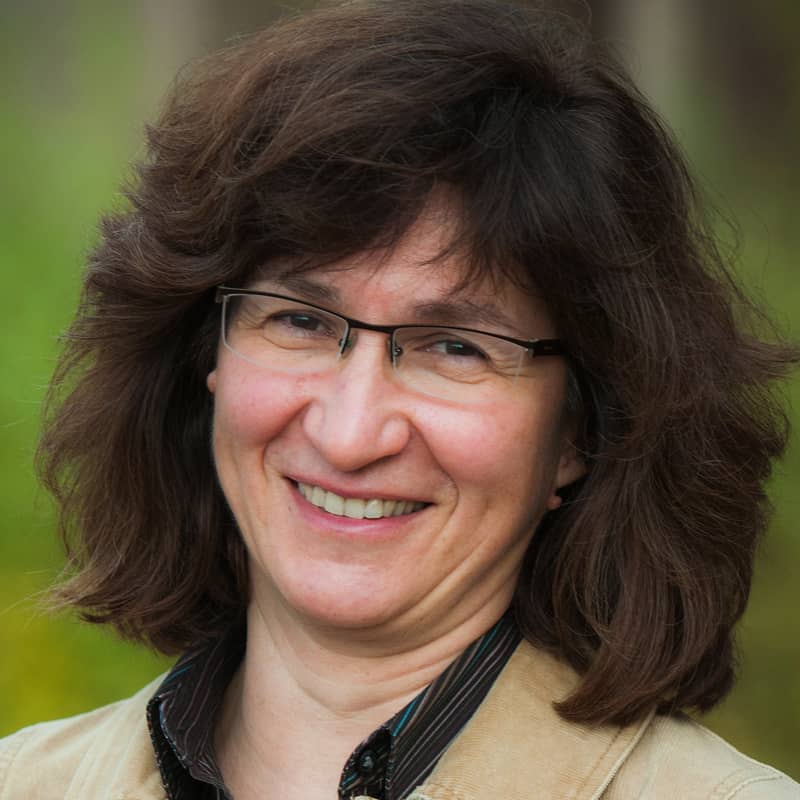
Inna Sharf is a Professor at the Department of Mechanical Engineering, Faculty of Engineering, McGill University. She is affiliated with the Aerospace Mechatronics Laboratory, focusing on dynamics, control, and robotics. Her work spans space robotics, UAVs, forestry automation, and multibody systems. Ph.D., University of Toronto B.ASc., University of Toronto Her research interests include: Dynamics and control of robotic systems Space robotics for debris removal and on-orbit servicing Unmanned aerial vehicles (quadrotors, indoor airships) Forestry robotics for tree-harvesting automation Multibody dynamics and contact modeling Recent publications emphasize: Control algorithms for quadrotors and UAV swarms De-orbitation strategies using natural resonances Motion planning under dynamic constraints Thermalling and energy-efficient flight for gliders Collaborative payload transport and adaptive control Tether and net-based debris capture systems
Jane Luu is a Professor II at the Centre for Planetary Habitability (UiO), specializing in comets, asteroids, and interstellar objects . Her research focuses on dynamic processes in small Solar System bodies, including fragmentation, disintegration, and dust behavior. She collaborates with international teams using facilities like the Nordic Optical Telescope (NOT) and WIYN Telescopes. Email: jane.luu@geo.uio.no Address: Sem Sælands vei 13, Svein Rosseland's house, 0371 Oslo Her work includes studies on comet outbursts (e.g., 12P/Pons-Brooks), disintegration mechanisms (C/2019 J2), and interstellar interlopers like 2I/Borisov and ’Oumuamua, where she proposed fractal dust aggregate models. Recent publications examine episodic activity in asteroids (6478 Gault) and discus-shaped comets (C/2014 B1).
Chenguang Sun is an Assistant Professor in the Department of Earth and Planetary Sciences at the Jackson School of Geosciences, University of Texas at Austin. His research focuses on understanding the thermal and chemical evolution of Earth and other rocky planets, emphasizing volatile cycling, magma dynamics, and planetary habitability. He employs experimental petrology, thermobarometry, and geochemical modeling to decode planetary processes. Key research areas include deep volatile cycling, magmatic differentiation, and planetary differentiation mechanisms. He has pioneered methods such as Mg-REE coupled geospeedometry to study crustal formation rates and mantle dynamics. His work bridges laboratory experiments with field observations to address questions about Earth’s interior-surface interactions and planetary habitability. Education: Doctorate in Geochemistry/Petrology (not explicitly stated, inferred from career trajectory) Affiliations: Jackson School of Geosciences; Mineralogical Society of America Fellow (2021) Dr. Sun’s recent publications explore topics like CO2-rich melt thermobarometry, nitrogen delivery via giant impacts, and kimberlite magmatism. His awards include the MSA Award (2021) and AGU Outstanding Student Paper Award (2012). He advises graduate student Lucia G. Bellino and teaches advanced courses in thermodynamics of geological processes and solid Earth dynamics. His lab develops novel petrological tools for interpreting magmatic and metamorphic processes, with a focus on volatile cycling’s impact on planetary evolution. Ongoing projects include studying mantle-derived melt systems and their role in Earth’s carbon budget.
Professor Roger Flanagan is a distinguished academic specializing in construction management with over two decades of research contributions. His work primarily focuses on international construction business, risk management, sustainable building practices, and whole life cost appraisal. Affiliated with the Chartered Institute of Building, London, he has authored numerous technical guides and publications that shape construction industry practices globally. Specializes in international construction business dynamics Expert in risk management and sustainable building practices Author of influential technical guides for the construction industry Research spans construction economics and supply chain management Flanagan's research interests center on the complexities of international construction projects, with particular emphasis on risk management, sustainable building practices, and whole life cost considerations. His work examines how contractors navigate international markets, manage project complexity, and implement sustainable practices. Recent publications address materials procurement in MSMEs, pre-construction planning complexity, and the integration of renewable energy in building projects, reflecting evolving industry challenges. Analysis of his 15 most recent publications reveals a consistent focus on construction management challenges with increasing emphasis on sustainability and international business dynamics. His work spans construction economics, risk management, sustainable building practices, and supply chain management, with particular attention to Korean and Middle Eastern construction markets. The research demonstrates methodological diversity, employing panel threshold regression, system dynamics, and empirical case studies to address complex construction industry problems. Professor Flanagan has made significant contributions through his authored guides for the Chartered Institute of Building, including the Guide to Quality Management in Construction (2021), Site Management and Production Guide (2020), and Code of Quality Management (2019). These practical resources translate academic research into industry applications, demonstrating his commitment to bridging theory and practice in construction management. His collaborative research extends across international boundaries, working with academics from institutions in Asia, Europe, and the Middle East. This global perspective enriches his understanding of diverse construction markets and practices, informing his research on international competitiveness, cross-cultural project management, and global supply chain dynamics. Professor Flanagan's work on construction sector futures, particularly his contributions to Vision 2020 initiatives, demonstrates leadership in anticipating industry trends and challenges. His research on information complexity, system dynamics applications, and decision support systems positions him at the forefront of addressing emerging challenges in digital construction and project management.
Prof. Dr.-Ing. Matthias Gaderer is a Professor of Renewable Energy Systems at the TUM Campus Straubing, Technical University of Munich. His research focuses on energy systems for heat, electricity, and fuels, with a particular emphasis on biomass, solar, and geothermal energy applications. He leads projects in combustion technologies, low-emission systems, and decentralized energy systems. Gaderer holds a doctorate from TUM and has extensive industry experience in process engineering. His work includes establishing applied biomass research at the Bavarian Center for Applied Energy Research and leading the research group 'Thermal Use of Biomass in High-Temperature Processes.' He is actively involved in committees such as the Scientific Committee of CEBC and Bavarian Science Forums. His teaching includes courses on energy systems and biomass utilization. Key projects include Reverion GmbH, FlexBioNeuro, and H2 real-world laboratory initiatives. Education: Process Engineering from TU Graz and KTH Stockholm. Research interests span thermochemical gasification, combustion technologies, and energy economics. His publications emphasize biomass gasification, hydrogen production, and sustainable energy systems. He collaborates on EU-funded projects like E2Fuels and leads teams in developing innovative energy solutions.
Juan Antonio Añel Cabanelas is a Professor of Earth Physics at the University of Vigo , affiliated with the EPhysLab research group and the Specialized Group on Atmospheric and Ocean Physics of the Royal Spanish Society of Physics . He serves as an Executive Editor for Geoscientific Model Development and an Associate Editor for PLoS Climate . PhD in Physics (2007) from the University of Vigo, thesis: Climatic analysis of the tropopause using radiosonde data Taught courses in Meteorology, Atmospheric Physics, Computational Science, and Renewable Energy at the University of Vigo and international institutions His research focuses on climate change impacts , upper troposphere-lower stratosphere dynamics , renewable energy modeling , and computational reproducibility in climate research . He emphasizes instrumental data recovery and open science , with recent work addressing stratospheric contraction and mercury cycling . Key publications span extreme weather-energy sector interactions , Fortran code quality , and ozone data analysis . He mentors PhD students in Physics and Computer Science, and has collaborated with institutions in Mexico, Portugal, and the private sector. He advocates for free software and has organized workshops on climate intervention and citizen science . His work is funded by public grants from Spain's Government, Xunta de Galicia, and private entities like Naturgy and Acciona, with computing support from Google and Microsoft.
Professor Meng Tao is a full Professor in the School of Electrical, Computer and Energy Engineering at Arizona State University (ASU), Tempe campus. He also holds the concurrent appointment of Senior Global Futures Scientist within ASU’s Global Futures Scientists and Scholars initiative. Since joining ASU in 2011, he has led the Laboratory for Terawatt Photovoltaics and played a pivotal role in founding the U.S. Photovoltaic Manufacturing Consortium under SEMATECH. Education: Ph.D. Materials Science and Engineering, University of Illinois at Urbana-Champaign, 1998 M.S. Semiconductor Materials, Zhejiang University, China, 1986 B.S. Ferrous Metallurgy, Jiangxi Institute of Metallurgy, China, 1982 Research Focus: Professor Tao’s research is broadly centered on the science and engineering challenges of scaling photovoltaics to the terawatt level while ensuring sustainability and cost-effectiveness. His group investigates earth-abundant chalcogenide semiconductors and transparent conducting oxides for thin-film devices, substitutes silver with low-cost aluminum in Si solar cell metallization, develops energy-efficient electro-refining routes to upgrade metallurgical-grade silicon to solar-grade purity, pioneers value-added recycling technologies for end-of-life Si modules, and explores solar-powered electrolysis using metal/metal-oxide loops for long-term electricity storage. Grant Portfolio & Trends: Recent funding from NSF and DOE has supported projects on high-efficiency Schottky-barrier silicon cells, theoretical/experimental studies of iron oxysulfide absorbers, doping of cuprous oxide in electrolytes, and CVD-based valence-mending passivation for crystalline silicon. These grants underscore a consistent emphasis on materials innovation, process intensification, and circular-economy solutions for PV. Teaching & Mentoring: Professor Tao teaches and mentors across the EEE, MSE and CHE programs, offering courses ranging from introductory circuits to advanced photovoltaic energy conversion and doctoral dissertation supervision. While specific advisee names are not disclosed, the extensive thesis and research course listings indicate a large, active graduate group. Laboratory & Collaborative Networks: The Laboratory for Terawatt Photovoltaics under his direction serves as the central hub for experimental work on solar cell fabrication, electroplating, electrochemical recycling, and materials characterization. The lab collaborates closely with national consortia such as SEMATECH and leverages ASU’s advanced clean-room and analytical facilities.
Dr. Lars Lauterbach is a University Professor at RWTH Aachen University , leading the Department of Synthetic Microbiology . His research focuses on molecular genetics, biochemistry, and gas-converting biocatalysts, particularly hydrogen-dependent enzymatic processes. Institution: RWTH Aachen University Role: Institute Head Contact: lars.lauterbach@rwth-aachen.de His work spans hydrogen metabolism , metalloenzymes , and electrobiochemistry , with recent publications emphasizing CO2 conversion, hydrogenase engineering, and enzymatic cofactor regeneration. Key research areas include: Hydrogen-driven biocatalytic cascades Oxygen-tolerant hydrogenases Carbon dioxide valorization Multi-step enzymatic synthesis Hydrogen storage and utilization Redox chemistry in metalloproteins The 2023-2025 article list reflects trends in CO2-based biotechnology , biocatalytic hydrogenation , and synthetic microbial systems , with applications in pharmaceuticals, fine chemicals, and sustainable energy.
Professor Anthony J. Ryan, OBE, is the Professor of Physical Chemistry at the University of Sheffield and Founding Director of the Grantham Centre for Sustainable Futures. His research focuses on sustainable polymers, renewable energy, and the food-water-energy nexus. He leads sustainability initiatives integrating science, engineering, and social sciences. Ryan has held roles including Pro Vice Chancellor of the Faculty of Science (2008–2016) and Head of Chemistry. Educated at the University of Manchester (BSc, PhD) and UMIST (DSc), he has over 300 publications and co-authored influential books like The Solar Revolution . Education: BSc from University of Manchester PhD from University of Manchester DSc from UMIST Research Interests: Sustainable synthesis of polymers, flow-induced crystallization, organic photovoltaics, urban agriculture, and translational science communication. His work bridges fundamental research and real-world applications, emphasizing environmental and societal impact. Articles: Recent publications span polymer science, sustainable materials, and interdisciplinary sustainability challenges. Key themes include renewable materials, nanocomposites, and energy-efficient systems. Awards: OBE for Services to Science (2006) Beilby Medal & Prize (1999) Gold Medal, Society of Dyers and Colourists (2008) Advising & Grants: Leads major sustainability programs and collaborates with international bodies like the UNFCCC. His work includes public engagement via media and institutions like Chatham House. Labs/Teams: Directs the Grantham Centre, fostering cross-disciplinary sustainability research. Active in initiatives like Project Sunshine and urban horticulture projects.
Campbell Drake is a Senior Lecturer in Interior Architecture at the University of Technology Sydney's School of Architecture within the Faculty of Design, Architecture and Building. Registered as an architect in New South Wales and Victoria with over 15 years of professional experience, he specializes in sustainable eco-tourism development in environmentally sensitive locations. His work bridges academic research and practical application through partnerships with government and non-government agencies focused on Indigenous infrastructure and housing. Education: PhD from RMIT University (2012-2018) Masters of Research Architecture from Goldsmiths College, University of London (2009-2010) Bachelor of Architecture from RMIT University (1999-2005) Dr. Drake's research centers on the interaction between urban infrastructure and social formation within remote communities, particularly investigating socio-architectural relations in Indigenous contexts. His work explores how infrastructure can enhance wellbeing, cultural practices, and environmental sustainability. He specializes in participatory design methods that empower communities through culturally responsive approaches that integrate Indigenous knowledge systems. His research spans sustainable tourism development in Indonesia, Indigenous housing policy in Australia, cultural burning practices, and the spatial politics of tourism infrastructure, demonstrating a commitment to decolonizing design practices and creating architecture that serves community needs. His recent publications reveal a clear trajectory toward evaluating specific programs (like the Roads to Home Program and Wreck Bay housing strategy) while simultaneously developing theoretical frameworks for culturally responsive architecture. There's a consistent focus on Indigenous infrastructure, housing, and participatory design methodologies, with increasing attention to the intersection of traditional knowledge systems with contemporary design practices in remote Australian communities. His work bridges practical implementation with critical theoretical analysis of power dynamics in architectural practice. Scientific Awards: 2018 UTS Teaching and Learning Awards: Indigenous Professional Capabilities High Commendation Interior Design/Interior Architecture Educators Association Teaching Award (2018 Third place finalist) 2018 AILA Research, Policy & Communication Landscape Architecture Award International Interior Design Association 2014 Global Excellence Awards Dr. Drake supervises Masters and PhD students with a focus on Indigenous architecture and sustainable design. His funded research includes culturally responsive design principles for Aboriginal housing, evaluations of the Wreck Bay Village housing program, Roads to Home evaluations for Gulargambone & Bowraville Reserves, and solar lighting projects for Namoi and Gingie Reserves. His grants come from diverse sources including the NSW Aboriginal Land Council, National Indigenous Australians Agency, and Department of Planning Industry and Environment, reflecting the practical impact of his work. As a founding member of UTS TIISHA (The Indigenous Infrastructure and Sustainable Housing Alliance), Dr. Drake leads collaborative research projects focused on 'health enabling infrastructure' to address structural factors of Indigenous disadvantage. TIISHA works with multiple Aboriginal Land Councils and government agencies to evaluate and implement housing and infrastructure programs that respect cultural values and community needs, demonstrating his commitment to creating tangible benefits for Indigenous communities through architectural practice.
Hans Hellsmark is an Associate Professor and Senior Researcher at Chalmers University of Technology's Environmental Systems Analysis department. He serves as coordinator of the Chalmers Initiative for Innovation and Sustainability Transitions and as one of the profile managers for Technology Governance in Energy Transitions within the Energy Area of Advance. Additionally, he acts as Chalmers coordinator for the Swedish knowledge centre for renewable transportation fuels (f3), working with diverse stakeholders across academia, industry, and policy to facilitate societal transitions through knowledge support and tailored activities. His research focuses on innovation and research policy for transformative societal change, particularly examining how policy instruments drive sustainability transitions. Hellsmark investigates the socio-economic benefits of governmental investments in research infrastructure and analyzes the complex interactions between policy makers, industry actors, research institutes, and universities in facilitating energy transitions. His work specializes in policy mixes, directionality in transformative missions, and the role of pilot and demonstration plants in market formation for sustainable technologies. Recent publications reveal a strong focus on energy transition pathways in process industries and hydrogen economies, with recurring themes of policy alignment challenges, stakeholder narratives, and practical implementation of decarbonization strategies. His research consistently examines how directionality in policy missions influences industrial transformation and how demonstration projects bridge technology development and market formation. Hellsmark leads and participates in numerous research projects funded by VINNOVA, Swedish Energy Agency, Formas, and Nordic Energy Research, including 'Mission-driven policy instruments for zero and negative emissions' (2024-2026), 'Nordic Hydrogen Hubs' (2023-2026), and 'Pilot and Demonstration Plants for Energy Transitions' (ongoing since 2020). His work demonstrates extensive collaboration with researchers including Anna Bergek, Patrik Söderholm, and Johnn Andersson across multiple institutions. He works within the Environmental Systems Analysis research group at Chalmers, contributing to the university's Energy Area of Advance. His research connects closely with Chalmers' broader sustainability initiatives and knowledge platforms focused on system transformation, where he helps bridge academic research with practical policy applications in the energy transition.
Dr. Maja Krzic is a Professor at the Department of Forest and Conservation Sciences within UBC's Faculty of Land and Food Systems. Her research bridges soil science with sustainability education through community engagement and digital innovation, focusing on human impacts on soil properties across agricultural, grassland, and forest ecosystems. She develops cutting-edge teaching tools like the Digging into Canadian Soils open textbook and SOILx interactive platform. PhD (University of British Columbia, 1997) MSc (University of Belgrade, 1990) BSc (University of Belgrade, 1986) Her publications (2010-2025) explore greenhouse gas dynamics in agricultural systems, soil carbon sequestration in elevation gradients, and innovative educational approaches including problem-based learning and augmented reality. Recent work addresses climate-resilient soil management in coastal British Columbia and gender parity in soil science academia. Major awards include: 3M National Teaching Fellow (2016) UBC Killam Teaching Prize (2006) Fellow, Soil Science Society of America (2023) Platinum AVA Digital Award for SOILx (2015) She has mentored 28 graduate students and postdocs, including Amy Wells (2024), Clara Roa-Garcia (PhD, 2018), and Preston Cumming (Postdoc, 2015). Current projects focus on climate change adaptation in Delta farmland and regenerative agricultural practices.
Florian Rabitz is a Professor in the Department of International Relations at Vilnius University's Institute of International Relations and Political Science (VU TSPMI). His work focuses on global environmental politics , international institutions , and the governance implications of new and emerging technologies in sustainability contexts. He holds a PhD in Political Science from the Free University of Brussels. Education : PhD in Political Science (Free University of Brussels) Rabitz's research explores the intersection of technology and global governance, particularly in areas like space resource utilization , gene drive organisms , and solar radiation management . His recent publications analyze the formation of international regimes for space resources and the equity challenges of asteroid mining. He contributes to global policy discussions through his role as a Senior Research Fellow at the Earth System Governance Project and as a member of the Ad Hoc Technical Expert Group on Synthetic Biology under the Convention on Biological Diversity. His methodological approaches include social network analysis and topic modeling to map complex governance systems. Key Affiliations : Earth System Governance Project Convention on Biological Diversity (Expert Group) Rabitz has presented his research at major international conferences, including the European Consortium for Political Research General Conference and the Toronto Conference on Earth System Governance.
Professor Patrick Rinke leads the Chair of AI-based Materials Science at the Technical University of Munich (TUM), within the TUM School of Natural Sciences and Department of Physics. His research group develops advanced electronic structure and machine learning methods to address critical challenges in materials science, surface science, physics, chemistry, and nanoscience. Professor Rinke's research spans multiple cutting-edge domains including electronic structure theory development, machine learning applications for materials science, data-driven materials discovery, biomaterials engineering, atmospheric science applications, clean energy materials, and hybrid materials systems. His work integrates advanced computational methods with practical applications across diverse scientific fields, particularly focusing on how artificial intelligence can transform traditional materials research. Analyzing his recent publications reveals strong trends in applying machine learning techniques to materials discovery, with particular emphasis on Bayesian optimization methods, active learning approaches for molecular data, and efficient dataset generation strategies. His research spans from fundamental electronic structure theory to practical applications in biomaterials, atmospheric science, and renewable energy technologies. Professor Rinke has received several prestigious awards including the August-Wilhelm Scheer visiting professorship (2017), a German Science Foundation research scholarship (2007), the Outstanding Postdoctoral Research Achievement Award from UC Santa Barbara (2009), recognition as an Outstanding Referee for Physical Review journals (2014), and the Institute of Physics Computational Physics Group Thesis Prize (2003). Professor Rinke actively contributes to the academic community through teaching and supervision. For the Winter term 2025/26, he is teaching courses including Academic Writing Skills, Introduction to Machine Learning for Materials Science, Current Topics in AI-Based Materials Science, and Machine Learning for Natural Sciences. His research group includes several team members working on diverse projects spanning the intersection of AI and materials science.
Elaina Hyde is an Associate Professor in the Department of Physics and Astronomy at York University, serving as Director of the York Allan I. Carswell Observatory. She is affiliated with the Faculty of Science and eligible to supervise graduate students in the Physics and Astronomy program. Her research focuses on galactic archaeology, galaxy formation, and data science for astrophysics, leveraging cloud computing and machine learning. She has contributed to major initiatives like the GALAH survey and studies of the Sagittarius stream. Her work combines observational astronomy with technical leadership in telescope operations and public outreach. Hyde is also a certified Google Cloud Trainer and Engineer, integrating industry-level data science practices into academic and educational contexts. Education & Professional Background : While specific educational details are not listed, her roles indicate advanced expertise in astrophysics and data science. She has held technical and leadership positions in telescope operations and academic observatories. Research Interests : Hyde's work bridges computational and experimental astrophysics, emphasizing: Galactic archaeology via chemical and kinematic analysis of stellar populations Data-driven approaches to galaxy formation modeling Development of automated spectroscopic pipelines (e.g., GALAH survey) Machine learning applications for spectral classification and dimensionality reduction (e.g., t-SNE techniques) Astronomy education through public telescope access and interdisciplinary training Publications Overview : Her recent work focuses on the GALAH survey's chemical and kinematic inventory of the solar neighborhood, Sagittarius stream dynamics, and machine learning-enhanced spectral analysis. Key themes include stellar abundance trends in open clusters, tidal debris identification, and multi-survey data integration with Gaia. Labs & Teams : Leads the York Allan I. Carswell Observatory, fostering observational astronomy research and public engagement. Collaborates with global telescope networks and industry partners in cloud computing.