Dr. Daniel Müllensiefen is a Professor of Music Psychology at Goldsmiths College, University of London, and Director of the MSc Music Mind and Brain program. His research focuses on music cognition, including melodic memory, earworms, musical expertise measurement (via the Gold-MSI), and forensic musicology. He has held roles such as Scientist in Residence at DDB UK, exploring sonic branding, and is a co-founder of the consultancy Musikgutachten.de. Müllensiefen leads the longitudinal LongGold project studying musical development in adolescents. He received the 2016 Anneliese Maier Award for his contributions to music psychology. Education: PhD in Systematic Musicology from the University of Hamburg (2005), studies in Musicology and Journalism at Hamburg and Salamanca Universities. Research Interests: Musical sophistication, cognitive mechanisms in music perception, educational psychology of music, and applications in advertising/forensic contexts. Active in software development for music analysis (e.g., FANTASTIC, psychTestR). Key Contributions: Gold-MSI psychometric tool, forensic music similarity analysis, and studies on involuntary musical imagery (earworms). Collaborations with institutions like the German Humboldt Foundation and InnovateUK.
Dr. Daniel Eadens is an Associate Professor in the Department of Educational Leadership and Higher Education at the University of Central Florida (UCF). Previously, he served as Assistant Department Chair and tenured Associate Professor at Northern Arizona University. His career spans diverse roles including elementary music teacher, middle school special education instructor, school administrator, and retired Army Reserve Major with service in Japan and Iraq. Dr. Eadens holds an Ed.D. in Educational Leadership and Policy Studies from the University of South Florida. His research focuses on critical educational issues such as school safety, social justice, and school board governance. He co-edited Social Justice Instruction: Empowerment on the Chalkboard and actively contributes to professional journals as an editor and peer reviewer. His recent publications emphasize pandemic impacts on education, online learning dynamics, financial literacy policies, and administrator preparation. Key themes include leveraging technology for equitable education, addressing systemic inequities, and enhancing leadership practices in K-12 and higher education contexts. Dr. Eadens has been recognized for contributions to the field, though specific award names are not detailed in the provided materials. His work bridges practical leadership training with scholarly research, advocating for human-centered approaches to educational challenges.
Rob Locke is a Senior Lecturer in Lighting Technology at the Faculty of Business and Creative Industries, University of South Wales. He joined the university in 2006 after a 20-year career with the BBC in Wales, specializing in broadcast TV lighting. As Course Leader for Sound and Live Event Production, and Lighting Design and Technology, he emphasizes industry collaboration to provide students with real-world production experiences. His technical expertise includes hardware interfaces and programming in C++/Python. Research interests focus on applying broadcast TV lighting principles to academic training and interdisciplinary collaborations. Notable projects include technical support for the 2012 Olympics (OBS), USW graduation broadcasts, and TEDx technical production. He maintains strong ties with industry through partnerships in set design, fashion, and music production.
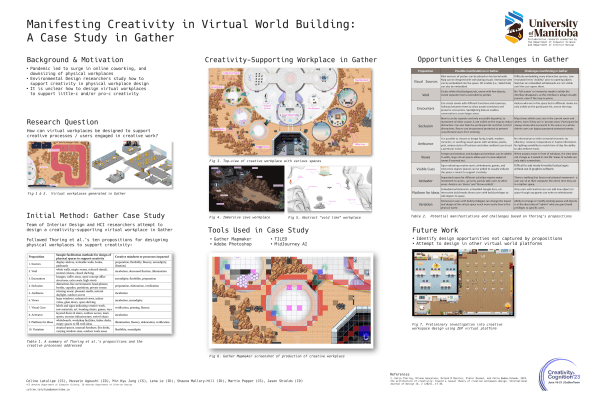
Dr. Celine Latulipe is a Professor in the Department of Computer Science at the University of Manitoba, with prior tenure as a Professor at the University of North Carolina at Charlotte. She holds a PhD in Computer Science from the University of Waterloo (2006) and has a strong focus on Human-Computer Interaction (HCI), Computer Science Education, and technology support for older adults. Her research explores caregiver-older adult partnerships in digital spaces, inclusive pedagogy for underserved populations, and creativity-support tools. Education: PhD (Computer Science, Waterloo), MMath (Computer Science, Waterloo), B.A. (Economics & Applied Studies, Waterloo) Affiliations: Co-Chair of SIGCHI Cares Committee, Steering Committee Member of ACM Creativity & Cognition Conference, and Research Affiliate at UNC Charlotte. Recent Leadership: Co-Chair of Creativity & Cognition 2024 (Chicago) and Virtual Venue Chair for 2025. Designed immersive virtual conference spaces using Gather.Town (e.g., C&C 2021/2023). Grants & Funding: NSERC-funded projects on aging technology and financial accessibility. Research Themes: Her work spans financial technology for older adults (e.g., proxy banking accounts), CS curriculum innovation, and interdisciplinary collaboration beyond STEM. She advocates for equitable educational practices and has published widely on pandemic-era learning, inclusive teaching, and digital accessibility. Professional Impact: Supervises graduate students (e.g., Zach Havens, Min Kyu Jung) and collaborates on projects like the Connected Learner initiative. Her recent work addresses caregiver password-sharing risks and anti-racist curricular frameworks.
Mariusz Rybnik is a Lecturer at the Institute of Informatics, University of Bialystok. He holds an MSc in fuzzy c-means classification from Bialystok University of Technology and a PhD in task decomposition and Artificial Neural Networks from Paris XII Val-de-Marne University. His research focuses on cognitive modeling, music information processing, biometric systems, and embedded safety technologies. He contributes to projects like Religion, Ideology & Prosociality , implementing computational models to study secularizing societies. Education: MSc: Fuzzy C-Means Classification (Bialystok University of Technology) PhD: Task Decomposition & Artificial Neural Networks (Paris XII Val-de-Marne University) Research Interests: Artificial Intelligence & Machine Learning applications Cognitive modeling and agent-based simulations Biometric authentication systems (e.g., keystroke dynamics, face recognition) Music information retrieval and harmonization models Embedded systems for automotive safety (eCall, accident detection) Projects & Contributions: Lead developer for computational models in the Religion, Ideology & Prosociality project Advances in eCall systems for vehicle safety and emergency response Innovations in fusion of biometric traits for security initiatives Advising & Grants: No formal advisees listed; active in collaborative research projects. Labs/Teams: Affiliated with the Institute of Informatics' research groups in AI and embedded systems.
Stacey Hancock is an Associate Professor of Statistics at Montana State University (MSU), where she contributes to the Department of Mathematical Sciences. She earned her Ph.D. in Statistics from Colorado State University (2008), M.S. from Montana State University (2004), and B.A. in Mathematics and Music from Concordia College (2001). Her research focuses on statistics and data science education, including student learning processes in statistical concepts, flipped classroom dynamics, and curriculum development. She leads the NSF-funded MSU Storytelling Group, which introduces computer science to rural and Indigenous middle school students in Montana through storytelling. Additional research interests include time series analysis (particularly change-point detection) and ecological statistics. Dr. Hancock teaches courses such as Stat 401 (Applied Methods in Statistics) and Stat 505 (Linear Models). She actively develops innovative teaching methods, including integrating Tableau for data visualization and hands-on simulation activities. Her NSF grant work emphasizes bridging computer science education with environmental applications. She has published widely on statistical pedagogy, computational skills in environmental science, and interdisciplinary curriculum design.
Anestis Georgios is a Laboratory Teaching Staff member (EDIP) at the Technical University of Crete (TUC), affiliated with the School of Electrical and Computer Engineering. He is part of the TUC/MUSIC Laboratory (Distributed Multimedia Information Systems and Applications) and holds a Master's degree in Computer Engineering and Operations Research, alongside a Diploma in Electronics and Computer Engineering from TUC. His professional roles include permanent staff in the Distributed Multimedia Information Systems and Applications Laboratory (2004–2015) and an associate partner at the Computer Technology Institute’s eGovernment Division (2003). Education: Master of Engineering in Computer Engineering, TUC (2001) – Thesis: 'Designing an Information System to Support Virtual Communities of Users' (supervisor: Prof. Stavros Christodoulakis) Master of Science in Operations Research, TUC (2001) – Thesis: 'Development of a decision support system for multicriteria evaluation of IT qualifications' (supervisor: Prof. Nikolaos Matsatsinis) Diploma in Electronics and Computer Engineering, TUC (1997) – Thesis: 'Design and Implementation of a Boolean and Similarity Retrieval System on top of Relational Database Management Systems' (supervisor: Prof. Stavros Christodoulakis) Research Interests: Anestis focuses on multimedia systems, distributed architectures, decision support systems, and knowledge management. His work integrates pervasive computing, service-oriented architectures (SOA), and peer-to-peer (P2P) technologies to address challenges in cultural tourism, digital business ecosystems, and educational technologies. He emphasizes user-centered design principles and the semantic interoperability of systems. Article Trends: His publications span topics such as retrieval systems (REALM, 2024), pervasive gaming (Rollick games, 2023), and cultural tourism interactions (2006–2018). Early work (1998–2004) centered on distributed knowledge management and decision support frameworks, while recent contributions explore formal languages for location-based applications and theatrical learning experiences. Professional Contributions: Anestis has led or participated in EU projects like 'Digital Business Ecosystems' (2003–2006) and 'Caravan Next: Feed the Future' (2015–2019). He has developed platforms like the Skills Evaluator (2003–2006) for IT qualification assessment and SSLE for semantic service descriptions (2007). No awards are explicitly listed, but his projects reflect significant industry and academic impact. Labs/Teams: He contributes to the TUC/MUSIC lab, focusing on distributed multimedia systems and applications. His work bridges theoretical research with practical implementations in cultural heritage, smart tourism, and enterprise systems.
Sarah Hauser serves as Vice Dean and Lecturer at the Lucerne School of Computer Science and Information Technology, part of Lucerne University of Applied Sciences and Arts. She holds an MSc in Informatik from ETH Zurich with minors in Information Security and Software Engineering, complemented by Fine Arts modules from Berlin University of the Arts. Her professional experience includes leadership roles such as Head of the Computer Science Degree Program and Head of iCompetence at FHNW School of Engineering. She has also worked as an IT Consultant and Software Developer. Education: MSc ETH in Informatik (ETH Zurich) Fine Arts Modules (Berlin University of the Arts) Executive MBA in International Management (University of Zurich) University Teaching Certificate (Lucerne University of Applied Sciences and Arts) Her research focuses on Secure Distributed Computation Systems , Social Network Analysis , and Computational Music Thinking . She actively engages in software engineering projects and curriculum development for higher education. Her competencies span management, project coordination (Scrum Master I certified), and student project coaching. Professional Development: HEM Executive Program (swissuniversities) Project Management (BWI Management Education) Assessor and Coach Training (FHNW)
Marcel Vonesch is a Lecturer at the Lucerne School of Music (HSLU), specializing in Computer-Music Applications and Contemporary Music Production. He holds a degree in Musicology from the University of Zurich and a 'Commercial Arranging' diploma from Berklee College of Music (Magna Cum Laude). His career includes roles as a guitarist for Walt Disney Co., music producer for SF DRS and Puppentheater Bleisch, and sound engineer with TonArt Productions. Teaches 'Music and Computer' at HSLU Freelance composer/producer for MTV, HBO, and corporate clients Operates a mobile recording studio with expertise in Ableton and Steinberg software Research focuses on digital music education (ITC - Musikunterricht digital), groove perception in jazz/funk, and hybrid digital-analog music formats. Competencies include composing, arranging, and producing for film/TV/advertising. Recent works include soundtracks for short films and commercials, with 15+ years studio experience as both musician and producer.
Chrysafiadi Konstantina is an Assistant Professor in the Department of Informatics at the University of Piraeus's School of Information and Communication Technologies. Her work bridges fuzzy logic, artificial intelligence, and educational technology to develop adaptive systems for diverse applications. Research Interests: Her primary focus includes fuzzy logic-driven personalization, intelligent tutoring systems, and machine learning applications in education and safety. Key areas are: Design of adaptive educational games and e-learning platforms AI-enhanced cultural analysis using large language models Smart home safety systems with fuzzy-based emergency alerts Personalized recommendation engines for tourism and entertainment Publication Trends: Recent work (2023-2025) demonstrates extensive use of fuzzy logic combined with machine learning to create context-aware systems. Dominant themes include personalized education (e.g., programming tutors, adaptive quizzes), cultural heritage analysis (e.g., song/poem interpretation with GPT), and safety solutions (e.g., fire prevention in smart homes).
Sotiropoulos Dionisios is an Assistant Professor at the Department of Informatics, University of Piraeus. His research focuses on bio-inspired computing and machine learning methodologies, with a specific emphasis on social media analysis. He has held postdoctoral positions at the Athens University of Economics and Business (Department of Management Science and Technology) and serves as a visiting researcher at the Norwich Business School, University of East Anglia. He is a member of the SocioMine research group. Education: PhD in Informatics (2011), University of Piraeus; BSc in Informatics (2003), University of Piraeus His research spans Machine Learning , Data Mining , Evolutionary Computation , Signal Processing , and Intelligent Software Systems . Recent work explores hybrid AI architectures combining knowledge graphs and large language models for cultural analytics, boundary-aware classification, and transparent financial modeling using genetic programming. His publications reveal trends in applying machine learning to social media analytics, healthcare diagnostics, cryptocurrency trading, and cultural domains like music and political speech. Key methodologies include LSTM networks , artificial immune systems , BERT models , and reinforcement learning . As part of the SocioMine research group , he develops user modeling techniques for personalized recommendation systems and investigates opinion formation dynamics in social networks.
Robert Q. Topper is a Professor of Chemistry at The Cooper Union's Albert Nerken School of Engineering. He holds a B.S. in Physics and Chemistry from Florida State University and a Ph.D. from Yale University. His research focuses on computational and theoretical chemistry, including nanoscience, material science, and biophysics, with emphasis on Monte Carlo methods, machine learning, and quantum mechanics. He has mentored over 115 students and published extensively in top journals like Physical Review Letters and the Journal of Chemical Physics. Dr. Topper’s academic journey includes roles as Department Chair at Monmouth University and a visiting researcher at NYU. He has organized 5 international conferences and delivered 23 invited seminars. His awards include the 2025 Teaching Award from the New York American Chemical Society and two recognitions on Cooper Union’s 'Student’s List.' Teaching spans general, physical, and theoretical chemistry at all academic levels. He collaborates with researchers globally, including NYU’s Tuckerman group. His work bridges theory and experiment, addressing environmental and material challenges. Beyond academia, he volunteers with the New Jersey State Youth Orchestra and enjoys music, hiking, and graphic novels. Research highlights include studies on ammonium nitrate nanoparticles, atmospheric aerosols, and computational methods for battery research. He leads a lab advancing machine learning applications in molecular dynamics, with recent grants for next-gen battery materials development.
Sean Cusack is an Adjunct Professor in the Department of Electrical and Computer Engineering at The Cooper Union. He holds a BSE from The Cooper Union (1998) and has extensive industry experience in software infrastructure at Bloomberg LP, Merrill Lynch, and Jefferies & Co. His professional work includes system-level interfaces, data-mining, and financial statistical arbitrage systems. Since 2003, he has taught CS102 (Introduction to Computer Science) and led cross-disciplinary courses like EID364 (Web/App Development) and EID103 (Design). He co-founded Learnosaurus, Inc. , an edtech venture converting K-5 homework into gamified learning tools, which aims to launch in schools by 2013. Sean is deeply engaged in Cooper Union’s community, co-founding the Cooper Union Entrepreneurship Society (CUES), organizing events like the Startup Challenge, and managing initiatives like CooperUnionTaskForce.com. He also serves on the Alumni Council and Friends of Cooper Union, focusing on communications and stakeholder coordination. Education: Bachelor of Science in Engineering (BSE), The Cooper Union, 1998 Research & Innovation: His work spans financial software systems, educational game design, and cross-school project management. Learnosaurus, his primary venture, reflects his dual focus on pedagogy and computational infrastructure. He actively explores the intersection of technology and education through workshops like Cooper App Camp and collaborations with the Flatiron School. Community Engagement: Beyond academia, Sean co-ran Boy Scout Troop 999 at Icahn House West, advocates for Cooper Union’s operational transparency via documentation projects, and performs piano music at community events. His personal interests in scuba diving and global travel inform his collaborative approach to problem-solving.
Irene Bal is an Assistant Professor in the Education Specialties Department at Loyola University. She holds advanced degrees in Educational Research and Music Education and has presented extensively on technology integration in K-12 settings. M.E., University of South Carolina - Educational Research M.M.E., University of South Carolina - Music Education B.M.E., Furman University - Music Education Her research focuses on technology integration in the Visual and Performing Arts, engagement with adult learners, professional development in the workplace, and distance learning methodologies. She emphasizes blended learning, project-based classrooms, and student-centered technology use. Recent publications highlight trends in instructional technology, including the Hour of Code, Discovery Education tools, and strategies for creating engaging digital learning environments. She has secured multiple technology grants and received recognition for innovative teaching practices. iPevo Wish Pool Recipient Schoolastic Winner: Scholastic Education Colonial Life Strong Schools Grant Award 21st CCLC Grant Award Technology Grant, Richland School District One Tec Savvy Teacher of The Year Award Irene has presented at state and regional conferences on topics such as grant writing, blended instruction, and student engagement, while serving on the Advisory Board for Fortis College.
Dr. Rukshan Athauda is a Senior Lecturer at the University of Newcastle, affiliated with the School of Information and Physical Sciences (Computing and Information Technology). He holds a PhD in Computer Science from Florida International University and has over 15 years of academic and industry experience. His roles include leadership positions such as Program Convenor for multiple degree programs and RHD Coordinator. Research Expertise: His work spans Database Systems, Educational Technology, Cloud Computing, and IT Security. Notable projects include frameworks for collaborative music post-production, virtual labs in education, and trust models in digital ecosystems. He has co-authored 75+ publications and attracted $741K in grants. Teaching: Currently teaches Systems and Network Administration and Cloud Computing. Previously developed courses in databases and IT systems at the University of Moratuwa and SLIIT in Sri Lanka. Professional Activities: Editorial board member of the International Journal of Computer and Information Technology. Keynote speaker at multiple conferences and recipient of awards for collaboration and teaching innovation. Grants & Supervision: Lead 19 grants, including projects on transport scheduling and learning analytics. Supervised 10+ PhD/Masters projects on topics like cybersecurity, learning frameworks, and fog-cloud environments.