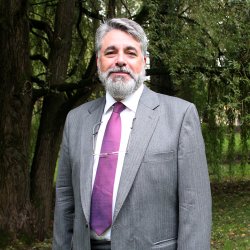
Diyi Yang serves as an Adjunct Professor within the School of Interactive Computing at the Georgia Institute of Technology, where they contribute to the Machine Learning (ML@GT) research initiative. This academic unit operates under Georgia Tech's College of Computing and focuses on human-centered computing, artificial intelligence, and interdisciplinary technological innovation. Dr. Yang's research spans critical domains including Natural Language Processing and Machine Learning, with significant contributions to Computational Social Science and Social Computing. Their work integrates algorithmic approaches to analyze linguistic patterns and social dynamics, developing systems that model human behavior through computational frameworks. This research bridges technical AI advancements with real-world societal applications, particularly in understanding online interactions and community structures. No scientific awards or honors were specified in the available information. The provided text contains no mention of prizes, fellowships, or medals received by Dr. Yang. While Dr. Yang holds an advisory capacity as an Adjunct Professor, specific details about graduate students supervised or research grants managed are absent from the source material. Their role appears focused on research collaboration rather than formal student mentorship based on the available data. Dr. Yang is actively affiliated with Georgia Tech's Machine Learning (ML@GT) research group, a cross-disciplinary consortium connecting over 100 faculty members across engineering, computing, and social sciences. This affiliation facilitates collaborative projects in algorithm development, ethical AI implementation, and large-scale data analysis for social phenomena.
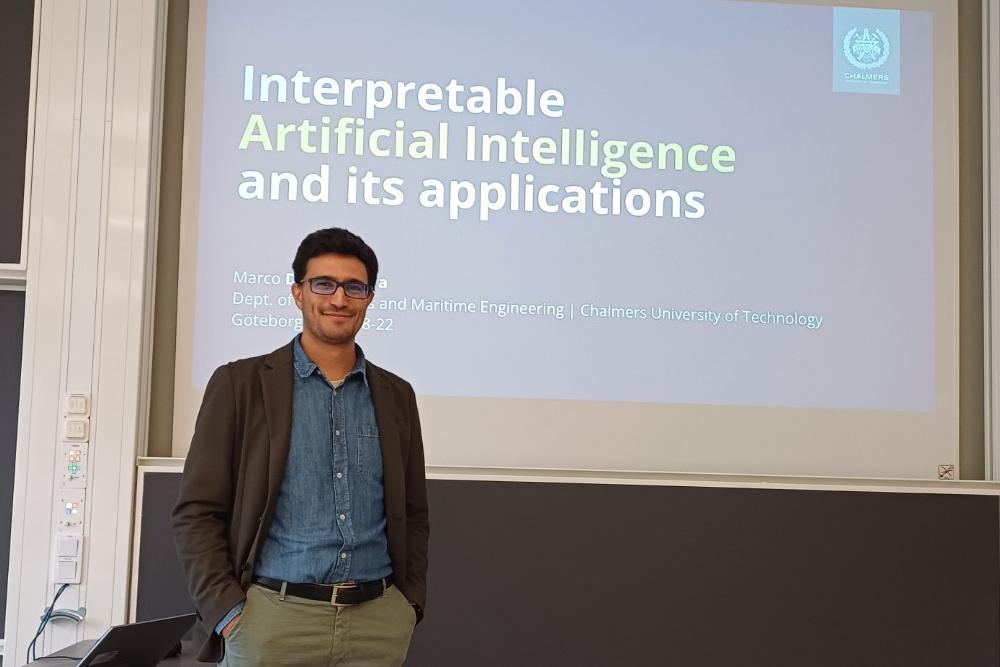
Marco L. Della Vedova is a Senior Lecturer in Applied Artificial Intelligence at Chalmers University of Technology, Sweden. He works in the Vehicle Engineering and Autonomous Systems division within the Department of Mechanics and Maritime Sciences, as part of Prof. Mattias Wahde's research group. Since 2025, he has served as Director of the Data Science and AI master's programme (MPDSC) at Chalmers, where he teaches courses including Introduction to Artificial Intelligence and Digitalization in Sports. Dr. Della Vedova earned his academic foundation at the University of Pavia, Italy, where he completed his BSc (2006), MSc (2009), and PhD (2013) in Computer Engineering. His doctoral research focused on "Real-Time Physical Systems and Electric Load Scheduling" under Prof. Tullio Facchinetti. During his PhD studies, he spent a year at U.C. Berkeley hosted by Prof. Francesco Borrelli at the Model Based Predictive and Distributed Control Lab. His research spans multiple AI domains with a strong emphasis on interpretability. Dr. Della Vedova develops interpretable methods for conversational AI, naturalness evaluation of forests using canopy height models, and geospatial applications. His work bridges theoretical AI with practical societal benefits, particularly in environmental monitoring, transportation systems, and orienteering. He has previously contributed to cloud computing, hate speech detection, and cyber-physical energy systems, demonstrating his interdisciplinary approach to AI research. Dr. Della Vedova's publication record reveals a consistent trajectory of impactful research across multiple domains of artificial intelligence. His recent work shows a strong focus on interpretability in AI systems, with significant contributions to natural language processing, geospatial analysis, and causal inference. The research demonstrates both theoretical depth and practical applications, particularly in environmental monitoring and social media analysis. His methodology often combines traditional machine learning approaches with novel interpretability techniques, creating bridges between complex AI systems and human understanding. Dr. Della Vedova has received several prestigious recognitions for his work: Best PhD thesis award from the Order of the Engineers of Bergamo (2013) Italian champion of Il Cervellone (2012) Top Italian performer in IEEEXtreme 6.0 programming competition (148th overall globally, 2012) Premio Arturo Schena award from Fondazione Credito Valtellinese (2010) With over 50 students supervised through bachelor's and master's theses, Dr. Della Vedova has established himself as a dedicated mentor in the AI community. His current PhD students include Minerva Suvanto working on interpretable NLP and Vivien Lacorre developing AI for railway infrastructure inspection. His supervision spans diverse topics from forest naturalness evaluation to hate speech detection and transportation optimization. Beyond formal supervision, he actively contributes to educational initiatives including serving as Director of Chalmers' Data Science and AI master's program and developing innovative teaching methods that connect theoretical concepts with real-world applications. Dr. Della Vedova is deeply embedded in both academic and professional communities. He leads the Applied Artificial Intelligence research group at Chalmers while maintaining strong connections with European research networks through projects like the ERASMUS+ EUrienteering initiative. His interdisciplinary approach is reflected in collaborations across computer science, environmental science, and social sciences. Notably, he applies his AI expertise to orienteering both as a researcher developing localization methods and as a licensed Event Advisor for the International Orienteering Federation, demonstrating how his professional and personal interests converge in innovative ways.
Danijel Skočaj is Full Professor at the University of Ljubljana, Faculty of Computer and Information Science , and serves as Head of the Visual Cognitive Systems Laboratory . He is an internationally recognized researcher in computer vision, machine learning, and cognitive robotics , with a strong focus on deep-learning solutions for real-world visual perception tasks and their ethical implications. Education: While specific degrees are not listed in the text, Professor Skočaj’s 2002 “Best PhD paper award” confirms he holds a PhD in the relevant field. Research Interests: His work spans Computer Vision & Pattern Recognition Deep Learning & Neural Networks Cognitive Robotics & Autonomous Navigation Visual Anomaly & Surface-Defect Detection AI Ethics & Societal Impact of AI These interests manifest in both theoretical advances and practical systems deployed in industry and public infrastructure. Publication Trends: Recent papers (2020-2024) emphasize deep-learning architectures for defect detection, robotic grasping, autonomous navigation, traffic-sign recognition, and 3-D anomaly detection , demonstrating a clear trajectory toward robust, real-time, and data-efficient visual intelligence. Awards & Honors: Prometheus of Science Award 2021 (Slovenian Science Foundation) Golden Plaque, University of Ljubljana 2020 ARRS National Award for Exceptional Scientific Achievement 2011 & 2022 Multiple Best-Paper awards at ERK conferences (2013, 2017, 2019) Top-downloaded paper recognition, Journal of Intelligent Manufacturing 2020 Grants & Projects: He currently leads or co-leads five major 2025-2028 national and EU projects (RTFM, SMASH, COMET, RoDEO, MUXAD) totaling several million Euros, focusing on advanced computer vision, machine learning for science & humanities, autonomous systems, and explainable AI. Past leadership includes EU FP7 CogX, GOSTOP, ViLLarD, and many ARRS programmes. Laboratory & Team: The Visual Cognitive Systems Laboratory hosts a dynamic group of doctoral and master’s students working on cutting-edge perception systems. The lab’s open-source low-cost robotic platform and datasets are widely adopted for education and research.
Nina Franz is a Researcher at the Institute of Media Studies, Braunschweig University of Fine Arts, specializing in the Theory and History of Technology. She holds a doctorate in Cultural Studies from Humboldt University of Berlin and has held research positions at Bauhaus University Weimar and Humboldt University Berlin. Her research spans military imaging technologies from early modern period to computer age, climate catastrophe narratives in humanities and contemporary art, history of automation, and critical analysis of technological destruction narratives. She examines how imaging systems mediate power relations in warfare, medicine, and colonial contexts, with particular focus on ultrasound, drone warfare, and military surveillance systems. Her recent publications reveal strong interdisciplinary trends across Media Studies, Cultural History, and Critical Military Studies, with recurring themes of visual epistemology, technological mediation, and the weaponization of perception. Key subfields include drone warfare protocols, medical imaging interfaces, algorithmic control systems, and climate catastrophe representations. Doctoral Scholarship, Gerda Henkel Foundation (2015-2018) As a curator and educator, Franz has organized international conferences including 'Remote Control. Scales of Mediated Intervention' (2017) and co-curated exhibitions like 'A Better Version of You' (2016-2018) with Goethe-Institut Seoul. Her current teaching includes courses on military imaging and rearmament discourses, with mandatory participation in the 'Fascism and Mediality' workshop (2025). She regularly presents at academic conferences on military imaging technologies, including upcoming lectures at Staatliche Hochschule für Gestaltung Karlsruhe and Johannes Gutenberg-Universität Mainz. Her work bridges academic research with contemporary art curation, examining how military technologies permeate civilian perception through screen media and imaging systems.
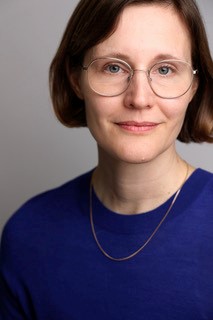
Laura State serves as a Research Fellow at the Humboldt Institute for Internet and Society (HIIG) in Berlin, Germany, where she contributes to the AI & Society Lab's Impact AI project. This initiative develops transdisciplinary auditing methodologies to evaluate artificial intelligence systems' contributions to societal transformation and ecological sustainability through rigorous impact assessment frameworks. Her academic credentials include: PhD in Data Science from Scuola Normale Superiore, Pisa, Italy (Advised by Salvatore Ruggieri and Franco Turini) MSc in Neural Information Processing from the University of Tübingen BSc in Physics from the University of Rostock State's research synthesizes hard sciences with social perspectives to investigate AI's societal and planetary implications. She specializes in transparency and accountability mechanisms for non-interpretable machine learning models, developing assessment methodologies to determine how AI can foster sustainable futures. Her interdisciplinary approach integrates technical AI development with regulatory frameworks and ecological impact analysis, emphasizing real-world applicability through industry-academia collaboration. Her 2023-2025 publications reveal a cohesive research trajectory centered on explainable AI and regulatory compliance, particularly regarding GDPR requirements. Key themes include legal-technical alignment for explanation systems, bias/fairness policy frameworks, and innovative evaluation tools like REASONX. The work consistently bridges machine learning theory with societal accountability, demonstrating methodological rigor in translating technical capabilities into public-interest applications. As a core member of HIIG's AI & Society Lab, State collaborates on transdisciplinary teams examining AI's role in sustainability transitions. The Impact AI project coordinates researchers from computer science, law, and social sciences to develop evaluation frameworks that measure AI's contribution to UN Sustainable Development Goals, with active engagement in policy dialogues and public science initiatives like Lange Nacht der Wissenschaften.
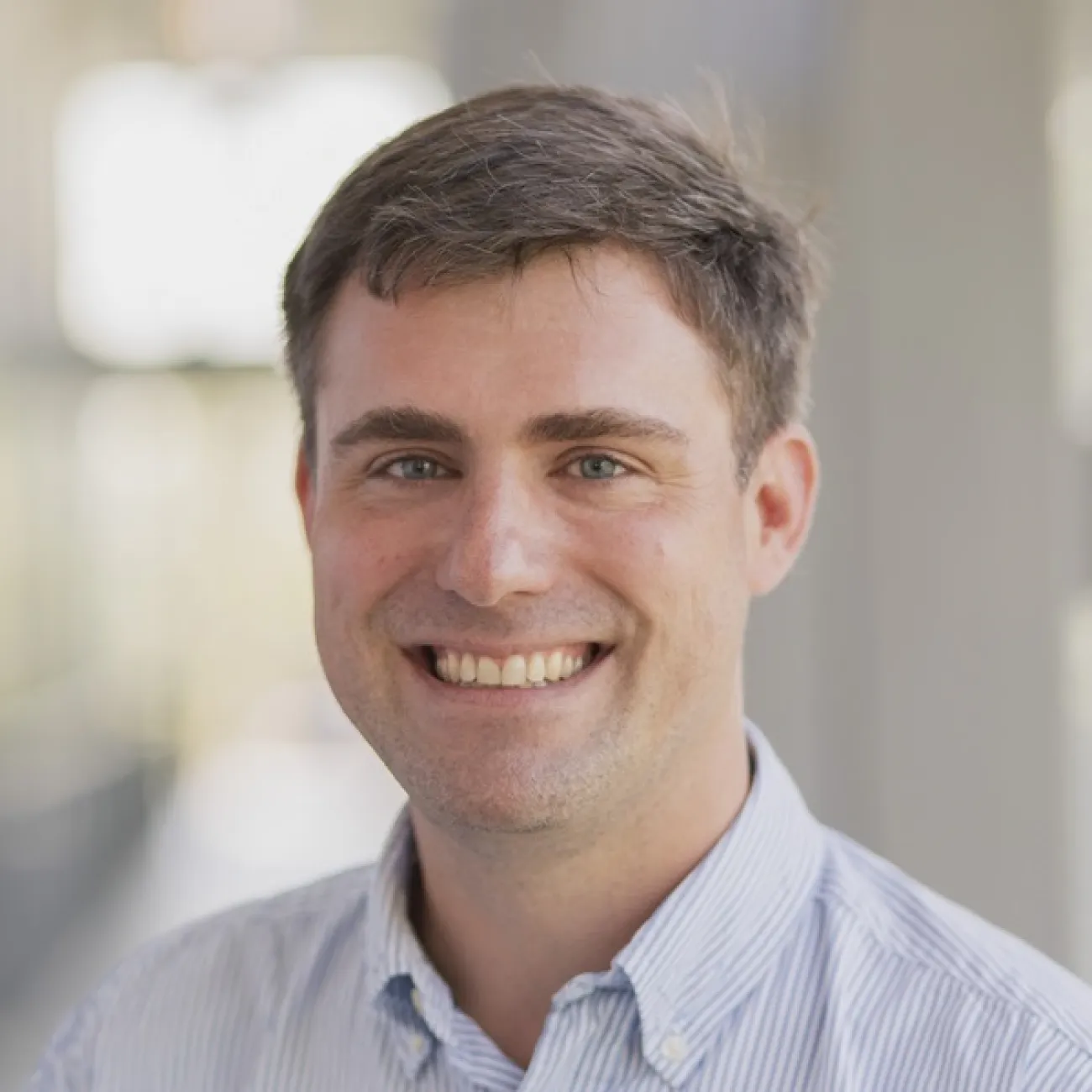
Professor Sebastian Stein is a faculty member in the Electronics and Computer Science department at the University of Southampton, specializing in artificial intelligence and multi-agent systems. He holds a PhD from the University of Southampton (2008) and an MEng in Computer Science from the University of Warwick. His research focuses on citizen-centric AI, mechanism design, and applications in smart energy, transportation, and disaster response. He leads or collaborates on projects such as the EPSRC-funded 'Citizen-Centric Artificial Intelligence Systems' and 'Future Electric Vehicle Energy networks supporting Renewables (FEVER)'. Education: PhD in Multi-Agent Systems (University of Southampton, 2008), MEng Computer Science (University of Warwick) Research Groups: Agents, Interaction and Complexity research group His work emphasizes incentive engineering in dynamic systems, sequential decision-making under uncertainty, and societal challenges like smart mobility and electric vehicle infrastructure. Key awards include the Blue Sky Ideas Award (AAMAS-2021) and Best Demonstration Award (AAMAS 2025). He currently supervises multiple PhD students in computer science and engineering.
Dr. Selçuk Uluağaç is an Eminent Scholar Chaired Associate Professor at Florida International University (FIU), leading the Cyber-Physical Systems Security Lab. He holds a courtesy appointment in the Knight Foundation School of Computing and Information Science. Previously, he worked at Georgia Tech and Symantec, with degrees from Georgia Tech (PhD) and Carnegie Mellon University (MS). His research focuses on cybersecurity, privacy, and IoT/CPS systems, funded by NSF, DOE, and industry partners exceeding $18M. He has authored hundreds of publications, secured 17 patents (one licensed), and serves on editorial boards of IEEE journals. Education: PhD in Electrical and Computer Engineering, Georgia Institute of Technology (200X); MS in Computer Science, Carnegie Mellon University (200X). Research Interests: Developing security frameworks for IoT devices, privacy-preserving techniques, machine learning for cybersecurity, and CPS threat mitigation. Notable projects include sensory channel threat analysis, IoT fingerprinting, encrypted traffic privacy leakage detection, wearable-based authentication, and cryptomining activity detection. Awards: Recognized with prestigious NSF CAREER Award and multiple institutional awards for research and teaching excellence. Active in professional service, including conference chairs (ACM WiSec 2019, IEEE CNS 2022 TPC Chair) and NIST panels. Grants & Funding: Over $18M from NSF, DoE, US Air Force, Google, Microsoft, and Cisco. Entrepreneurial focus with patents commercialized. Labs & Teams: Directs the Cyber-Physical Systems Security Lab, collaborating on applied security solutions. Media-featured research highlights societal cybersecurity impacts.
Colin Milburn holds the Gary Snyder Chair in Science and the Humanities at UC Davis, with appointments in Cinema and Digital Media, English, and Science and Technology Studies. He directs the UC Davis ModLab. His interdisciplinary scholarship examines relations between literature, science, and technology, with focus areas including science fiction, history of biology and physics, nanotechnology, video games, and digital humanities. Recent publications explore speculative technologies, citizen science games, and quantum technology's societal implications. As an expert on gaming culture, he has advised on game design and cost management for players. His work combines critical theory with media studies to analyze how games and speculative fiction shape scientific imagination.
Paul Maher is an Associate Professor at the University of Limerick's Department of Psychology and Centre for Social Issues Research. His research focuses on emotions, attitudes, and political orientation, particularly the role of epistemic emotions in shaping political polarization and group identity. He investigates disillusionment as an affective response to meaning-threatening events and its link to ideological rigidity and nostalgic tendencies. His work employs bipartite network visualizations to map political attitude clusters, with notable contributions during the early stages of the COVID-19 pandemic analyzing how public health attitudes predict behavioral outcomes. Maher holds a PhD awarded in 2017. Education: PhD in Psychology (2017) Key Research Areas: Political Psychology, Epistemic Emotions, Attitude Networks, Misinformation, Identity Dynamics Collaborations: Extensive work with institutions including the University of Limerick's Centre for Social Issues Research and international teams on computational social science models. His recent studies explore how social norms and opinion-sharing behaviors reinforce group identities, with applications in understanding polarization during crises. He has contributed to UN Sustainable Development Goals related to education and societal resilience through his work on trust in science and pandemic responses. Publications highlight interdisciplinary approaches, integrating agent-based modeling, network analysis, and experimental psychology. His work on disillusionment's role in Brexit and Trump phenomena demonstrates real-world policy relevance.
Dr. Mike Ryder is a Lecturer in Marketing at Lancaster University's Management School, specializing in interdisciplinary research bridging literature, philosophy, technology studies, and marketing. He teaches modules such as Digital Marketing, Social Media, and serves as Programme Director for the MSc Digital and Social Media Marketing. His research explores the intersection of new technologies with ethics, biopolitics, and science fiction. He holds a PhD ('Citizen Robots: Biopolitics, the Computer and the Vietnam Period') and is a Senior Fellow of Advance HE. Education: PhD in Literature/Technology, MA English (Distinction), BA (Hons) English with Creative Writing (First Class). Prior to academia, he worked in video games, healthcare ghostwriting, and digital communications. He directs Mental Capacity Ltd, a healthcare training firm. Awards include the Pilkington Award for Teaching. Research interests include AI ethics, digital marketing pedagogy, and science fiction's role in conceptualizing societal futures. He participates in interdisciplinary groups like the Lancaster Intelligent, Robotic and Autonomous Systems Centre and Centre for Consumption Insights. Supervision focuses on digital marketing, AI ethics, and interdisciplinary projects combining philosophy and technology.
Richard King is a Professor at Arizona State University's School of Electrical, Computer and Energy Engineering and a Senior Global Futures Scientist. He holds a Ph.D. (1990), M.S. (1987), and B.S. (1985) in Physics from Stanford University. His research focuses on high-efficiency photovoltaics, semiconductor defects, and multijunction solar cell technologies. Key contributions include achieving over 40% solar cell efficiency in 2006. He leads the King Lab, exploring photovoltaic materials, deployment strategies, and societal integration of solar energy. Research interests span defect-tolerant materials (e.g., perovskites, CIGS), recombination phenomena, and low-cost thin-film solar cells. Awards include the 2010 William R. Cherry Award and R&D 100 recognition. He has led NSF-funded projects like the Quantum Energy and Sustainable Solar Technologies (QESST) Engineering Research Center. Education: Ph.D./M.S. Electrical Engineering, Stanford University (1990/1987); B.S. Physics, Stanford (1985) Grants: NSF QESST ERC (2011–2017) and Boeing/Spectrolab collaborations Labs/Teams: King Lab at ASU, focusing on photovoltaic science, deployment, and education
Professor Alan Woodward is a renowned computer security expert at the University of Surrey, affiliated with the Surrey Centre for Cyber Security and Computer Science Research Centre. His career spans academia, government service, and private sector leadership, including pivotal roles in IT businesses like Charteris plc. He holds fellowships and chartered status across multiple prestigious institutions and actively advises governmental bodies such as Europol. Education: Undergraduate studies in Physics & Astronomy Postgraduate research in adaptive filtering and signal recovery at the University of Southampton's Institute of Sound and Vibration Research Research Focus: Woodward's interdisciplinary work bridges cybersecurity, digital forensics, and signal processing. His expertise includes cryptographic methods, steganography for covert communications, digital watermarking for data protection, and novel approaches to forensic computing. Current projects explore quantum computing threats and real-world cybercrime mitigation. Publication Trends: His recent articles demonstrate a strong focus on emerging cyber threats across societal and technical domains. Key themes include quantum cryptography vulnerabilities, organized cybercrime patterns, critical infrastructure risks, mobile/cloud security challenges, and public cybersecurity education with practical guidance for digital safety. Honors & Credentials: Fellow: Institute of Physics, British Computer Society, Royal Statistical Society Chartered Status: Engineer (CEng), IT Practitioner (CITP), Physicist (CPhys) Eur Ing (European Engineer) Leadership & Outreach: Beyond academic research, Woodward directs technology enterprises and leads public STEM engagement. He frequently contributes to international media (BBC, The Times, The Telegraph) as a cybersecurity commentator. His Surrey research teams collaborate with law enforcement and industry partners on threat intelligence initiatives.
Marco Rozendaal is a researcher at Delft University of Technology's Industrial Design Engineering department, specializing in Human-Centered Design and Human Technology Relations. He focuses on ethical dimensions of technology, human-robot interaction, wearable health solutions, and critical design philosophies. His work bridges theoretical research and practical applications, such as designing embodied coaches for stroke rehabilitation and exploring moral stress in technical practice. Research Interests: Rozendaal investigates how technology impacts human behavior and ethics, emphasizing embodied interaction, friction in digital systems, and healthcare innovations. Notable areas include AI ethics, wearable technologies for body awareness, and the sociotechnical implications of robotics in workplaces and healthcare settings. His projects often involve interdisciplinary collaborations with theater professionals, medical practitioners, and farmers. Publications Trends: His recent work highlights themes like moral stress in technical fields, human-robot collaboration in mixed-reality environments, and ethical design frameworks. Key contributions include guidelines for robot communication in dairy farming and critical analyses of seamless technology's societal impacts. Awards: He received the 2018 Best Paper Award for exploring ambiguity in behavioral design, recognizing his contributions to design theory and ethics. Teaching & Projects: Rozendaal teaches courses like Design in Robotics and Videography . He leads research initiatives such as Wearable Technology for Increased Body Awareness and MUG CUP , which support parents of hospitalized children. His work also addresses the 'New Normal' in post-pandemic design practices. Labs & Teams: His research is conducted within TU Delft's Human-Centered Design group, collaborating with industry partners and academic networks to advance ethical and human-centric technological solutions.
Arijit Khan is an Associate Professor in the Department of Computer Science at Aalborg University, Denmark. He leads the Data Engineering, Science and Systems group and is affiliated with the Technical Faculty of IT and Design. His research focuses on Graph Neural Networks , Blockchain , Data Management , and AI interpretability . He is the Principal Investigator (PI) of a major project on Data Management, Fundamental Algorithms, and Machine Learning for Emerging Problems in Large Networks (2022–2027). Research Interests : Graph Data Management & Machine Learning Blockchain Transaction Analysis Large Language Model + Knowledge Graph Synergies Healthcare AI (e.g., ICU glucose prediction) Explainable AI for Graph Neural Networks Research Trends : His publications emphasize neuro-symbolic systems , uncertain graph analysis , and AI-driven blockchain insights . Recent work bridges large language models with knowledge graphs and explores GPU performance optimization via shader code analysis. Awards & Grants : No explicit awards listed, but his active research grants include a 5-year project on large network analysis with interdisciplinary applications in life and health sciences. Funding emphasizes algorithmic innovation and data science integration. Labs/Teams : Head of the Data Engineering, Science and Systems research group, focusing on AI for societal impact ('AI for the People') and scalable graph data systems. Collaborations span blockchain analytics, healthcare informatics, and GPU architecture design.
Vaibhav Garg is a Collegiate Assistant Professor of Computer Science at the Virginia Tech Innovation Campus. Previously, he worked as a teaching and coding instructor at Outco Company in California. His research focuses on applying computational methods to societal challenges such as detecting inciting speech on social media and auditing rogue mobile apps for misuse. He holds a Ph.D. in Computer Science from North Carolina State University (2024), an M.S. from Indraprastha Institute of Information Technology, Delhi (2019), and a B.S. from The LNM Institute of Information Technology (2017). Research Interests: Applied Natural Language Processing Social Media Analytics Cybersecurity AI for Social Good Responsible Computing Educational Technology His recent work includes publications on inciting speech detection, trauma narratives analysis, and mobile app misuse audits. These studies emphasize ethical AI applications in addressing societal issues like online harassment and privacy violations. Awards & Honors: Carla Savage Award (2023) for outstanding Ph.D. research at NC State Grants & Funding: National Security Agency (NSA) research grants during Ph.D. National Science Foundation (NSF) research grants during Ph.D. His current work explores interdisciplinary solutions at the intersection of NLP and social responsibility, with a focus on developing technologies that promote ethical online environments.