معرفی
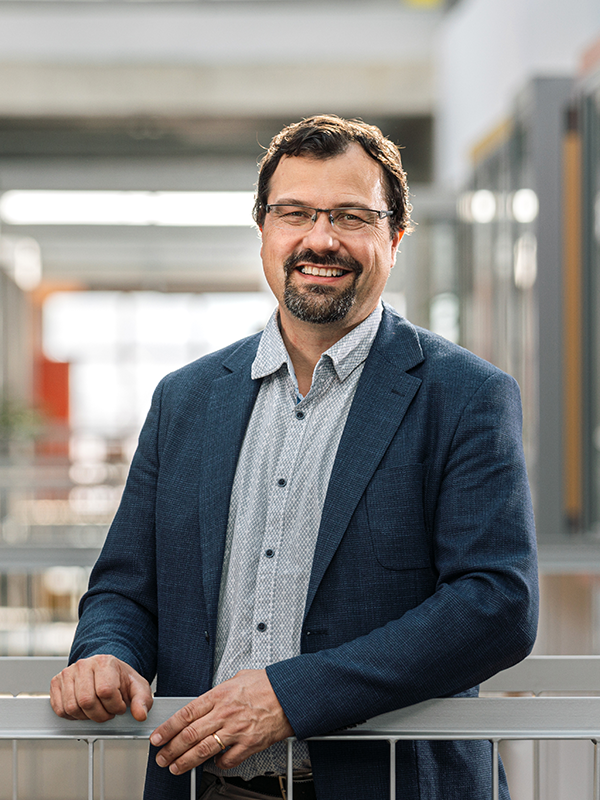
Danijel Skočaj is Full Professor at the University of Ljubljana, Faculty of Computer and Information Science, and serves as Head of the Visual Cognitive Systems Laboratory. He is an internationally recognized researcher in computer vision, machine learning, and cognitive robotics, with a strong focus on deep-learning solutions for real-world visual perception tasks and their ethical implications.
Education: While specific degrees are not listed in the text, Professor Skočaj’s 2002 “Best PhD paper award” confirms he holds a PhD in the relevant field.
Research Interests:
His work spans
- Computer Vision & Pattern Recognition
- Deep Learning & Neural Networks
- Cognitive Robotics & Autonomous Navigation
- Visual Anomaly & Surface-Defect Detection
- AI Ethics & Societal Impact of AI
These interests manifest in both theoretical advances and practical systems deployed in industry and public infrastructure.
Publication Trends: Recent papers (2020-2024) emphasize deep-learning architectures for defect detection, robotic grasping, autonomous navigation, traffic-sign recognition, and 3-D anomaly detection, demonstrating a clear trajectory toward robust, real-time, and data-efficient visual intelligence.
Awards & Honors:
- Prometheus of Science Award 2021 (Slovenian Science Foundation)
- Golden Plaque, University of Ljubljana 2020
- ARRS National Award for Exceptional Scientific Achievement 2011 & 2022
- Multiple Best-Paper awards at ERK conferences (2013, 2017, 2019)
- Top-downloaded paper recognition, Journal of Intelligent Manufacturing 2020
Grants & Projects: He currently leads or co-leads five major 2025-2028 national and EU projects (RTFM, SMASH, COMET, RoDEO, MUXAD) totaling several million Euros, focusing on advanced computer vision, machine learning for science & humanities, autonomous systems, and explainable AI. Past leadership includes EU FP7 CogX, GOSTOP, ViLLarD, and many ARRS programmes.
Laboratory & Team: The Visual Cognitive Systems Laboratory hosts a dynamic group of doctoral and master’s students working on cutting-edge perception systems. The lab’s open-source low-cost robotic platform and datasets are widely adopted for education and research.