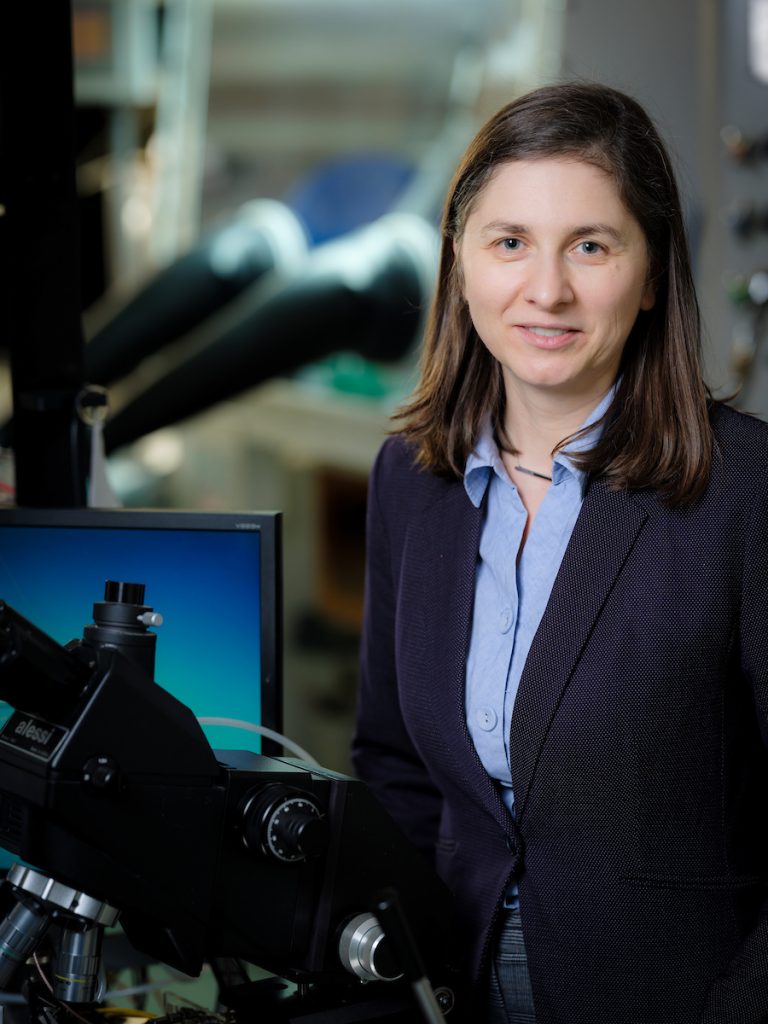
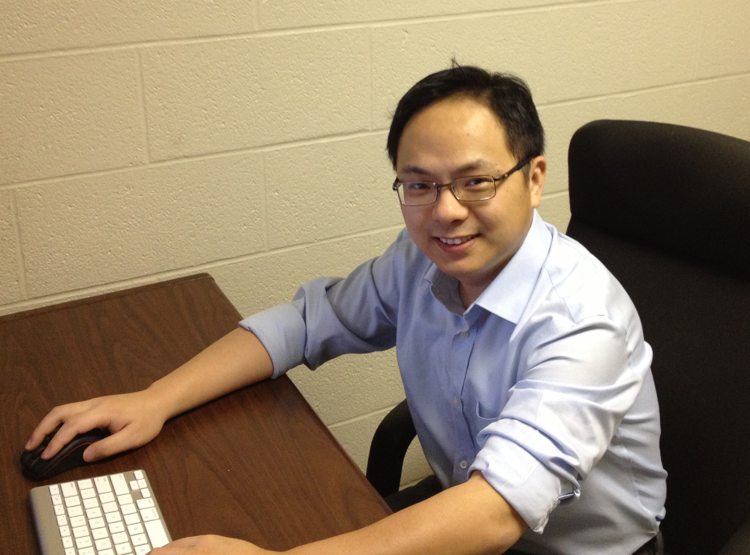
Umit Ozgur is a faculty member at Virginia Commonwealth University's College of Engineering with expertise in semiconductor device physics and nanomaterials. His research focuses on advanced optoelectronic devices, heterostructure engineering, and nanoscale fabrication techniques. Specializes in wide bandgap semiconductors (ZnO, Ga2O3, HgCdTe) Key areas: graphene field-effect transistors , MEMS/NEMS reliability , and composition-tunable nanoalloys Recent work explores epsilon-near-zero materials , plasmonic integration , and high-precision silicon etching His publications (2023–2025) demonstrate strong emphasis on infrared photodetection , hot-electron transport , and nanoscale device optimization for next-gen electronics. Current projects likely involve hybrid 2D material systems and novel semiconductor synthesis methods.
Jennifer Cribbs is a Professor in the School of Teaching, Learning & Educational Sciences at Oklahoma State University, where she has served since 2016, first as an Associate Professor (2016-2022) and then as a Professor (2022-present). Her academic work focuses on mathematics education, particularly examining how students develop mathematics identity and persist in STEM fields. Dr. Cribbs earned her educational credentials from prestigious institutions: Ph.D. in Curriculum and Instruction with a focus on Mathematics Education from Clemson University (2012) Master of Arts in Teaching, Secondary Mathematics Education from Converse College (2005) Bachelor of Science, Chemical Engineering from Florida Institute of Technology (1999) Before entering higher education, Dr. Cribbs taught secondary mathematics in the South Carolina public school system, giving her valuable practical experience that informs her research. Her certification as a Secondary Mathematics teacher from the South Carolina Department of Education (2005-2017) further demonstrates her commitment to quality mathematics instruction. Dr. Cribbs' research primarily investigates mathematics identity and student persistence in STEM , exploring how students develop their sense of self in relation to mathematics. She also examines teachers' beliefs and practices and how these connect to student affect and learning outcomes. Her work often employs mixed-methods approaches, combining quantitative scale development with qualitative exploration of student and teacher experiences. Her recent scholarly output demonstrates a clear trajectory toward developing robust instruments for measuring mathematics identity and related constructs, with several 2024-2025 publications focused on scale validation. She has also expanded her research to include semiconductor education and circuit debugging skills, indicating a broadening scope of her STEM education research. Her work consistently addresses practical applications for classroom teachers while contributing to theoretical understandings of mathematics identity development across K-12 and undergraduate contexts. Dr. Cribbs has secured significant research funding from multiple sources, including the National Science Foundation, National Security Agency, and the Oklahoma State Department of Education. Her grants portfolio demonstrates her ability to lead substantial research projects focused on STEM education, teacher development, and student engagement in mathematics. Through her work with preservice teachers and in-service educators, Dr. Cribbs has made substantial contributions to understanding how professional development influences teacher beliefs and classroom practices. Her research on the transition to online instruction during the pandemic provides valuable insights for teacher education programs navigating technological changes in education delivery.
Hang Nguyen is an Assistant Lecturer in Leadership at the CBL School of Management. Their research spans entrepreneurship, finance, healthcare, and engineering, with a focus on crowdfunding dynamics, healthcare interventions, and technical innovations. They have contributed to interdisciplinary studies in Vietnam and globally, addressing topics such as medication adherence, biomarker analysis, and semiconductor design. Research interests emphasize the intersection of finance and entrepreneurship, particularly in equity crowdfunding and small business financing. Nguyen also explores healthcare challenges in Vietnam, including asthma management and COPD genetics, alongside technical advancements like laser communication systems and robust control theory. Recent articles highlight Nguyen’s work on board dynamics in M&A contexts, herding behavior in crowdfunding, and Bayesian optimization in circuit design. Their interdisciplinary approach addresses both theoretical and applied problems in management, technology, and public health. No scientific awards or grants were explicitly mentioned in the provided texts. Nguyen has not listed advisees or laboratory affiliations, focusing instead on collaborative research projects across multiple disciplines.
Chu-Ryang Wie is a Professor in the Department of Electrical Engineering at the University at Buffalo's School of Engineering and Applied Sciences. He holds a PhD in Applied Physics from the California Institute of Technology. His research focuses on semiconductor device reliability under various stress conditions, radiation effects analysis, and quantum visualization techniques. Specialized in X-ray characterization of semiconductor materials using reciprocal space mapping, his work advances understanding of device degradation mechanisms and material properties.
Jung-Hun Seo is an Associate Professor in the Department of Materials Design and Innovation at the University at Buffalo, part of the School of Engineering and Applied Sciences. His research focuses on developing next-generation flexible electronics and optoelectronics, novel nano/micro fabrication processes, and heterogeneous integration of ultra-wide bandgap semiconductors. Education: PhD in Electrical and Computer Engineering from the University of Wisconsin-Madison (2014), MS from the same department (2011), and BS/MS in Electrical Engineering from Korea University (2006-2008). Research Interests: Flexible and stretchable electronics Wide-bandgap semiconductor materials (e.g., Ga2O3, diamond) Nanomembrane fabrication and integration High-performance photodetectors and photodiodes Energy-efficient device designs Labs/Teams: Director of the Future Materials & Devices Research Lab. Collaborates on projects involving semiconductor heterostructures and advanced fabrication techniques.
Dr. Alexandra Paterson is an Assistant Professor in the Stanley and Karen Pigman College of Engineering at the University of Kentucky, jointly appointed in Materials Engineering and Electrical Engineering. Her work focuses on organic materials and device engineering for advanced electronics applications. Ph.D. in Experimental Solid State Physics from Imperial College London (2017) B.Sc. in Physics from the University of Exeter (2009) Her research spans organic electronics, bioelectronics, printed sensors, flexible devices, and semiconductor physics. She investigates the synthesis, characterization, and application of organic materials in electrochemical transistors and mixed ionic–electronic conductors. Recent articles emphasize stability improvements in organic electrochemical transistors via solvent degassing and chemical doping , the design of high-mobility PEDOT:PSS fibers , and innovations in glycolated polythiophenes for bioelectronic interfaces. Her work also explores fundamental dopant-counterion mechanisms and charge transport dynamics in organic semiconductors. She leads the Organic Materials and Devices Laboratory , contributing to next-generation neuromorphic bio-hybrid technologies and thermoelectric textiles . Her career prior to 2021 includes postdoctoral research at KAUST and applied physics roles at QinetiQ Ltd.
Professor Anne Graham is the Founding Director of the Centre for Children and Young People (CCYP) at Southern Cross University, holding a conjoint Professorial appointment at the University of New South Wales. With a background in primary education and sociology, she has led over 60 research projects, securing over $8 million in funding, focusing on children’s rights, wellbeing, and ethical research practices. Her work emphasizes interdisciplinary collaboration with government bodies, NGOs, and community organizations to influence policy and practice globally. Her educational qualifications include a DipT (CatholicTC), BEd (CatholicTC), MEd (T&D) from University of New England, and a PhD from Southern Cross University. Key achievements include the Seasons for Growth program, benefiting over 300,000 children globally, and co-developing the Student Participation Survey (SPS) to enhance student wellbeing. She has been recognized with awards such as the Southern Cross University Research Award (2023) and the Outstanding Contribution to Impact Award (2022). Research interests span children’s social and emotional wellbeing, ethical research methodologies, and teacher learning. Recent work includes the School is for Everyone (SIFE) project, enhancing equity in education, and Beyond Safety: Ethical Practice Involving Children (EPIC), prioritizing ethical standards in child-focused organizations. Her extensive grants portfolio includes ARC Linkage and Discovery grants, reflecting a commitment to impactful research. Professional activities include leading workshops on ethical practice and advising on disaster resilience initiatives like post-bushfire community recovery in East Gippsland.
Dr. Oana Jurchescu is a Professor of Physics at Wake Forest University, holding the Baker Family Professor of Physics endowed chair since July 1, 2021. She leads the Organic Electronics Lab, which focuses on bioelectronics, functional materials, and structure-property relationships in organic semiconductors. Her work bridges experimental research with mentorship, training students who have won prestigious scholarships like Goldwater, Churchill, and Gates Cambridge. Affiliation: Department of Physics, Wake Forest University Lab: Organic Electronics Lab Research Focus: Organic and flexible electronics, condensed matter physics, radiation dosimetry, and semiconductor microstructure Dr. Jurchescu's research explores advanced materials for organic field-effect transistors (OFETs), radiation dosimeters, and printable electronics. She has published nearly 100 peer-reviewed papers, holds three patents, and secured $10 million in research funding. Her lab investigates charge transport, trap states, and device stability under extreme conditions. Recent publications highlight her contributions to laser-printed perovskites, non-covalent interaction engineering in polymers, and radiation dosimetry applications. She has delivered over 50 invited/plenary talks and organized conferences in thin-film transistor technologies. Scientific Awards: National Science Foundation CAREER award (2013) Physics Faculty Excellence in Teaching Award (twice) URECA Award For Excellence in Mentorship Reid-Doyle Prize for Teaching Kulynych Family Omicron Delta Kappa Award WFU Award for Excellence in Research Dr. Jurchescu collaborates on interdisciplinary projects like the NSF-DFG solvent-free perovskite manufacturing initiative. Her work impacts medical electronics, environmental sensors, and high-performance organic semiconductors.
Dr. Constantin Orita is a Professor at the Department of Electronic Materials, Technical University of Iași. His research focuses on electronic materials and reliability engineering. Contact: orita@etc.tuiasi.ro | Phone: 0232-213737. Current research domains include advancements in material science applications for electronics. Despite limited publication details provided, his work likely intersects with semiconductor reliability and material characterization techniques.
Prof. M. Lourdes Calzada is a Research Professor at the Materials Science Institute of Madrid (ICMM), part of the Spanish National Research Council (CSIC). She leads the Electroactive Oxides for Smart Devices (EOSMAD) research group, focusing on functional metal oxide thin films for flexible electronics. Her work emphasizes low-temperature solution processing of ferroelectric, piezoelectric, and multiferroic materials. She holds a PhD in Chemistry from the University of Alcalá de Henares (1990) and has led over 30 national and European R&D projects, coordinating 8 national and 2 European initiatives. She has published 175+ papers, holds 3 patents, and supervised 6 PhD students (two awarded top honors in chemistry). Her research integrates sustainable methods and interdisciplinary approaches, pioneering advancements in flexible electronics and semiconductor integration. Education: PhD in Chemistry, University of Alcalá de Henares (Madrid), 1990 Research Interests: Functional metal oxides (dielectric, piezoelectric, ferroelectric) Sol-gel and soft-chemistry synthesis Low-temperature solution processing for flexible electronics Nanostructured materials and thin films Self-assembled systems on semiconductor/flexible substrates Grants & Awards: Coordinator of 8 National and 2 EU-funded projects Spanish Representative for COST Action 514 (Chemical Solution Deposition) Labs & Teams: Head of the EOSMAD group at ICMM-CSIC, specializing in electroactive oxides for smart devices. Her group focuses on advanced materials for emerging technologies such as electronic skin and wearable electronics.
Prof. Nicola Schulz is a Lecturer for Electric Power Systems at the FHNW Institute of Electric Power Systems within the FHNW School of Engineering and Environment at the University of Applied Sciences Northwestern Switzerland. Their teaching focuses on power electronics, energy storage technologies, and energy systems design for mechanical engineers. Research interests include power electronics reliability, SiC semiconductor applications, battery technology (e.g., second-life lithium-ion batteries), and magnetic component characterization. They also explore energy lab setups for environmental engineering education. Research activities emphasize multi-physical characterization of power semiconductors, online condition monitoring, and optimization from device to system levels. Battery-related work includes technical and economic analyses of repurposed batteries and battery management systems (BMS). Recent publications highlight advancements in SiC converter reliability, proton/neutron radiation effects on power devices, and smart grid optimization through solid-state transformers and multi-agent simulation frameworks like SmartStability. Prof. Schulz’s work bridges academic research and practical applications in sustainable energy systems. Their address is at Klosterzelgstrasse 2, 5210 Windisch, with direct contact via nicola.schulz@fhnw.ch. They are affiliated with the FHNW Campus Brugg-Windisch and actively engaged in industry partnerships through research collaborations.
Xiao Shen is an Associate Professor in the Department of Physics and Materials Science at the University of Memphis, College of Arts and Sciences. As a computational physicist, his research focuses on condensed matter physics and modern electronic-structure methods to investigate solid-state phenomena. Research areas: 2D materials (particularly silicon telluride), memristive systems, thermoelectrics, defect engineering, ferroelectric metals, and magnetocaloric effects Teaching: Quantum Mechanics, Statistical Mechanics, and Computational Physics courses Funding: National Science Foundation, ORAU Ralph E. Powe Jr. Faculty Enhancement Award, University of Memphis Research Investment Fund, and College of Arts and Sciences Early Career Research Award His publications (2015-2025) demonstrate expertise in computational modeling of phase transitions in vanadium dioxide, defect engineering in garnet crystals, memristive switching mechanisms, and 2D nanomaterials with applications in electronics and energy systems. Scientific awards include: National Science Foundation grants Ralph E. Powe Jr. Faculty Enhancement Award (ORAU) Early Career Research Award (University of Memphis) Research Investment Fund support Dr. Shen actively supervises research projects and has published extensively on topics ranging from radiation effects in semiconductors to nanostructured supercapacitor materials , with recent work focusing on ultrafast phase transitions and dimensional material properties .
Adil Koukab is a Lecturer and Scientific Collaborator at EPFL's School of Engineering (STI), affiliated with the Department of Electrical Engineering (GR-SCI-IEL). He holds teaching roles in multiple EPFL programs, including SEL and SMT teaching units. His research focuses on analog, RF, and mixed-signal IC design, EDA development, and radiation-hardened electronics. He has supervised over 30 M.S. projects and co-supervised several PhDs. Education: M.S. and Ph.D. from Supélec and Metz University. He has been at EPFL since 2000, contributing to teaching four magistral courses and six labs annually for over 400 students across three institutes. He is also a faculty representative in the STI council and the EPFL teaching council. Research Interests: Design and modeling of analog/RF/mixed-signal ICs, radiation effects in CMOS, and EDA tool development. His work addresses challenges in high-energy physics applications, medical imaging sensors (e.g., Medipix4), and power electronics. Recent publications span advancements in pixel detectors, radiation-hardened CMOS, and power converter optimization. His contributions include developing noise-optimized VCOs and substrate coupling models for mixed-signal systems.
Michel Nagel is a Lecturer at the Department of Information Technology and Electrical Engineering at ETH Zürich. His research focuses on power semiconductor devices, particularly silicon carbide (SiC) MOSFETs, with an emphasis on dynamic electrical characteristics, circuit modeling, and layout optimization. Key areas include gate resistance behavior, parallel device stability, and electrothermal modeling. His work addresses challenges in high-frequency switching, parasitic effects in power electronics, and virtual prototyping for reliable PCB designs. Recent contributions include studies on SiC MOSFET internal gate resistance dynamics and the role of layout parasitics in switching performance. Research interests span semiconductor device physics, power electronics system design, and modeling techniques. He collaborates on topics such as thermal management of power modules and stability analysis of parallel device configurations.
Dr. Mauro Pietro Mario Ciappa is a Lecturer at the Department of Information Technology and Electrical Engineering at ETH Zürich. His research focuses on modeling, characterization, and reliability of power semiconductors. He is affiliated with the Institut für Integrierte Systeme and is based in Gloriastrasse 35, Zurich. His technical expertise includes semiconductor device physics, power electronics applications, and reliability assessment methodologies. No specific grants, awards, or student advisees are listed in the provided information. Contact: ciappam@ethz.ch