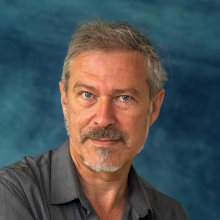
Danny Fox is the Linguistics Section Head and holds the Anshen-Chomsky Professor of Language & Thought position at the Massachusetts Institute of Technology (MIT). He is affiliated with the Department of Linguistics and Philosophy within the School of Humanities, Arts, and Social Sciences. His research focuses on syntax, semantics, and their interfaces with pragmatics, with particular emphasis on theoretical linguistics, natural language semantics, and formal models of linguistic meaning. His academic contributions span over three decades, with key works on scalar implicatures, exhaustification, presupposition projection, and the syntax-semantics interface. Notable recent publications include explorations of large language models' implications for theoretical linguistics and the analysis of distributive inferences in syntax. Fox has collaborated extensively with researchers like Roni Katzir, Martin Hackl, and Shigeru Miyagawa, advancing formal semantic frameworks and computational linguistics. His work often bridges empirical linguistic analysis with formal theoretical models, addressing challenges in pragmatic reasoning, quantification, and linguistic economy principles. Talks and lectures on topics such as cyclic linearization, question semantics, and exhaustivity further highlight his interdisciplinary approach to language structure and meaning.
Scott AnderBois is Associate Professor and Director of Linguistics at Brown University. His community-engaged research documents endangered languages like A'ingae (Ecuador) and Yucatec Maya, combining fieldwork with formal semantic analysis. Recent work examines apprehensional modality, switch-reference systems, and definiteness marking. AnderBois develops digital corpora including the A'ingae Language Documentation Project and U koorpusil maaya t'aan (Yucatec Maya corpus). His teaching spans semantics, pragmatics, typology, and linguistic field methods.
Acrisio Pires is a Professor of Linguistics at the University of Michigan's College of Literature, Science, and the Arts. His research program focuses on syntactic theory and comparative syntax within the Minimalist framework, with significant contributions to understanding language acquisition and bilingualism. Professor Pires explores fundamental questions about linguistic knowledge, cross-linguistic variation, and the relationship between syntactic theory and language change, with particular expertise in Portuguese, Spanish, and other languages. His educational background includes a Ph.D. from the University of Maryland, College Park. Professor Pires' research investigates how syntactic theory can explain linguistic variation across human languages and what contribution comparative syntax makes to scientific models of language. His work examines how linguistic theory and language acquisition research contribute to explaining language change mechanisms and what factors lead to differences in bilingualism and second language acquisition outcomes. Current projects include a book on syntactic theory from a comparative perspective for Cambridge University Press and collaborative studies with PhD students examining differential object marking in L2 Spanish, constraints on wh-movement, acquisition of Indian English by Bengali-English bilinguals, and Chinese syntax acquisition by English-Chinese bilinguals. Analysis of Professor Pires' publication record reveals a consistent focus on syntactic theory within the Minimalist framework and its applications to language acquisition across diverse language pairs. His work spans comparative syntax of Portuguese, Spanish, Chinese, Greek, Sinhala, Berber, Russian, Hawaiian, Croatian, Korean and Arabic, with particular attention to phenomena like differential object marking, wh-movement, null subjects, and the syntax-semantics interface. A significant thread throughout his research is the examination of how theoretical syntax interfaces with experimental and acquisition data to build comprehensive models of human language knowledge. Professor Pires has advised numerous PhD students who have secured academic positions worldwide, including at Taipei Medical University, University of New Hampshire, National Taiwan Normal University, University of North Texas, University of Wisconsin-Milwaukee, and the University of Michigan. His current PhD advisees include Will Nediger, Sujeewa Hettiarachchi, and Tridha Chatterjee (co-advisor), with research focusing on various aspects of syntactic theory and language acquisition. He has also mentored many undergraduate honors students whose work centered on syntactic theory, Minimalism, and syntactic change, including Natasha Abner, Emily Coppess, Charles Crissman, Nayana Dhavan, Ed Cormany, Lauren Friedman, and Shang Kong. Professor Pires is affiliated with the Center for Latin American and Caribbean Studies (LACS) at the University of Michigan, reflecting his research focus on Portuguese and Spanish linguistics. His teaching portfolio includes courses in syntax (introduction to syntax, graduate syntax, syntactic theory, Minimalism, comparative syntax), semantics, language and cognition, and language acquisition and bilingualism.
Maria Ivana Lorenzetti-Dep is an Associate Professor in English Linguistics at the University of Verona, Department of Foreign Languages and Literatures. She holds a Ph.D. in English Linguistics from the University of Pisa. Her research focuses on political discourse analysis, syntax-semantics interface, cognitive linguistics, metaphor, translation, and contrastive analysis. She has conducted visiting research at the University of Antwerp (IPrA Research Center) and UC Berkeley’s Department of Linguistics. Ph.D.: University of Pisa (English Linguistics) Visiting Scholarships: IPrA Research Center (Antwerp), UC Berkeley Teaching roles span courses in English Language, Political Discourse, and Linguistics across multiple programs since 2006. She currently teaches in bachelor’s and master’s programs on political language, tourism, and international commerce. Editorial Board Member: Bibliography of Metaphor and Metonymy (John Benjamins) Research Groups: Anglophone Studies Group (journal IPERSTORIA), Syntax-Semantics Interface Studies Key projects include digital humanities applications in foreign languages (2018–present), political discourse analysis (2012–), and contrastive linguistics (2014–). She leads initiatives in interdisciplinary theater research (SKENÈ Lab) and digital humanities (DAIH Lab).
Lukas Lewerentz is a Research Fellow holding dual positions: as a postdoc at the Department of Philosophy at Justus Liebig University Giessen and at Heinrich Heine University Düsseldorf's Chair of Epistemology and Philosophy of Language (project: 'Norms and Nature of Acceptance'). His research focuses on philosophy of language, semantics/pragmatics interface, and epistemology, particularly exploring context-dependence in communication and comparative analysis of linguistic vs pictorial assertion. He earned his DPhil from the University of Oxford (2022) under Professors Paul Elbourne and Ofra Magidor, with a thesis proposing a novel theory of conversational contexts to address challenges in situation semantics. Prior education includes studies at the University of Edinburgh and Humboldt University Berlin. Current research includes semantics of definite labels, quantifier theory, and pictorial communication mechanisms. He teaches logic courses (e.g., 'Intermediate Logic,' 'Philosophy of Lying') and supervises theses in philosophy of language. His work has appeared in journals like Journal of Philosophical Logic and Synthese .
Sandeep Prasada is a Professor and Director of the General Psychology MA Program at Hunter College, part of the City University of New York (CUNY). He holds a PhD in Cognitive Science from the Massachusetts Institute of Technology (MIT). His primary affiliation is with the Department of Psychology within the School of Arts and Sciences. Dr. Prasada's research focuses on the cognitive mechanisms underlying lexical and conceptual representation and development. Key areas include how humans form concepts across diverse domains (e.g., objects, abstract ideas), the interplay between conceptual and perceptual/linguistic representations, and developmental changes in conceptual processing. His work employs interdisciplinary methods, including ERP studies to explore neural correlates of conceptual representation. His publications span journals like Cognition , Psychonomic Bulletin & Research , and Cognitive Science , addressing topics such as principled connections in conceptual systems, generic language, and the formal structures of common sense conceptions. While no specific awards are listed, his contributions reflect sustained engagement with foundational questions in cognitive psychology and developmental science. As Director of the MA program, he oversees graduate education in general psychology. His research and teaching emphasize bridging cognitive science, linguistics, and developmental psychology.
Laurent Dekydtspotter serves as Professor and Chair of Second Language Studies at Indiana University Bloomington's College of Arts and Sciences, with additional appointments in French and Italian, Linguistics, and Germanic Studies. His leadership spans departmental administration and cross-disciplinary research initiatives focused on neural mechanisms in language acquisition. His academic foundation includes a Ph.D. in Linguistics from Cornell University (1995), an M.A. in TESOL/Linguistics from Washington State University (1989), and English degrees from Université Catholique de l'Ouest (M.A. 1987, B.A. 1985). Dekydtspotter's research pioneers the development of interpretive knowledge in L2 learners, examining how phrasal semantics, lexical semantics, and pragmatic inferences interact during sentence processing. His groundbreaking work demonstrates that second language learners engage in deep structural processing —contradicting theories of superficial lexical/contextual reliance—through meticulous experiments on context-syntactic integration in French acquisition. Current investigations leverage gamma oscillation analysis to map neural operational workspaces for syntax across L1/L2 processing. Analysis of his 15 most recent publications reveals an evolutionary trajectory from syntactic processing studies toward integrated neurolinguistic frameworks, consistently emphasizing a unified epistemology for native and nonnative language comprehension. This progression highlights methodological sophistication through time-frequency analyses of wh-movement, anaphora resolution, and agreement phenomena. His scholarly recognition includes: Teaching Excellence Recognition Award (TERA), 1999 Dekydtspotter actively mentors graduate researchers through co-authored publications while securing research support for his neurocognitive investigations. His teaching portfolio spans advanced French syntax, semantics, and pedagogy courses including Introduction to French Semantics and Topics in French Acquisition. Departmental leadership as Chair positions him at the forefront of shaping second language studies curricula and research directions. Through the Early African Cinemas Lab and cross-departmental collaborations, he contributes to IU's linguistic research ecosystem while advancing theoretical models of language faculty development through parsing-to-learn acquisition frameworks.
Kyle Rawlins is an Associate Professor and Director of Graduate Studies in the Cognitive Science Department at Johns Hopkins University. His research focuses on natural language semantics and pragmatics, emphasizing interdisciplinary approaches integrating theoretical linguistics, computational modeling, and experimental data. He holds a PhD in Linguistics from UC Santa Cruz (2008) and has taught courses such as Semantics 1 and 2, as well as specialized seminars on questions and discourse dynamics. His work explores topics including definiteness in cross-linguistic contexts, the pragmatics of questions and conditionals, and discourse attention mechanisms. Collaborations with scholars like Justin Bledin and Sadhwi Srinivas have yielded influential studies on presupposition dynamics and anaphoric variability. Rawlins has advised PhD student Sadhwi Srinivas, contributing to her research on Kannada bare nominals. His teaching and research materials, including NASSLLI courses, highlight his commitment to bridging formal semantics with computational and experimental methods. Education: PhD in Linguistics, UC Santa Cruz, 2008 Teaching: Semantics 1/2, NASSLLI courses on questions and conditionals His research spans definiteness, discourse dynamics, and clause-embedding, often leveraging crowd-sourced data and computational models. Ongoing projects include investigations into Korean demonstratives and Italian polar questions, reflecting his interest in cross-linguistic pragmatics. He has contributed to major journals and conferences, with a focus on bridging theoretical and applied linguistic research.
Charlotte Eisenrauch is a Research Associate at the German Institute of Johannes Gutenberg University Mainz since October 2022. Her work bridges descriptive linguistics, syntax, and pragmatics, with a focus on written texts in public spaces. University : Johannes Gutenberg University Mainz Role : Research Associate Research Interests : Her research explores the interaction of grammar and pragmatics on regulatory signs in public spaces, constructionist approaches to signage, reference creation mechanisms, and implications for German language teaching. She employs corpus studies and theoretical frameworks from Construction Grammar and semantics-pragmatics interface analysis. Publication Trends : Her 2024 publication with Rita Finkbeiner establishes connections between syntactic constructions and illocutionary forces in public signage, emphasizing pedagogical applications for school teaching. Contact : Email: eisenrac@uni-mainz.de Phone: +49 6131 39 30337 Office: Room 01-916 (Philosophicum), Jakob-Welder-Weg 18, 55128 Mainz
Prof. Jochen Geilfuß-Wolfgang is a Professor of German Linguistics at Johannes Gutenberg University Mainz since 2007. He holds expertise in German grammar (syntax, phonology, orthography), hyphenation rules, and focus semantics. His career includes research roles at Collaborative Research Center 340 (University of Tübingen) and the University of Leipzig. He earned his doctorate (1995) from Tübingen and habilitation (2004) from Leipzig. Education: Studies in German and Philosophy at Universities of Göttingen, Konstanz, and Tübingen (1983–1988). Key research focuses on word division, orthographic systems, and morphosyntactic phenomena. He co-edited From Pragmatics to Grammar (2007), exploring marginal grammatical phenomena. Research Interests: Orthographic and typographic standards German verb morphology and syntax Focus-sensitive constructions Hyphenation algorithms Language pedagogy in spelling instruction Publications emphasize syntactic theory and practical applications of orthography. His work bridges formal linguistics with practical language issues, including hyphenation optimization and educational linguistics.
Dr. Jorge Porcel is an Associate Professor in the Department of Arts, Languages, and Philosophy at Missouri University of Science and Technology (Missouri S&T). He also serves as a Faculty Researcher at the Center for Science, Technology, and Society (CSTS) at Missouri S&T. His primary disciplines are Spanish and Portuguese Language and Literature, with research interests focusing on foreign language education, sociolinguistic dynamics, and language maintenance among Latino communities. His work examines language attitudes in engineering and STEM contexts, diaspora communities, and theoretical aspects of Spanish grammar. Education Ph.D., University of Pittsburgh (2002) Research Interests Dr. Porcel’s research explores the intersection of language and culture, particularly in multilingual settings. Key themes include: Language policy and institutional language practices Language shift/maintenance among U.S. Latino populations Sociolinguistic analysis of Miami’s Cuban speech community Spanish verb morphology and tense-aspect-modality systems Articles Overview His publications span both applied and theoretical linguistics, with recent work addressing language attitudes in engineering education and sociolinguistic dynamics in diaspora communities. Earlier studies focus on Spanish verb conjugation systems and critiques of linguistic paradigms. His work frequently bridges theoretical frameworks with real-world language usage patterns. Labs/Teams Active within the CSTS at Missouri S&T, he collaborates on interdisciplinary projects linking technology, science communication, and language education.
Athulya Aravind is an Associate Professor of Linguistics and Cognitive Science at Yale University, holding the Alfred Henry (1929) and Jean Morrison Hayes Career Development Professorship at MIT previously. Her research focuses on child language acquisition, syntax, semantics, and cognitive development. She directs the Child Language Development Lab, investigating how children acquire first languages through behavioral experiments. Prior to Yale, she was a faculty member in MIT’s Department of Linguistics & Philosophy, where she also earned her PhD. Her work bridges theoretical linguistics and experimental approaches, with a focus on presupposition projection, quantifier acquisition, and syntactic-pragmatic interactions. Education: PhD in Linguistics from MIT. She has taught courses including Language Acquisition (undergraduate/graduate), Advanced Syntax, and Topics in Semantics, often collaborating with institutions like Harvard and CreteLing. She serves as an Associate Editor for Language Acquisition and Linguistics and Philosophy . Her research explores developmental trajectories in syntax and semantics, with recent studies on mutual exclusivity in word learning, presupposition processing in children, and AI communication ethics. Key contributions include redefining the study of presupposition projection in conditionals and conjunctions, and experimental work on Malayalam syntax and semantics. Her lab emphasizes interdisciplinary approaches, combining linguistic theory with cognitive science methodologies. Collaborations with scholars like Gabor Brody and Martin Hackl highlight her network within the field.
Kai von Fintel is the Andrew W. Mellon Professor of Linguistics at MIT, part of the Department of Linguistics and Philosophy. His research focuses on semantics, pragmatics, and philosophy of language, with a particular emphasis on modality, quantification, and presupposition accommodation. He co-founded the open-access journal Semantics & Pragmatics and has contributed extensively to formal semantics and its intersections with logic and philosophy. Fintel’s work spans topics such as anankastic conditionals, generalized quantifiers, and the semantics of epistemic modals. He holds a PhD in Linguistics and has taught at MIT since 2000. His academic journey includes graduate studies at the University of Cologne and UMass Amherst, where he was influenced by pioneers like Angelika Kratzer and Irene Heim. Fintel is a vocal advocate for open-access publishing and has authored over 60 scholarly articles. His office is located in MIT’s 32-D882 building, and he actively participates in academic discussions on linguistics and philosophy.
Sabine Iatridou is the David W. Skinner Professor of Linguistics at the Massachusetts Institute of Technology (MIT), affiliated with the Department of Linguistics and Philosophy. Her research focuses on syntax, semantics, and their interface, with particular emphasis on modality, negation, temporal adverbials, definiteness, and cross-linguistic variation. She has held leadership roles including serving as Linguistics Section Head at MIT. Key research interests include the syntax-semantics interface of imperatives, the composition of deontic modals, and the interaction between negation and temporal structures. Her work often employs cross-linguistic data to explore universal principles, with notable contributions on Turkish syntax and Greek clitics. Publications demonstrate sustained engagement with topics like X-marking theory, focus-sensitive constructions, and event semantics. Collaborations with scholars like Kai von Fintel and Hedde Zeijlstra highlight her contributions to formal semantics. Her work is frequently published in top journals such as Linguistic Inquiry and Linguistics and Philosophy . Educational roles include teaching advanced courses on modals and imperatives, and she has mentored numerous graduate students through MIT's linguistics program. Her research has been supported by grants including the LSA Institute and multiple conference presentations.
Roland Hinterholzl is a Full Professor at the Department of Linguistics and Comparative Cultural Studies at Ca' Foscari University of Venice. He serves as the Delegate of the Rector for the Coordination of the European Alliance Eutopia. His research focuses on German linguistics, syntax, historical linguistics, and pragmatics. He teaches courses such as Linguistic Pragmatics and German Language and Translation at both undergraduate and graduate levels. Administrative Role: European Alliance Coordination Delegate Teaching: Courses include LINGUA TEDESCA 3, LINGUISTICA TEDESCA, and LINGUA TEDESCA - LINGUA E TRADUZIONE Research Interests: Modal particles, word order change, syntactic theory, Germanic language evolution He has led research projects on modal particles and word order variation, collaborating with institutions like ZAS Berlin and DFG. His recent publications explore syntactic phenomena in German and English historical syntax.