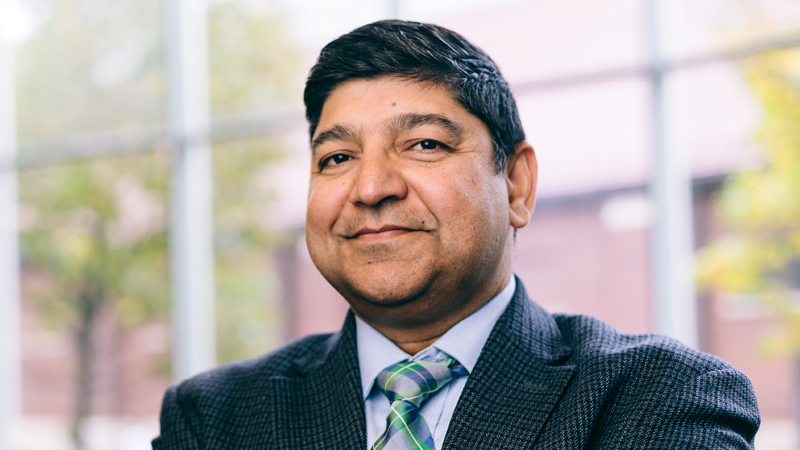
Sunil K. Prabhakar is a Professor of Computer Science at Purdue University, currently serving as the Vice Provost for Faculty Affairs and former Department Head. He holds a PhD from the University of California, Santa Barbara, and a BTech from the Indian Institute of Technology, Delhi. Education: PhD, Computer Science, University of California, Santa Barbara, 1998 MS, Computer Science, University of California, Santa Barbara, 1998 BTech, Electrical Engineering, Indian Institute of Technology Delhi, 1990 Research Interests: Focuses on database systems, uncertain data management, cloud database integrity, sensor databases, and digital rights management. His work emphasizes developing systems for probabilistic data, ensuring authenticity in outsourced databases, and scalable solutions for multimedia and sensor applications. Grants & Projects: NSF Grant IIS-1017990: Ensuring Integrity of Outsourced Databases NSF Grant IIS-09168724: Uncertain Data Management Students & Advising: Advised over 15 PhD and MS students, including Ryan Rossi (Palo Alto Research Center), Rohit Jain (Google), and Reynold Cheng (University of Hong Kong). Labs & Teams: Involved in projects like the ORION uncertain data management system, the C4E4 environmental cyberinfrastructure initiative, and collaborations with industry (e.g., Naval Surface Warfare Center).
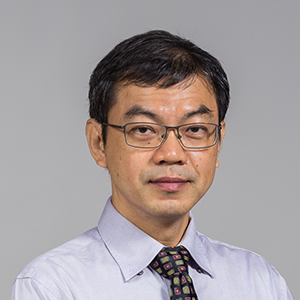
CHANG Ee-Chien is an Associate Professor in the Department of Computer Science at the School of Computing, National University of Singapore (NUS). He serves as the Lead Principal Investigator of the National Cybersecurity R&D Laboratory (NCL) and previously served as Deputy Director of the Center for Technology, Robotics, Artificial Intelligence and the Law (TRAIL) from 2019 to 2022. He also chaired the Joint Academic Committee for the Bachelor of Computing in Information Security program from 2016 until April 2023. Dr. Chang received his Ph.D. in Computer Science from New York University in 1998, following his M.Sc. and B.Sc. in Mathematics from the National University of Singapore in 1993 and 1991 respectively. He completed postdoctoral work with DIMACS at Rutgers University and NEC Labs America. His research focuses on information security, multimedia security, and their intersection. His work spans from foundational research in cryptographic techniques for noisy data and image watermarking to contemporary challenges in data privacy, cloud security, and adversarial machine learning. Dr. Chang has published extensively in top-tier security and computer science venues including CCS, EUROCRYPT, USENIX Security, and ACM Multimedia. Analysis of his recent publications reveals a strong emphasis on practical security solutions using hardware features like Trusted Execution Environments, innovative approaches to watermarking using generative models, and addressing emerging threats in machine learning systems. His work bridges theoretical cryptography with real-world security challenges, particularly in cloud infrastructure and privacy-preserving technologies. Active leadership in National Cybersecurity R&D Laboratory Extensive service on program committees for major security conferences Consultancy roles with Huawei, i-Sprint, and Singapore Accreditation Council Media commentary on cybersecurity issues for major Singaporean outlets Dr. Chang has mentored numerous research fellows and students who have gone on to academic and industry positions worldwide. His educational contributions include developing cybersecurity curriculum and innovative teaching methods such as penetration testing using real-world university applications. He has taught core security courses including CS2107 Introduction to Information Security continuously since 2014.
Clare Birchall is Professor of Contemporary Culture at King's College London's Department of English within the Faculty of Arts & Humanities. Her research focuses on contested knowledges, digital culture, and the politics of visibility. She has led major research projects funded by AHRC and CHANSE examining conspiracy theories, disinformation, and digital surveillance. Birchall's research explores how digital technologies transform political discourse and cultural production, with particular attention to conspiracy theories as cultural phenomena. She investigates how transparency and secrecy function in datafied societies, examining tensions between open information and privacy rights. Her publications demonstrate sustained engagement with digital epistemology and political communication, consistently examining how online environments reshape knowledge production. Recent work analyzes pandemic misinformation ecosystems and algorithmic amplification of conspiracy narratives. Birchall actively supervises PhD students working on material secrecies in literature, representations of torture in media, and raced subjectivities in television. She serves on editorial boards for Cultural Studies, Media Theory, and New Formations, and engages public audiences through media commentary and gallery talks.
Florentin Rochet is an Assistant Professor at the University of Namur's Faculty of Computer Science. His research focuses on anonymous communication , network security , and encrypted transport protocols , with a particular emphasis on improving privacy-enhancing technologies and protocol design. He holds a PhD in Applied Cryptography and has contributed to projects like TCPLS (TCP/TLS integration) and CLAPS (Tor path selection). Key academic milestones include joining UNamur in 2022 as an Assistant Professor, completing a postdoc at the University of Edinburgh (2021), and serving on program committees for Usenix Security, ACM CCS, and PoPETs. He has received the Usenix Security Noteworthy Reviewer Award (2023) and the 2020 Alan Berman Research Publication Award. His research spans flexible anonymous networks , secure transport protocols , and authentication technologies , with notable work on improving Tor's resilience against attacks through location-aware path selection and enhancing TLS/TCP integration for modern networks. He also leads a research group exploring eBPF security and WebAssembly runtime protections. Teaching responsibilities include computer security and privacy courses, with a 6-year teaching assistant position involving bachelor's/master's instruction and PhD supervision. His lab focuses on applied cybersecurity, network protocol innovation, and privacy-preserving systems design.
Prof. Máire O'Neill is a Professor of Information Security at Queen's University Belfast, leading the Centre for Secure Information Technologies and the UK Research Institute in Secure Hardware and Embedded Systems (RISE). She holds a MEng and PhD from Queen's University Belfast under Prof. Sir John McCanny. Her work focuses on hardware security, including attack-resilient computer hardware, PUFs, post-quantum cryptography, and secure embedded systems. Notable achievements include a six-fold improvement in AES hardware efficiency and patented PUF techniques addressing counterfeiting. Key roles include EPSRC Leadership Fellowship and Royal Academy of Engineering Fellowship. Research interests span hardware security architectures, nanotechnology-based security, and quantum-resistant cryptography. Awards include Royal Irish Academy membership, Irish Academy of Engineering Fellowship, and British Female Inventor of the Year. Recent projects include the EU H2020 SAFEcrypto initiative for post-quantum encryption and TruDetect for hardware Trojan detection. She advises on cybersecurity for IoT and connected devices, emphasizing secure manufacturing and long-term system resilience against quantum threats. Labs/Teams: Principal Investigator at the Centre for Secure Information Technologies (CSIT) and RISE. Active in multi-national collaborations like the EU's SAFEcrypto. Supervised over 8 PhD students (details in full description). Grants include funding from EU H2020, EPSRC, and industry partnerships.
Abderrahim Ouarghidi is a Teaching Professor in the Department of Anthropology at Pennsylvania State University, specializing in African Studies and Anthropology. His research focuses on Moroccan socio-ecological systems, traditional knowledge, and cultural heritage conservation. He investigates rural livelihoods, ethnobotanical practices, and environmental change in Morocco's High Atlas Mountains and oases. While specific educational details are not provided in the text, his work demonstrates expertise in anthropology, botany, and environmental studies. Research interests include crop diversity, medicinal plant conservation, and the intersection of traditional practices with modern challenges such as market integration and climate change. His publications analyze topics like arbuscular mycorrhizal fungi in endemic plants, pesticide use in pome fruit cultivation, and the ethics of archaeological remote sensing in sacred spaces. He emphasizes interdisciplinary approaches, combining ethnography with molecular methods like DNA barcoding to address biodiversity and health concerns. No scientific awards or grants are explicitly mentioned, though his active research portfolio suggests involvement in relevant funding networks. He advises no listed students but contributes to teaching and mentoring in anthropology and African studies programs. Ouarghidi's work often highlights community-based conservation strategies and the vulnerability of traditional knowledge systems to globalization. His research has implications for policy-making in sustainable agriculture, cultural heritage management, and public health.
Marc Pomplun is a Professor and Chair of the Department of Computer Science at the University of Massachusetts Boston, and Director of the Visual Attention Laboratory. His research focuses on analyzing, modeling, and simulating human vision through eye-tracking, cognitive modeling, and interdisciplinary applications in education, neuroscience, and human-computer interaction. Education: Ph.D. in Cognitive Science (University of Bielefeld, Germany, 1998) Diploma Thesis in Computer Science (University of Bielefeld, 1994) Research Interests: Marc’s work spans visual attention, eye movements, dyslexia, human-computer interaction, and computational modeling of vision. He uses eye-tracking to study reading, memory, and visual search, and applies findings to assistive technologies and educational tools. Publications & Trends: His recent work includes AI-driven medical imaging for Alzheimer’s and cancer detection, gaze-based biometric identification, and adaptive learning systems for neurodiverse learners. He has published extensively in journals like Vision Research , PLoS ONE , and Journal of Vision . Scientific Awards: No specific awards are listed in the provided text. Advising & Grants: While no specific students are named, Marc has mentored numerous researchers and received funding for projects like GeoGaze, which integrates gaze data into geoscience education for neurodiverse learners. Labs & Teams: He directs the Visual Attention Laboratory at UMass Boston, focusing on interdisciplinary research in vision science and technology.
Dr Jenny Robson is a Senior Lecturer at the University of East London's School of Education and Communities, specializing in early childhood education, pedagogical innovation, and policy analysis. Her research critically examines intersections between education policy, security measures, and children's rights, with a focus on counter-terrorism frameworks, Roma education, and participatory values education. She has published extensively on topics such as the Prevent Duty in UK education, ethical leadership in marketized early years provision, and the impact of pandemic-driven online learning. Her work bridges theoretical scholarship and practical pedagogical strategies, emphasizing participatory methods and critical dialogue in early childhood settings. Key areas of contribution include analyzing governance structures through panoptic theory, exploring playful pedagogy in teacher training, and addressing marginalization of Roma communities in austerity-driven education systems. Dr Robson's recent publications (2022–2025) highlight her focus on evolving educational challenges, including pandemic-era adaptive teaching and the complex interplay between security policies and childhood development. She has contributed chapters to edited volumes on Prevent Duty implementation and maintains an active research agenda addressing both micro (classroom practices) and macro (policy) levels of education systems.
Ruba Al Omari is an Assistant Professor, Teaching Stream in the Department of Electrical Engineering & Computer Science at York University. She holds a PhD in Computer Science from Ontario Tech University, where she earned the Doctoral Excellence Award. Her research focuses on cybersecurity, machine learning applications in security, and the intersection of brain-computer interfaces (BCIs) with password memorability and user behavior analysis. Dr. Al Omari has over 15 years of industry experience in IT roles spanning network management and security. Her teaching portfolio includes graduate and undergraduate courses in cybersecurity, network security, applied cryptography, malware analysis, and machine learning. Notable courses include 'Attack and Defense Special Topics in IT: AI in Cybersecurity' and capstone projects in computer security. Research interests emphasize leveraging EEG signals and neural networks to predict password memorability, studying user behavior in password usage, and exploring BCI applications for facial recognition and image tagging. Her work bridges cognitive science, neuroscience, and computational security systems. Publications consistently address themes of password security, BCI-driven biometric authentication, and cognitive aspects of cybersecurity. Awards include the Doctoral Excellence Award from Ontario Tech University (exact year not specified in text). Previous roles included program coordinator for AI and Cybersecurity programs at Durham College, alongside teaching experience at Ontario Tech University. Industry background includes user support and network management roles, providing practical insights into IT security challenges.
Linda Walters is a Pegasus Professor in the Department of Biology within the College of Sciences at the University of Central Florida. She directs the Coastal and Estuarine Ecology Laboratory (CEELAB), conducting field research at UCF's main campus and the Fellers House Field Station in Canaveral National Seashore. Her work focuses on Florida's Indian River Lagoon system, integrating ecological research with community engagement. Her research spans three primary domains: oyster reef restoration addressing boat wakes, algal blooms, invasive species, and microplastics; living shoreline stabilization studying mangrove/marshgrass recruitment and microplastic pollution; and wading bird conservation examining habitat use and human impacts. She employs interdisciplinary approaches combining field ecology, biogeochemistry, hydrodynamics, and social science, with strong emphasis on community science and K-12 outreach through children's storybooks and oyster storytelling yoga. Recent publications reveal intensifying focus on microplastic pollution pathways, climate-driven ecosystem shifts (tropicalization), and innovative restoration techniques like biodegradable materials. Her work increasingly integrates technology such as 360° virtual field trips and GIS mapping to enhance research accessibility and public engagement. Dr. Walters secures major funding from NSF, NOAA, Disney Conservation Fund, and state agencies. Her lab collaborates extensively with Florida Fish and Wildlife, National Park Service, Florida Sea Grant, and community organizations. She actively mentors undergraduate and graduate students through UCF's Biology Department, requiring prospective researchers to engage with CEELAB's restoration and outreach activities prior to developing independent projects. CEELAB operates as a hub for coastal research, bringing together biologists, engineers, social scientists, and volunteers. The lab maintains strong community ties through restoration workshops with Coastal Conservation Association-Florida and Mudhole Tackle, plus regular outreach events documented on their Facebook page. Their work directly informs regional conservation efforts in Florida's threatened estuarine ecosystems.
Cong Shi is an Assistant Professor in the Department of Computer Science at New Jersey Institute of Technology (NJIT). His research focuses on applied machine learning, security and privacy for mobile systems, and robust/trustworthy AI. Specific interests include adversarial machine learning, WiFi sensing, and AR/VR security. Education: Ph.D. in Electrical and Computer Engineering from Rutgers University (2022), M.S. in Electrical Engineering from Stevens Institute of Technology (2015), B.S. in Electrical Engineering and Automation from Guangdong University of Technology (2013). Research highlights include developing methods for vital sign monitoring using motion sensors, backdoor defense mechanisms in AI models, and privacy leakage prevention in AR/VR ecosystems. Recent work explores attacks on RF signal classification and vibration-based speech reconstruction. His publications appear at venues like IEEE S&P, ACM CCS, and AAAI. Teaching responsibilities include courses like CS 645 (Security and Privacy in Computer Systems) and CS 785 (Seminar in Computer Science).
Luca Crocetti is an Assistant Professor at the Department of Information Engineering (DII) of the University of Pisa. His research focuses on hardware security, embedded systems, and VLSI design for applications in Automotive, Space, IoT, and High-Performance Computing. He specializes in cybersecurity modules for automotive systems, space-grade FPGAs, and digital signal processing in satellite communications. His teaching includes electronics laboratory practices and cybersecurity principles, with a recent course on hardware's role in security for the Ph.D. program in Information Engineering. He has authored over 20 publications and holds 3 patents (1 national, 2 international), with notable work on cryptographic cores, secure boot mechanisms, and automotive cybersecurity. His contributions span efficient hardware implementations of AES, SHA-3, and other cryptographic algorithms, emphasizing compliance with standards like CCSDS for space applications. His research trends highlight a focus on hardware-efficient architectures, modular design for scalability, and robust security protocols for trusted environments. Notable publications address cryptographic co-processors for the European Processor Initiative, PUF-based security for RISC-V, and FPGA-based RNGs. While no formal awards are listed, his active role in cutting-edge cybersecurity projects underscores his contributions to embedded and space system security. His teaching and research emphasize hands-on lab experiences and real-world applications of hardware security principles.
Dong Chen is an Associate Professor in the Department of Computer Science at the Colorado School of Mines. His research focuses on building data-driven experimental systems in Cyber-Physical Systems (CPS), IoT, Embedded AI, and Embodied AI, with applications in smart devices, homes, cities, and renewable energy systems. He leads the Next Generation Cyber-Physical Systems Laboratory (CPSLab), emphasizing open-source systems and datasets. Dr. Chen holds PhDs in Electrical and Computer Engineering (2018, University of Massachusetts Amherst) and Computer Science (2014, Northeastern University). His work addresses security, privacy, sustainability, and efficiency in smart environments. Notable contributions include SolarFinder, SolarTrader, PrivacyGuard, and VoiceAttack, which tackle challenges in IoT privacy, energy trading, and adversarial attacks. He received the NSF CAREER Award (2023) and is a member of Sigma Xi, ACM, AAAI, and IEEE. His research spans system design, AI applications, and cross-cutting domains like solar energy modeling and edge computing. Current projects include AgileDART (edge stream processing) and SolarDetector (satellite-based PV array identification). Advising and collaborations: Dr. Chen seeks PhD and undergraduate students with strong CS/EE backgrounds. His lab focuses on CPS/IoT security, energy systems, and AI-driven solutions. He has published extensively on topics ranging from smart grid optimization to adversarial machine learning.
Travis Mayberry is an Assistant Professor in the Cyber Security department at the United States Naval Academy. His research focuses on cryptographic protocols, cloud security, privacy-preserving technologies, homomorphic encryption, and secure voting systems. He holds a PhD in Computer Science from Northeastern University, with a dissertation on practical Oblivious RAM (ORAM) protocols for private data outsourcing. He also contributed to the Scantegrity project at the University of Maryland, Baltimore County, developing end-to-end verifiable voting systems. Key areas of research include privacy in mobile devices, secure communication protocols, and cryptographic mechanisms for data protection. His work has been published in top venues like Privacy Enhancing Technologies Symposium (PETS), Network and Distributed Systems Security Symposium (NDSS), and ACM Computer and Communications Security (CCS). He received a Distinguished Paper Award in 2014 for his research on combining ORAM and PIR for efficient private file retrieval. Mayberry’s publications analyze vulnerabilities in Bluetooth Low Energy protocols, TLS client authentication tracking, and MAC address randomization in mobile devices. He has collaborated extensively on secure voting systems (e.g., Scantegrity) and practical ORAM implementations like ObliviSync and rORAM. His contributions bridge theoretical cryptography with real-world applications in privacy and security.
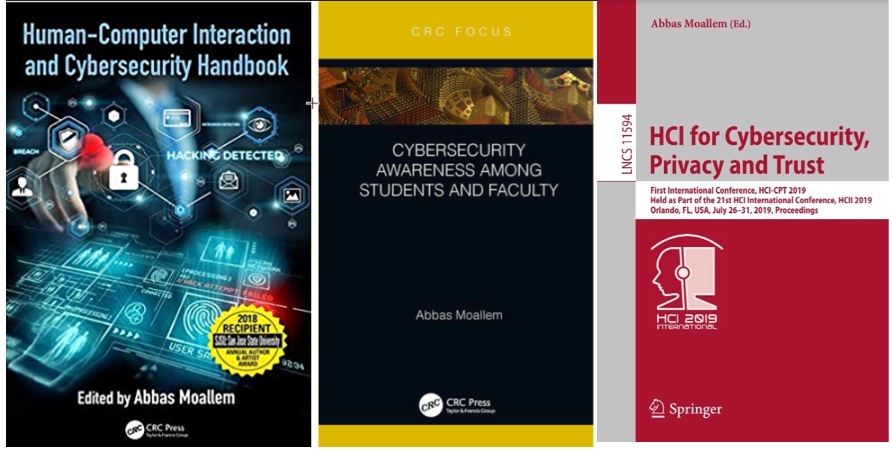
Dr. Abbas Moallem is an Adjunct Professor in the Industrial & Systems Engineering Department at San José State University's College of Engineering, where he teaches Human Computer Interaction, Cybersecurity, Information Visualization, and Human Factors. He also serves as executive director of UX Experts and holds an adjunct position at California State University, East Bay. His professional activities include significant leadership roles in major academic conferences. Education: Ph.D. in Ergonomics/Human Factors, University of Paris Nord (XIII), 1987 M.S. in Ergonomics/Human Factors, University of Paris Nord (XIII), 1982 M.S. in Biomechanics, University of Paris Val-de-Marne(XII), 1980 B.A., University of Tehran, 1978 With over 30 years of experience in human factors, ergonomics, and human-computer interaction, Dr. Moallem's research focuses on the critical intersection between human behavior and cybersecurity. His work examines how interface design, terminology, and user experience impact security outcomes, with particular attention to making security mechanisms more usable and understandable. He has pioneered research in cybersecurity awareness, particularly among students and faculty, and investigates how human factors contribute to both vulnerabilities and solutions in cybersecurity contexts. His research extends to smart systems, AI interfaces, and the human elements in emerging technologies. Dr. Moallem's publication record demonstrates a clear trajectory toward increasingly specialized work at the HCI-cybersecurity intersection. His recent articles and books focus on human factors analysis of cyberattacks, dashboard design for security visibility, terminology in security interfaces, and frameworks for understanding user behavior in security contexts. He has edited multiple conference proceedings specifically dedicated to HCI for Cybersecurity, Privacy, and Trust from 2019 through 2025, establishing this as a distinct and growing research domain. Professional Leadership: Communication and Exposition Chair of HCI International and Applied Human Factors and Ergonomics International conferences Program Chair of HCI-CPT: International Conference on HCI for Cybersecurity, Privacy, and Trust Track Chair of Human Factors in Cybersecurity at AHFEI conferences Editorial board member for multiple professional journals Dr. Moallem has translated his academic expertise into practical applications through his consultancy work. He has served as a senior engineering product manager and usability expert at NETGEAR, and as a UI Architect at PeopleSoft and Oracle Corporation. His industry experience spans over 11 years at companies including Tumbleweed and Axway, where he applied human factors principles to real-world technology products. He has consulted across diverse industries in Europe, Canada, and the USA, bridging the gap between academic research and practical implementation. His laboratory and team activities center around UX Experts, his consultancy organization, and the academic communities he helps lead through conference organization and editorial work. Through these channels, he fosters collaboration between researchers and practitioners working at the intersection of human factors and cybersecurity.