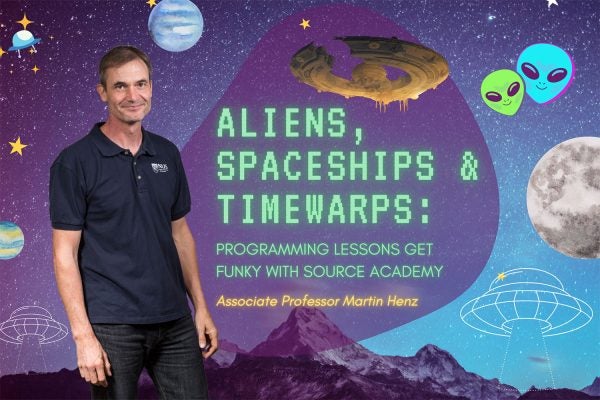
Martin Henz is an Associate Professor at the National University of Singapore , affiliated with the School of Computing and its Department of Computer Science . His academic journey includes an M.Sc. in Computer Science from Stony Brook University (1993) and a Dr.rer.nat. in Computer Science from Saarland University (1997). He has also worked as a Research Scientist at the German Research Centre for Artificial Intelligence. Research Focus : Scalable Experiential Learning, Systems for Teaching/Learning, AI in Education, Programming Languages, Algorithms, and Constraint Programming. Key Projects : Source Academy (immersive programming environment), Deep Teaching (LMS enhancements), and NUS Seafarers (maritime experiential learning). Publications span education technology, programming languages, and sustainable engineering, with recent works focusing on JavaScript-based pedagogy, automated question generation, and electric vehicle conversions. He supervised Rahul Singhal 's PhD, leading to the educational startup Cerebry, and co-founded Workforce Optimizer Pte Ltd with Alan Sevugan. Awards : NUS Annual Digital Education Award (2021) NUS Annual Teaching Excellence Award (2016/17) Fulbright Scholarship (1990) Startup @ Singapore Champion (2001)
Corina Pasareanu is an ACM Fellow and IEEE ASE Fellow serving as a Principal Scientist at Carnegie Mellon University's CyLab Security and Privacy Institute and Technical Professional Leader for Data Science at NASA Ames Research Center through KBR. Her work bridges formal methods, software verification, and artificial intelligence to ensure the safety and security of complex systems, particularly autonomous systems and machine learning applications. Dr. Pasareanu received her academic training at: Ph.D. in Computer Science, Kansas State University (2001) M.S. in Computer Science, University Politehcnica of Bucharest (1995) B.S. in Computer Science, University Politehcnica of Bucharest (1994) Her research focuses on developing formal verification techniques that can provide mathematical guarantees about the behavior of complex software systems. She specializes in applying model checking, symbolic execution, and compositional verification methods to challenges in autonomy, security, and AI safety. Her recent work addresses the verification of systems incorporating machine learning components, particularly neural networks used in safety-critical applications like autonomous vehicles. She investigates how to ensure these systems behave correctly even when their perception components have uncertainties or are subject to adversarial attacks. Analysis of her recent publications shows a strong trend toward verifying AI and machine learning systems, particularly focusing on neural networks in autonomous systems. Her work increasingly addresses the challenges of Large Language Models, examining both their vulnerabilities to attacks and methods to defend against them. She also continues to advance traditional software verification techniques while adapting them to modern programming languages and paradigms. Dr. Pasareanu has received numerous prestigious awards recognizing her contributions to the field: ACM Fellow IEEE ASE Fellow ETAPS Test of Time Award (2021) ASE Most Influential Paper Award (2018) ESEC/FSE Test of Time Award (2018) ISSTA Retrospective Impact Paper Award (2018) ACM Impact Paper Award (2010) ICSE 2010 Most Influential Paper Award (2010) As an advisor, Dr. Pasareanu mentors several PhD students and postdoctoral researchers, often in collaboration with other faculty members at CMU. Her students focus on cutting-edge research at the intersection of formal methods and AI safety. Her research is supported by substantial funding from diverse sources including NSF, DARPA, NASA, AWS, and industry partnerships. She leads multiple projects focused on AI security, formal verification of neural networks, and software analysis techniques. Dr. Pasareanu also plays a significant role in the broader research community, serving as Program/General Chair for major conferences including ICSE 2025, and as an associate editor for IEEE TSE and STTT. Dr. Pasareanu leads research teams working on projects like "Trinity: Neurosymbolic Learning and Reasoning" (DARPA) and "HUGS: Human-Guided Software Testing and Analysis" (NSF). Her work often involves interdisciplinary collaboration between computer scientists, formal methods experts, and domain specialists to address complex safety challenges in autonomous systems.
Ruben Martins is an Assistant Professor at Carnegie Mellon University's School of Computer Science and serves as the program director of the Master of Science in Computer Science (MSCS) . His research focuses on the intersection of constraint programming, program synthesis, analysis, and verification, with recent work aiming to make formal methods tools more accessible through automated reasoning. Ruben earned his Ph.D. with honors from the Technical University of Lisbon, Portugal (2013) , followed by postdoctoral research at the University of Oxford (2014-2015) and UT Austin (2015-2017) . Research Interests : Ruben's work bridges constraint programming and program synthesis , with applications in software verification , optimization , and automated reasoning . He has developed award-winning tools like Open-WBO , a modular MaxSAT solver that has won gold medals in international competitions. His publications span top-tier venues such as POPL , PLDI , FSE , SAT , and CP , often addressing real-world challenges from program analysis to network security. Scientific Awards include: Distinguished Paper Award at PLDI 2018 Distinguished Paper Award at FSE 2021 Distinguished Paper Award at SAT 2022 Gold medals for Open-WBO in MaxSAT competitions Teaching & Advising : Ruben mentors Ph.D., Master’s, and undergraduate students in research projects related to program synthesis, formal methods, and constraint solving. He teaches courses such as Bug Catching: Automated Program Verification and Advanced Topics in Logic: Automated Reasoning and Satisfiability , emphasizing hands-on experience with tools like Why3. His advising spans topics from AI-driven program repair to network protocol verification , fostering collaboration across disciplines.
Paul Franzon is the Cirrus Logic Distinguished Professor and Associate Department Head for Graduate Affairs at the Department of Electrical and Computer Engineering, North Carolina State University. He holds a PhD and Bachelor's in Electrical Engineering and a Bachelor's in Physics/Mathematics from the University of Adelaide, Australia. His research focuses on quantum information science, machine learning-driven hardware design, 3D integration, and high-speed systems. Education: PhD in Electrical Engineering, University of Adelaide (1988) Bachelor's in Electrical Engineering, University of Adelaide (1984) Bachelor's in Physics and Mathematics, University of Adelaide (1982) Research Interests: Quantum computing and algorithm optimization AI-driven design automation for 3D integrated circuits High-speed communication systems Hardware security and FPGA acceleration Awards & Honors: IEEE Fellow (2006) Alcoa Foundation Distinguished Engineering Research Award (2005) NC State Alumni Distinguished Undergraduate Professor Award (2003) NSW Australia Expatriate Scientist Award (2003) Advising & Grants: Advised PhD student Priyank Kashyap (2023 graduate) Recipient of NSF Young Investigators Award (1993) Labs & Collaborations: Center for Advanced Electronics Through Machine Learning (CAEML) IEEE EPS Society (Associate Editor)
Jasmin Blanchette is a Professor of Theoretical Computer Science and Theorem Proving at the Institute for Informatics, Ludwig-Maximilians-Universität München (LMU), where he also serves as Dean of Studies for Computer Science since January 2024. He is additionally affiliated as a guest researcher with the VeriDis group at Loria in Nancy, France. His research lies at the intersection of automated and interactive theorem proving, with a focus on higher-order logic and proof automation. Key projects include the development of tools like Sledgehammer, Nitpick, and Zipperposition, and foundational work on (co)datatypes and higher-order superposition. His recent publications reflect a strong trend in formalizing and verifying automated reasoning techniques, especially in higher-order logic, with applications in proof automation, SMT solving, and logical verification. Articles frequently appear in top venues such as CADE, ITP, and the Journal of Automated Reasoning. CADE 2023 Best Paper Award for 'Verified given clause procedures' FroCoS 2023 Best Paper Award (with Visa Nummelin and Sander Dahmen) IPA Dissertation Award (awarded to his student Petar Vukmirović) Dutch 'cum laude' distinction (awarded to his student Anne Baanen) Dutch Prize for ICT Research 2022 Blanchette has advised numerous PhD and postdoctoral researchers, many of whom are now active contributors to the formal methods community. He has received significant research grants through projects like Matryoshka and Nekoka. He is also the editor-in-chief of the Journal of Automated Reasoning and plays a central role in organizing key conferences such as ITP, CADE, and CPP. He leads an active research group at LMU, consisting of postdocs and PhD students working on topics such as higher-order superposition, formalization of voting systems, categorical logic, and proof search heuristics. The team collaborates closely with international groups, including those at Inria and TU Wien.
Prof. Dr. Rolf Wanka is a Professor at the Department of Computer Science, Friedrich-Alexander-Universität Erlangen-Nürnberg (FAU), specializing in efficient algorithms and combinatorial optimization. His research focuses on swarm intelligence, discrete optimization algorithms, and scheduling problems, particularly in timetabling and robotics applications. Education : Sc.D. (Dr. rer. nat.) in Computer Science His work includes theoretical and experimental analyses of particle swarm optimization (PSO) algorithms, addressing runtime complexity, stagnation behavior, and convergence properties. He has developed novel heuristics for timetabling and sorting problems, with applications in multi-robot systems and medical imaging. Notable collaborations include studies on Markov chain-based PSO and fairness in academic scheduling. Key trends in his recent publications span swarm intelligence , discrete optimization , and scheduling heuristics , with a focus on robust timetabling , runtime analysis , and stochastic algorithm behavior . While no explicit scientific awards are listed, his mentorship in the Max Weber-Programm highlights his advisory role in academia. His publications demonstrate interdisciplinary applications of algorithms in robotics , medical imaging , and parallel computing , leveraging both theoretical rigor and practical experimentation. The full description below provides exhaustive details on his academic contributions and affiliations.
Haobin Ni is a Postdoctoral Scholar at the University of Washington in the Programming Language and Software Engineering (PLSE) group, advised by Professor Zachary Tatlock. His research bridges theoretical formal methods with practical systems development in programming languages and security. Education: Ph.D. in Computer Science, Cornell University (2024). Dissertation: "Formal Modeling Languages for High-assurance Domain-specific Systems." Advisors: Greg Morrisett and Robbert van Renesse. Ni's research focuses on language design, program analysis, and compiler optimization with emphasis on formal verification of distributed systems, concurrent programs, and parsers. He pioneers secure smart contract languages using information flow control type systems and develops novel protocols for distributed systems. His work consistently targets high-assurance systems where correctness and security are critical, spanning blockchain, binary parsing, and state machine replication. Analysis of his 11 publications (2019-2024) reveals three dominant research thrusts: compositional security frameworks for smart contracts (especially against reentrancy attacks), provably correct implementations of critical infrastructure like ASN.1 parsers, and modular abstractions for distributed ledger technologies. His methodology combines deep theoretical formalization with practical implementation, resulting in tools and protocols adopted in real-world systems. Scientific awards: Best Paper Award, IEEE Symposium on Security and Privacy (2021) ICPC World Finals Gold Medal (2016) ICPC World Finals Silver Medal (2014) Ni actively mentors through competitive programming: he coached Cornell's ICPC team (2018-2024), leading them to World Finals qualifications in 2019 and 2023, and volunteered for high school programming contests. Currently, he leads the PLSE Programming Languages Reading Group (PLRG) at the University of Washington, fostering community engagement in PL research. His work shows strong industry collaboration, particularly with Microsoft Research on blockchain and security projects. As a core member of UW's PLSE group, Ni contributes to one of academia's leading programming languages research teams. His current leadership of the PLRG demonstrates active community building, while his technical work on Charlotte and ASN1★ positions him at the forefront of secure distributed systems research.
Kuldeep S. Meel is the Stephen Fleming Early-Career Associate Professor at Georgia Institute of Technology's School of Computer Science and an Associate Professor at the University of Toronto (currently on leave). His research focuses on the intersection of Formal Methods and Artificial Intelligence, emphasizing scalable automated reasoning techniques. He holds prestigious awards including the 2022 ACP Early Career Researcher Award and the 2019 NRF Fellowship for AI. His work has been recognized with multiple best paper awards at conferences like ICLP, CAV, and IJCAI. Meel's research spans automated reasoning, formal methods, and their applications in AI. He has developed influential tools like ApproxMC and UniGen, advancing model counting and uniform sampling. His academic journey includes roles at NUS and collaborations with institutions globally. Teaching excellence is highlighted by NUS Annual Teaching Awards (2022, 2023). Awards include Distinguished Paper Awards at CAV-23 and CAV-24, and 1st place in Model Counting Competitions. His lab has produced notable advisees securing tenure-track positions worldwide. Current projects explore distribution testing, probabilistic reasoning, and AI verification.
Dave Tompkins is an Associate Professor in the David R. Cheriton School of Computer Science at the University of Waterloo. He holds a PhD in Computer Science and a MASc in Electrical Engineering from the University of British Columbia, along with a BESc and BSc from Western University. His primary research focuses on Stochastic Local Search (SLS) algorithms for the Satisfiability Problem (SAT) and MAX-SAT. Research Interests: His work spans Stochastic Local Search Algorithms SAT and MAX-SAT problem solving Dynamic Local Search techniques Heuristic algorithm design and optimization Data compression and image coding Genetic algorithms and game theory Scientific Awards: He has received Best Paper Award (2006, CCAI) Best Poster Awards (2003, ASI; 1999, ASI) Gold and Silver Medals in SAT Competitions (2004) Incomplete Solver Track Awards (2012, MAX-SAT) Projects: He is known for developing the UBCSAT framework and the Captain Jack SAT solver. He has also contributed to standards like JBIG2 and JPEG-2000.
Koushik Sen is a Professor in the Department of Electrical Engineering and Computer Sciences at the University of California, Berkeley. He holds a B.Tech from IIT Kanpur and M.S./Ph.D. from UIUC. His research focuses on Software Engineering, Programming Languages, and Formal Methods, emphasizing tools like DART, CUTE, and Jalangi for improving software reliability. He leads projects such as CORVETTE and Sky Computing Lab, and collaborates with Samsung Research America on JavaScript analysis. Sen has received prestigious awards including the Sloan Fellowship and ACM SIGSOFT Impact Award. Education: B.Tech, Indian Institute of Technology, Kanpur M.S. and Ph.D., University of Illinois at Urbana-Champaign Research Interests: Software Testing, Verification, Symbolic Execution, Security, and Quantum Computing. His work bridges automated testing (e.g., concolic testing) with machine learning for bug detection and program synthesis. Projects include Hindsight Logging for ML reproducibility and quantum circuit optimization (QFAST). Awards: NSF CAREER, IFIP Manfred Paul, ACM SIGSOFT Distinguished Paper (multiple), and Sloan Fellowship. Advising: Supervised over 30 students/postdocs, leading to faculty roles at UBC, CMU, and industry positions at Google, Facebook, and Samsung. Labs/Teams: Berkeley Center for Responsible, Decentralized Intelligence (RDI), EPIC Data Lab, and Sky Computing Lab. Active in quantum computing and hardware fuzzing (RTL-FuzzLab).
Gaurav Rattan is an Assistant Professor in the Department of Applied Mathematics at the University of Twente's Faculty of Electrical Engineering, Mathematics and Computer Science (EEMCS), where he joined in May 2024. His research focuses on the mathematical foundations of machine learning on graphs and discrete structures, with particular emphasis on theoretical aspects of graph neural networks. University of Twente, Department of Applied Mathematics (May 2024-present) TU Darmstadt, Postdoctoral Researcher in Pascal Schweitzer's group RWTH Aachen, DFG Eigene Stelle Researcher in Martin Grohe's group Dr. Rattan completed his PhD at IMSc Chennai under V. Arvind and earned his B. Tech. from IIT Bombay, establishing a strong foundation in theoretical computer science and mathematics. His research spans graph theory, algorithms, and machine learning on graphs, with specific expertise in graph isomorphism, graph homomorphisms, and the theoretical underpinnings of graph neural networks. He applies mathematical techniques from logic and algebra to develop theory-driven approaches for graph learning systems, with practical applications in optimization, bioinformatics, and databases. Dr. Rattan's publication record reveals a consistent focus on the intersection of theoretical computer science and machine learning. His recent work explores Weisfeiler-Leman algorithms, symmetry breaking techniques, and parameterized complexity of graph problems, demonstrating how classical graph algorithms connect with modern graph learning methodologies. His research provides crucial theoretical foundations for understanding the capabilities and limitations of graph neural networks. Active in the academic community, Dr. Rattan regularly presents at conferences including the Netherlands Mathematical Congress, SIGAlgo, LOGAMS, and specialized workshops on graph learning. Recent presentations include "From Graph Homomorphisms Densities to Graph Learning" at the Graph Learning Workshop at NITMB Chicago and "Color Refinement: One Algorithm, Many Facets" at SIGAlgo 2024.
Dr. Vijay Ganesh is a Professor of Computer Science at Georgia Institute of Technology, where he also serves as Associate Director of the IDEaS Institute and is affiliated with Tech AI. Previously, he held roles as Associate Professor (2018–2023) and Assistant Professor (2012–2018) at the University of Waterloo, and Research Scientist at MIT (2007–2012). He earned his PhD from Stanford University in 2007. His research focuses on SAT/SMT solvers and their applications in AI, software engineering, security, mathematics, and physics. Notable contributions include developing solvers like MapleSAT, Z3str4, and AlphaZ3, and exploring machine learning-augmented reasoning. He has led projects in logic for AI, proof complexity, and security of blockchain technologies. His awards include ACM Impact Paper (2019), ACM Test of Time (2016), and DATE’s Ten-Year Most Influential Paper (2008). He has advised startups like Quantstamp, a blockchain security firm, and co-directed the Waterloo AI Institute (2021–2023). His teaching includes courses on discrete mathematics, software engineering, and AI. Education: PhD in Computer Science, Stanford University (2007); Master’s in Electrical Engineering, Stanford (2000) Research Interests: SAT/SMT solvers, formal methods, automated testing, AI security, combinatorial mathematics Affiliations: Georgia Tech’s School of Computer Science, IDEaS Institute
Craig S. Kaplan is a Professor at the University of Waterloo's David R. Cheriton School of Computer Science within the Faculty of Mathematics. His research bridges computer science and mathematical art, focusing on computational geometry, geometric pattern design, and algorithmic art. He holds degrees including a Ph.D. and M.Sc. from the University of Washington (2002, 1998) and a B.Math. from the University of Waterloo (1996). His work spans applications of mathematics in art and design, including Islamic geometric patterns, computer graphics, and computational geometry. Notable contributions include developing methods for generating Islamic geometric patterns, exploring aperiodic tilings (including the discovery of an aperiodic monotile in 2023), and creating tools for artistic visualization like RepulsionPak and FlowPak. He also engages with digital art forms such as generative algorithms, stereoscopic 3D rendering, and interactive applications for mindfulness and VR. His publications reflect a focus on geometric algorithms, pattern generation, and interdisciplinary art-science projects. Though no explicit awards are listed, his prolific output and contributions to mathematical art suggest significant recognition in his field. His work often emphasizes computational methods for artistic expression, combining rigorous mathematics with creative outcomes.
Roie Levin is an Assistant Professor at Rutgers University's Department of Computer Science. He received his PhD in Algorithms, Combinatorics and Optimization from Carnegie Mellon University in 2022, advised by Anupam Gupta. Prior to that, he worked at the Allen Institute for Artificial Intelligence (2015-2017) and earned dual BSc degrees in Computer Science/Applied Mathematics and Mathematics from Brown University (2015). Before joining Rutgers, he was a Fulbright Postdoctoral Fellow at Tel Aviv University under Niv Buchbinder. Current Role: Assistant Professor in Computer Science Academic Training: PhD (2022) CMU, BSc (2015) Brown University Postdoctoral: Fulbright Fellow at Tel Aviv University Levin's research focuses on approximation algorithms for uncertain environments (online/dynamic/streaming models) and submodular function optimization. His work spans theoretical foundations and practical implementations across distributed systems, geometric constraints, and reinforcement learning paradigms. Teaching includes graduate and undergraduate algorithms courses (CS 344, CS 513) with emphasis on problem-solving techniques, computational complexity, and modern algorithmic trends. His publications showcase expertise in online algorithms, submodular optimization, and approximation theory with applications in clustering, caching, and machine learning. The 2025 articles demonstrate continued exploration of online consistency and contention resolution, while 2023-2024 works focus on submodular optimization under uncertainty and dynamic environments. Earlier publications (2015-2017) cover semantic parsing, geometric approximation, and planar graph optimization. Fulbright Postdoctoral Fellow Levin's research connects theoretical guarantees with practical implementations, bridging classical algorithm design with modern machine learning applications. His recent work explores primal-dual methods in online settings and robust subspace approximation techniques for streaming data environments.
Dr. Yacine Sam is a Lecturer in Computer Science at the Polytechnic School of the University of Tours (EPU), affiliated with the Fundamental and Applied Computer Science Laboratory of Tours (LIFAT). His research focuses on databases, knowledge representation & reasoning, web services, and semantic web technologies. Doctorate in Computer Science, Paul Cézanne University Aix-Marseille 3 (2008) Master 2 Research in Computer Science, Claude Bernard University Lyon 1 (2005) Dr. Sam's research spans multiple subfields including: Trustworthy execution of adaptive business processes Privacy ontologies for Web of Things Deep learning applications in personalized service recommendations Linked open data frameworks for semantic integration Blockchain implementations in distributed systems Health analytics using collaborative IoT data Contact: yacine.sam@univ-tours.fr