Dr. Ramkrishan Maheshwari is an Associate Professor at the Institute of Mechanical and Electrical Engineering, University of Southern Denmark, specializing in power electronics and motor drive systems. His research focuses on advanced power converter topologies, wide bandgap semiconductors, and renewable energy integration. University: University of Southern Denmark Rank: Associate Professor Research: Power Converters, PWM Techniques, Wide Bandgap Devices Recent work involves small DC-link capacitors, machine learning-based component selection, and hydrogen production systems. His Google Scholar articles highlight innovations in converter design and control algorithms. Awards include the BHJ Foundation Teaching Prize (2023) and a Best Paper Award (ICPEE 2021). He supervises PhD students like M. A. Khan and R. K. Mahapatra and leads projects such as 'Efficient Cost Saving Grid Friendly PtX Converter' funded by Mads Clausens Fond.
Georgios Arvanitidis is an Associate Professor at the Technical University of Denmark (DTU) in the Department of Applied Mathematics and Computer Science, specifically within the Section for Cognitive Systems (CogSys). He has established himself as a leading researcher in geometric machine learning, focusing on the application of differential geometry principles to enhance machine learning models. His work bridges theoretical mathematics with practical applications in artificial intelligence, with particular emphasis on understanding the geometric structure of data manifolds and latent spaces. Dr. Arvanitidis completed his educational journey with a Bachelor's degree from the Department of Informatics at the Aristotle University of Thessaloniki, followed by a Master's degree in Computer Science from Saarland University supported by the Max Planck Institute for Informatics. He earned his PhD at DTU's Cognitive Systems section under the supervision of Søren Hauberg, with additional research experience at Philipp Hennig's Probabilistic Numerics group. Prior to his current position as associate professor, he was a PostDoc at the Max Planck Institute for Intelligent Systems working with Bernhard Schölkopf. Dr. Arvanitidis's research primarily focuses on differential geometry in machine learning , where he explores how geometric structures can enhance representation learning and statistical modeling. His work in generative models investigates how learning the geometry of data manifolds can improve deep learning architectures. In the domain of deep learning theory , he examines why deep learning models generalize effectively on unseen data, with particular attention to the curvature properties of loss landscapes. His research in approximate Bayesian inference applies geometric principles to improve uncertainty quantification in neural networks. Through his innovative approaches, Dr. Arvanitidis has established himself as a leading researcher in geometric machine learning, contributing to both theoretical foundations and practical applications across various domains including robotics and life sciences. The publication trends of Dr. Arvanitidis reveal a consistent and evolving focus on geometric approaches to machine learning problems. His recent work (2023-2025) demonstrates increasing sophistication in applying Riemannian geometry to deep learning architectures, with particular emphasis on latent space geometry, optimization on manifolds, and geometric interpretations of neural network behavior. A notable pattern is the progression from foundational work on geometric representations to more applied research in areas like robotics and causal inference. His publications span top-tier conferences including NeurIPS, ICML, ICLR, and AISTATS, reflecting the high impact of his research. The interdisciplinary nature of his work is evident in collaborations across mathematics, computer science, and robotics domains, with recent papers addressing challenges in multimodal sampling, safety guarantees for dynamical systems, and counterfactual explanations. Dr. Arvanitidis has received several notable scientific awards and recognitions: Sapere Aude starting grant from the Independent Research Fund Denmark (DFF) GADL funding i-Rase, Pathfinder, and EIC (European Innovation Council) funding Best reviewer award for NeurIPS 2019 Best reviewer award for NeurIPS 2018 Best student paper award at Robotics: Science and Systems (R:SS) 2021 Dr. Arvanitidis actively mentors PhD students and researchers, currently supervising Alejandro Valverde, Johanna Gegenfurtner, and Albert Kjøller Jacobsen. He has previously co-supervised Alison Pouplin's PhD and worked with research assistant Georgios Pantis. His group receives substantial funding through multiple prestigious grants including the Sapere Aude starting grant from the Independent Research Fund Denmark, as well as European Innovation Council funding. He has been instrumental in creating opportunities for students interested in geometric machine learning, offering BSc and MSc thesis projects focused on generative models, deep learning theory, and optimization techniques. Dr. Arvanitidis also contributes significantly to the academic community as a reviewer for top conferences including ICLR and TMLR, and as an area chair for NeurIPS, ICML, AISTATS, and UAI. He co-organized the Machine Learning Summer School 2020 in Tübingen, further demonstrating his commitment to education and community building. Dr. Arvanitidis leads a vibrant research group focused on geometric machine learning within the Cognitive Systems section at DTU. His team includes multiple PhD students working on cutting-edge research at the intersection of differential geometry and artificial intelligence. The group has developed notable software tools, including the "geometric_ml" GitHub repository with over 70 stars, which contains implementations for applying Riemannian geometry in machine learning. His research has practical applications in robotics, where geometric approaches enable more robust motion planning, as evidenced by his work on "Reactive Motion Generation on Learned Riemannian Manifolds" which received a best student paper award. Additionally, his methodologies have found applications in life sciences, as mentioned in his 2022 AISTATS paper. The collaborative nature of his work is evident through extensive partnerships with researchers at institutions including the Max Planck Institute for Intelligent Systems, University of Cambridge, and various European universities. His recent news items indicate active engagement with the academic community through talks, conference presentations, and ongoing supervision of new PhD students joining his group.
Sadegh Talebi is a Tenure Track Assistant Professor in the Machine Learning Section at the Department of Computer Science, University of Copenhagen . His research focuses on theoretical aspects of reinforcement learning, Markov decision processes, online learning, stochastic multi-armed bandit problems, and resource allocation in networks. Education BSc in Electrical Engineering (minor: Electronics) from Iran University of Science and Technology (IUST) (2004) MSc in Electrical Engineering (minor: Communication Systems) from Sharif University of Technology (2006) PhD in Electrical Engineering from the Department of Automatic Control at KTH Royal Institute of Technology (supervised by Alexandre Proutiere and Mikael Johansson) Research Specializes in theoretical foundations of reinforcement learning and online learning Key contributions in stochastic optimization, MDPs, and bandit algorithms Collaborates on applications in resource allocation and quantum computing Publications include high-impact work on offline RL, differentially private exploration, and scalable MDP solutions in journals like Neural Processing Letters and conferences such as NeurIPS and UAI.
Peter Danholt is an Associate Professor at the School of Communication and Culture, Aarhus University, affiliated with the Department of Digital Design and Information Studies, the Centre for Science-Technology-Society Studies, and the SHAPE – Shaping Digital Citizenship research initiative. His work spans multiple interdisciplinary domains, focusing on the sociotechnical dimensions of digital systems in healthcare, welfare, and organizational contexts. His research interests include IT in healthcare , pervasive computing , gender and technology , organizational change , and qualitative research methods . He employs ethnographic and fieldwork-based approaches to study how digital technologies reshape work practices, citizenship, and care relations. His work often draws on Science and Technology Studies (STS), Actor-Network Theory, and relational ontologies. The recent publications highlight a consistent focus on digital healthcare systems (e.g., Teledialogue), data-driven governance , and the ethical implications of surveillance in welfare . Themes such as vulnerability, privacy, and citizen agency recur across his research, particularly in projects involving digital interventions in social work and patient care. Principal Investigator : Shaping Digital Citizenship – SHAPE (Independent Research Fund Denmark, 2022–2023) Collaborative Projects : CDC: Cultures of Data Collaboration , Teledialog , Håndhygiejne projektet , Sundhedsbarometer projektet He has contributed extensively to academic discourse through journal articles, conference papers, and book chapters, with a strong emphasis on ethnographic depth and theoretical innovation. His public engagement includes media contributions on AI, digital ethics, and urban technology. He has participated in organizing workshops and conferences, including EASST2010 and SHAPE Workshop (2024), and has delivered lectures on technoscience, surveillance, and welfare technology. His collaborations extend across Denmark and internationally, reflecting a robust network in STS and digital society research.
Per Lynggaard is a Professor of Electronics at the Technical University of Denmark (DTU) , leading the B.Eng. program in Electronics. Previously, he held an Associate Professor role at Aalborg University, combining academic excellence with a robust industrial career in technical-scientific research and development. Education: M.Sc. in Electrical Engineering and Information Technology (EE and IT) Ph.D. in Electronics from Aalborg University Research Interests: Focus on Integrated Circuit Design, Wireless Sensor Networks (WSN), Machine Learning, IoT, and Smart City Technologies . His work emphasizes energy-efficient systems, cybersecurity in IoT, AI-driven interference mitigation, and sustainable energy harvesting solutions. He has contributed to UN Sustainable Development Goals through projects addressing smart infrastructure and environmental monitoring. Projects & Collaborations: Leads and participates in EU-funded initiatives such as InnoTech (2023–2025) for green transition solutions and TransportTech (2023–2026) for Industry 4.0 logistics. Active in cybersecurity research via projects like Jamming Against Critical Wireless Communication , aiming to protect critical infrastructure. Awards: Recognized with multiple honors and rewards during his industrial career, though specific names are not listed. His work has been cited widely, with notable impact in IoT security and energy-efficient systems. Advising & Grants: Supervises Turnip T.N. in a PhD project on 6G security protocols. Engaged in securing funding for projects like F2D2: The Community for Dynamic Data (2021–2030), focusing on dynamic data systems and cybersecurity. Labs & Teams: Collaborates in interdisciplinary teams such as the InnoTech TaskForce and F2D2 Community , advancing IoT and AI integration. His research bridges academia and industry, with outputs spanning smart cities, healthcare IoT, and sustainable energy systems.
Chris Valentin Nielsen is an Associate Professor in the Department of Civil and Mechanical Engineering at the Technical University of Denmark (DTU). His research focuses on metal forming, joining processes, and tribology, with expertise in formability, tool development, and numerical modeling. His work contributes to UN Sustainable Development Goals related to sustainable manufacturing. He supervises PhD students in projects such as sustainable busbars for electric vehicles and adjustable tool design for high-volume production. His research interests include metal forming (e.g., deep drawing, ironing), joining technologies (resistance welding, laser welding), and advanced manufacturing methods like additive manufacturing. He employs finite element modeling and experimental analysis to bridge fundamental and applied research. Collaborations span global institutions, addressing challenges in material behavior, process optimization, and tool durability. Recent publications explore topics such as dieless Nakajima testing for additive materials, punch design improvements, and asperity deformation mechanics. His work emphasizes sustainability, robust production systems, and eco-friendly lubrication solutions. Projects involve interdisciplinary teams, integrating numerical simulations with industrial applications to enhance manufacturing efficiency and material performance.
Andreas Kugi is the Scientific Director at the AIT Austrian Institute of Technology and a full professor of Complex Dynamical Systems at TU Wien (Vienna University of Technology) in the Faculty of Electrical Engineering and Information Technology, Institute of Automation and Control. He has held significant academic and leadership roles across Europe, including professorships at Saarland University and offers from TU Dresden and KIT. His research focuses on the modeling, control, and optimization of complex dynamical systems , with strong applications in mechatronics, robotics, and industrial automation . He has led major research centers such as the Christian Doppler Laboratory for Model-Based Process Control in the Steel Industry and the Center for Vision, Automation & Control at AIT. His work bridges theoretical control design and real-world industrial implementation. The recent publications reflect a consistent focus on nonlinear, hybrid, and distributed parameter systems , with applications in robotics, manufacturing, energy, and process industries. His research integrates advanced control theory with practical engineering challenges, emphasizing real-time optimization, robustness, and system efficiency. Scientific Awards: Mechatronic Systems Outstanding Investigator Award (IFAC, 2022) Goldene Stefan-Ehrenmedaille (OVE, 2023) 16 best paper awards Andreas Kugi has supervised over 50 completed PhD dissertations and has been deeply involved in research leadership, including serving as Editor-in-Chief of Control Engineering Practice (2010–2017) and Vice President of the OVE Austrian Electrotechnical Association (2017–2023). He has secured and led numerous research grants, particularly through industrial collaborations in automation and process control. He leads and contributes to major research initiatives, including the Center for Vision, Automation & Control at AIT and the Christian Doppler Laboratory , fostering interdisciplinary teams focused on industrial digitalization and smart systems.
Mahmood Mazare is a Postdoctoral Researcher at SDU Mechatronics (CIM), University of Southern Denmark. His work focuses on advanced control systems and cybersecurity applications in energy generation technologies. Primary affiliations: University of Southern Denmark Research Interests: Control systems optimization Reinforcement learning applications Cybersecurity in energy systems Wind power generation security Optimal control strategies Compressed air motor technology Recent Research Trends: Mazare's publications demonstrate expertise in developing secure control systems for renewable energy applications, particularly focusing on mitigating cyber threats through reinforcement learning approaches and addressing disturbances in power conversion systems. Scientific Contributions: 3 peer-reviewed journal publications in the past year covering topics in control theory, wind power security, and compressed air motor systems.
Jalal Kazempour is a Full Professor at the Technical University of Denmark (DTU) in the Department of Wind and Energy Systems (DTU Wind), where he leads the Energy Markets and Analytics (EMA) section and serves as Head of Studies for the MSc program in Sustainable Energy Systems. He is an Associate Editor for Operations Research and a Senior Member of both IEEE and INFORMS, and he contributes to EU energy policy through ACER’s Expert Group on Flexibility Needs Assessment. His research lies at the intersection of optimization, game theory, control, and machine learning, focusing on data-driven approaches for modern power systems with high renewable penetration. He investigates market design, grid services, and coordination mechanisms for integrated energy systems involving electricity, hydrogen, natural gas, and district heating, aiming to improve system efficiency and decision-making. Recent publications highlight trends in privacy-preserving optimization, bidding strategies for wind and hydrogen, flexibility aggregation, and market clearing in coupled energy systems, reflecting a strong emphasis on stochastic and robust optimization, machine learning, and real-world applicability in energy markets. Scientific Awards: Best Paper Award of IEEE SmartGridComm 2023 Best Paper Award of IEEE Transactions on Power Systems (2019–2021) Best Teacher Award, DTU Electrical Engineering Department (2019) IEEE Senior Member (2018) INFORMS Senior Member (2025) Outstanding Editor, International Transactions on Electrical Energy Systems (2017) Advising and Grants: He supervises multiple PhD students across projects on power-to-X, virtual power plants, and AI for market design. He has secured major funding, including a 9.5 million DKK EUDP grant for privacy-preserving data sharing and an Industrial PhD project with Energinet funded by Innovation Fund Denmark. Labs and Teams: He founded and leads the Energy Markets and Analytics (EMA) section at DTU, formerly known as the Energy Analytics and Markets (ELMA) group, which hosts over 10 researchers and organizes the annual DTU PES Summer School.
Mohammad Hassan Khooban is an Associate Professor at the Department of Electrical and Computer Engineering, specializing in Electrical Energy Technology at Aarhus University . His research emphasizes advanced control strategies for power systems, renewable energy integration, and smart grid technology. While specific educational background details are not explicitly stated, his work demonstrates expertise in power electronics, control systems, and machine learning applications. His projects include pioneering initiatives like QuantumEcoCircuits (2024–2027) and Smart Synergy Mechanism (2023–2025), focusing on sustainable energy systems, electric vehicle charging dynamics, and resilient grid operations. His research interests span adaptive control methodologies, grid resilience under cyber threats, and the optimization of energy storage systems. He has contributed to peer-reviewed journals such as IET Renewable Power Generation and IEEE Transactions on Smart Grid , exploring topics ranging from PID controllers to fractional-order sliding mode control for unmanned aerial vehicles. No scientific awards are listed, but his work is supported through grants and collaborative projects. He is actively involved in lab initiatives related to power systems and renewable energy technologies.
Kasper Jessen is an Assistant Professor at Aalborg University's Faculty of Engineering and Science, affiliated with the Esbjerg Energy Section. He holds a Master's in Sustainable Energy Engineering (Offshore Energy Systems, 2018) and a Bachelor's in Energy Engineering (Dynamic Systems, 2016). His research focuses on sustainable energy technologies with emphasis on power electronics, microgrid stability, and solid oxide electrolysis systems. Primary research domains include: Design and control of DC microgrid infrastructure Robust power conversion for renewable energy systems Real-time simulation of electrochemical processes Advanced control algorithms for power-to-X applications Dynamic modeling of solid oxide electrolyzers His recent publications (2023-2024) demonstrate strong focus on microgrid stability solutions, real-time emulation of electrolysis systems, and advanced control schemes for power converters. Research consistently addresses renewable integration challenges through experimental validation and simulation. Currently leads or contributes to several major projects: Control and Protection of DC Microgrids (PI, ongoing since 2019) BlueBARGE : Renewable electricity for maritime applications (EU Commission, 2024-2026) Robust And Dynamic Electrolysis for Power-to-X (2024-2027) EMPOWER : Sustainable batteries for zero-emission transport (2022-2025) DynEfuel : Dynamic eFuel production technology (2023-2025)
Irena Vodenska is Professor of Finance and Director of Finance Programs at Boston University’s Metropolitan College, Department of Administrative Sciences. She holds a PhD in statistical finance and an MA in economics from Boston University, an MBA from Vanderbilt University, and a BS in computer information systems from the University of Belgrade. She is also a Chartered Financial Analyst (CFA) charter holder. Her research is at the intersection of finance, complexity science, and artificial intelligence, focusing on systemic risk modeling, ESG investments, and financial network dynamics. She has led major interdisciplinary research projects funded by the National Science Foundation, the European Commission, and the U.S. Army Research Office. PhD, Statistical Finance – Boston University MA, Economics – Boston University MBA – Owen Graduate School of Management, Vanderbilt University BS, Computer Information Systems – University of Belgrade Dr. Vodenska’s research interests include network theory in finance, systemic risk propagation, AI-powered ESG analysis, cryptocurrency price forecasting, and financial regulation. She employs big data, machine learning, and natural language processing to analyze financial news, market dynamics, and corporate sustainability. Her work investigates how climate disinformation spreads via social networks and influences public policy and governance. The recent articles highlight a consistent focus on modeling financial and economic systems using network science and AI. Trends include systemic stress testing, sentiment analysis in financial markets, cascading failures, and the interplay between macroeconomic indicators and financial networks. Her work spans econophysics, behavioral finance, public health economics, and ethical AI in fintech. National Science Foundation (NSF) research grant (2023) NSF EAGER Award (2014–2015) European Commission FET Open Grant (2012–2014) U.S. Army Research Office (ARO) Grant (2020–2021) MEXT Post-K Computer Grant, Japan (2016–2019) Alexander Hamilton Fulbright Fellowship (1994) Owen Graduate School Fellowship (1995–1996) Dr. Vodenska teaches core finance courses such as Investment Analysis and Portfolio Management, Derivatives Securities, and Financial Regulation and Ethics. She co-developed the MET AD 678 course with Professor Tamar Frankel from BU Law, emphasizing real-world case studies and ethical decision-making. Her research grants have supported innovative work in systemic risk modeling, AI for ESG, and financial network stability. She is actively involved in mentoring, conference organization, and editorial roles in leading journals. She is a key organizer of the International School and Conference on Network Science (NetSci) and the Big Data in Economics, Science, and Technology (BEST) Conference. Her lab and research team focus on complexity in financial systems, bringing together economists, physicists, computer scientists, and data analysts to study global financial stability and sustainability.
Shuai Zhao is an Assistant Professor at the AAU Energy Department, Faculty of Engineering and Science, Aalborg University. His research focuses on applying machine learning and artificial intelligence techniques to enhance reliability and condition monitoring in power electronic systems, with specific interests in lifetime estimation, fault diagnosis, and health management of critical components like capacitors and semiconductor devices. Institution: Aalborg University School: Faculty of Engineering and Science Department: AAU Energy Email: szh@energy.aau.dk His research spans multiple domains including: Physics-informed machine learning for power converter systems Remaining useful life prediction with hybrid Bayesian deep learning Thermal transient analysis and stress emulation methods IoT-enabled monitoring schemes for semiconductor devices Neural network applications in lithium-ion battery prognostics Recent publications show a strong trend toward integrating domain-specific physics with machine learning frameworks to address real-world challenges in: Power electronics reliability under operational stress Anomaly detection in multivariate time-series data Robust fault diagnosis for railway traction systems Temperature estimation in electric vehicle motors Imbalanced data handling in diagnostic systems Capacitance degradation modeling under environmental factors Current projects demonstrate collaboration with leading institutions on: AI-assisted long-term maintenance strategies Physics-informed neural network architectures Smart agricultural monitoring systems via IoT platforms Advanced particle filter methods for life prediction
Ole Stegmann Mikkelsen serves as an Associate Professor in the Department of Business and Sustainability at the University of Southern Denmark, Kolding campus. His expertise encompasses strategic sourcing, global supply chain management, and supply chain resilience, with a particular focus on small and medium-sized enterprises in Denmark. He also acts as an external examiner for MSc and BSc theses at Copenhagen Business School and brings extensive industry experience from leadership roles in procurement at Danfoss A/S. Education: PhD in Supply Chain Management (University of Southern Denmark) MSc in Economics & Business Administration (Operations and Organisation), 1994 BSc in Economics & Business Administration, 1992 High School, 1986 Staff Sergeants Academy, 1983 Sergeants Academy, 1979 Professor Mikkelsen's research centers on strategic sourcing and procurement in global contexts, including buyer-supplier relationships, supplier relationship management, global sourcing, and corporate social responsibility. His recent work investigates supply chain resilience, particularly how Danish manufacturing SMEs navigate disruptions such as the Covid-19 pandemic and cybersecurity threats. He explores the role of digital technologies, reshoring trends, and cross-organizational collaboration in building robust supply chains. Analysis of his 15 most recent publications (2022-2025) reveals a consistent focus on supply chain resilience in Danish manufacturing SMEs, with emerging themes including the impact of Industry 4.0, pandemic recovery, and EU sustainability regulations. His work bridges academic theory and practical application, often involving direct collaboration with industry partners to develop actionable frameworks for risk mitigation. Awards: Outstanding Reviewer (2018) Mikkelsen has supervised numerous student projects at both undergraduate and graduate levels and serves as an external examiner at Copenhagen Business School. His research is supported by projects funded by private foundations, including "Supply Chain Resilience in small and medium-sized Danish manufacturing enterprises" (2022-2023) and "Sales & Operations Planning in small and medium-sized Danish manufacturing enterprises" (2017-2019), which involved partnerships with regional manufacturing firms. He collaborates closely with colleagues such as Jesper Stentoft and Thomas B. H. Kjær within the Department of Business and Sustainability, forming a research cluster focused on supply chain innovation. Their work frequently engages with Danish manufacturing enterprises through workshops, surveys, and joint problem-solving initiatives to address real-world supply chain challenges.
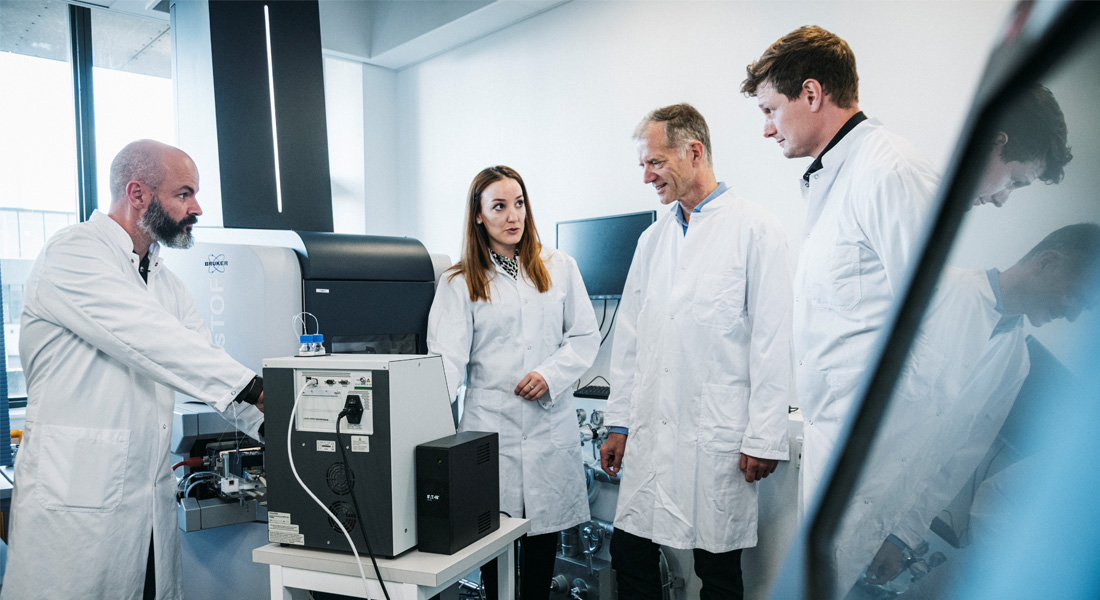
Professor Matthias Mann is Research Director and Group leader at the Proteomics Program at Novo Nordisk Foundation Center for Protein Research (CPR) at the University of Copenhagen's Faculty of Health and Medical Sciences. He also holds a Director position at the Max-Planck Institute of Biochemistry in Munich. As one of the most highly cited researchers in the world with h-index 216 and over 200,000 citations, Mann is a pioneer of mass spectrometry-based proteomics who has made landmark contributions to the development of electrospray ionization. Professor Mann's research interests focus on proteomics technology development and its application to biological and clinical problems. His Clinical Proteomics group applies mass spectrometry-based proteomics to understand human health and disease, with the goal of improving patient diagnosis, stratification, and prevention of diseases such as metabolic disorders and cancer. The group has established robust, high-throughput proteome profiling pipelines for clinical cohorts and develops AI-guided platforms for analyzing proteomes from low amounts of formalin-fixed, paraffin-embedded samples. A key research area is the interpretation of multi-omics data through the Clinical Knowledge Graph, which harmonizes multi-omics data with meta-data for machine learning applications. Professor Mann's recent publications demonstrate trends across several fields including clinical proteomics, biomarker discovery, mass spectrometry technology development, and multi-omics integration. His work spans applications in cancer research, metabolic diseases, neuroscience, and cardiac biology, with a consistent focus on translating proteomic technologies into clinical applications for personalized medicine. Dr H.P. Heineken Prize for Biochemistry and Biophysics 2024 Louis-Jeantet Foundation Prize for Medicine (2012) Leibniz Prize of the German Research Society (2012) Körber European Science Award (2012) Ernst Schering Prize (2012) Protein Society Anfinsen Award (2005) Novo Nordisk Prize (2004) Professor Mann has mentored numerous researchers, with several former post-docs receiving prestigious ERC Starting Grants. His research has been supported by significant funding from the Novo Nordisk Foundation and other major research organizations. The Mann Group maintains collaborations with clinical researchers across multiple institutions to apply proteomics to patient cohorts and disease studies. The Mann Group operates within the Novo Nordisk Foundation Center for Protein Research at the University of Copenhagen, working closely with other research groups including the Choudhary Group, Olsen Group, and others within the CPR. The group maintains state-of-the-art mass spectrometry facilities and develops computational tools for proteomic data analysis, creating an integrated environment for technological innovation and biological discovery.