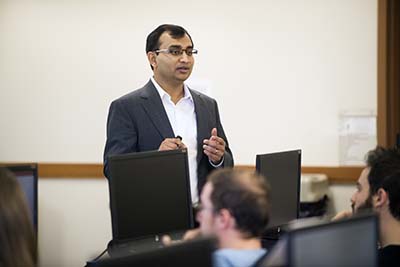
Andrew Stephen is the L’Oréal Professor of Marketing and Deputy Dean for Faculty and Research at Saïd Business School, University of Oxford. He leads the Marketing faculty and directs the Oxford Future of Marketing Initiative, focusing on emerging technologies like AI and data-driven strategies in marketing, media, and advertising. His research explores digital marketing, consumer behavior, and the impact of new technologies, earning him recognition as a top global marketing scholar. His academic contributions span leading journals such as the Journal of Consumer Research and Harvard Business Review. He serves as editor of the Journal of Consumer Research, co-editor of the International Journal of Research in Marketing, and actively engages with industry through councils like the Mobile Marketing Association’s Brand Safety Council. Teaching responsibilities include marketing curriculum oversight and courses across MBA, Executive MBA, and DPhil programs, focusing on digital transformation, marketing analytics, and the future of marketing. His work bridges academic rigor with industry relevance, addressing challenges in tech-enabled marketing and global brand strategies. Awards: Top marketing academic in the UK (AMA), featured in Poets & Quants’ top 40 under 40, multiple research excellence awards. Labs/Initiatives: Oxford Future of Marketing Initiative, fostering collaborations with leading companies to tackle industry challenges. Grants/Advising: Extensive industry partnerships and academic grants not explicitly detailed in the text.
Ariel Pakes is the Thomas Professor of Economics at Harvard University, part of the Faculty of Arts and Sciences and the Department of Economics. He previously held the Charles and Dorothea Dilley Professorship at Yale University and tenured roles at institutions including the University of Wisconsin and the Hebrew University of Jerusalem. His research focuses on industrial organization (I.O.), the economics of technological change, and econometric theory. Pakes has advised notable students who now lead economics departments globally and has received prestigious awards including the Frisch Medal (1986) and election to the American Academy of Arts and Sciences (2002). Education: Pakes earned his Ph.D. in Economics from Harvard University in 1980. His academic journey includes roles as a lecturer at Harvard and positions at the University of Jerusalem. Research Interests: Pakes has pioneered methodologies for analyzing I.O. models, including demand and cost system estimation. Recent work examines AI’s impact on pricing strategies, antitrust policy implications of market dynamics, and healthcare cost structures. His theoretical contributions include simulation estimators and frameworks for dynamic oligopolies. Awards: Frisch Medal (Econometric Society, 1986) Fellow of the Econometric Society (1988) Fellow of the American Academy of Arts and Sciences (2002) Best Graduate Student Advisor Award (Yale University, 1996) Advisory and Grants: Pakes has served on NSF panels, including the Economics Advisory Panel and Presidential Fellow Advisory Board. His consulting work spans government agencies and large firms. He edited the RAND Journal of Economics and co-chaired the AEA Census Advisory Panel. Labs/Teams: Collaborates with NBER as a Research Associate and contributes to interdisciplinary projects like the PNAS issue on 'Science, Technology and the Economy.'
Claire Célérier is an Associate Professor of Finance at the Rotman School of Management, University of Toronto, where she holds the Canada Research Chair in Household Finance. Her academic career spans prestigious institutions including the University of Toronto (where she advanced from Assistant to Associate Professor between 2016-2022) and the University of Zurich (2014-2016). She maintains an affiliation with the People's History Lab and actively contributes to academic discourse through conference organization including 'Race, Equity and Public Policy' (2023) and 'Banks, States and the People' (2024). Dr. Célérier's research explores how finance can benefit households through multiple lenses including behavioral economics, asset pricing, and financial history. Her work investigates innovation in finance, diversity and inclusion impacts, and historical perspectives on financial systems. She has developed significant expertise in household finance, banking, and the intersection of finance with social issues, particularly racial disparities in financial markets as demonstrated in her award-winning research on the Freedman's Savings Bank. Her scholarly output shows a clear trajectory from foundational work on security design and investor behavior toward increasingly socially relevant research on financial inclusion, racial equity, and household financial decision-making. Recent publications demonstrate her growing focus on historical contexts of financial systems and their contemporary implications, particularly regarding marginalized communities. Canada Research Chair in Household Finance (2024) Bank of Canada Governor's Award (2022) University of Toronto Top 5% Merit Award (2021) Petro Canada Young Innovators Award Program (2021) Multiple Rotman School of Management Teaching Awards (2019-2021) Ieke van den Burg Prize for Research on Systemic Risk (2015) Dr. Célérier has successfully secured substantial research funding including Insight Development Grants (CAD 54,500), Connaught Research Grant (CAD 10,000), and the Marianne and Marcus Wallenberg Foundation Grant (EUR 400,000). She mentors several PhD students including Andrada Bilan (2020), Alexey Vasilenko (2023), and Purnoor Tak (Expected 2026), and has supervised numerous master's theses at both University of Toronto and University of Zurich. Her service contributions include Rotman School of Management MBA program committee, executive committee, seminar coordination, and faculty recruiting committee.
Tim Ceci is a Part-time Lecturer at Parsons School of Design, The New School. He is a Senior Retail/Omni-channel and Arts/Culture Executive with extensive experience in luxury retail and corporate leadership. His career includes roles at Goyard, Hall des Lumiéres, Saks Fifth Avenue, LVMH, and Nike. He focuses on business development, strategic planning, and customer experience optimization. Education: BA in Business with Marketing Major from Hofstra University. Research Interests: Business Development, Retail Project Management, Omni-channel Retail Strategies, Strategic Planning in Luxury Brands, Fashion Industry Dynamics, and Cross-cultural Customer Experience Design. He also explores intersections between arts/culture and retail environments. Professional Roles: Advisory board member for emerging fashion organizations, international conference presenter, and founder of Tim Cecci Retail Consulting (www.timceci.com). His LinkedIn profile further details professional activities. Teaching: Recently taught PMFM 5070: Retailing & Service Design in Spring 2025.
Brendan Russo serves as an Associate Professor in the Department of Civil Engineering, Construction Management, and Environmental Engineering at Northern Arizona University, where he conducts influential research in transportation safety and traffic engineering. His work focuses on improving safety outcomes for vulnerable road users through rigorous analysis of crash data, traffic operations, and emerging mobility technologies, with significant contributions to Arizona-specific transportation challenges and national safety practices. Russo's research program centers on bicycle and pedestrian safety, crash severity analysis, and the integration of autonomous systems into transportation networks. He employs advanced methodologies including spatial analysis, statistical modeling (e.g., random parameters bivariate probit models), and observational studies to investigate traffic stress levels, intersection safety, and the impacts of infrastructure treatments. His work consistently bridges theoretical transportation engineering with practical applications for safer community design. Analysis of Russo's recent publications reveals a strong emphasis on emerging transportation technologies and their safety implications, particularly regarding autonomous delivery robots and vehicle-pedestrian interactions, while maintaining core focus on traditional safety concerns like bicycle crash frequency and severity. His research demonstrates increasing integration of spatiotemporal analysis and scenario-based testing methodologies, with a clear geographic concentration on Arizona metropolitan regions that provides valuable localized insights applicable to broader transportation contexts. No scientific awards were mentioned in the provided text. No specific information about advising responsibilities or grant funding was provided in the text, though his extensive publication record and dataset contributions indicate active research leadership. Russo collaborates within a robust research network centered on transportation safety, frequently partnering with colleagues including Gehrke, Smaglik, and Holliday on projects involving field data collection, bicycle infrastructure evaluation, and safety performance metrics. His work leverages both observational studies and simulation approaches to develop data-driven guidance for transportation practitioners, with particular attention to Arizona's unique transportation environment and metropolitan planning challenges.
Gilbert Fridgen is Full Professor in Digital Financial Services and holder of the PayPal-FNR PEARL Chair at the University of Luxembourg's Interdisciplinary Centre for Security, Reliability and Trust (SnT). He leads the FINATRAX research group focusing on blockchain, digital identity, and sustainable digital solutions. His research explores decentralized technologies in finance, energy systems, and public administration. Current projects investigate blockchain applications in industrial demand response, NFT markets, EU digital identity wallets, and DeFi institutional adoption. Prof. Fridgen examines the intersection of technology with regulatory frameworks and user behavior in energy and financial systems. He collaborates extensively with industry partners including PayPal and Spuerkeess. Prof. Fridgen actively contributes to EU digital policy discussions, particularly regarding the European Digital Identity Wallet framework and decentralized finance governance.
Dr Luke Garrod is a Senior Lecturer in Economics at Loughborough University's Loughborough Business School. He holds a PhD, MPhil, and BA from the University of East Anglia. His research focuses on industrial organization, competition policy, consumer policy, and behavioral economics, with a particular emphasis on modeling firm incentives in imperfectly competitive markets. He received the International Journal of Industrial Organization Best Theoretical Paper Award 2019 for his work on collusion mechanisms. His book on hub-and-spoke cartels provides critical insights into antitrust enforcement strategies. Teaching responsibilities include Principles of Microeconomics (ECA002) and Industrial Economics (ECC005). He serves as an Associate Editor for the International Journal of the Economics of Business and contributes to economic consultancy through his role at Economic Insight. His research has explored topics such as cartel damages quantification, digital market regulation, and the interplay between consumer protection and competition policies. Key awards include the 2019 Best Theoretical Paper Award, reflecting his contributions to advancing antitrust and competition policy frameworks. His work bridges theoretical economic modeling with practical regulatory applications, addressing emerging challenges in global competition dynamics and digital economy policies.
Mohammad Saifur Rahman is the Daniels School Chair in Management and a Professor of Management Information Systems at the Mitch Daniels School of Business, Purdue University. Previously, he was an Associate Professor at the Haskayne School of Business, University of Calgary. His academic journey includes significant leadership roles such as co-chairing the Conference on Information Systems and Technology (CIST) in 2013 and serving as president of the INFORMS eBusiness Society in 2014. Currently, he serves as an associate editor for both Management Science and Information Systems Research (ISR). Ph.D. in Management Information Systems, Krannert School of Management, Purdue University (2008) MBA in Management Information Systems, Southern Illinois University (2004) BS in Computer Science, Southern Illinois University (2002) Rahman's research primarily focuses on the economic implications of digital transformations. His work examines how digitization affects consumer behavior, market structures, and business strategies across various industries. He investigates the value of digital traces in driving consumer behavior and improving decision-making, particularly in omnichannel retail environments. His research on the sharing economy has revealed important insights about economic disparities, showing how platforms like Airbnb provide economic benefits to predominantly white neighborhoods while failing to generate similar spillover effects in predominantly Black or Hispanic neighborhoods. His recent publications reveal a consistent focus on the intersection of technology, economics, and social impact. Rahman's work frequently examines how local market structures interact with digital platforms to create or exacerbate economic inequalities. His research spans multiple disciplines including information systems, economics, marketing, and operations management, with a particular emphasis on empirical studies using real-world data from major companies like Walmart and Cisco. CICP Faculty Commercialization Award (2020) INFORMS Sandy Slaughter Early Career Award (2018) World's Top 40 Business School Professors Under 40 by Poets and Quants (2017) Jay N. Ross Young Faculty Scholar Award (2015) Dean's Award for Outstanding Research Achievement (University of Calgary, 2014) Rahman has secured substantial research funding from organizations including Social Sciences and Humanities Research Council (SSHRC), Adobe Systems ($50,000 grants in 2017 and 2020), Trask Innovation Fund ($21,218), and NSF I-Corps ($50,000). He has advised numerous PhD students and collaborated with industry partners to translate research into practical applications. Rahman co-founded RightFit Analytics, a precision health analytics solution that utilizes AI to learn success patterns in healthcare. He has organized significant academic events including the Krannert-Walmart Data Dive (believed to be the first data dive on a college campus) and the Dawn or Doom Data Dive in cooperation with Cisco. Rahman actively engages with industry through consulting and collaborative research projects. His work with Walmart, Cisco, and other major corporations demonstrates his ability to bridge academic research with practical business applications. He has been particularly active in studying how AI and big data analytics can be leveraged to improve business decision-making while addressing potential negative consequences like algorithmic bias and economic inequality.
Prof. Dr. Frank Ulbrich is a Lecturer and Programme Director for the BSc Business Administration at the Lucerne School of Business (HSLU). He holds a PhD in Business Administration from the Stockholm School of Economics. His academic career spans roles at universities in Sweden, the UK, Canada, and Switzerland, alongside IT & Management consulting experience. Research focuses on management education, project management, information management, and organizational change. He has published extensively in areas like shared services, digital transformation, and curriculum development. Notable awards include multiple Emerald Literati Awards and a Fellowship from the Higher Education Academy. Education: PhD in Business Administration (Stockholm School of Economics) Affiliations: Institute of Business and Regional Economics at HSLU Teaching Subjects: Academic Methods, Higher Education Management, Project Management, Digital Transformation Recent presentations include discussions on bridging academia-industry gaps, curriculum integration of SDGs, and data-driven learning strategies. His work emphasizes aligning education with labor market needs and advancing evidence-based teaching practices.
Joel Goh is Associate Professor at the Department of Analytics and Operations, NUS Business School, National University of Singapore. He serves as Director of the J.Y. Pillay Comparative Asia Research Centre (under NUS Global Asia Institute) and PhD Program Director at the Institute of Operations Research and Analytics (IORA). Previously, he was Assistant Professor at Harvard Business School (2014-2017) and Visiting Scholar (2017-2022). BSc, MSc, PhD in Operations, Information, and Technology from Stanford University His research focuses on healthcare analytics (preventing health conditions, hospital operations, frailty assessment), supply chain analytics (digital business models, platform leakage), and service platform operations (hospital-at-home programs, incentive design). He co-created the Robust Optimization Made Easy (ROME) software. Recent publications analyze workplace psychological safety (2024), hospital-at-home models (2024), and platform leakage dynamics (2023). His work spans 18+ journals with 740+ citations for burnout cost studies (2022) and 606+ citations for physician well-being research (2017). Teaching Honors : 2023: Best MBA Teaching & Skinner Innovation Award 2021: NUS Annual Teaching Excellence Award 2020: Early Career Research Excellence Award & 40 Under 40 Best MBA Professors Advising & Grants : Served as PhD Program Director. Received NUS Start-Up Grant R-314-000-110-133 (2021) and Humanities & Social Sciences Fellowship (2021). Editorial roles include Associate Editor at Management Science , Manufacturing & Service Operations Management , and Senior Editor at Production and Operations Management .
Samir Dani is a Professor of Operations and Supply Chain Management at Keele University’s Keele Business School. He holds Chartered Manager status and is a Fellow of multiple professional bodies, including the Higher Education Academy and Chartered Institute of Logistics and Transport. Prior to academia, he worked in India’s automotive industry. His research focuses on supply chain resilience, sustainability, food logistics, and Industry 4.0 technologies like AI and Blockchain. Affiliations: Keele University (current), University of Huddersfield (2014–2019), Loughborough University (2005–2008) Leadership: Former Head of Logistics, Marketing, Hospitality, and Analytics Department at University of Huddersfield Industry Engagement: £5M Leeds City Region LEP Supply Chain Program, UK-India trade advisory roles Research Interests: Supply chain risk and resilience Food supply chain sustainability AI, IoT, and Blockchain applications Industry 4.0 transformations Recent Article Trends: Focus on climate action impacts, blockchain trust mechanisms, and SME net-zero strategies. His work bridges academic theory with industry challenges, emphasizing technology adoption and sustainability. Awards: Prix des Associations (2015), UK Top 100 Logistics Professional (2017/18) Grants: £800K+ from EPSRC, IMCRC, and KTP Advisory Roles: Editorial Board member of Supply Chain Management: An International Journal, Academic Review Board member of International Journal of Operations and Production Management.
Kevin Manaugh is an Associate Professor at McGill University, specializing in Urban Planning with a focus on sustainable transportation and spatial justice. His research examines how decision-making processes in urban development balance environmental, economic, and social equity goals, particularly through transport systems. He holds a PhD in Urban Planning from McGill University (2013). His key research interests include integrating social equity into land use policies, analyzing accessibility impacts on socioeconomically diverse populations, and studying behavior change related to sustainable transportation. Current projects explore equitable transit accessibility, responses to local mobility policies, and health/well-being effects of sustainable transport choices. Manaugh has published extensively on transportation equity, urban form analysis, and GIS applications. His work bridges theoretical frameworks with practical policy implementation, emphasizing participatory approaches to urban planning. Notable contributions include studies on pandemic street reallocation equity and cycling infrastructure prioritization strategies. His research has been supported by interdisciplinary collaborations and applied to Canadian urban contexts. Despite prolific output, Manaugh maintains an active engagement with public discourse on urban mobility challenges and equitable urban futures.
Janna Parker is a professor in the Department of Marketing at James Madison University, specializing in digital marketing, retailing, and nonprofit marketing. With a career transition from political campaigns, she focuses on social media's role in personal and professional branding. Her research examines work-personal social media boundaries, employer governance policies, and volunteerism in nonprofit contexts. Education: Bachelor's in History (California State University Sacramento), Master's (Cameron University), Doctorate (Louisiana Tech) Teaching Interests: Digital marketing education, social media strategy, nonprofit marketing Her scholarly work spans social media governance, volunteer engagement, and retail dynamics, with recent emphasis on digital marketing pedagogy and cancel culture implications. Parker has contributed to academic journals through empirical studies and conceptual commentaries. Key article trends include: Digital marketing education evolution (2024) Social media governance in corporate and nonprofit contexts (2024) Online teaching satisfaction in higher education (2022) Volunteer brand community dynamics (2020) Consumer behavior frameworks (2019) Her media appearances include expert commentary on holiday retail strategies and social media research, reflecting practical applications of her academic work.
Stefano NASINI is an Associate Professor at the University of Lille 3, specializing in Quantitative Methods within the Economics and Mathematics Sciences. He holds a HDR (Habilitation à Diriger des Recherches) from the University of Lille 3 (2021), a Ph.D. in Statistics and Operations Research from the Polytechnic University of Catalonia (2015), and a Master in Statistics (2011). His research focuses on optimization, complex networks, statistical inference, and microeconomic applications. He has held academic positions including a post-doctoral role at IESE Business School (2014–2016) and a visiting researcher role at the University of Lisbon (2014). His work spans scheduling optimization, network analysis, financial contagion modeling, and energy system planning. Key contributions include specialized algorithms for large-scale optimization problems and frameworks for decentralized portfolio management. He is a member of the LEM research group and teaches courses in optimization, econometrics, and social network analysis at the Grande École and MSc levels. Publications highlight interdisciplinary applications, including network-based diffusion models, multi-market financial strategies, and dynamic choice analysis. His research bridges theoretical advancements in operations research with practical challenges in economics, energy, and transportation systems. No scientific awards are explicitly listed in the provided materials. His advising roles and grants are not detailed here, but his extensive publication record reflects active collaboration within academic and applied domains.
Zoe Lee is a Reader (Associate Professor) in Marketing at Cardiff Business School, Cardiff University , and Programme Director for MSc Strategic & Digital Marketing. She serves as an Associate Editor for the Journal of Strategic Marketing and editorial board member for Journal of Business Research and Journal of Philanthropy & Marketing . Research Interests: Responsible Branding Brand Purpose & Activism Sustainability Communications in Fashion Nonprofit Marketing Strategy Digital Brand Management Recent Publications (2023-2025) examine brand activism in permacrisis, social media banter between brands, disability inclusion in luxury fashion, and sustainability communication strategies. Her work combines empirical studies with systematic literature reviews across Journal of Marketing Management , European Journal of Marketing , and Journal of Business Research . Scientific Awards: Outstanding Article in Nonprofit & Voluntary Sector Quarterly (2018) Nominated for ESLA Awards (2021-2025) for teaching excellence Dean's Award for Citizenship (2017) Supervision: Currently supervising PhD students in corporate brand purpose, sustainability, and brand activism. Actively engaged in grant-funded projects including British Council research on inclusive policies and Hodge Foundation public value internships.