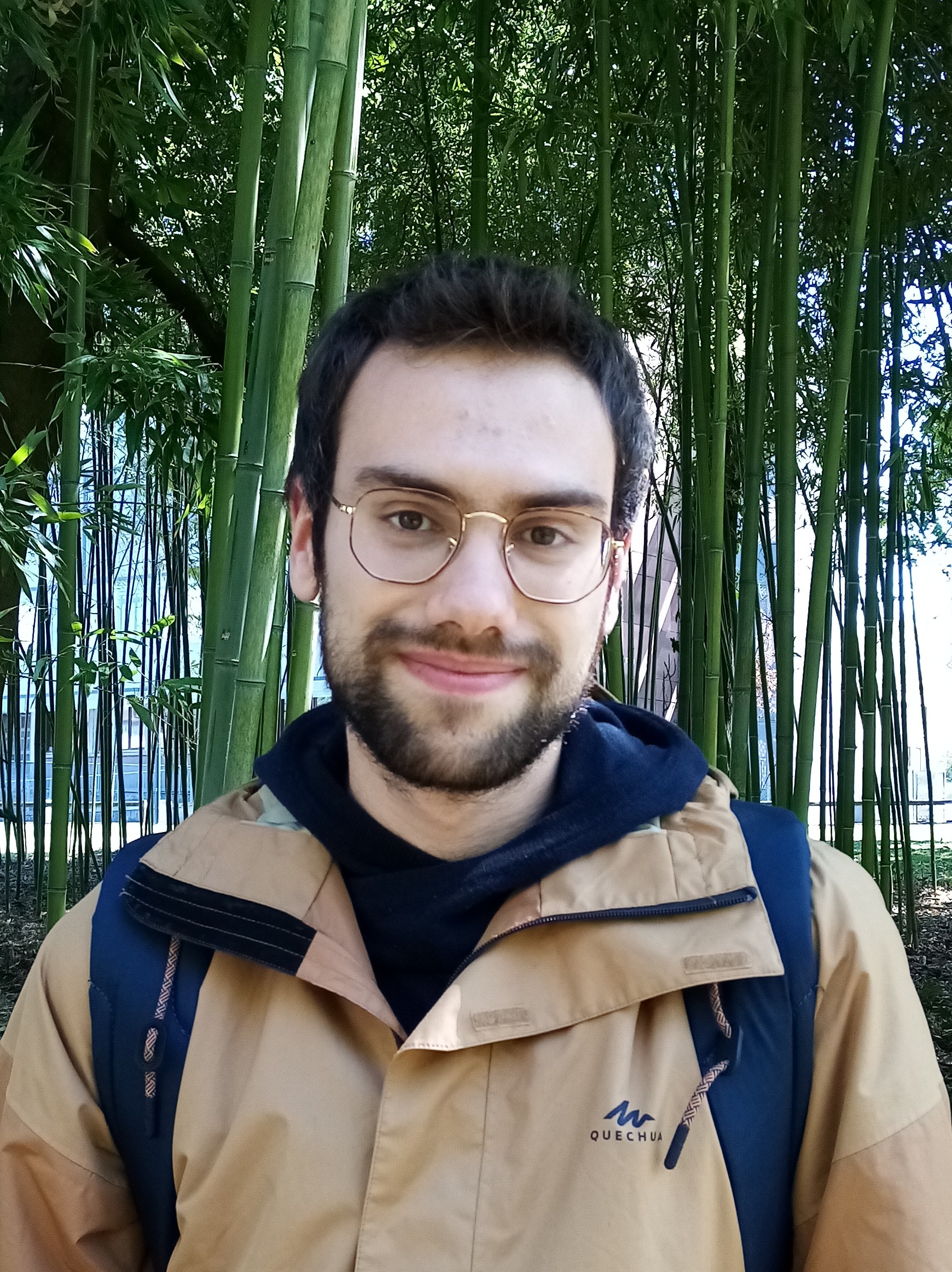
Jean-Philippe Dacquin is a Lecturer at the University of Lille , affiliated with the Catalysis and Solid State Chemistry Unit . His research focuses on the synthesis of porous catalytic materials for environmental applications, including biodiesel production and pollutant abatement. He has co-authored 18 A-rank journal articles and 43 total publications since 2008. Research Interests: Heterogeneous catalysis, environmental catalysis, and nanostructured materials. His work emphasizes: Synthesis of oxides and mixed oxides with controlled porosity Active phase dispersion on hierarchical supports Recent Publications (2024–2017) highlight trends in: Metal-Organic Frameworks (MOFs) for antiviral applications Perovskites for formaldehyde oxidation Nitride catalysts in ammonia synthesis Hierarchical porosity for CO2 conversion Teaching: Undergraduate courses in aqueous and inorganic chemistry, and the European Master’s program in Applied Spectroscopy for Chemistry.
Eric Duviella is a Professor at IMT Nord Europe, specifically within the Department of Automatic Control and Computer Sciences. He has been a permanent faculty member since 2007 and was promoted to full Professor in 2015. His academic affiliations include strong ties with the University of Lille, Universitat Politècnica de Catalunya, and the University of Seville through collaborative research and joint Ph.D. supervision. Education: Diplôme d'Ingénieur, Ecole Nationale d'Ingénieurs de Tarbes (ENIT), 2001 M.S., Institut National Polytechnique de Toulouse (INPT), 2001 Ph.D. in Industrial Systems, Institut National Polytechnique de Toulouse, 2005 HDR (Habilitation à Diriger des Recherches), University of Lille 1, 2014 His research interests center on Reactive Control Strategies , Supervision and Prognosis , and the Modeling of Large-Scale and Environmental Systems , particularly Hydrographical and Water Systems . His work aims at predictive maintenance, adaptive management under climate change, and improving navigation and water quality through advanced control techniques. The 15 most recent publications reflect a strong trend toward Model Predictive Control (MPC) , distributed and decentralized control architectures , leak detection in water networks , and resilience of inland waterways under climate stress . Keywords across these works include control engineering, water systems, fault diagnosis, and data-driven modeling, indicating a multidisciplinary approach combining automation, environmental science, and computational intelligence. Scientific Awards: Best paper award at CODIT 2017 Eric Duviella has actively supervised numerous Ph.D. and Master’s students from institutions including IMT Lille Douai, Universitat Politècnica de Catalunya, and the University of Seville. He has led significant research grants such as GEPET-Eau, CHEEF2, and CASTR-Eau, focusing on sustainable water management, hydropower optimization, and robotic monitoring. His work often involves partnerships with agencies like VNF, EDF, and local water authorities. He is involved in key research labs and teams including the Laboratoire d'Automatique, Génie Informatique et Signal (LAGIS), and collaborates internationally through mobility programs with UPC and the University of Seville. His leadership in organizing special sessions at major conferences (e.g., IFAC, HIC) underscores his role in shaping discourse in water system control and supervision.
Bryant Ashley Hudson is a Full Professor of Management at IÉSEG School of Management in Paris, France, specializing in organizational responses to marginalization. His research examines stigma, institutional processes, and social dynamics within marginalized contexts including LGBTQ+ organizations and abortion service providers. He contributes to the Department of Management and Society and the LEM research center. Education: Ph.D. in International Management Studies, University of Texas at Dallas (1997) Master of Business Administration, University of North Carolina at Greensboro (1983) Hudson investigates strategic responses to organization-level stigma and shame through institutional theory lenses. His work explores embodied knowledge, emotional dynamics in institutional processes, and taboo topics in organizational behavior. Current projects analyze housing for LGBTQ senior citizens in France and diffusion of LGBTQ workplace benefits in the US, bridging sociology, psychology, and management disciplines. His publication trajectory reveals deepening focus on stigma mechanisms and LGBTQ+ organizational dynamics, with increasing interdisciplinary collaboration. Recent work integrates emotional sociology into institutional theory while maintaining empirical rigor across diverse contexts from football stadiums to social housing. Scientific Awards: 2020 Joanne Martin Trailblazer Award (Academy of Management) 5th Annual Tucker Award for Excellence in Swearing (2019) Hudson mentors graduate students and teaches across IÉSEG's Grande Ecole programs, covering organization fundamentals, research methodology, and change management. His advisory work focuses on institutional theory applications while contributing to sectoral research in Strategy and Sustainability.
Dr. Meng Wang is a Professor at the School of Computer Science, University of Bristol, where he leads the Programming Languages Research Group. His career includes prior roles as a Lecturer at University of Kent and Assistant Professor at Chalmers University of Technology. Current Affiliation: University of Bristol Past Affiliation: University of Kent Past Affiliation: Chalmers University of Technology Research interests center on applying theoretical rigor to practical programming, with a focus on designing languages and tools for software development and testing. Key areas include: Bidirectional Programming Functional Programming Software Testing Type Systems Embedded Languages Publication trends show a strong emphasis on bidirectional programming, functional language design, and compiler techniques. His recent work explores large language model applications in code translation and formal verification of refinement types in object-oriented systems. Supervision and team leadership include mentoring 12 current PhD students and 1 Research Associate, while past mentees include notable researchers who have transitioned to industry and academic roles. He has organized workshops like VeTSS summer school and co-chaired PEPM 2024, demonstrating active community engagement.
Ozanam François is a CNRS Researcher at the Condensed Matter Physics Laboratory (PMC, UMR 7643) at École polytechnique, where he has been active since 1988. He served as director of PMC from 2005 to 2014 and has been president of the Chemistry Department at École polytechnique since 2012. His work is centered in the Electrochemistry and Thin Films group, focusing on semiconductor/electrolyte interfaces and functional materials. Engineer, École polytechnique (1984) DEA in Solid State Physics, Paris-Sud University (1985) Doctorate, Paris-Sud University (1988) His research spans the physics and electrochemistry of semiconductors , with emphasis on porous silicon , surface functionalization , and vibrational spectroscopy at interfaces. He explores applications in bio-sensing and lithium-ion batteries , particularly through surface modifications to enhance electrode stability and performance. His recent publications reflect a strong trend in operando characterization of battery materials using infrared spectroscopy, surface functionalization for biosensing, and the physics of nanostructured semiconductors. His work bridges fundamental surface science with practical energy and biomedical applications. While no formal awards are listed, his sustained leadership and publication record in high-impact journals signify recognition in the field. He mentors students through collective scientific projects and Master’s programs in Quantum Devices and Molecular Chemistry. He has not received mention of specific grants, but his CNRS affiliation implies sustained research funding. His work is conducted within the multidisciplinary PMC laboratory, which fosters collaboration across solid-state chemistry, surface physics, and electrochemistry.
Jonathan Aldrich is a Professor of Computer Science at Carnegie Mellon University in the School of Computer Science , jointly appointed in the Software and Societal Systems Department and the Computer Science Department . He is an internationally recognized expert in programming languages, software engineering, and verification, with a strong emphasis on human factors and usability in language design. Education: Ph.D. in Computer Science and Engineering, University of Washington (2003) B.S. in Computer Science, Caltech Research Interests: Prof. Aldrich's research lies at the intersection of programming languages and software engineering , focusing on how language design affects software quality and developer productivity. His work spans: Gradual verification and type systems Ownership and typestate checking Security and information flow control Usability of advanced type systems Domain-specific languages for blockchain and IoT Recent Work Trends: His recent publications emphasize gradual verification techniques, which allow developers to incrementally verify software correctness. He has also explored liquid types , information flow control , and usability barriers in advanced type systems. His work often combines formal methods with empirical studies to ensure practical impact. Awards & Recognition: NSF CAREER Award (2006) Dahl-Nygaard Junior Prize (2007) ICSE Most Influential Paper Award (2012) DARPA Computer Science Study Group Leadership & Service: Prof. Aldrich has held numerous leadership roles in the academic community, including: Director, CMU Software Engineering Ph.D. Program (2013–2019) General Chair, SPLASH 2015 Program Chair, OOPSLA 2017 Steering Committee Chair, SPLASH (2017–2019) Member, ACM Publications Board Industry Engagement: He is the Chief Technology Officer of Noteful , a startup he co-founded during his 2022 sabbatical, focused on music education through interactive apps.
Abdelali OUDRISS is an Associate Professor at the Department of Physics , La Rochelle University , France, and a member of the LaSIE UMR CNRS 7356 laboratory. He co-leads the Professional Bachelor for Optician program and serves as a teaching coordinator between La Rochelle University and EIGSI engineering school . Research Focus: Microstructure-electrochemistry coupling, hydrogen diffusion/trapping in metals, hydrogen embrittlement, and corrosion-fatigue interactions. Key Contributions: Mechanistic studies on hydrogen adsorption in nickel single crystals, modeling of hydrogen-assisted fracture, and characterization of archaeological iron alloys. Publications span Materials Characterization , Corrosion Science , and Acta Materialia , addressing hydrogen behavior in steels, nickel, and titanium alloys. His work emphasizes multi-scale analysis and experimental-numerical hybrid approaches. Administrative Roles: Secretary of SF2M West section, LaSIE council member, and teaching committee member. Techniques: EBSD, nanoindentation, thermal desorption spectroscopy, and finite element modeling.
Jean-Baptiste Eichenlaub is an Associate Professor at Université Savoie Mont Blanc (USMB), affiliated with the Laboratoire de Psychologie et NeuroCognition (LPNC). Previously, he held postdoctoral positions at Massachusetts General Hospital/Harvard Medical School and Swansea University. His work spans sleep research , cognitive neuroscience , and neural correlates of dreaming , with a focus on memory consolidation , dream recall frequency , and REM sleep mechanisms . Ph.D. in Cognitive Neuroscience (Lyon Neuroscience Research Center, 2011) Master of Physiology & Neuroscience (Lyon University, 2008) Bachelor of Biology (Lyon University, 2006) His research integrates neuroimaging , electrophysiology , and computational tools , exemplified by contributions like the DREAM EEG database and Spinky toolbox for sleep analysis. Recent publications examine sleep habits in preteens , dream-lag effects , and gamma oscillations in NREM sleep . Notable roles include: Junior member, Institut Universitaire de France (2024 - present) Co-responsible - Memory Team (2021 - present) Coordinator - 1st Year Bachelor's in Psychology (2021 - 2024)
Rabéa Ameur-Boulifa is an Associate Professor at Télécom Paris, affiliated with the Communications and Electronics (Comelec) Department. She is a member of the LabSoc research team within the Information Processing and Communication Laboratory (LTCI). Her work focuses on integrated and embedded systems, emphasizing design, modeling, verification, and security. LabSoc (System on Chip research team) LTCI (Information Processing and Communication Laboratory) Her research spans formal methods for system verification, security guidelines specification, and compositional analysis of distributed systems. Publications highlight applications in automotive software safety, asynchronous component modeling, and detection of vulnerabilities like integer overflow in embedded systems. The majority of her recent work (2022–2025) centers on open automata refinements, formal requirement validation, and compositional verification techniques. Keywords include formal methods, embedded systems, security guidelines, and distributed component modeling.
Catherine Gaulon-Nourry serves as a Lecturer in the Faculty of Sciences at the University of Maine, conducting research within the IMMM Laboratory's Methodologies and Organic Synthesis team. Her academic career spans over 15 years at this institution, with additional postdoctoral experience at The Institute of Cancer Research in the UK. Her research focuses on organic synthesis for anticancer applications , particularly the development of peloruside A analogues and novel synthetic methodologies. Key projects include constructing macrocyclic molecules based on marine-derived peloruside A for antimitotic studies and pioneering new approaches using α-trialkylsilyl-α-diazoacetones. Her work involves interregional collaborations with CEISAM in Nantes and SCR in Rennes under the Cancéropôle Grand-Ouest network. Analysis of her publication record reveals a strong trajectory in medicinal organic chemistry , with early work on BRAF kinase inhibitors (2009-2010) evolving into specialized marine natural product synthesis (2012-2015). Her research demonstrates consistent innovation in diazo compound chemistry and cycloaddition methodologies, with applications spanning anticancer drug development and fundamental synthetic techniques. As an educator, she teaches organic chemistry across multiple levels (L2 to M2) with significant pedagogical responsibilities including Master 2 ChiMaNa program coordination and establishing a dual-degree program with Vietnam National University. Her research group includes doctoral students and postdoctoral fellows working on synthetic methodology development.
Sophie BARRAU is a Professor at the University of Lille, affiliated with the Faculty of Science and Technology (FST) and the Department of Physics. She leads the Polymer Systems Engineering research team within the Materials and Transformations Unit (CNRS UMR 8207). Her work focuses on piezoelectric polymers and composites, particularly exploring structure-property relationships and functional materials for energy harvesting applications. She co-leads the Bachelor's degree program in Physics-Chemistry at the University of Lille. Key Projects: ANR NanoPiC (multi-scale piezoelectric behavior of nanostructured composites). Research Themes: Development of piezoelectric polymers, functional nanocomposites, and smart materials. Her research emphasizes advanced materials with applications in energy conversion and sensor technologies. Over 15 recent publications highlight her contributions to piezoelectric composites, polymer processing, and nanoscale characterization. She has supervised multiple PhD students, including Thibaut MOREL (functional nanocomposites) and Mélanie GIRARDOT (piezoelectric copolymer studies). Publications span journals like ACS Applied Materials & Interfaces , Polymers , and Small , reflecting her interdisciplinary approach to materials science.
Patrice Bonhomme is a Teacher-researcher at the University of Tours, affiliated with the Polytechnic School of the University of Tours (EPU) and the Fundamental and Applied Computer Science Laboratory of Tours (LIFAT, UR 6300). His primary role involves both teaching and research activities within the Computer Science Department. Patrice holds a PhD from the University of Tours, as evidenced by his 'MEMOIRE DE THESE' published in 2001. His educational background and current position reflect a deep specialization in computer science and engineering disciplines. His research interests focus on Scheduling and Control , Discrete Event Systems , and Real-Time Systems , with particular emphasis on Petri Nets as a modeling framework. He explores advanced control strategies, state estimation techniques, and fault diagnosis methodologies for time-critical systems. Key areas include energy optimization, decentralized control policies, and symbolic analysis of Petri Net-based systems. In recent years, his work has centered on developing novel algorithms for P-Time Petri Nets, addressing challenges in unobservable transitions and partial observability. He has contributed to both theoretical advancements and practical applications in manufacturing and real-time system optimization. Patrice has been actively involved in international conferences, presenting papers at IFAC and IEEE events. Notably, he served as a reviewer for the T-ASE journal (2004-2005) and contributed to proactive/reactive control methodologies for time-critical systems. His research demonstrates a consistent trajectory toward enhancing system efficiency through formal methods and algorithmic innovations. He is part of the Computer Science Laboratory Team at the University of Tours, specializing in the control of discrete event systems. No scientific awards are explicitly listed in his profile, and he has no documented advisees.
Gregory Michel is a Professor of Clinical Psychology and Psychopathology at the University of Bordeaux, affiliated with the Faculty of Psychology and the Department of Clinical Psychology and Psychopathology. He has led significant research initiatives including the Psychology, Health and Quality of Life laboratory and the Inserm Healthy team on youth health within Bordeaux Population Health. He founded CERUP and co-investigated the i-Share study on student health. His research centers on risky and violent behaviors , particularly in youth, covering psychocriminology, addiction (to screens, video games, and substances), cyberbullying, dangerous games like the choking game, psychopathy, and recidivism. He is deeply involved in the prevention of antisocial behavior and the promotion of psychosocial skills. A key focus is mindfulness meditation for children in primary education, aiming to improve mental well-being and emotional regulation. His recent publications reveal a strong trend in understanding developmental psychopathology, adolescent mental health, and the etiology of criminal behavior. He integrates clinical, forensic, and public health perspectives, often employing systematic reviews and cross-cultural studies. His work bridges research and public policy, particularly in school safety and youth protection. Gregory Michel has contributed extensively to public discourse through media appearances on France Inter, France 5, and France 2, discussing topics such as toxic personalities, teenage risk-taking, and mindfulness in education. He has authored several influential books, including Video Game and Internet Addiction and Preventing Delinquency from Early Childhood . As a mentor and educator, he co-directs the University Diploma in Psychocriminology: Psychopathology of Antisocial and Violent Behavior and Criminal Justice Responses. He has also been a regular columnist for Cerveau & Psycho magazine since 2014. His research has informed expert missions for the Ministry of National Education, especially during the States General of School Safety and School Bullying. Gregory Michel leads or has led research teams focused on youth health and psychosocial development, including the i-Share cohort and CERUP. His work continues to influence both clinical practice and public policy in France and beyond.
Bruno Dupuy is a Permanent Researcher and Principal Investigator at the Pasteur Institute in Paris, France, within the Department of Microbiology. He is a key member of the 'Biologie cellulaire de l’infection microbienne' unit, working under the leadership of Isabelle Martin-Verstraete. His primary research focus is on the pathogenesis of the anaerobic bacterium Clostridioides difficile , a major cause of nosocomial infections. His research interests center on understanding the fundamental mechanisms of C. difficile virulence. This includes studying the biology of anaerobic biofilms and their role in infection, the complex regulatory network controlling toxin synthesis and secretion, and the adaptive strategies the bacterium uses to survive host stresses like oxidative damage. His work also extends to evaluating novel therapeutic strategies, such as cationic copolypeptoids, for combating this pathogen. His recent publications highlight a strong trend in molecular microbiology, focusing on bacterial surface structures (like the S-layer), toxin function, and host-pathogen interactions using advanced techniques like RNAseq and monoclonal antibody characterization. Bruno Dupuy has an active research program, leading multiple projects funded by grants like ANR JCJC. He mentors a team of PhD students and post-doctoral fellows, contributing to the training of the next generation of scientists. He has also been involved in educational activities, such as co-organizing a workshop on Bacterial RNAseq.
Antonio Casares Santos is a postdoctoral researcher in Theoretical Computer Science at the University of Warsaw, working under Mikołaj Bojańczyk. His research spans logic, formal languages, and graph-based infinite games. Doctoral Degree (2023) - University of Bordeaux (supervised by Thomas Colcombet, Nathanaël Fijalkow, Igor Walukiewicz) Master's Degree - Mathematical Logic and Foundations of Computer Science (Université de Paris-Cité, France) His work focuses on ω-automata, transducers, and memory requirements in games, with applications in formal verification and reactive synthesis. Recent publications emphasize efficient algorithms for energy games, automata minimization, and positional strategies in ω-regular languages. Key trends in his research include Optimal transformations between automata models (Muller, Parity, Rabin) Algorithmic complexity analysis for infinite games Positionality and memory characterizations History-deterministic automata Scientific recognition includes: Science and Technology Prize (University of Bordeaux, 2023) Best Student Paper Award (CSL 2022) He supervises students at the University of Warsaw and ENS Rennes, covering topics from history-deterministic automata to value-iteration algorithms. Teaching roles include algorithmic game theory tutorials and imperative programming instruction.