Alexandre Chanson is a Lecturer at the Polytechnic School of the University of Tours (EPU), affiliated with the Blois Computer Science Department within the Fundamental and Applied Computer Science Laboratory (LIFAT, UR 6300). His research focuses on data mining, machine learning, and human-centered AI systems. Academic Focus: Exploratory data analysis, optimization algorithms, and recommender systems Contact: Office 331, Jean Jaurès Campus, Blois | Phone: +33 254 552 168 | Email: alexandre.chanson@univ-tours.fr Research Trends: Alexandre's work bridges mathematical programming with interactive data exploration, emphasizing explainable AI and optimization frameworks like the Traveling Analyst Problem. Key contributions include local explanation clustering, comparison query generation, and personalized data narration. Scientific Awards: No specific honors identified in the current dataset.
Emin Karagözoğlu serves as Associate Professor of Economics and Associate Provost at Bilkent University, Ankara. His institutional affiliations include: Department of Economics, Bilkent University Graduate Program in Neuroscience, Bilkent University Aysel Sabuncu Brain Research Center, Bilkent University Research Affiliate, CESifo, Munich Member, Bilgi Economics Lab, Istanbul He received his PhD in Economics from Maastricht University in 2010. His research bridges Behavioral Economics, Experimental Economics, and Game Theory with neuroeconomic applications. Key investigations focus on Bargaining Theory, Fairness Concerns in economic decisions, Moral Preferences, and Distributive Justice mechanisms. He examines how reference points and focal points shape negotiation outcomes while exploring rationing problems and contest theory through experimental frameworks. Karagözoğlu actively shapes academic discourse as Associate Editor for European Economic Review (since May 2025) and Frontiers in Behavioral Economics (since April 2023). He organizes the BEET workshop series (9th edition scheduled for Seoul National University in August 2025) and contributes to special journal issues on strategic behavior. His laboratory affiliations with the Aysel Sabuncu Brain Research Center and Bilgi Economics Lab enable interdisciplinary neuroeconomic research using experimental methodologies.
Dr. Lee A Butler is a Lecturer at the School of Mathematics , University of Bristol . Their research focuses on number theory, irrationality proofs, and transcendental number theory, with recent work involving Diophantine equations and applications of Brun's criterion. University: University of Bristol School: School of Mathematics Academic Rank: Lecturer Email: malab@bristol.ac.uk Research Trends: Butler's publications highlight connections between exponential functions, algebraic surfaces, and integer sequences. They explore sufficient conditions for irrationality in infinite series and analyze classical conjectures like the three and four exponentials problems. Teaching Practice: Butler contributes to pedagogical methods in mathematics education, focusing on improving students' mathematical literacy through writing and reading practices.
Prof. Dr. Gordana Nikić is an Associate Professor at Singidunum University in Belgrade. She holds a doctorate in Psychology from the University of Belgrade, with expertise in Developmental Psychology , Emotional Intelligence , and Rational Emotive & Cognitive-Behavior Therapy (RE&CBT) . As a certified RE&CBT psychotherapist and supervisor, she combines academic work with clinical practice. Doctoral studies: Psychology, University of Belgrade (2004-2009) Master’s studies: Psychology, University of Belgrade (2000-2004) Basic studies: Sociology, University of Belgrade (1984-1989) Her research focuses on emotional competencies , managerial behavior , and partner relationships . Recent work includes analyzing video game consumption patterns (2025), gender differences in emotional intelligence (2021), and public-private partnerships (2017). Her publications span interdisciplinary approaches to relationships, stress management in the workplace, and psychotherapy applications in sexual health. Key trends in her work include emotional intelligence in business , CBT in relationship counseling , and cross-disciplinary studies of socio-emotional traits. She has presented at international conferences, including the 23rd Congress of the European Association for Psychotherapy (2018). Scientific Awards: Associate Fellow of the Albert Ellis Institute She actively contributes to education as a lecturer and founded the Serbian Center for RE&CBT . Her work bridges academic research with clinical practice in preventing emotional problems.
Brian Hedden is an Associate Professor of Philosophy at Australian National University (ANU). Prior to ANU, he held faculty positions at the University of Sydney and completed a postdoc at the University of Oxford after earning his PhD at MIT. His research spans epistemology, decision theory, ethics, and political philosophy, focusing on rationality, collective action problems (e.g., climate change), algorithmic fairness, and legal evidence. Education: PhD (MIT), Postdoc (Oxford) Key Affiliations: ANU, University of Sydney, MIT, Oxford His work investigates multidimensional value comparisons, time-biases in rational planning, and statistical evidence applications in law and AI ethics. Recent publications address counterfactual decision theory and legal probabilism. Scientific Awards: Discovery Early Career Researcher Award (ARC) Discovery Project Grant (ARC) with Mark Colyvan Hedden has contributed to journals including Mind , Journal of Philosophy , and Philosophy and Public Affairs . He authored the monograph Reasons without Persons (OUP 2015).
Prof. Dr. Habil Pencho Stoyanov Penchev is a distinguished Professor at the Faculty of Economics of St. Cyril and St. Methodius University of Veliko Turnovo. With over three decades of academic experience, he has established himself as a leading expert in management theory, sustainable development, and public administration. His extensive research portfolio demonstrates deep engagement with both theoretical frameworks and practical applications in organizational management. Prof. Penchev's research interests span multiple critical areas of modern management science, with particular focus on sustainable development implementation, regional governance, strategic business organization, and management of small and medium enterprises in the Bulgarian food industry. His scholarly work consistently addresses the intersection of theoretical management principles with real-world administrative challenges. The analysis of Prof. Penchev's 15 most recent publications reveals a strong thematic focus on sustainable development (appearing in 5 of the 15 works), organizational management (7 publications), and regional governance (3 publications). His work demonstrates a consistent evolution from theoretical management frameworks toward more applied regional development strategies, with increasing emphasis on sustainability challenges in recent years. Prof. Penchev has led significant research projects including "Management competencies of young managers and entrepreneurs" (2014) and "Priorities of operational programs and needs of Veliko Tarnovo municipality" (2009), demonstrating his active engagement with practical management challenges facing Bulgarian institutions and businesses. His academic contributions extend to developing educational materials for distance learning in organizational development and sustainable development, reflecting his commitment to advancing management education through innovative teaching methodologies.
Ragnar Soleng is an Associate Professor in the Department of Mathematics and Statistics at UiT The Arctic University of Norway, Tromsø, specializing in the intersection of pure mathematics and cryptographic applications. His institutional affiliation demonstrates a commitment to advancing theoretical and applied research within Scandinavia's northernmost university. His research spans Number Theory, Cryptography, Algebraic Geometry, and Information Security, with particular focus on elliptic and hyperelliptic curves. Soleng's work explores homomorphisms from rational points to class groups in quadratic fields, algebraic tori constructions, and cryptographic implementations. This research bridges abstract algebraic structures with real-world security protocols, reflecting both theoretical depth and practical relevance. Analysis of his publication trajectory from 1994 to 2018 reveals consistent evolution from foundational studies in elliptic curves over complex numbers toward cryptographic applications. His contributions to the Norwegian Information Security Conference (NISK) proceedings demonstrate active engagement with security practitioners, while his journal articles maintain rigorous mathematical standards. The recurring theme across decades is the exploitation of algebraic structures for cryptographic innovation. No information is available regarding doctoral students supervised or research grants obtained. Similarly, details about laboratory affiliations or collaborative research teams were not provided in the source material.
Ljubisa Miskovic is a Senior Scientist at École Polytechnique Fédérale de Lausanne (EPFL), holding multiple positions including at the Laboratory of Computational Systems Biotechnology (LCSB) within the School of Basic Sciences (SB) and Institute of Chemical Sciences and Engineering (ISIC), as well as at the Swiss Center for Scientific Computing (SCGC) and the School Council SB. He earned his Ph.D. degree in Automatic Control from EPFL in 2006 under the co-supervision of Dominique Bonvin and Alireza Karimi. Following his doctoral studies, he pursued postdoctoral research at the Centre for Systems Engineering and Applied Mechanics at Universite Catholique de Louvain with Michel Gevers before returning to EPFL to work with Vassily Hatzimanikatis. Dr. Miskovic's research spans systems biology, metabolic engineering, synthetic biology, data-driven control design, system identification, stochastic processes, and estimation theory. His work focuses on developing computational approaches for metabolic network analysis, kinetic modeling of genome-scale metabolic networks, and applying machine learning techniques to metabolic engineering problems. His recent publications demonstrate increasing integration of generative AI methods with traditional metabolic modeling approaches. His publication trends over the last five years reveal a clear progression from traditional metabolic modeling to sophisticated machine learning-enhanced approaches, with particular emphasis on genome-scale kinetic modeling, strain optimization for biochemical production, and uncertainty quantification in biological systems. Much of his recent work centers on applications in S. cerevisiae and P. putida for producing valuable biochemicals including p-coumaric acid and muconic acid. Dr. Miskovic has advised several doctoral students including Toumpe Ilias, Andreozzi Stefano, Choudhury Subham, and Tokic Milenko. He teaches courses in numerical methods and chemical process control at EPFL, demonstrating his commitment to both research and education in systems biotechnology. As a member of the Laboratory of Computational Systems Biotechnology led by Professor Vassily Hatzimanikatis, Dr. Miskovic contributes to a multidisciplinary team that combines expertise in computational biology, systems engineering, and metabolic modeling to advance the field of systems biotechnology.
Randy Ridenour is a Professor of Philosophy at Oklahoma Baptist University (OBU), where he has served on the faculty since 2000. Based in Montgomery Hall, he holds a Ph.D. from the University of Oklahoma and integrates military experience as an Army Reserve chaplain—including active duty during the Iraq War—with his academic work in philosophical inquiry and pedagogy. His educational background includes: B.A. from the University of Oklahoma M.A. from the University of Oklahoma Ph.D. from the University of Oklahoma (Dissertation: "An Essentialist Theory of Modality") Ridenour's research spans metaphysics (particularly modal theory), epistemology (focusing on Gettier problems and truth conditions), and philosophy of religion (examining naturalism and theism through Bayesian frameworks). His work extends to philosophy of mind (Gödel's implications for AI), logic, historical analysis of ancient/modern philosophy, and aesthetics. He actively innovates in humanities education through technology integration. His scholarly output reveals consistent engagement with foundational questions across eras: the 2000 presentation on probabilistic reasoning in religious epistemology represents his most recent theoretical contribution, while 1997 works demonstrate interdisciplinary reach—from technology-enhanced medieval pedagogy to critiques of computational consciousness and epistemological debates. This trajectory highlights dual commitments to rigorous metaphysical analysis and practical educational advancement. No scientific awards are documented in available sources. Ridenour mentors undergraduate philosophy students through courses like Metaphysics (PHIL 4603) and Epistemology (PHIL 3653), though specific advisees and grant funding details remain unlisted in public materials.
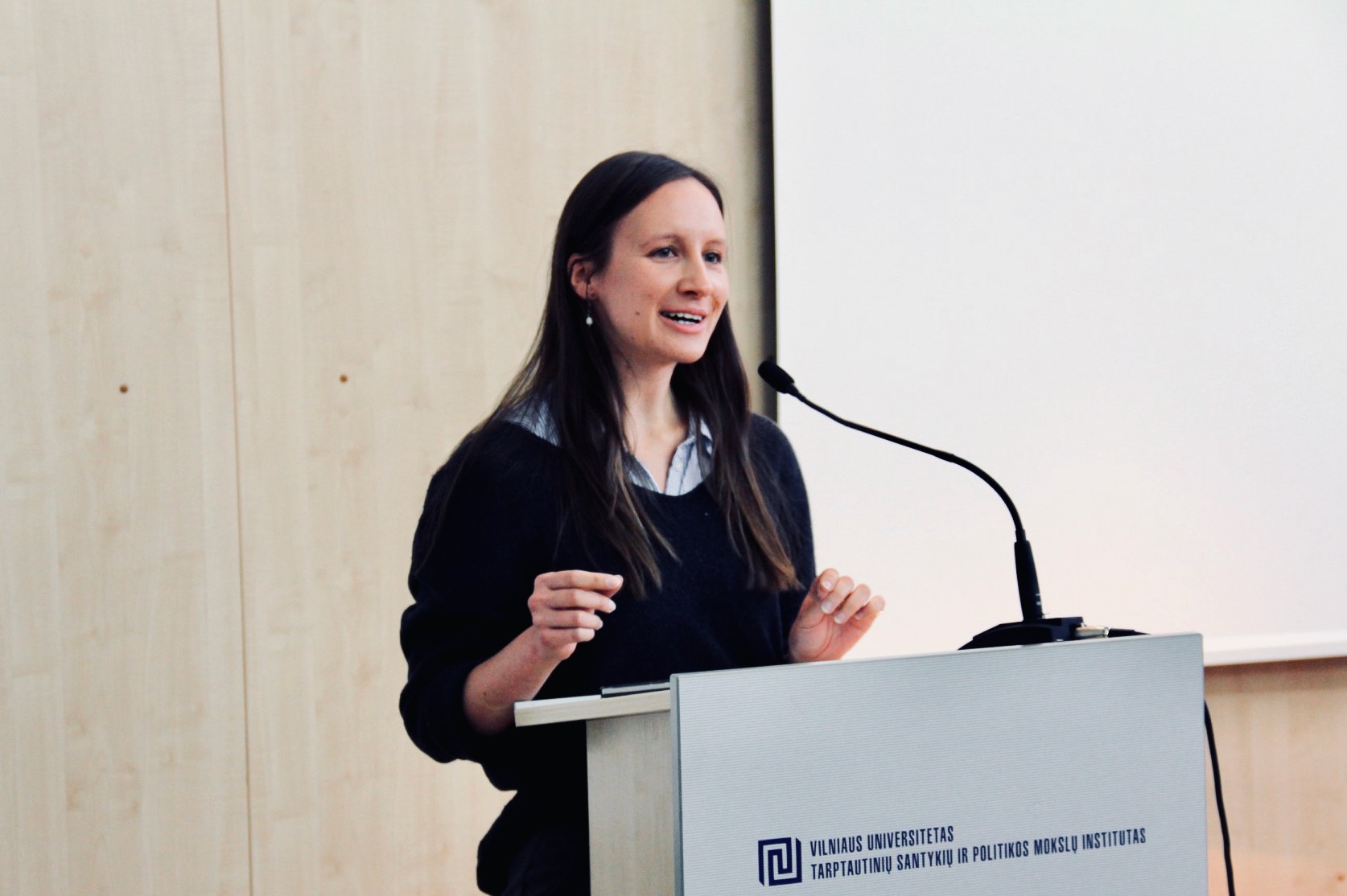
Dr. Aistė Noreikaitė is a Researcher at the Department of Political Philosophy and History of Ideas within the Institute of International Relations and Political Science at Vilnius University. She also serves as an assistant at the Faculty of Philosophy, demonstrating her dual affiliation across these academic units. Dr. Noreikaitė completed her academic journey at Vilnius University, earning both her Bachelor's and Master's degrees in Philosophy before defending her PhD dissertation in 2021 titled "The Challenge of Ronald Dworkin's Practical Philosophy: The Question of Moral Justification." Her scholarly work centers on the intersection of political theory and moral philosophy, with particular expertise in classical and contemporary ethical frameworks. Dr. Noreikaitė's research explores how philosophical traditions from Kant to contemporary thinkers like Ronald Dworkin address fundamental questions of moral justification and political order. She examines the historical development of political thought while applying these insights to contemporary ethical dilemmas, with special attention to how Lithuanian philosophical traditions engage with Western philosophical discourse. Analysis of Dr. Noreikaitė's publications reveals a consistent focus on the foundations of ethics and their relationship to political philosophy. Her work demonstrates particular interest in how metaphysical considerations inform ethical reasoning, the tension between value pluralism and moral justification, and the application of Kantian rationalism to contemporary moral problems. These publications collectively represent a cohesive research trajectory examining the philosophical underpinnings of moral and political discourse. Dr. Noreikaitė has contributed to significant research projects including "The modern problem of the relationship between morality and politics: the challenge for Western and Lithuanian philosophy," funded by the Research Council of Lithuania. While specific teaching awards aren't mentioned, her academic contributions have been recognized through presentations at international conferences including the European Conference on Ethics, Religion and Philosophy in Brighton, the International Conference on Ethics at the University of Porto, and the Future of Normativity conference at the University of Kent. In her academic role, Dr. Noreikaitė teaches "Problems of Political Science: Politics and Morality," connecting theoretical frameworks to practical political considerations. Her research grants from the Lithuanian Research Council demonstrate institutional recognition of her scholarly contributions to understanding the complex relationship between moral philosophy and political theory in both Western and Lithuanian contexts.
Helena Eriksson is a researcher at the Department of Teaching and Learning , Stockholm University. She contributes to the research group MaRCU: Mathematical Reasoning and Conceptual Understanding , focusing on algebraic reasoning, geometric concepts, and mathematical problem-solving in multilingual classrooms. Research Emphasis: Algebraic thinking, fractional reasoning, and curriculum development Methodology: Collaborative learning models and symbolic representation Her work explores how learning activity theory (Davydov) can develop theoretical thinking in young students through structured mathematical tasks. Key studies include analyzing teacher actions that promote engagement with geometric concepts (2024) and examining the interplay between algebraic and fractional reasoning (2021). Publications emphasize tool-mediated reasoning and cross-cultural educational practices.
Gevorg Grigoryan serves as a Research Associate Professor in the Department of Computer Science at Dartmouth College, with joint appointments in the Departments of Biological Sciences and Chemistry. He is affiliated with the Institute for Biomolecular Targeting and maintains an active research program at the intersection of computational science and protein biology. Education: B.S. from University of Maryland Baltimore County Ph.D. from Massachusetts Institute of Technology Dr. Grigoryan's research program focuses on deciphering how protein function emerges from molecular structure and amino acid sequences. He employs an interdisciplinary approach combining computational modeling with experimental validation to investigate protein-protein recognition mechanisms, structural basis of allostery, and principles of protein design. His work spans computational biology, biophysics, and structure-based molecular engineering with applications in therapeutic development and biomaterials design. His recent publications demonstrate consistent contributions to understanding transmembrane protein interactions, structural motif analysis, and de novo protein design. The research integrates statistical mechanics, computational algorithms, and molecular modeling to address fundamental questions in protein science. Dr. Grigoryan teaches across multiple levels of the curriculum including COSC 75/175 (Introduction to Bioinformatics), COSC 86/186 (Computational Structural Biology), COSC 70/170 (Numerical and Computational Tools for Applied Science), and COSC 10 (Problem Solving via Object Oriented Programming). He mentors graduate students through Dartmouth's Molecular and Cellular Biology, Computer Science, and Quantitative Biomedical Sciences programs. His laboratory pursues quantitative approaches to protein design principles, with particular interest in transmembrane protein interactions, molecular recognition, and energy landscapes of protein folding. The lab maintains active collaborations across disciplines to bridge computational predictions with experimental validation in protein engineering.
Matthias Koeppe is a Professor of Mathematics at the University of California, Davis, with additional appointments as a Faculty Member in Applied Mathematics, Computer Science graduate programs, UC Davis TETRAPODS Institute of Data Science (UCD4IDS), and as a Faculty Affiliate at the UC Davis Center for Data Science and Artificial Intelligence Research (CeDAR) and UC Davis DataLab. His work uniquely bridges theoretical mathematics with practical software implementation, focusing on optimization and discrete mathematics. Dr. Koeppe completed his academic education at Otto-von-Guericke-Universität Magdeburg, earning his Ph.D. in Mathematics in 2002 with a dissertation titled "Exact Primal Algorithms for General Integer and Mixed-Integer Linear Programs," advised by Robert Weismantel. His academic journey progressed from Researcher at Otto-von-Guericke University (2003-2008) to Assistant Professor (2008-2010), Associate Professor (2010-2012), and Full Professor (2012-present) at UC Davis. Professor Koeppe's research centers on mathematical optimization (particularly integer programming), computational discrete mathematics, and mathematical software development. His seminal contributions include extensive work on the Gomory-Johnson infinite group problem, cut-generating functions, and rational generating functions for integer programming. He has developed several critical software packages including LattE integrale for lattice point enumeration, 4ti2 for algebraic computations, and cutgeneratingfunctionology for cut-generating function research. As the lead developer of SageMath since 2015 (where he is the #1 contributor by authored commits), and creator of passagemath (a pip-installable modularized fork) since October 2024, he has significantly advanced mathematical computation accessibility. His publication record shows a clear evolution from foundational integer programming algorithms to specialized areas like multi-row cuts and generating function methods, with recent emphasis on software implementation and accessibility. The work consistently demonstrates how theoretical advances can be translated into practical computational tools. Fakultätspreis 2000 for the best diploma thesis, Department of Mathematics, Otto-von-Guericke University of Magdeburg GOR Dissertation Award 2003 of the German Operations Research Society (GOR) Fakultätspreis 2003 for the best dissertation, Department of Mathematics, Otto-von-Guericke University of Magdeburg Professor Koeppe has mentored numerous doctoral students including Amitabh Basu (now at Johns Hopkins), Robert Hildebrand (Virginia Tech), Brandon Dutra (Google), Yuan Zhou (University of Kentucky), Jiawei Wang (Uber), and Chun Yu Hong (Google). His research has been supported by multiple NSF grants including "High-performance computations with rational generating functions" (2009-2013), "Infinite-dimensional relaxations of mixed-integer optimization problems" (2013-2017), and "Collaborative Research: Next-Generation Cutting Planes" (2020-2025). As the lead developer of SageMath and founder of passagemath, Professor Koeppe directs substantial software development efforts that have created essential infrastructure for mathematical research worldwide. His workgroup at UC Davis combines deep theoretical investigation with practical software engineering, fostering an environment where mathematical theory directly informs computational practice and vice versa, making significant contributions to both academic research and practical applications in optimization.
Eric Pacuit is a Professor in the Department of Philosophy at the University of Maryland, College of Arts and Humanities. His academic career spans interdisciplinary research at the intersection of logic, game theory, social choice theory, and artificial intelligence. Prior to joining the University of Maryland, he completed his PhD in Computer Science at the City University of New York Graduate Center and held postdoctoral positions at the Institute for Logic, Language and Computation at the University of Amsterdam and in the Departments of Philosophy and Computer Science at Stanford University. Professor Pacuit's research interests focus on logic (especially modal logic) , social choice theory , game theory , decision theory , formal and social epistemology , and problems that arise in AI and ethics . His work bridges philosophical inquiry with computational methods, particularly in voting theory and collective decision-making. He maintains an active research program that combines theoretical foundations with practical applications in democratic processes and AI alignment. His recent publications demonstrate a clear trajectory toward integrating social choice theory with artificial intelligence, particularly in addressing how collective decision-making principles can inform AI alignment with diverse human values. Pacuit's development of voting methods like Split Cycle and Stable Voting represents significant contributions to resolving majority cycles and spoiler effects in electoral systems. His work increasingly focuses on the intersection of voting theory and machine learning, as seen in studies on neural network manipulation of voting systems. Vidi grant from the Dutch science foundation (NWO) Professor Pacuit leads a weekly logic research group at the University of Maryland and is actively involved in the academic community through presentations at major conferences. His research has been supported by the National Science Foundation and the Dutch science foundation. He is currently preparing for presentations at TARK 2025 and ESSLLI 2025, and co-organizing the Social Choice for AI Ethics and Safety 2025 workshop, demonstrating his ongoing active engagement in the field.
Marco Streng is an Associate Professor and PhD director at the Mathematical Institute of Leiden University. His research focuses on the intersection of number theory, algebra, and geometry with applications to cryptography. Research Interests: Number Theory: Specializing in complex multiplication, modular forms, and Diophantine approximation with emphasis on elliptic and hyperelliptic curves Algebraic Geometry: Working extensively with abelian varieties, genus two curves, and class invariants Cryptography: Applying theoretical results to practical cryptographic systems, particularly elliptic curve cryptography His research bridges pure mathematical theory with practical applications, particularly in cryptographic protocols. His publication record shows consistent contributions to understanding class invariants, modular units, and height functions across various algebraic structures. Academic Service: PhD director at the Mathematical Institute Organizer of the General Mathematics Colloquium Active participant in international conferences and workshops Dr. Streng maintains strong international collaborations, particularly with researchers in France, Germany, and the United States, as evidenced by his extensive conference participation across Europe and North America.