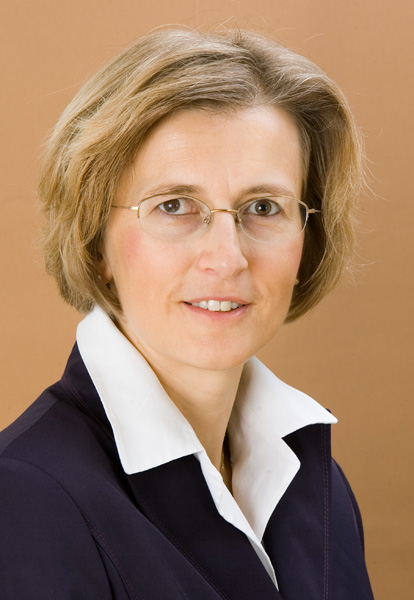
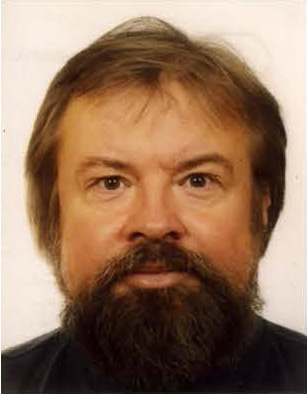
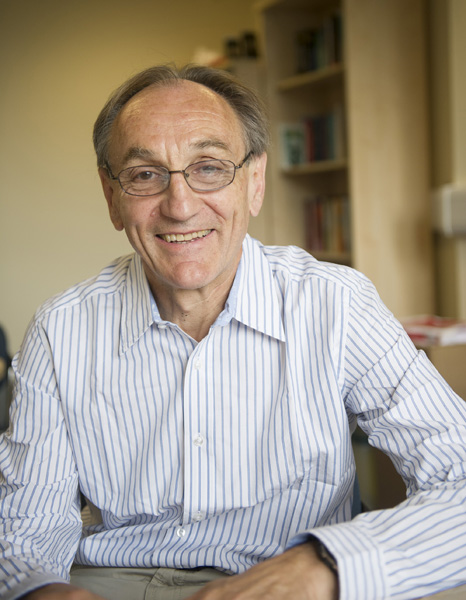
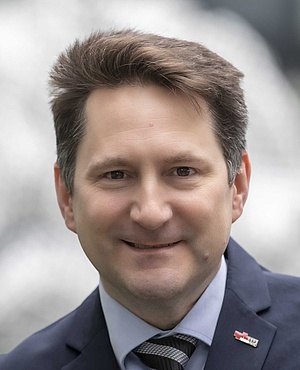
Michaela Szölgyenyi is a Professor at the Institute of Statistics within the Faculty of Technical Sciences at the University of Klagenfurt. Her research focuses on stochastic processes, numerical methods for stochastic differential equations (SDEs), and applications in financial and actuarial mathematics. She specializes in analyzing SDEs with irregular coefficients, including discontinuous drift and jump-diffusion dynamics. Her work emphasizes approximation methods for such equations, with contributions to optimal transport, risk theory, and insurance mathematics. She has published extensively on convergence rates, numerical schemes like the Euler-Maruyama and Milstein algorithms, and their applications in modeling financial and actuarial scenarios. She is affiliated with interdisciplinary projects and teaches courses related to stochastic analysis and mathematical finance.
**Dr. Stefan Nehrer** is a **Professor and Dean of the Faculty of Health and Medicine** at the University for Continuing Education Krems. His research focuses on regenerative medicine, orthopedics, and the application of artificial intelligence (AI) in medical diagnostics. Key areas of expertise include cartilage repair, osteoarthritis therapy, and tissue engineering. He leads projects such as ‘Artificial Intelligence in Orthopedic Radiography Analysis’ and ‘Minced Cartilage in Regenerative Medicine.’ **Research Projects**: Assessing biomechanical biomarkers for knee osteoarthritis (2024–2027) Nutrition and movement for osteoarthritis self-efficacy (2022–2025) AI-driven analysis of radiographic images for knee and spinal conditions **Publications**: His work spans journals like *Biomacromolecules*, *Macromolecular Bioscience*, and *Journal of the Mechanical Behavior of Biomedical Materials*, with a focus on 3D bioprinting, biomaterials, and AI applications. Recent studies explore silk fibroin hydrogels for meniscus regeneration and deep learning for Cobb angle measurements. **Awards & Recognition**: While no specific awards are listed, his contributions to regenerative medicine and AI in healthcare highlight significant scholarly impact. **Grants & Funding**: Projects funded by Austrian federal programs and industry collaborations, such as ‘Additive Manufacturing for Partial Implants’ (2022–2024). **Labs/Teams**: His work integrates interdisciplinary teams in biomedical engineering, orthopedics, and AI, with a focus on translating research into clinical practice.
Marc Kurz is a Professor at FH Hagenberg's Department of Information and Communications Technology (ICT). His research focuses on activity recognition, energy data infrastructure, and human-computer interaction strategies for energy literacy. He leads major EU projects like CELINE and ECLIPSE addressing smart city energy systems and open-source energy frameworks. Key projects include cross-sectorial innovation in localized energy systems (CELINE) and energy consumption reduction via open-source tools (ECLIPSE). He co-organized the 2024 EEL-HCI workshop advancing accessible energy data engagement. Received 7 Best Paper Awards between 2012-2023 Active in organizing conferences like AISyS 2024 and ASPAI 2024 His work bridges ICT innovations with practical energy solutions, emphasizing community empowerment through technology.
Kathrin Probst is Professor at University of Applied Sciences Upper Austria, Hagenberg Campus, focusing on human-computer interaction and tangible interfaces. Her research develops smart textiles, sustainable fashion technologies, and novel interaction paradigms through projects like BAMBI and Active Office. Work explores the materiality of interaction, with recent investigations into textile signifiers, traceability systems for fashion, and biodesign approaches. Research demonstrates strong experimental design focus and attention to material properties. Publications advance understanding of textile-based interfaces, ergonomic workplace design, and unconventional interaction methods. Work contributes to both technical implementation and design theory. Awards include: ACM Europe Council Best Paper Award (2018) UIST Best Paper Award (2018) Organizes the Expanded conference on interactive surfaces. Research collaborations include University of Calgary and National University of Singapore.
Prof. Vladimir Kolmogorov is a faculty member at the Institute of Science and Technology Austria (IST Austria), specializing in discrete optimization and algorithm design. He holds a Ph.D. in Computer Science from Cornell University and has held positions at Microsoft Research and University College London. His research focuses on combinatorial optimization, MAP inference in graphical models, and applications in computer vision. Educations: M.S. in Applied Mathematics and Physics, Moscow Institute of Physics and Technology Ph.D. in Computer Science, Cornell University Research Interests: Dr. Kolmogorov's work spans algorithmic optimization, including complexity analysis of constraint satisfaction problems, graph algorithms, and machine learning applications. His contributions include foundational work on graph cuts for computer vision and the development of efficient optimization methods for discrete problems. Publications: His recent work includes advancements in parallel algorithms for Gibbs distributions, semidefinite programming, and combinatorial optimization. These contributions highlight his expertise in bridging theoretical computer science with practical applications. Awards: Royal Academy of Engineering/EPSRC Research Fellowship (2006–2011) ERC Consolidator Grant (2014–2020) Best Paper Award at ECCV 2002 Outstanding Student Paper Award (NIPS 2007) Best Paper Honorable Mention (CVPR 2005) Advising and Grants: He has advised multiple PhD students and leads a research team at IST Austria. His grants include significant funding for exploring optimization in machine learning and discrete systems. Labs/Teams: His lab focuses on theoretical and applied discrete optimization, collaborating with institutions globally. Current projects include developing faster algorithms for graph problems and advancing Gibbs distribution analysis.
Christoph H. Lampert is a Professor at the Institute of Science and Technology Austria (ISTA), leading the Machine Learning and Computer Vision Group. His research focuses on creating robust, fair, and verifiable machine learning systems with strong theoretical foundations. Academic Rank: Professor (ISTA) Research Focus: Machine Learning, Computer Vision, Robustness, Fairness, Formal Verification Editorial Roles: Action Editor (JMLR), Former Editor (IJCV), Associate Editor-in-Chief (TPAMI) His recent publications explore robust deep learning architectures, formal verification of neural networks, and fairness in multi-source learning environments. Research keywords span neural network design, algorithmic accountability, and structured data modeling. Scientific achievements include: DARPA Disruptive Ideas award (2023) ISTA Alumni Award (2023) He has mentored numerous PhD students including: Bernd Prach (2022 thesis: Robust image classification with 1-Lipschitz networks) Egor Zverev, Nikita Kalinin, Hossein (Qualifying Exam passed 2023-2025) Alex Peste (2023 thesis: Robustness and Fairness in Machine Learning) Mary Phuong (2021 thesis: Underspecification in Deep Learning) Amelie Royer (2020 thesis: Computer Vision applications) Alexander Kolesnikov (2018 thesis: Weakly-Supervised Segmentation) Alex Zimin (2018 thesis: Dependent data learning)
Josef Leydold is Associate Professor of Statistics and Mathematics at Vienna University of Economics and Business. His research develops computational methods for random variate generation and graph theoretical applications. Research Areas: Design of black-box algorithms for non-uniform random numbers; geometric properties of graph Laplacians; spherical harmonics applications; and optimization techniques. Publications: Focus on practical algorithms for statistical computing, including monographs on automatic random variate generation and mathematical foundations for economists. No awards or student supervision details are documented.
Tomas Masak is an Assistant Professor at the Department of Statistics and Mathematics, Vienna University of Economics and Business (WU). He holds a PhD in Mathematics from EPFL Lausanne (2018–2022) and an MSc in Mathematical Statistics from Charles University. His academic roles include Bernoulli Instructor at EPFL (2022–2024) and Research and Teaching Assistant at Technical University of Munich (2017–2018). Education Mathematics PhD, EPFL Lausanne (2018–2022) Mathematical Statistics MSc, Charles University (completed 2017) His research focuses on functional data analysis, covariance estimation, and statistical computing. Recent work includes the Functional Graphical Lasso and methods for sparsely observed random surfaces. Publications span journals like the Annals of Statistics , Journal of the American Statistical Association , and Biometrika , emphasizing open-access venues. Keywords across his work include functional analysis, covariance modeling, and high-dimensional statistics. He actively participates in scientific lectures and peer review, serving as a reviewer for the Annals of Statistics and Journal of Machine Learning Research in 2024. His collaborations span Europe and focus on data science applications.
Elena Andreeva is a tenure-track Assistant Professor in the Security and Privacy department at TU Wien. Her research focuses on symmetric cryptography, including authenticated encryption, block ciphers, hash functions, privacy-friendly protocols, and blockchain technologies. She coordinates the Double-Degree Program in IT Security and actively participates in the Faculty Council. Her work emphasizes both theoretical foundations and practical cryptographic solutions for secure data communication and storage. Research interests include designing and analyzing cryptographic algorithms with applications in IoT-to-cloud secure computation, lightweight encryption schemes, and quantum-resistant primitives. Her projects, such as SFB SPyCoDe (2023–2026), explore efficient compression functions and expanding PRFs for arithmetization-oriented hashing. Articles Overview : Recent publications emphasize authenticated encryption schemes (e.g., COLM), pseudorandom number generators (TPRF-based), and novel cryptographic designs like Forkcipher. These contributions address both theoretical security models and practical efficiency in resource-constrained environments. She advises students on master/bachelor theses and internships, fostering the next generation of cybersecurity researchers. Her involvement in curriculum development and interdisciplinary programs underscores her commitment to advancing both academic and applied cryptography.
Uwe Egly is an Associate Professor at the Department of Knowledge-Based Systems, Faculty of Informatics, Technische Universität Wien (TU Wien). His research focuses on automated reasoning, proof theory, knowledge representation, and computational logic, with a strong emphasis on quantified Boolean formulas (QBFs), argumentation frameworks, and applications of AI in engineering. He leads projects funded by the Austrian Science Fund (FWF) and the Vienna Science and Technology Fund (WWTF), including the Boolean project (2011–2019) and FAME (2011–2014). Egly is known for developing QBF solvers like DepQBF and contributing to SAT-solving techniques. He teaches courses such as Abstract Argumentation , Formal Methods in Computer Science , and Quantum Computing . His research interests span proof complexity, satisfiability checking, and AI-driven algorithms for path planning. He has advised numerous students on theses involving quantum algorithms, QBF solver optimizations, and argumentation frameworks. Egly’s work bridges theoretical computer science with practical applications, including contributions to deformation monitoring systems and circuit synthesis using SAT-based methods. He is involved in international workshops and conferences, such as SAT, FMCAD, and Dagstuhl Seminars, and has edited proceedings for events like SAT 2014 . His collaborations include projects on scenario-based testing of UML diagrams and semantics-aware model versioning. Egly’s interdisciplinary approach integrates logic, artificial intelligence, and computational methods to solve complex theoretical and applied problems.
Monika Henzinger is a Full Professor of Computer Science at the University of Vienna since 2009. Previously, she held faculty positions at the Ecole Polytechnique Federale de Lausanne (2005-2009) and the University of the Saarland (1999-2005). She has also worked as a Director of Research at Google Inc and as a Research Staff member at Digital Equipment Corporation . Education: Ph.D., Computer Science, Princeton University (1993) Diploma, Computer Science, University of the Saarland (1989) Her research focuses on combinatorial algorithms , data structures , algorithmic game theory , and web information retrieval , with significant contributions to dynamic graph algorithms and probabilistic verification. Her work addresses problems in sponsored search auctions, web mining, and formal verification of stochastic systems. Key trends in her publications include web algorithmics , dynamic graph processing , probabilistic verification , and online optimization . Her research has been recognized through prestigious grants like the ERC European Young Investigator Award and the NSF CAREER Award . Scientific Awards: ERC Advanced Grant (2013) Honorary Doctorate, Technical University Dortmund (2013) European Young Investigator Award (2004) NSF CAREER Award (1995) She has advised PhD students at EPFL and the University of Vienna , including Paul Dütting and Veronika Loitzenbauer . Her editorial roles include serving as Editor of EATCS Monographs in Theoretical Computer Science and on the ACM Research Highlights board. She has led projects such as the Doctoral School Computational Science and Dynamic Graph Algorithms in Directed Graphs .
Marek M. Karpinski is a Chair Professor of Computer Science at the University of Bonn and a founding member of the Hausdorff Center for Mathematics . He has held visiting or professorial positions at institutions such as Princeton University, Carnegie-Mellon University, and the University of Edinburgh. His affiliations also include the B-IT Research School on Applied Informatics and the Lab for Foundations of Computing . His research spans efficient algorithms , combinatorial optimization , computational complexity , randomized approximation techniques , and applications in network design , quantum computation , and molecular biology . Recent work focuses on approximation hardness for NP-hard problems, graph algorithms , and algebraic computational complexity . His scientific contributions include polynomial time approximation schemes for dense NP-hard problems and key publications in randomized algorithms , VC dimension , and network optimization . He has advised numerous researchers and received honors such as the Humboldt Research Award and the Max Planck Research Prize .
Bakhodyr Khoussainov is a Professor and the Head of the Algorithms and Logic Lab at the University of Electronic Science and Technology of China (UESTC) , since 2021. He has also been a Professor at the University of Auckland (1996–present), with prior roles including Visiting Professor at institutions like Kyoto University, National University of Singapore, and Cornell University. His work spans Theoretical Computer Science and Mathematical Logic , focusing on automatic structures, algorithmic randomness, and computability. Education: PhD in Mathematics from Novosibirsk University (1988), Diploma in Mathematics (1984), BSc in Mathematics (1981). His research interests include Automatic structures , Computable model theory , Algorithmic randomness , and Games on graphs . He has contributed to the theory of automatic groups and solved problems related to algorithmically random structures. The trends in his recent publications highlight advancements in Parity Games (2022), Infinite Strings (2022), and Quasi-polynomial time complexity (2017). His work often bridges Computability , Automata Theory , and Game Theory , with interdisciplinary applications. Scientific Awards: Research Excellence Award, New Zealand Mathematical Society (2002) Humboldt Fellowship (2002) JSPS Invitation Fellowships (2001, 2012, 2016) Fellow of The Royal Society of New Zealand (2005) Aitken Lectureship (2019) Humboldt Research Award (2019) Humboldt Prize (2020) EATCS Nerode Prize co-winner (2021) He supervises numerous PhD and Master's students and has secured significant grants, including Marsden Fund grants (2000–2016), NSFC grant (2022–2026) , and MoE Singapore grant (2016–2020) . He served as Editor of the Journal of Symbolic Logic (2014–2021) and contributed to major conferences like LICS and ICALP.
Hervé Moulin is the D.J. Robertson Chair in Economics at the University of Glasgow, where he has been since 2013. Prior to this, he held professorial positions at Rice University, Duke University, and Virginia Polytechnic Institute. His academic journey began with a PhD in Mathematics from the Université de Paris in 1975, following his graduation from the École Normale Supérieure in 1971. His research focuses on cooperative game theory, social choice, incentive compatibility, and fair division mechanisms. Moulin has significantly contributed to redefining normative economics, particularly in designing fair resource allocation systems for scenarios like voting, asset division, and rationing. His work bridges theoretical foundations with practical applications in areas such as traffic pricing, communication networks, and commons exploitation. Moulin has been honored as a Fellow of the Econometric Society (1983), the Royal Society of Edinburgh (2015), and the British Academy (2018). He served as President of the Society for Social Choice and Welfare (1998–1999) and the Game Theory Society (2018–2020). His contributions include over 140 peer-reviewed articles and five books, emphasizing the intersection of mathematics, economics, and social choice theory.
Tobias Schreck is a Professor at the Institute of Visual Computing (formerly Computer Graphics and Knowledge Visualization) at Graz University of Technology, affiliated with the Faculty for Computer Science and Biomedical Engineering. His research focuses on Visual Data Analysis, 3D Object Retrieval, and Immersive Analytics, with applications in engineering and industrial contexts. He holds a Dr.rer.nat. from the University of Konstanz and has held academic positions including Assistant Professor at the University of Konstanz and Head of the Visual Search and Analysis Group at TU Darmstadt. Education: Dr.rer.nat., University of Konstanz (2006) M.Sc. in Information Engineering, University of Konstanz (2002) Dipl.-Volkswirt (M.Sc. Economics), University of Konstanz (1999) His research interests include visual analytics for high-dimensional and spatial-temporal data, digital libraries, and collaborative analysis tools. He leads funded projects like HEREDITARY (EU Horizon Europe) and VR4CPPS (FFG), and has served as a program chair for IEEE VAST and EuroVis. His work emphasizes user interaction, eye-tracking integration, and immersive visualization techniques. He supervises a research team including postdocs, PhD students, and student assistants, and collaborates on projects like CrossSAVE-CH and the Joint PhD Programme with Nanyang Technological University. His contributions span publications in IEEE Transactions, EuroVis, and ACM conferences, addressing challenges in data exploration, anomaly detection, and visualization design.