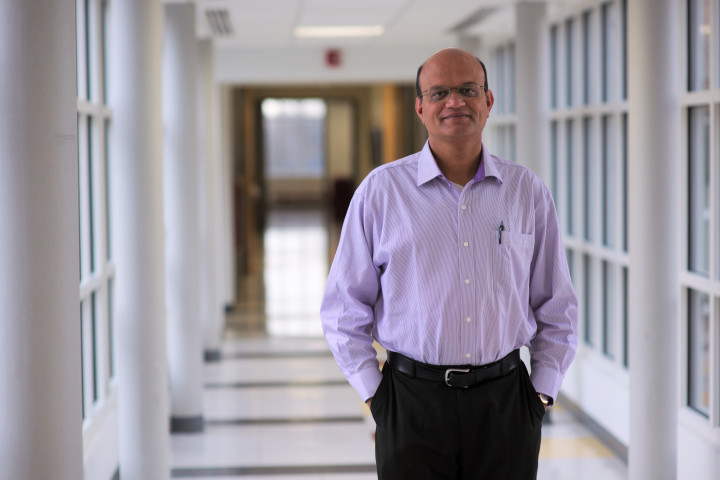
Richard Kenyon is a Professor in the Department of Mathematics at Yale University within the Faculty of Arts and Sciences, specializing in rigorous mathematical frameworks for complex probabilistic systems. His foundational work established the first rigorous results on the dimer model, catalyzing breakthroughs in Schramm–Loewner evolution theory. Recent research introduced novel homotopic invariants for random graph structures, forging unexpected links between probability theory and representation theory. His methodology bridges discrete mathematics with continuous geometric phenomena. Core research domains include: Statistical Mechanics (phase transitions, lattice models) Geometric Probability (random surfaces, tiling configurations) Combinatorial Probability (exact enumeration, asymptotic analysis) Mathematical Physics (conformal invariance, critical phenomena) Representation Theory (symmetric groups, Lie algebras) Topological Probability (homotopy invariants, random walks) Current investigations focus on probabilistic interpretations of algebraic structures and geometric constraints in high-dimensional random systems.
Brendan McKay is a Professor in the School of Computing at the Australian National University (ANU), where he conducts research at the intersection of mathematics and computing. His work is deeply rooted in combinatorics, graph theory, and probabilistic methods in discrete structures. His research interests span a wide range of topics in discrete mathematics, including random graphs , asymptotic enumeration , Hamiltonian cycles , planar and bipartite graphs , matrix theory , and computational combinatorics . His work often combines theoretical depth with algorithmic applications, particularly in the analysis of complex networks and discrete systems. The recent publications (2015–2025) reflect a sustained focus on asymptotic enumeration techniques, structural properties of graphs, and algorithmic challenges in graph isomorphism and distance queries. Key themes include the use of probabilistic tools (e.g., cumulant expansions, martingales), enumeration under degree constraints, and symmetry-preserving operations on maps. His collaborations frequently involve researchers such as Mikhail Isaev, Catherine Greenhill, and Qing Wang. Scientific Awards and Recognitions: Fellow, Australian Mathematical Society (2000 → …) Fellow, Australian Academy of Science (1997 → …) McKay has led and co-led several major research projects, including Deep Learning for Graph Isomorphism and Hypergraph models for complex discrete systems , demonstrating leadership in both theoretical and applied directions. He has not explicitly listed advisees, but his role as Principal Investigator (PI) on multiple projects indicates active mentorship and grant leadership. His work often involves interdisciplinary applications in bioinformatics and network science. He is associated with research groups and projects focused on graph algorithms , random discrete structures , and computational combinatorics , often in collaboration with the mathematical sciences community at ANU and beyond.
Aravind Srinivasan is a Distinguished University Professor and Professor of Computer Science at the University of Maryland, College Park, with additional appointments in UMIACS (University of Maryland Institute for Advanced Computer Studies) and AMSC (Applied Mathematics & Scientific Computation). He is an Amazon Scholar since 2019, applying his expertise in algorithms to cloud computing challenges at AWS. Dr. Srinivasan earned his B.Tech in Computer Science & Engineering from IIT Madras (1989) under Prof. C. Pandu Rangan, followed by a Ph.D. in Computer Science from Cornell University (1993) under Prof. David B. Shmoys. He completed postdoctoral work at the Institute for Advanced Study (Princeton) and DIMACS (Rutgers) from 1993-94. His research spans algorithms, probabilistic methods, data science, network science, and machine learning , with applications across multiple domains. He has pioneered work at the intersection of algorithms and AI, focusing on interpretability and explainability. His research in health includes computational epidemiology, cancer genomics, pharmacology, organ exchange, and medical devices. In the Internet economy, he works on E-commerce, digital marketing, cloud optimization, crowdsourcing, and social networks. He is a leading researcher in algorithmic fairness, developing methods to systematically incorporate probabilistic, per-user/demographic fairness in AI systems. His work also extends to networking algorithms, distributed computing, and sustainable growth applications including energy networks. His recent publications reveal a strong trend toward integrating algorithmic fairness with practical applications in healthcare, resource allocation, and sustainability. The research shows increasing focus on probabilistic methods for fair decision-making in online environments, with applications ranging from kidney exchange programs to pandemic response planning. His work consistently bridges theoretical computer science with real-world impact. Professional Recognition: Elected Fellow of six professional societies: ACM, IEEE, AMS, AAAS, EATCS, and SIAM Member of Academia Europaea (the Academy of Europe) Distinguished University Professor of the University of Maryland (2020) Dijkstra Prize, Danny Lewin Award, and Distinguished Career Award in Computer Science Dr. Srinivasan has advised an extensive portfolio of students at all levels, from high school to postdoctoral researchers. His current PhD students include Sharmila Duppala, Kishen Gowda, and Sanna Madan (co-advised with Eytan Ruppin). His graduated PhD students have gone on to faculty positions (Brian Brubach at Wellesley, Bo Han at George Mason), industry leadership roles (Tom DuBois as CTO of Maven/Salesforce), and research positions at major tech companies. His research has been funded by Adobe, Amazon, Google, NSF, IARPA, and other government agencies, focusing on applications in cloud computing, epidemiology, and fair resource allocation. He serves as Associate Editor for ACM Transactions on Algorithms and previously served as Editor-in-Chief (2014-2020), and as Managing Editor of Theory of Computing (2006-2019).
Professor Daniel Kleitman is a faculty member in the Massachusetts Institute of Technology (MIT) Department of Mathematics , where he has taught courses such as 18.310 Principles of Discrete Applied Mathematics , 18.01 Calculus , and 18.022 Calculus . His academic rank is Professor, with a career spanning decades in combinatorics, discrete mathematics, and interdisciplinary applications. Teaches 18.310 (Discrete Applied Mathematics) Teaches 18.01 (Calculus) Teaches 18.022 (Multivariable Calculus) Research Interests Professor Kleitman’s work lies at the intersection of combinatorics , graph theory , and discrete applied mathematics . His research explores: Theoretical foundations of discrete mathematics Error-correcting codes and cryptographic algorithms Applications to computer science, biology, and physics Geometric and probabilistic methods in combinatorics Publications Trends His publications since 1980 emphasize combinatorics , graph theory , and algorithm design . Key areas include: Combinatorial geometry (convex sets, planarity) Network optimization (spanning trees, linear programming) Coding theory (Shannon bounds, BCH codes) Interdisciplinary applications (gene recognition, urban homicide analysis)
Dingyuan Liu is a Researcher at the Karlsruhe Institute of Technology (KIT) , affiliated with the Department of Mathematics and the Discrete Mathematics research group. His work is supervised by Prof. Maria Axenovich, and he focuses on extremal and probabilistic combinatorics , discrete geometry , and incidence structures of points and hyperplanes . Research Interests: Dingyuan Liu's research spans extremal combinatorics , probabilistic combinatorics , and discrete geometry . He investigates Ramsey and Turán type problems , extremal properties of random graphs , and geometric configurations in planar and hypercube settings . Publication Trends: Liu's recent work explores geometric combinatorics in higher dimensions, sumset bounds , interpoint distance multiplicities , and visibility in hypercubes . His contributions bridge extremal set theory , poset saturation , and graph coloring in discrete geometry contexts. Supervision: Dingyuan Liu is advised by Prof. Maria Axenovich, a leading expert in discrete mathematics. He collaborates with researchers such as F. C. Clemen, A. Dumitrescu, J. Balogh, L. Mattos, and T. Szabó. Labs and Teams: Liu is part of the Discrete Mathematics Research Group at KIT, which aligns with broader institutes like the Institute of Algebra and Geometry and Metrics Geometry groups.
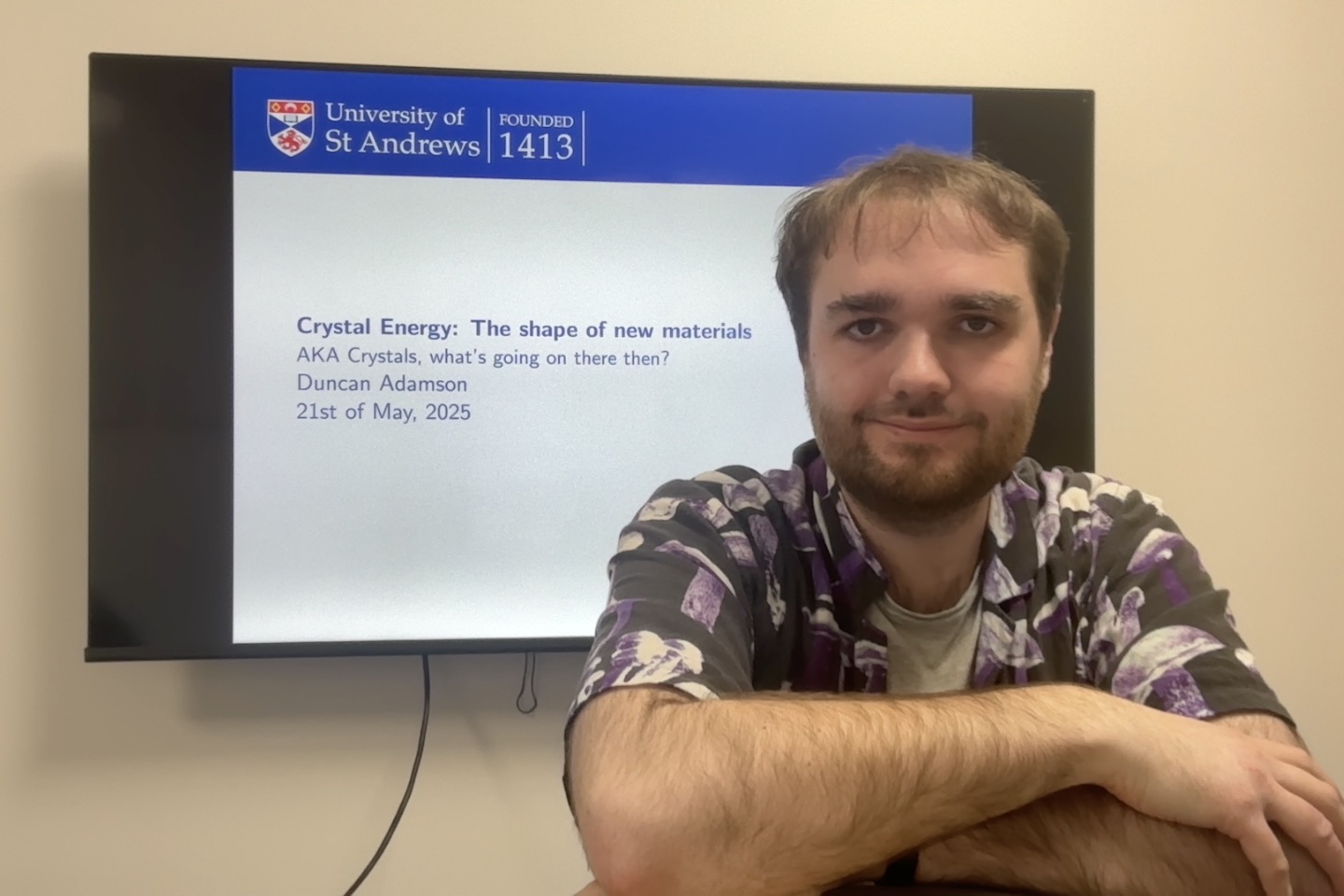
Duncan Adamson is a Lecturer in the School of Computer Science at the University of St Andrews, United Kingdom. He has held prior research positions at the Leverhulme Research Centre for Functional Materials Design, the University of Göttingen, Reykjavik University, and the University of Liverpool. His academic foundation includes a PhD from the University of Liverpool supervised by Prof. Igor Potapov and undergraduate studies at the University of Glasgow. His research lies at the intersection of theoretical computer science and discrete mathematics, with a focus on combinatorics on words , algorithm design , crystal structure prediction , and temporal graphs . He explores symmetry in multidimensional words, develops algorithms for combinatorial enumeration, and investigates computational hardness in materials science. His work often bridges abstract theory with real-world applications in chemistry and robotics. The recent publications show a strong trend in combinatorial algorithms , particularly in enumeration, ranking, and optimization over structured words, graphs, and sequences. A significant portion of his work involves the k-centre problem for implicitly defined combinatorial classes and temporal graph colouring , with increasing emphasis on algorithmic complexity and practical implementation. His 2024 paper on harmonious colourings in temporal matchings was awarded best paper at SAND 2024, highlighting the impact of his research. Scientific Awards: Best Paper Award, SAND 2024 – 'Harmonious Colourings of Temporal Matchings' Duncan Adamson has been supported by the Leverhulme Research Centre for Functional Materials Design during his PhD and postdoctoral work. While no formal advisees are listed, his supervision by leading researchers and collaborative projects suggest active mentorship and team integration. He teaches core computer science modules at St Andrews, including CS2001 and CS3302, and maintains a busy research schedule with weekly meetings and supervisory responsibilities. His research is conducted within the Algorithms and Complexity group at St Andrews, continuing collaborations with international teams in Iceland, Germany, and beyond. Projects often involve interdisciplinary efforts, especially in applying computational techniques to materials science and chemistry.
Marco Molinaro is a Professor in the Computer Science Department at PUC-Rio . He previously held Assistant Professor positions at TU Delft (EWI), Georgia Tech (ISyE, ACO), and was a PhD student in the ACO program at Carnegie Mellon University . Education: PhD in Algorithms, Combinatorics, and Optimization (ACO), Carnegie Mellon University Research Interests: Marco's work lies at the intersection of online algorithms , convex optimization , machine learning , and operations research . His recent publications analyze: Online scheduling and VM allocation in data centers Complexity of branch-and-bound trees Information-theoretic bounds for optimization problems Explainable decision trees and their theoretical limits Stochastic and adversarial bandit algorithms Curvature properties in optimization sets His research often bridges abstract mathematical frameworks (e.g., Lipschitz functions, supermodular norms) with practical applications in cloud computing, machine learning, and game theory. Publication Trends: Marco's recent work focuses on online convex optimization and its extensions to data center resource allocation (Kamino: latency-driven VM scheduling), dynamic bin packing , and information complexity in mixed-integer models. He frequently collaborates with researchers at institutions like Carnegie Mellon University and TU Delft, with recurring co-authors Santanu Dey, Amitabh Basu, and Thomas Kesselheim. Teaching: Marco teaches advanced courses in algorithm design and analysis at PUC-Rio, including: Analise de Algoritmos (2020–2025) Projeto e Analise de Algoritmos (postgraduate, 2020–2025) Algoritmos e Incerteza (postgraduate, 2020) Estruturas Discretas (2021) His curriculum emphasizes online learning , random-order models , and PAC learning , with connections to game theory and practical implementations.
Dr. Ivan Kryven is an Associate Professor in Mathematical Modeling at the Mathematical Institute, Faculty of Science, Utrecht University. His research spans graph theory, probability, numerical methods for dynamical systems, partial differential equations, stochastic analysis, and randomized algorithms, with applications primarily in chemistry and materials science. His expertise includes: Mathematical Modeling Stochastic Modeling Discrete Mathematics Graph Theory Differential Equations Statistical Physics Dr. Kryven's research focuses on the mathematical foundations of complex systems, with particular interest in network science, random graphs, and their applications to polymer science and materials engineering. His work often bridges discrete and continuous mathematical objects, revealing fundamental connections across different domains. Much of his research has practical applications in chemistry and materials science, with recent efforts expanding into complex societal systems and epidemiology. His scientific contributions demonstrate strong trends in percolation theory, random graph representations of physical processes, and computational methods for analyzing complex networks. His work connects theoretical mathematics with practical applications in materials science, epidemiology, and complex systems analysis. His notable scientific contributions include publications in Nature Communications, Physical Review E, and Scientific Reports, with research spanning from polymer networks to epidemic modeling and complex systems analysis. Dr. Kryven has supervised numerous students through their academic journey: PhD Students: Ruben Hendriks, Mike de Vries, Jochem Hoogedijk, Niek Mooij, Verena Schamboeck (now at Austrian Power Grid), Yuliia Orlova (now postdoc at University of Amsterdam) Master Students: Yeyang Hu, Josanne Verheule, Hannah Onverwagt, Niels Scholte, Fleur Slegers, Mike de Vries, Niek Mooij, Camillo Schenone, Andi Lin, Thomas Bakx, Nynke Brouwer, Yaïr Hein, Frits Verhagen, Femke Ieperen Postdoc: Rik Versendaal (now faculty at TU Delft) He is actively involved in the Mathematics of Complexity research theme at Utrecht University and participates in outreach activities through µ-Open, providing opportunities for student engagement in mathematical research.
Benjamin Dadoun is an Associate Professor in the field of probability theory at Le Mans University, affiliated with the Laboratoire Manceau des Mathématiques (LMM). His research focuses on asymptotic convex geometry, random matrices, high-dimensional phenomena, and growth-fragmentation processes. His research interests include: Asymptotic behavior of random structures in high dimensions Growth-fragmentation processes and their scaling limits Random convex polytopes and their geometric properties Random matrix theory and associated energy functionals Dadoun's recent publications demonstrate a strong focus on the intersection of probability theory, convex geometry, and high-dimensional analysis. His work often involves establishing precise asymptotic behaviors and phase transitions in high-dimensional settings. He has made significant contributions to understanding the properties of Schatten balls, Poisson polytopes, and growth-fragmentation processes, with publications in top journals like Journal of Functional Analysis and Random Matrices: Theory and Applications. His doctoral thesis completed at the University of Zurich under Jean Bertoin established foundational work on growth-fragmentation processes, showing how these continuous processes emerge as scaling limits of discrete Markov branching structures.
Xavier Goaoc is a Professor of Computer Science at Université de Lorraine, affiliated with the Department of Computer Science & Engineering at École des Mines de Nancy and the Gamble research team (joint between LORIA and INRIA). His research focuses on algorithms and discrete mathematics, particularly discrete and computational geometry, including convex hulls, intersection patterns, topological generalizations, and geometric transversal theory. University: Université de Lorraine School: School of Engineering Department: Department of Computer Science & Engineering Research Team: Gamble (LORIA/INRIA) Emails: xavier.goaoc@loria.fr , xavier.goaoc@univ-lorraine.fr His research spans computational geometry, combinatorial convexity, geometric transversal theory, and random geometric structures. Key topics include homological minors, order types of point sets, and geometric optimization. His 15 most recent publications highlight advancements in computational geometry algorithms, structural complexity, and topological constraints. Notably, his work has received Best Paper Awards at SoCG 2020, 2018, 2016, and 2012. Administrative roles include heading the computer science & engineering department at Mines Nancy and co-chairing the computer science department of the IAEM doctoral school. He is also a member of the Université de Lorraine's ‘pôle AM2I’ council. Teaching activities encompass courses in algorithms, computer architecture, blockchains, and geometric models for vision, with publications and grants reflecting his interdisciplinary impact in computer science and mathematics.
Daniel C. Jerison is an Assistant Professor in the Department of Mathematics and Statistics at the University of San Francisco, supporting undergraduate programs in mathematics and data science. His academic career demonstrates a strong trajectory through prestigious institutions including Stanford University, Harvard University, Cornell University, and Tel Aviv University. Education: PhD in Mathematics, Stanford University, 2016 BA in Mathematics, Harvard University, 2007 Dr. Jerison specializes in discrete probability theory with emphasis on the properties of random objects and convergence of Markov chain algorithms. His research explores random planar maps, abelian sandpiles, circle packing, and discrete complex analysis. His work bridges theoretical mathematics with applications in statistical physics, examining how complex systems evolve and reach equilibrium states through sophisticated probabilistic methods. His approach often combines combinatorial techniques with analytical methods to solve problems in discrete geometry and probability. Analysis of Dr. Jerison's publications reveals consistent focus on the intersection of probability theory and discrete structures. His research demonstrates sophisticated mathematical techniques for analyzing convergence rates in Markov chains, establishing geometric criteria for planar structures, and solving boundary value problems for discrete systems. The recurring themes across his work include probabilistic methods applied to geometric problems, the study of self-organized critical systems, and theoretical frameworks for understanding complex discrete phenomena. Dr. Jerison has extensive teaching experience across multiple institutions, teaching courses ranging from foundational calculus to advanced probability theory. He has taught Probability Theory I (Math 6710), Stochastic Processes (Math 4740), Linear Algebra for Engineers (Math 2940), Prove It! (Math 3040), and Applied Complex Analysis (Math 4220) at Cornell University, in addition to his current teaching responsibilities at USF. He has also been involved with prestigious summer programs for high school students including PROMYS and SUMaC, where he directed research labs and served on admission committees.
Dr. Eng. Jan Bolek is an Assistant Professor at the Faculty of Physics, Warsaw University of Technology. His research focuses on optical engineering and holographic technologies. Specializes in holographic pattern recording Works with photomagnetic materials and liquid crystal composites Develops diffraction control techniques His work intersects Optics , Nanophotonics , and Signal Processing with applications in advanced imaging systems. Recent publications demonstrate expertise in spatial light modulator calibration and computational holography optimization. Key contributions include: Wavefront aberration correction techniques Diffraction order suppression methods Self-organized photonic structures
David Gamarnik is a Professor of Operations Research at the Operations Research and Statistics Group within the Sloan School of Management at the Massachusetts Institute of Technology (MIT). He holds a PhD in operations research from MIT (1998) and a BA in mathematics from New York University (1993). Prior to joining MIT in 2005, he was a research staff member at IBM T.J. Watson Research Center. Research Interests : Discrete probability, optimization and algorithms, quantum computing, statistics, machine learning, and stochastic processes. His recent work focuses on algorithmic obstructions in random structures, quantum optimization, and high-dimensional statistical models. He has contributed to understanding the overlap gap property in combinatorial problems and the performance of gradient descent in neural networks. Scientific Awards : Fellow of the Institute for Mathematical Statistics (IMS) Fellow of the Institute for Operations Research and Management Science (INFORMS) Fellow of the American Mathematical Society (AMS) Erlang Prize Best Publication Award from the Applied Probability Society of INFORMS Franz Edelman Prize competition finalist He currently serves as an area editor for Mathematics of Operations Research and has previously held editorial roles in Operations Research , Annals of Applied Probability , Queueing Systems , and Stochastic Systems journals.
Michel Goemans is the RSA Professor and Head of the Department of Mathematics at the Massachusetts Institute of Technology (MIT), with additional affiliations at MIT CSAIL and MIT ORC. Previously, he held the Leighton Family Professorship (2007-2017) and adjunct/visiting positions at the University of Waterloo, University of Louvain, and RIMS Kyoto. His research focuses on combinatorial optimization , discrete algorithms , and approximation methods , with applications spanning network design, stochastic optimization, and algorithmic game theory. His publications consistently explore fundamental problems in mathematical programming and theoretical computer science. Notable awards include: Leroy P. Steele Prize (2022) George B. Dantzig Prize (2021) Farkas Prize (2012) Fellowships: AMS, ACM, SIAM, Guggenheim, Sloan Foundation Doctor Honoris Causa (Université catholique de Louvain) He advises doctoral candidates and postdocs, with prominent former students including David Williamson (Cornell), Jon Kleinberg (Cornell), and Aleksander Madry (MIT). Research is primarily funded by NSF and ONR grants.
Nathan (Nati) Linial is a Professor at the School of Computer Science and Engineering at The Hebrew University of Jerusalem, where he has maintained a distinguished academic career spanning several decades. His research bridges multiple mathematical disciplines with theoretical computer science. Linial's primary research interests encompass Combinatorics, Theory of Algorithms, Geometry, Analysis, and Computational Molecular Biology . His work often explores the deep connections between discrete mathematics and computer science, particularly focusing on high-dimensional combinatorial structures, metric embeddings, and their algorithmic applications. His publication record demonstrates consistent contributions across decades, with recent work focusing on high-dimensional permutations, simplicial complexes, graph theory, and coding theory. Linial has developed significant theoretical frameworks for understanding complex combinatorial structures and their geometric representations. Among his notable achievements is being named an AMS Fellow and receiving the 2008 Conant Prize for the influential survey paper "Expander graphs and their applications" co-authored with S. Hoory and A. Wigderson. His research has shaped multiple areas of theoretical computer science and discrete mathematics. Linial has served on the editorial boards of prestigious journals including Israel Journal of Mathematics (where he was Chief Editor 2013-2017), Random Structures and Algorithms , and Combinatorica . He has supervised numerous students throughout his career and maintains active research collaborations worldwide.