معرفی
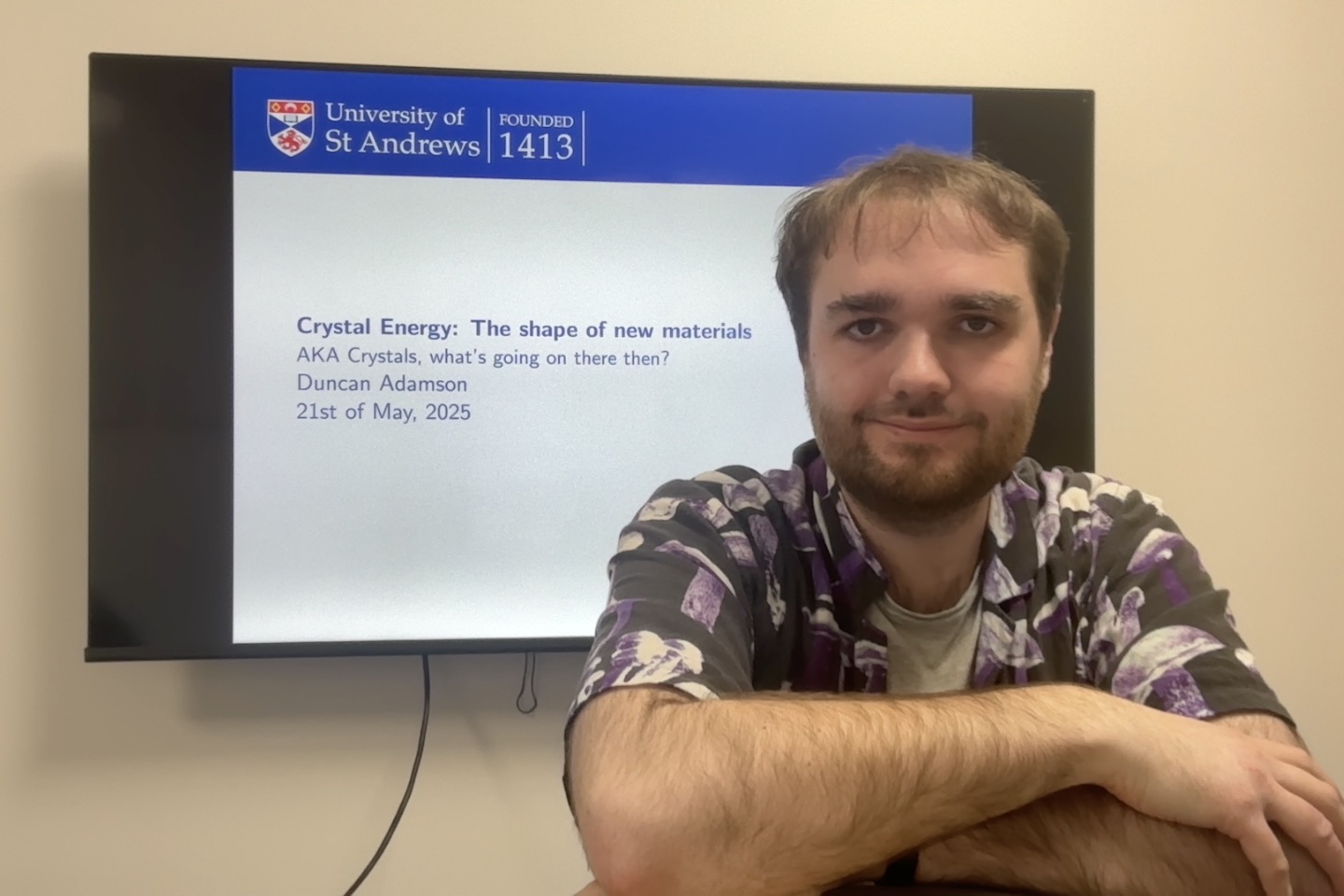
Duncan Adamson is a Lecturer in the School of Computer Science at the University of St Andrews, United Kingdom. He has held prior research positions at the Leverhulme Research Centre for Functional Materials Design, the University of Göttingen, Reykjavik University, and the University of Liverpool. His academic foundation includes a PhD from the University of Liverpool supervised by Prof. Igor Potapov and undergraduate studies at the University of Glasgow.
His research lies at the intersection of theoretical computer science and discrete mathematics, with a focus on combinatorics on words, algorithm design, crystal structure prediction, and temporal graphs. He explores symmetry in multidimensional words, develops algorithms for combinatorial enumeration, and investigates computational hardness in materials science. His work often bridges abstract theory with real-world applications in chemistry and robotics.
The recent publications show a strong trend in combinatorial algorithms, particularly in enumeration, ranking, and optimization over structured words, graphs, and sequences. A significant portion of his work involves the k-centre problem for implicitly defined combinatorial classes and temporal graph colouring, with increasing emphasis on algorithmic complexity and practical implementation. His 2024 paper on harmonious colourings in temporal matchings was awarded best paper at SAND 2024, highlighting the impact of his research.
Scientific Awards:
- Best Paper Award, SAND 2024 – 'Harmonious Colourings of Temporal Matchings'
Duncan Adamson has been supported by the Leverhulme Research Centre for Functional Materials Design during his PhD and postdoctoral work. While no formal advisees are listed, his supervision by leading researchers and collaborative projects suggest active mentorship and team integration. He teaches core computer science modules at St Andrews, including CS2001 and CS3302, and maintains a busy research schedule with weekly meetings and supervisory responsibilities.
His research is conducted within the Algorithms and Complexity group at St Andrews, continuing collaborations with international teams in Iceland, Germany, and beyond. Projects often involve interdisciplinary efforts, especially in applying computational techniques to materials science and chemistry.