Professor Craig Sale holds the position of Professor of Human Physiology and Nutrition at Manchester Metropolitan University (MMU) and previously led research initiatives at Nottingham Trent University (NTU). He specializes in investigating exercise and nutrition interventions, particularly focusing on bone and muscle adaptations. His roles include Co-Lead of NTU’s Health & Wellbeing Strategic Research Theme, Director of the SHAPE Research Centre, and REF Unit of Assessment Coordinator for UoA C24. His research spans bone metabolism, muscle performance, genetics, sports nutrition, biomechanics, and environmental physiology, with a commitment to impactful real-world applications. His research has addressed topics such as beta-alanine supplementation for exercise performance, diet/exercise interventions for bone health in athletes, and the biological actions of carnosine. He has supervised 17 completed PhD students and currently guides 8 more. His awards include Fellowship in the American College of Sports Medicine (ACSM) and a Section Editor role at the European Journal of Sports Sciences. Recent work emphasizes bone biomarker responses to exercise, myocardial carnosine roles, and pregnancy’s legacy on athletic performance.
Prof. Dr. Stefan Huber is a Full Professor (W3) at the Faculty of Chemistry and Biochemistry , Ruhr-Universität Bochum , Germany. His research focuses on non-covalent interactions in organocatalysis , particularly halogen bonding , chalcogen bonding , and cyclopropenium derivatives for applications in molecular recognition , crystal engineering , and radical stabilization . Full Professor since 01/2022 Associate Professor (W2) 2014-2021 Independent Researcher at TU Munich 2009-2013 Research Interests include: Design of halogen/chalcogen bond donors for catalysis Supramolecular chemistry in solution and solid phases Quantum chemical modeling of transition states and binding strengths His work bridges experimental synthesis (NMR, X-ray, ITC) with computational methods , supported by the ERC Starting Grant (2015-2020) and collaborations within the RESOLV Cluster . Scientific Awards : Hoechst Dozentenpreis (2016) Robert-Sauer-Preis (2014) Hans-Fischer-Gedächtnispreis (2013) Ernst-Otto-Fischer-Lehrpreis (2012) Thieme Chemistry Journals Award (2010) Students : Over 20 Ph.D. and Master’s students, including Dominik Reinhard, Tim Steinke, Raffaella Papagna, and Julian Stoesser. The group maintains modern synthesis labs and collaborates with institutions like the University of Geneva and TU Munich .
Nathaniel George is a Lecturer in Politics of the Middle East at SOAS, University of London. His work bridges global political history and international relations, focusing on revolution, counterrevolution, sectarianism, and US foreign policy in the Arab world. PhD in History, Rice University MA in Middle East Studies, American University of Beirut BA in Cinema, University of Iowa Research spans the modern Arab world, emphasizing Lebanon, Palestine, and the Mashriq. His scholarship interrogates decolonization, imperial legacies, and the dialectics of revolutionary and counterrevolutionary movements. His recent publications analyze the intellectual history of counterrevolutionaries like Charles Malik, the Lebanese National Movement’s constitutional challenges, and transnational solidarity networks. These works appear in American Historical Review , Cultural Anthropology , and Arab Studies Journal . Fellow of the Higher Education Academy (FHEA) George supervises PhD research on Middle Eastern migration diplomacy, diaspora activism, and political party decline. He also leads departmental initiatives including the MSc Middle East Pathway and student experience programs.
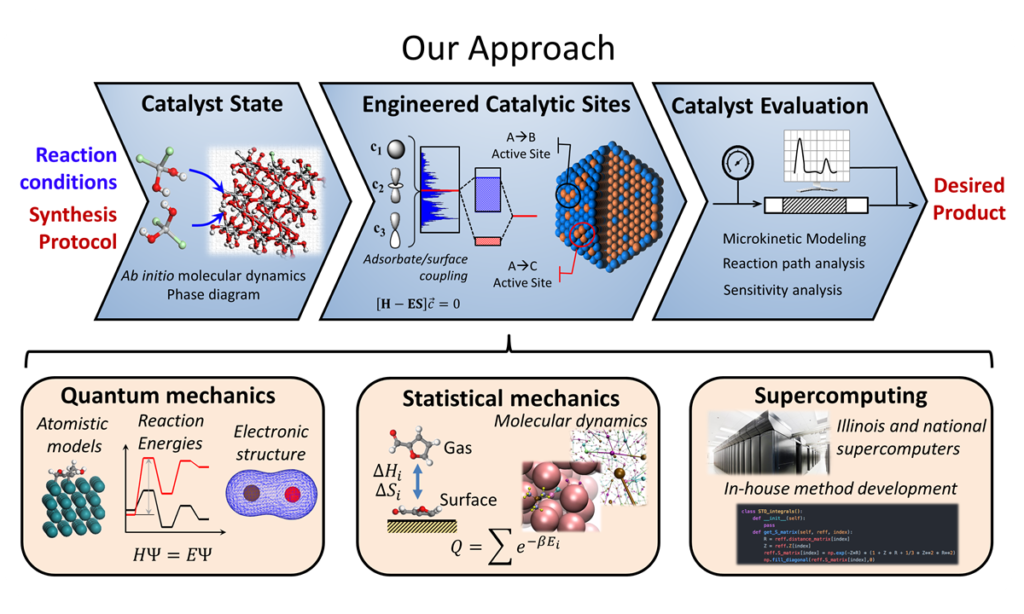
Dr. Alex Mironenko is an Assistant Professor in the Department of Chemical and Biomolecular Engineering at the University of Illinois at Urbana-Champaign. His research focuses on developing quantum mechanical methods to predict catalytic behaviors for renewable energy and chemical production. He leads the Mironenko Lab, which emphasizes computational models for heterogeneous catalysis, reactive force fields, and nanozyme design. Education: PhD in Chemical Engineering, University of Delaware (2018) Kadanoff-Rice Postdoctoral Scholar, University of Chicago (2018-2020) MS in Chemical Engineering, University of Kansas (2012) Diploma of Engineer, Omsk F.M. Dostoevsky State University, Russia (2009) Research Interests: Computational heterogeneous catalysis Reactive force fields derived from first principles Low-dimensional metal oxide catalysts Nanozymes and biomimetic catalysis Selective C-C coupling for CO₂ valorization Improving density functional theory accuracy Awards: ACS Petroleum Research Fund Doctoral Investigator Award (2021) Allan P. Colburn Outstanding Dissertation Prize (2019) Kadanoff-Rice Postdoctoral Fellowship (2018-2020) Advising and Grants: Advised PhD student Neil Tran (publication on methanol carbonylation mechanisms) Funded by NSF, ACS, and industry partnerships Labs/Teams: Mironenko Virtual Catalysis and Quantum Chemistry Lab Collaborations with institutions like University of Chicago and industry partners
James Kwan is an Associate Professor in the Department of Engineering Science at the University of Oxford and a Tutorial Fellow at Balliol College. His research focuses on sonochemistry, catalytic processes, and biomedical applications of cavitation, particularly in energy conversion, environmental engineering, and material science. He holds a BSc from Rensselaer Polytechnic Institute and advanced degrees from Columbia University. Key research interests include ultrasound-driven chemical reactions, design of catalytic cavitation agents, and development of sonochemical reactors for hydrogen production and CO2 conversion. He has pioneered work on cavitation-enhanced drug delivery and immunotherapy using nanostructured materials. Notable achievements include a Junior Research Fellowship at New College and contributions to breakthroughs in sonochemical reactor design and biomedical applications. His group actively explores synergies between ultrasound technology and sustainable energy, with recent studies addressing seawater splitting and CO2 utilization. Current research also involves cavitation noise characterization using machine learning and optimizing pulsed acoustic waves for enhanced sonochemical efficiency. Collaborations span engineering, chemistry, and biomedical fields, with a focus on translating lab innovations into industrial and clinical applications.
Stephen Bradforth is a Professor of Chemistry at the University of Southern California and Senior Advisor to the Dean for Research Strategy and Development in the Dornsife College of Letters, Arts and Sciences . He earned his PhD in Physical Chemistry from the University of California, Berkeley (1992) and conducted postdoctoral research at the University of Chicago . B.A., Natural Sciences, Cambridge University (1987) Ph.D., Physical Chemistry, UC Berkeley (1992) Postdoctoral Associate, University of Chicago (1993–1996) His research focuses on ultrafast laser spectroscopy to study chemical reactions in complex environments like aqueous systems and molecular materials . Key projects include: Solar Energy Conversion : Investigating photosensitizers based on earth-abundant elements (Cu, Zn, Zr) and organic photovoltaics with BODIPY cores. DNA Photodamage : Mechanisms of cyclobutane pyrimidine dimer (CPD) formation under UV exposure, emphasizing base-stacking effects. Electronic Structure in Ethereal Solvents : Studying solvated electrons in liquid ammonia and their role in carbanion stabilization. His 15 most recent articles (2004–2024) highlight advancements in photoelectron spectroscopy , singlet fission for solar cells, and DNA damage pathways . Collaborations span medicine, physics, and engineering . Scientific Awards include the ACS Physical Chemistry Division Senior Experimental Award (2023) , STAR Awardee (2019) , Cottrell Scholar , and Fellow of APS and AAAS . He has received both Junior (2001) and Senior Raubenheimer Awards (2022) at USC. Advising has been a cornerstone, with 23 PhD students graduated and 4 current candidates. His 15 most recent publications (2012–2024) emphasize ultrafast dynamics , charge transfer mechanisms , and environmental photochemistry . Labs & Teams : The Bradforth Group operates advanced time-resolved photoelectron spectrometers , liquid microjet systems , and high-repetition-rate laser facilities . Current projects include metallic water solutions (Nature 2021), DNA photophysics (FASEB J 2011), and carbanion electronic structure in ammonia.
Richard Nielsen is an Associate Professor in the Department of Political Science at MIT, affiliated with the Institute for Data, Systems, and Society (IDSS), the Security Studies Program (SSP), and the Center for International Studies (CIS). His research integrates quantitative methods with ethnographic insights to study Middle East politics, religion, political violence, and gender dynamics. He holds a PhD in Government and AM in Statistics from Harvard University, and a BA in Political Science from Brigham Young University. His first book, *Deadly Clerics* (2017), examines clerical radicalization in Sunni Islam, while current work explores female religious authority in digital spaces. Education: PhD in Government (Harvard, 2013), AM in Statistics (Harvard, 2010), BA in Political Science (BYU, 2007). Research focuses on: Islamic authority dynamics, online religious preaching (especially by women), counterterrorism, and methodological innovations in text analysis. He develops tools for Arabic text analysis and advises on computational social science methodologies. His work bridges political science, computer science, and Islamic studies. Teaching includes courses on international relations, political methodology, and Middle East politics. He has mentored over 20 PhD students, many now in academic and policy roles. Grants and collaborations include Carnegie Fellowship research and MIT's interdisciplinary initiatives. Labs/Teams: Political Methodology Lab (MIT), affiliated with IDSS and SSP. His work emphasizes computational tools for social science, such as the *arabicStemR* package for text analysis.
Wendell Walters is an Assistant Professor in the Department of Chemistry and Biochemistry at the University of South Carolina. He holds a Ph.D. in Earth, Atmospheric, and Planetary Sciences from Purdue University (2016) and a B.S. in Chemistry from the University of Maryland College Park (2012). His research focuses on atmospheric chemistry's environmental and climatic impacts, leveraging stable isotope analysis to trace anthropogenic and natural emissions of reactive nitrogen and sulfur. Key areas include urban air quality, polar atmospheric dynamics, and the interplay between atmospheric chemistry and climate systems. Education: B.S., Chemistry, University of Maryland College Park (2012) Ph.D., Earth, Atmospheric, and Planetary Sciences, Purdue University (2016) Research Interests: Walters' work integrates field observations, laboratory experiments, and computational modeling to understand atmospheric processes. His research themes include: Reactive nitrogen and sulfur chemistry in changing environments Atmospheric chemistry in remote regions (e.g., polar zones) Urban air quality and greenhouse gas emissions He employs novel stable isotope techniques (e.g., δ¹⁵N, δ¹⁸O) to quantify emissions from vehicles, agriculture, and fossil fuels, linking these to particulate matter formation and climate impacts. Grants & Awards: Walters has secured over $1.5M in funding, including an NSF Postdoctoral Fellowship (2016) and an EPA Seed Grant (2022). His research has been recognized with awards like the Bisland Dissertation Fellowship and the Henry Silver Environmental Science Award. Advising & Outreach: He mentors students in laboratory and field research, emphasizing interdisciplinary approaches. Outreach efforts include community-driven air quality monitoring in Providence, RI, and mentoring underrepresented students via programs like the Leadership Alliance. Labs/Teams: The Walters Research Group collaborates with institutions such as Brown University and the U.S. EPA, focusing on advancing isotopic tools for environmental science.
Professor Ziad Mallat is a distinguished Professor of Cardiovascular Medicine at the University of Cambridge, where he serves as the BHF Professor of Cardiovascular Medicine since 2010. He is affiliated with the Victor Phillip Dahdaleh Heart & Lung Research Institute and is a Principal Investigator in the Cardiovascular and Respiratory Medicine section of the Department of Medicine. Elected as a Fellow of the Academy of Medical Sciences (FMedSci) in 2020, Professor Mallat has established himself as a leading figure in cardiovascular immunology research. Professor Mallat received his MD and degree in Cardiovascular Disease from University of Paris VI, and his PhD from University of Paris VII. He was appointed Director of Research at Inserm, France, in 2007. His academic journey has positioned him at the forefront of cardiovascular research, with particular expertise in immune mechanisms of cardiovascular disease. Professor Mallat's research focuses on the immune mechanisms leading to cardiovascular inflammation in atherosclerosis, post-ischaemic injury (such as myocardial infarction), and aortic aneurysm and dissection. His laboratory develops novel immuno-modulatory and vaccination-based strategies to promote protective immune responses, aiming to radically change the management and treatment of these common and serious cardiovascular diseases. His approach combines basic science research, pre-clinical experimentation in animals, and translation clinical investigation in patients. Analysis of Professor Mallat's recent publications reveals a strong focus on the intersection of immunology and cardiovascular disease, particularly investigating regulatory T cells, B cell responses in atherosclerosis, and immune-modulatory therapies. His work spans from fundamental mechanisms to clinical translation, with several studies examining therapeutic approaches like low-dose interleukin-2 for cardiovascular inflammation. Fellow of the Academy of Medical Sciences (FMedSci) Co-Editor of Atherosclerosis journal Editorial Board member of Circulation Research and JCI Insight Professor Mallat has published over 250 papers in peer-reviewed journals, with landmark contributions including identifying prominent roles for specific pathogenic and regulatory immune pathways in atherosclerosis and post-ischaemic remodeling. His basic research activities are complemented by proof-of-concept clinical trials using immune-modulatory therapies in patients with coronary artery disease. He maintains active collaborations with the British Heart Foundation and is involved in the Cambridge BHF Centre of Research Excellence.
Sameer Naik is a Senior Lecturer at the School of Mechanical Engineering , Purdue University, where he has been actively involved in research since his Ph.D. graduation from Purdue in 2004. His work bridges fundamental combustion science and applied engineering for energy systems. Ph.D., Purdue University, 2004 Dr. Naik's research focuses on gas turbine combustion and internal combustion engines , utilizing advanced laser-based spectroscopy techniques for diagnostics. His expertise spans thermodynamics , combustion chemistry , and environmental impact analysis in propulsion systems. His publication record (10+ peer-reviewed articles) demonstrates technical leadership in laser-induced fluorescence applications, CARS spectroscopy , and high-pressure combustion analysis . These works address critical challenges in sustainable energy and transportation technologies , particularly in reducing emissions from gas turbines. Contact: naiks@purdue.edu
Robert G. Salomon is the Charles Fredrick Mabery Professor of Research in Chemistry at Case Western Reserve University and holds a secondary appointment as Professor of Ophthalmology in the Department of Ophthalmology & Visual Sciences. With a career spanning over four decades at Case Western since 1973, Dr. Salomon leads the Lipid Research Group focused on understanding the role of lipid oxidation in disease processes and developing new diagnostic tools and therapeutic strategies. Dr. Salomon received his B.S. in Chemistry from the University of Chicago in 1966, followed by a Ph.D. in Organic Chemistry from the University of Wisconsin in 1971. He completed postdoctoral studies at both the University of Wisconsin and Indiana University before joining Case Western Reserve University, where he progressed from Assistant Professor to his current named professorship. Dr. Salomon's research bridges chemistry, biology, and medicine with groundbreaking work on lipid oxidation products. His laboratory discovered critically important compounds including levuglandins and isolevuglandins - highly reactive oxidized lipids that contribute to disease through reactions with proteins and DNA. His work has established connections between lipid oxidation and conditions such as age-related macular degeneration, atherosclerosis, and cancer. The research employs a multidisciplinary approach combining organic synthesis, analytical chemistry, immunology, and cell biology to investigate disease mechanisms and develop potential interventions. Analysis of Dr. Salomon's recent publications reveals a continued focus on the biochemical and pathological effects of lipid oxidation products, particularly their role in retinal diseases and cancer. His work demonstrates how compounds like HOHA lactone and carboxyethylpyrroles contribute to disease mechanisms through protein modification, inflammation, and cellular dysfunction, with significant implications for understanding disease progression and developing targeted therapies. Mortar Board 'Top Prof' Award (2003) Cleveland Clinic Innovator Award (2006) Editorial Advisory Board, Chemical Research in Toxicology (2009-) Editorial Advisory Board, Journal of Lipids (2009-) Editorial Advisory Board, Organic Chemistry International (2009-) NIH Synthetic and Biological Chemistry A Study Section (2012-16) Director, Visual Sciences Research Center Tissue Culture & Hybridoma Core (2015-) Associate Editor, Free Radical Research (2019-) Dr. Salomon's Lipid Research Group operates from the Millis Science Center at Case Western Reserve University, working in a laboratory previously occupied by Nobel Laureate George A. Olah. His laboratory features extensive capabilities for HPLC analysis, radiochemical experiments, cell culture (bacterial and mammalian), immunological studies, organic synthesis, and tissue fractionation. Through strong collaborative interactions with biomedical researchers at the CWRU School of Medicine and the Cleveland Clinic Foundation, Dr. Salomon's research extends into sophisticated mass spectroscopic analyses, animal studies, and clinical investigations on human subjects.
Dr. Stephanie Alice Baker serves as Deputy Head of the Department of Sociology and Criminology at City St George's, University of London, where she holds the position of Reader. She earned her PhD from the University of Western Sydney in 2010 and a BA (Hons. 1st Class) from the University of Sydney in 2006. Prior to her current position, she held academic appointments at Goldsmiths University of London, University of Greenwich, and research positions at Indian Institute of Technology-Bombay and several Australian universities. Her research focuses on health and wellness cultures, particularly how influencers establish trust, intimacy and authority online. She has published extensively on the self-help and wellness industry, including the books Lifestyle Gurus: constructing authority and influence online (Polity, 2019) and Wellness Culture: how the wellness movement has been used to empower, profit and misinform (Emerald, 2022). Her current research examines the role of new media technologies in amplifying false, misleading and harmful content online, with particular attention to the connections between wellness culture and conspiracy theories. Dr. Baker's recent publications reveal a consistent trajectory exploring how wellness culture has become a gateway to misinformation, conspiracy theories, and far-right extremism. Her work demonstrates how influencers weaponize wellness discourse to promote anti-vaccine messaging, conspiracy theories, and radical political views, particularly during the COVID-19 pandemic. Her research employs cultural sociology frameworks to understand the appeal of 'truther' narratives and the structural conditions that facilitate belief in conspiracy theories. Emerald Literati Network Award for Excellence (2013) Outstanding Paper Award Winner European Association for Sociology of Sport (2011) Young Researcher's Award Australian Federal Government (2010) Endeavour Research Award University of Western Sydney (2008) Postgraduate Research Award (full PhD scholarship) University of Sydney (2007) Dr. Baker has advised numerous government bodies, providing evidence to UK Parliament committees on influencer culture and misinformation. She has collaborated with international organizations including the World Health Organization and has been consulted by the UK Cabinet Office's Open Innovation Team on AI and mis/disinformation. Her media presence is significant, with appearances in BBC, The Guardian, New York Times, and co-creation of the podcast series Twenty-first Century Cults .
Carly Wayne is an Assistant Professor in the Political Science Department at Washington University in St. Louis, with a PhD from the University of Michigan. Her research focuses on the psychological underpinnings of political violence, including emotions in conflict, foreign policy decision-making, and the Israeli-Palestinian conflict. She examines how cognitive and emotional processes influence public and elite behavior in conflict contexts. Her work bridges international relations and political psychology, with key projects analyzing the long-term effects of political violence exposure, group dynamics in foreign policy, and radicalization pathways. She co-authored The Polythink Syndrome (2016 Alexander George Book Award winner) and Beyond Rationality (2021), which integrate behavioral approaches into political science frameworks. Education : PhD in Political Science, University of Michigan Funding : NSF grant ($300K) for studying political radicalization and de-radicalization via social media analysis Research Themes : Emotion and cognition in conflict Exposure to violence and public opinion Group processes in foreign policy Israeli-Palestinian conflict dynamics White nationalist radicalization Her research has been published in top journals including the American Journal of Political Science, International Organization, and World Politics. She collaborates with scholars like Taylor Carlson (WashU) and Erin Rossiter (Notre Dame) on interdisciplinary projects. She currently leads a team analyzing a 180,000+ interaction dataset on Israeli-Palestinian violence (2010–2020) and investigates interpersonal communication pathways in radicalization. Her work emphasizes behavioral microfoundations and methodological innovation, including experiments and machine learning applications.
Alex Cresswell is a Reader in the Department of Chemistry at the University of Bath, where he leads research in synthetic organic chemistry. His work focuses on catalysis (metal and metal-free), C–H bond functionalization, and the use of reactive intermediates for sustainable synthesis. He is affiliated with the Institute of Sustainability and Climate Change and collaborates on projects like the Sustainable Chemicals and Materials Manufacturing Hub. M.Chem, University of Oxford (2008) D.Phil., University of Oxford (2012) Postdoctoral Research Associate, University of Illinois at Urbana-Champaign (2012–2014) Postdoctoral Research Associate, University of Edinburgh (2014–2016) His research interests center on developing new synthetic methods for organic chemistry, with an emphasis on photocatalysis, radical chemistry, and sustainable approaches. Key themes include photoredox-hydrogen atom transfer (HAT), gold-catalyzed C–H arylation, and iron-mediated cross-coupling reactions. His work contributes to UN Sustainable Development Goals like responsible consumption and climate action. Recent publications highlight advancements in photoredox-HAT catalysis, automated synthesis of spirocycles, and mechanistic studies using transient absorption spectroscopy. Collaborative projects involve optimizing radical C–C bond formation and exploring paired electrosynthesis for green chemistry. Scientific Awards Royal Society University Research Fellowship (2016) As an advisor, Alex has mentored doctoral students including Hannah Askey, Jacob Turner-Dore, Alison Ryder, and Anna Kinsella, with a focus on training the next generation of chemists in sustainable methodologies. His group also collaborates with institutions like the University of Illinois, University of Edinburgh, and the Royal Society.
Kirsty Ogg is a Lecturer in Curating within the Art Department at Goldsmiths, University of London. She serves as Interim Director of Mimosa House, a space dedicated to promoting diversity and access in the arts. Previously, she was Director of New Contemporaries (2013-2023), where she expanded support for emerging artists, and held curatorial positions at Whitechapel Gallery (2009-2013) and The Showroom (1998-2008). Kirsty's research focuses on the intersection of emerging art practice, arts education, and access. Her work is informed by her background in grassroots, DIY artist-led organizations, with particular interest in understanding and overcoming socio-economic and cultural barriers that prevent artistic emergence. She is currently exploring parallels between artist-led cultures and pre-18th century egalitarian pirate communities, investigating how radical democratic principles from the Golden Age of Piracy might inform contemporary curatorial and institutional practices. Her recent publications reveal a strong focus on emerging artists, digital curation platforms, and the evolving landscape of contemporary art institutions. Ogg has produced numerous exhibition catalogs for the Bloomberg New Contemporaries series and has organized conferences addressing critical issues in curatorial practice, artist development, and the relationship between art schools, museums, and the academy. Kirsty serves as External Examiner for the MLitt Curatorial Practice Contemporary Art program at Glasgow School of Art (2022-2025) and previously for the Curating Contemporary Art MA at Royal College of Art (2018-2020). Her professional activities demonstrate significant engagement with artist development, institutional critique, and creating pathways for emerging talent in the contemporary art world.