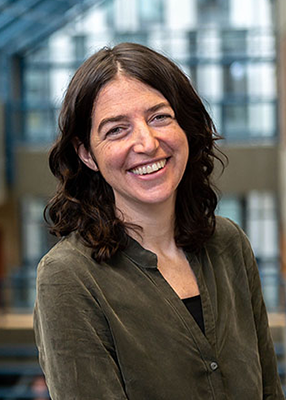
Adèle Garnier is an Associate Professor at the Department of Geography, Université Laval's Faculty of Forestry, Geography and Geomatics. She serves as Director of undergraduate geography programs and the certificate in sustainable tourism. Her research focuses on political geography, migration dynamics, and humanitarian governance, particularly examining refugee labor market participation, temporary migration policies, and technological impacts on immigration systems. Education : PhD in Political Science (Macquarie University/Universität Leipzig, 2012), MA in Political Science (Universität Leipzig, 2006), Diploma in Political Science (Paris, 2002) Her research integrates political geography , migration studies , and geographies of inequality , analyzing power structures in migration governance. Recent work explores Canada's digitalization of immigration, multiscalar impacts of refugee policies, and settler-colonial migration frameworks. Current research trends focus on technological governance of migration , refugee resettlement , and marketization of humanitarian services , with interdisciplinary approaches bridging political science and geography. Research Units : Graduate School of International Studies (ESEI), Immigration Research Team (ERIQA), Cultures-Arts-Societies Center (CELAT) Collaborations : Study Group on Ethnic Relations (Flers), Center for Refugee Studies (York University), Peace Research Institute Oslo She supervises graduate students in geography and co-leads multiple funded projects, including Liberating Migrant Labour (2023-2030) and digital migration governance research (2023-2028).
Stefan Kipfer is a Professor at the Faculty of Environmental and Urban Change , York University. He coordinates the Cities, Regions, Planning program and holds a PhD in Political Science from York University. His research focuses on the intersections of spatial organization, social order, and political rule, with particular emphasis on urban politics, racial capitalism, and anti-colonial theory. Education: PhD in Political Science, York University MES in Urban Political Economy and Ecological Politics, York University BA in Political Science and French, York University Kipfer's research spans transnational urban studies, critical theory, and radical political ecology. He explores: Urban social movements in Zurich, Toronto, and Paris State interventions in public housing, transit, and environmental policy The capitalist and racialized dimensions of urbanization Right-wing populism and neo-fascism Connections between Henri Lefebvre, Frantz Fanon, and Antonio Gramsci Recent work analyzes: Urbanization as neocolonial process Anti-racist and decolonial spatial strategies Transit justice and free public services Comparative urban governance Resistances to far-right regimes Articulation theory and political strategy He supervises graduate students in Environmental Studies, Geography, and Political Science, and has contributed to critical urban theory through publications linking Marxist, anti-colonial, and feminist frameworks.
Sarah Turnbull is an Associate Professor at the University of Waterloo, affiliated with the Balsillie School for International Affairs. Her work intersects criminology, sociolegal studies, and critical border/migration studies, focusing on immigration detention, deportation, punishment, and social justice through postcolonial, antiracist, and feminist lenses. Education: PhD and MA in Criminology and Socio-Legal Studies from the University of Toronto; BA from Simon Fraser University. Her current research includes: (1) a SSHRC-funded study on the National Immigration Detention Framework in Canada using Foucauldian genealogical methods; (2) the Prison Transparency Project , a comparative analysis of carceral transparency in Canada, Spain, and Argentina; and (3) a transatlantic study on pandemic impacts in prisons. She employs ethnographic and qualitative methods in her research. Selected Grants: 2023–2030: Co-Investigator, Prison Transparency Project (SSHRC Partnership Grant). 2022–2025: Principal Investigator, Reforming Detention (SSHRC Insight Grant). 2022–2023: Co-Principal Investigator, COVID-19 Justice as Penal Justice (Strathclyde-Waterloo Transatlantic Award). Turnbull’s publications and collaborations emphasize systemic inequalities, carceral mobilities, and ethical research practices. She co-founded the Prison Transparency Project and has contributed to dialogues on art as resistance in detention settings.
Lyndsay Campbell is a Professor at the University of Calgary, cross-appointed between the Faculty of Law and the Department of History in the Faculty of Arts. Her work bridges Canadian and American legal history, comparative law, and constitutional studies. Ph.D., Jurisprudence and Social Policy, University of California, Berkeley (2008) Master of Law, University of British Columbia (1999) J.D., University of British Columbia (1995) M.A., English Literature, University of Toronto (1991) B.A., English Literature, University of British Columbia (1990) Campbell's research focuses on Canadian and American legal history , libel law , constitutionalism , and imperial legalities . Her work examines intersections between legal and extralegal regulatory strategies, comparative approaches to law, and 19th-century Canadian constitutionalism. Current projects include an edited collection on Legal Histories of Empire with Shaunnagh Dorsett. Her publications analyze legal histories of censorship , racial justice in law , and gender-related legal frameworks . Recent work includes the 2022 monograph Truth and Privilege and the 2020 co-edited open-access volume Canada’s Legal Past . Fellow, Constitutional Law and History Program, University of California, Berkeley (2008) William Nelson Cromwell Fellowship in Legal History (2007) Dean's Normative Time Fellowship, UC Berkeley (2004) Regents Intern Fellowship (2001) Osgoode Society Legal History Prize (1998) SSHRC doctoral fellowship (1997) Campbell teaches courses in Canadian and American history, legal theory, and the undergraduate Law and Society program. She previously practiced law in British Columbia and clerked for justices at the British Columbia Court of Appeal.
Alina Sajed is an Associate Professor of International Relations in the Department of Political Science at McMaster University, where she joined in September 2013 after serving as Assistant Professor at the University of Hong Kong from 2010 to 2013. She earned her PhD in Political Science from McMaster University in 2008, following academic work at Alexandru Ioan Cuza University in Romania. Her educational background includes: Bachelor of Arts (Honours) in English and French Language and Literature from Alexandru Ioan Cuza University, Iași Master of Arts from Alexandru Ioan Cuza University, Iași Master of Arts in Political Science from McMaster University PhD in Political Science from McMaster University (2008) Professor Sajed's research critically examines international relations through decolonial and postcolonial lenses, with particular focus on colonialism, decolonization, anticolonial theory, and Third Worldism as global political projects. Her work centers on North Africa and the Middle East, exploring political violence, political Islam, and the unrealized potential of Third Worldism beyond rigid nationalist boundaries. She investigates how Algerian intellectuals engaged in translocal solidarity with other decolonization projects worldwide. Dr. Sajed has received significant recognition for her scholarly contributions, including: ISA's 2024 Theory Award for special issue 'Anticolonial Connectivity and the Politics of Solidarity' President's Award for Excellence in Graduate Supervision (2022) As an educator, she teaches courses including International Relations: North-South, Non-Western International Relations, and Politics of the Global South. She serves as Associate Editor at Contexto Internacional: Journal of Global Connections and has guest edited issues for South Atlantic Quarterly and Postcolonial Studies, demonstrating her leadership in advancing decolonial approaches to international relations scholarship.
Guofang Li is a Professor in the Department of Language and Literacy Education at the Faculty of Education, affiliated with the Centre for Early Childhood Education & Research (CECER). Her work centers on bilingual development and literacy education within multicultural contexts, particularly focusing on Chinese-Canadian communities. Her research interests include: Early bilingual development Family literacy practices Early literacy instruction methodologies Early education for minority learners Teacher education for multilingual classrooms Analysis of her 2021-2025 publications reveals a concentrated focus on Chinese-Canadian children's bilingual development, examining home literacy environments, digital technology impacts, and pandemic-related disruptions. She consistently advocates for equity-focused approaches in superdiverse educational settings, emphasizing translanguaging practices and critical perspectives on linguistic justice. Scientific Awards: No awards explicitly mentioned in source materials Advising and Grants: No specific student names or grant information provided in source materials Labs and Teams: Centre for Early Childhood Education & Research (CECER): An interdisciplinary hub facilitating collaborative research between academics, educators, and community partners focused on advancing evidence-based early childhood education practices through longitudinal studies and community-engaged projects.
Samantha King is a Professor in the Department of Kinesiology and Health Studies at Queen's University. She holds a PhD from the University of Illinois at Urbana-Champaign. Her interdisciplinary research integrates feminist, queer, and critical race theories to examine the intersections of health, sport, and the body. She leads the King Research Group, based in KINE 206J & 301V offices. King's research interests span topics such as drug cultures, food politics, and the sociology of sport. Her influential work includes the book Pink Ribbons, Inc: Breast Cancer and the Politics of Philanthropy , adapted into an NFB documentary. She explores themes like pharmaceutical use in professional sports, the ecological dimensions of embodiment, and multispecies approaches to sport studies. Her recent publications analyze racial capitalism in NFL pain management, pandemic-era human-animal relations, and the sociological implications of whey protein consumption. She has co-edited volumes on food ethics and bodily embodiment, reflecting her commitment to interdisciplinary dialogue. Her work bridges cultural studies, sociology, and health studies, addressing contemporary issues in sport, medicine, and everyday life. King’s academic contributions include over 30 peer-reviewed articles and edited collections. She has received international attention for critiquing corporate philanthropy in health activism and challenging normative frameworks in sport studies. Her current projects explore multispecies methodologies and the political economies of meat production.
Heather Dorries is an Assistant Professor jointly appointed to the Department of Geography and Planning and Centre for Indigenous Studies at the University of Toronto. Her work bridges Indigenous world-making and settler colonial urbanization, focusing on planning processes as tools of racial capitalism. Education PhD, University of Toronto MScPl, University of Toronto BA, McGill University Research Interests Dorries explores how Indigenous intellectual traditions—including environmental knowledge, legal orders, and cultural production—can inform anti-colonial planning practices. Her research interrogates the structural violence of settler colonial urbanization and develops theoretical frameworks for decolonizing planning. The recurring themes in her articles include Indigenous sovereignty , racial capitalism , and anti-colonial planning . Her work emphasizes the intersection of Indigenous urbanism and systemic critiques of colonialism. Contact & Affiliation Based at the Downtown Toronto (St. George) campus, she can be reached at heather.dorries@utoronto.ca in Sidney Smith Hall, Room 5016C.
Samuel Jean Bassetto is an Associate Professor in the Department of Mathematics and Industrial Engineering at Polytechnique Montréal. He serves as Director of the Continuous Improvement Laboratory (LABAC) and holds membership in multiple prestigious research groups including the Research Group on Globalisation and Management of Technology (GMT), Poly-Industries 4.0 Laboratory, Interuniversity Research Centre on Enterprise Networks, Logistics and Transportation (CIRRELT), and Institute for Data Valorization (IVADO). Dr. Bassetto's research spans multiple disciplines, focusing on continuous improvement through the integration of engineering, artificial intelligence, cognitive science, psychology, and design. His primary sphere of excellence is in New Frontiers in Information and Communication Technologies, with secondary expertise in Modeling and Artificial Intelligence and Human Health. He develops tools that place humans at the center of technology to enhance organizational performance while respecting human rhythms and cognitive limitations. His recent publication portfolio reveals a strong interdisciplinary approach, with research bridging industrial engineering, cognitive neuroscience, and AI ethics. His work addresses practical challenges in lean manufacturing assessment, racial bias in medical AI systems, cognitive data collection in natural environments, and condition monitoring for industrial machinery. The research consistently demonstrates a commitment to developing practical solutions that integrate human factors with technological innovation. NSERC Synergy Prize for Innovation recipient Principal investigator on multiple research grants from NSERC, FRQ, and MITACS Collaborations with over a dozen institutions across multiple countries Supervision of over 150 highly qualified personnel throughout his career Dr. Bassetto teaches specialized courses including CAP7011 (Creativity in Research), IND8444 (Continuous Improvement), IND8203 (Industrial Launch), and previously taught IND8178 (Production). His teaching philosophy emphasizes practical application, with courses featuring hands-on exercises, real-world scenarios, and gamification techniques to enhance learning. His supervision portfolio includes numerous Ph.D. and Master's students working on topics ranging from human-technology collaboration to reinforcement learning for production management. Through LABAC, Dr. Bassetto leads research initiatives focused on developing human-centered tools for continuous improvement in organizational settings. The laboratory conducts projects related to industrial IoT applications, cognitive aspects of process improvement, and the development of practical frameworks for organizations to enhance performance while maintaining respect for human rhythms and cognitive capabilities.
Dr. Nancy L. Sin is an Associate Professor in the Department of Psychology within the Faculty of Arts at the University of British Columbia. She teaches undergraduate and graduate courses in health psychology and supervises students at multiple levels. She is Co-Chair of the Antiracism Task Force for the Society for Biopsychosocial Science and Medicine and a member of the Steering Committee at the UBC Edwin S.H. Leong Centre for Healthy Aging. Previously, she served on the Executive Committee for the American Psychological Association's Division on Adult Development and Aging and established the Diversity Mentorship Program. PhD, University of California, Riverside, 2012 Dr. Sin's research focuses on biological and behavioural pathways linking daily well-being and stress to health. Her work demonstrates that emotional responses to daily stressors are associated with inflammatory, neuroendocrine, and autonomic mechanisms implicated in aging-related conditions like cardiovascular disease. She investigates daily positive events as protective factors for stress processes and health, with particular interest in emotional well-being and aging, stress-sleep cycles, and health equity. Her research spans multiple disciplines including health psychology, gerontology, and social psychology. Analysis of Dr. Sin's recent publications reveals consistent focus on daily stress processes, positive emotions, and health outcomes across the lifespan. Her work increasingly examines pandemic-related stressors, social determinants of health, and health disparities, with strong emphasis on methodological rigor through daily diary and longitudinal approaches. The publications demonstrate interdisciplinary collaboration across psychology, public health, and medicine, with growing attention to diversity, equity, and inclusion in health research. Distinguished Alumni Award, Department of Psychology, University of California, Riverside (2025) Fellow, Gerontological Society of America (2025) Innovative Research on Aging Award (Bronze Award) from the Mather Institute (2021) Michael Smith Foundation for Health Research Scholar (2020) Springer Early Career Achievement Award in Research on Adult Development and Aging (2019) Gerontological Society of America's Behavioral and Social Sciences Student Research Award Editor's Choice article at Annals of Behavioral Medicine Dr. Sin actively supervises undergraduate, MA, and PhD students, with a current focus on Health Psychology graduate students specializing in adult development and aging, stress, and health equity/disparities. Her research has been supported by significant grants as PI or Co-I from the U.S. National Institute on Aging, Social Sciences and Humanities Research Council of Canada, Canadian Institutes of Health Research, Canada Foundation for Innovation, and the Michael Smith Foundation for Health Research. She has established a strong research program examining daily experiences and their health implications across adulthood. Dr. Sin directs the UPLIFT Health Lab (Understanding Pathways Linking Inter- and Intraindividual Factors To Health), which explores psychosocial well-being and biobehavioural mechanisms underlying healthy aging. The lab investigates how daily positive events promote health through lower inflammation, adaptive cortisol profiles, and better health behaviors, with particular attention to how positive emotions buffer stress processes. The lab actively recruits community participants for studies on daily experiences and health, contributing to intervention development for promoting psychological and physical well-being across adulthood.
Bonar Buffam is an Associate Professor in the Department of History and Sociology at the University of British Columbia Okanagan. He is affiliated with the Irving K. Barber Faculty of Arts and Social Sciences and serves as a graduate student supervisor in the Power, Conflict and Ideas theme of the Interdisciplinary Graduate Studies program. His work focuses on race, empire, socio-legal studies, religion, and urban geographies. Buffam holds a PhD from the University of British Columbia (Vancouver), an MA from the University of Alberta, and a BA from Simon Fraser University. His research explores intersections of law, race, and state power, including projects such as the SSHRC-funded study on religious minorities in Western Canada (2018–2021). His publications analyze topics like legal regulation of Sikh gurdwaras, racial dynamics in criminal justice systems, and the sociological implications of public celebrations like Vaisakhi. He teaches courses such as Foundations of Sociological Thought, True Crime Sociology, and the Sociology of Religion, with a focus on critical theory and empirical case studies. Buffam supervises graduate research on themes including religion and secularism, cultural criminology, and social theory. His collaborative projects include work on 'Aesthetic Sociologies' with Heidi Bickis and Ondine Park. His interdisciplinary approach bridges historical analysis with contemporary socio-legal challenges.
Jean-Luc Bonniol is a Professor of Anthropology at Paul-Cézanne University (Aix-Marseille III) affiliated with UMR 6591 (IDEMEC) and the Mediterranean House of Human Sciences. His work focuses on postcolonial societies, race, and Caribbean cultural dynamics. Key affiliations: University of Aix-Marseille, IDEMEC research unit, Mediterranean anthropological networks. Doctoral research included studies on population genetics in Caribbean island communities. Research emphasizes colonial legacies, memory of slavery, and creolization processes. He has curated major collections like the 'Creole Societies' series. Publications span anthropology, sociology, and history, addressing topics like racialization, postcolonial identity, and Guadeloupean social movements. His 2009 analysis of labor strikes in Guadeloupe remains seminal. Received formal permissions to distribute works openly via Les Classiques des sciences sociales. Active in interdisciplinary dialogue blending anthropology with historical and political analysis.
Jeff Sahadeo is a Professor of Russian and Eurasian History at Carleton University, affiliated with the Department of History within the Faculty of Public and Global Affairs. He specializes in contemporary Central Asia and the Caucasus, with a strong focus on empire, migration, and nationalism. BA, Simon Fraser University MA, Carleton University PhD, University of Illinois at Urbana-Champaign His research explores the intersections of empire and identity in Russia and Central Asia, with particular attention to diaspora, migration, and comparative colonialisms. He investigates how historical memory shapes ethnic relations, especially in post-Soviet contexts like Kyrgyzstan and the Ferghana Valley. His work often employs oral history and interdisciplinary methods to understand the lived experiences of marginalized groups in Soviet and imperial Russia. Jeff Sahadeo's recent scholarly output reflects a deep engagement with themes of race, urban life, and empire. His publications analyze the racialization of southern migrants in Soviet cities, the imperial administration of Tashkent, and the geopolitical dynamics of contemporary Central Asia. The articles span disciplines including history, sociology, political science, and memory studies, with recurring subfields such as postcolonial theory, urban marginality, and historical trauma. His current research projects—funded by SSHRC—include studies on rivers and societies in Soviet Georgia and the multinational character of Soviet cities like Moscow and Leningrad. Committee Member, Reginald Zelnik Prize for Best Book in History, ASEEES (2018–2019) He has advised various research initiatives and leads the Migration Research Laboratory at South Ural State University, Russia. His public engagement includes media appearances on CBC, CTV, ABC News, and CFRA, particularly during the Ukraine crisis and on issues related to Russian foreign policy. He has also contributed to policy discussions through the Global Centre for Pluralism and the Kyrgyz Presidential Commission on Historical Science. Jeff Sahadeo teaches core courses in European, Russian, and Eurasian Studies, including graduate seminars on research methodology, imperialism, and Soviet culture. He co-teaches a course on Nazism and Stalinism, reflecting his broader interest in totalitarian regimes and comparative history.
Dr. Lauren Emberson (she/her/hers) is an Associate Professor in the Department of Psychology at the University of British Columbia, Faculty of Arts. She directs the Baby Learning Lab, which is part of UBC's Early Development Research Group, a consortium focused on infant and child development. Prior to her position at UBC, Dr. Emberson was an Assistant Professor at Princeton University where she co-founded and co-directed the Princeton Baby and Princeton Kid Labs. Education: Postdoctoral Associate, University of Rochester (PI Aslin) Ph.D, Cornell University (PIs Amso, Goldstein, Spivey) B.Sc, University of British Columbia Dr. Emberson's research focuses on learning, perception (audition, vision, crossmodal or multisensory), language development, face/object perception, and attention in infants. She investigates these capacities using behavioral and neuroimaging techniques, particularly fNIRS (functional near infrared spectroscopy), working primarily with very young infants (birth through 1 year) and preterm/premature infants. Her work examines how infants' learning capacities contribute to rapid development of perception in ecological contexts, with implications for understanding how early life experiences affect later outcomes. Analysis of Dr. Emberson's recent publications reveals a consistent focus on infant perception, learning mechanisms, and neuroimaging methodology. Her work increasingly incorporates advanced fNIRS techniques while maintaining focus on fundamental questions about how infants learn from their environment. There's a growing emphasis on individual differences, cross-cultural comparisons, and applications to infants facing developmental challenges. Dr. Emberson serves on the editorial board of Infancy (journal of the International Congress of Infancy Studies) and is a consulting editor for the Journal of Cognitive Neuroscience . Her research has been published in top journals including PNAS, Current Biology, Psychological Science, Cognition, Developmental Science, and the Journal of Neuroscience. Dr. Emberson has secured significant research funding from prestigious organizations including the Bill and Melinda Gates Foundation, James S. McDonnell Foundation, Natural Sciences and Engineering Research Council (NSERC), Canadian Institutes of Health Research (CIHR), and the National Institutes of Health (NIH). She collaborates with clinicians at BC Women's and Children's Hospitals to understand how different early life experiences impact learning and brain development. Dr. Emberson is currently accepting graduate students into her research program. The Baby Learning Lab, under Dr. Emberson's direction, is part of UBC's Early Developmental Research Group and collaborates with multiple institutions. The lab strives to provide interactive research experiences for infants and families while advancing scientific understanding of early cognitive development. The lab acknowledges that it operates on the traditional, ancestral, and unceded territory of the xʷməθkʷəy̓əm (Musqueam) people.
Philip Zachernuk is an Associate Professor in the Department of History at Dalhousie University, specializing in Modern African history with emphasis on intellectual traditions, slavery, colonialism, and educational systems. His scholarship bridges West African historical contexts with transnational Pan-African movements and diasporic engagements. His educational background includes a BA and MA from Dalhousie University and a PhD from the University of Toronto. Zachernuk's research examines how African intellectuals navigated colonial structures while redefining continental identity, particularly through education and print culture in Nigeria. His work challenges Eurocentric historical frameworks by centering African epistemological agency. Recent publications reveal sustained focus on Edward Wilmot Blyden's intellectual legacy, West African creolization processes, and the complexities of Pan-African cultural production. His scholarship demonstrates evolving engagement with animal studies, anonymity in colonial public spheres, and the economic dimensions of pre-independence Africa, reflecting interdisciplinary expansion within African historiography. Zachernuk teaches core courses including Slavery and Slaving in Global History, Rise and Fall of African Slavery, Wars and Revolts in 19th Century Africa, and Topics in African History (Nationalism & Independence), maintaining active office hours for student engagement in Winter 2025.