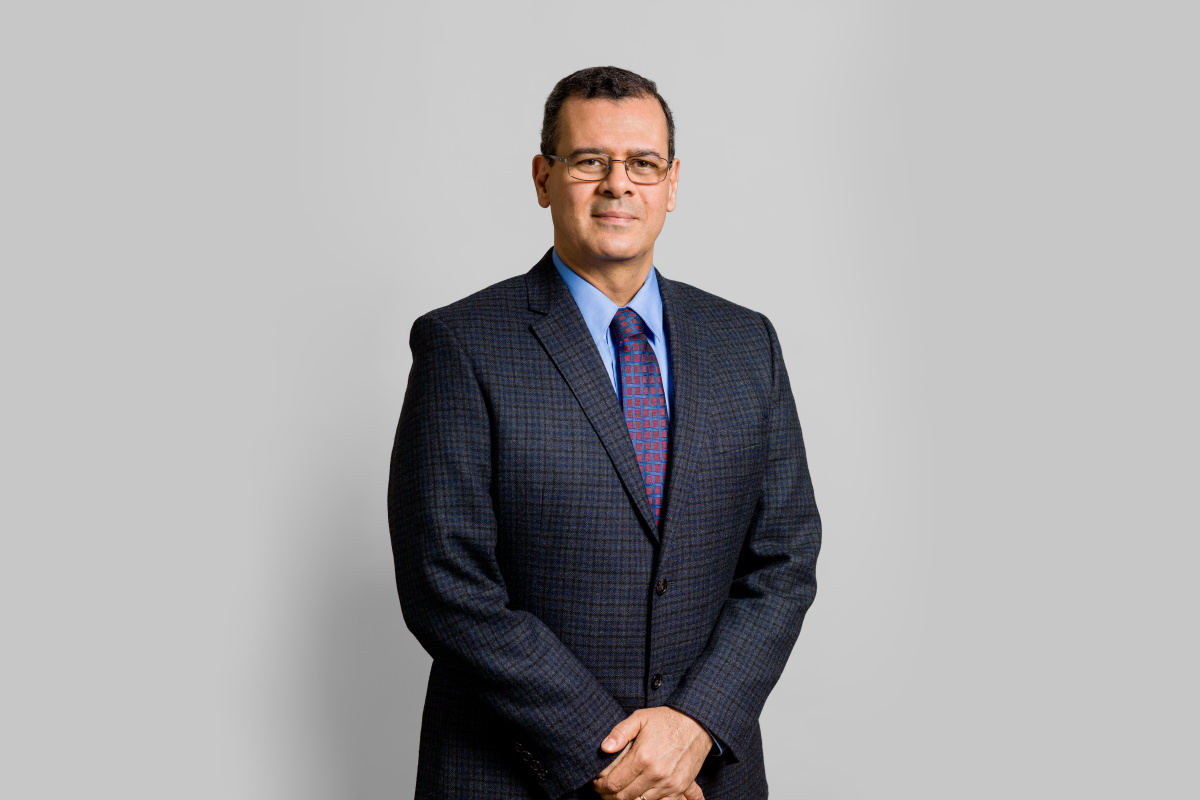
Dr. Daniel Valderas Gázquez is an Associate Professor and Research Scientist at Tecnun School of Engineering, University of Navarra. He holds a PhD in Electrical Engineering from the University of Navarra (2006) and has been actively involved in research projects related to antennas and electromagnetics, with expertise in electromagnetic simulation. Education: PhD (2006) and MSc (1998) from Tecnun School of Engineering, University of Navarra Research Interests: Focus on Ultra-Wideband (UWB) antennas, RFID systems, implanted antennas, wireless chipless sensors, Frequency Selective Surfaces, and radar technologies. His work bridges theoretical and applied electromagnetics. Collaborations: Maintains partnerships with MIT Auto-ID Lab and MIT City Science Lab, with visiting researcher appointments at Imperial College (2007), Queen Mary University of London (2008), and MIT (2022).
Nicolas Constantin is a Professor in the Department of Electrical Engineering at École de technologie supérieure (ÉTS), Université du Québec, where he teaches courses including Electrical Circuits (ELE105) and Analog Microelectronics (SYS811). His research focuses on analog and RF microelectronics, microwave circuits, and wireless communications, with specific expertise in RF transmitters and receivers, test methods for analog and RF circuits, and power integrity in high-speed switching systems. His educational background includes: B.Eng. from École de technologie supérieure (ÉTS) M.Sc.A. from Polytechnique Montréal Ph.D. from McGill University Dr. Constantin's research spans multiple domains within electrical engineering, with a consistent focus on improving the linearity and efficiency of RF power amplifiers through innovative techniques like positive envelope feedback. His work bridges fundamental circuit design with practical applications in wireless communications, aerospace systems, and power electronics. Recent research has expanded into GHz-range power integrity modeling for switch-mode converters, millimeter-wave identification systems, and integrated solutions for avionic applications, demonstrating both depth and evolution in his technical contributions. Analyzing his publication record from 1995 to 2025 reveals a clear progression from fundamental device characterization to sophisticated integrated system solutions. Early work focused on GaAs FET behavior and nonlinear analysis of power amplifiers, while more recent publications address system-level challenges in power integrity, millimeter-wave identification, and aerospace electronics. A consistent thread throughout his career has been the development of envelope feedback techniques for RF power amplifiers, which has resulted in multiple patents and continues to drive innovation in wireless communication systems. Dr. Constantin has actively supervised numerous graduate students through doctoral and Master's research projects. His students have explored topics including positive envelope feedback techniques, power integrity in SiP implementations, millimeter-wave antenna systems, and integrated control circuits for aerospace applications. His supervision spans both theoretical analysis and practical implementation, preparing students for careers in both industry and academia. As a key member of the LACIME (Communications and Microelectronic Integration Laboratory) at ÉTS, Dr. Constantin contributes to a research environment that spans from functional materials to communication protocols. The laboratory's multidisciplinary approach enables innovative solutions in micro- and nanofabrication, integrated circuit design, and photonic systems, with strong industry partnerships that facilitate technology transfer and real-world application of research findings.
Michael Amon is an Adjunct Professor at the University of San Diego School of Law, specializing in intellectual property law and patent litigation. He holds a JD (2002), MA (2001), and BS (1995) from institutions including the University of San Diego and Trinity University. Education: JD, 2002, University of San Diego MA, 2001, University of San Diego BS, 1995, Trinity University His professional experience includes clerking for federal judges and working as a patent litigator at Fish & Richardson P.C., focusing on cases involving computer technology, RFID, medical devices, and chemical compositions. He emphasizes hands-on legal practice, including discovery, trial, and claim construction. Research interests revolve around the intersection of law and technology, particularly in patent disputes and intellectual property frameworks. His expertise spans both legal theory and practical litigation strategies. Professor Amon is a member of the J. Clifford Wallace American Inn of Court and the American Bar Association, reflecting his commitment to legal excellence.
Nikola Vlahović, PhD is a Full Professor at the Department of Informatics , Faculty of Economics and Business, University of Zagreb. His work bridges informatics with business applications, focusing on data-driven decision making and digital transformation. University: University of Zagreb School: Faculty of Economics and Business Department: Informatics Academic Rank: Professor Email: nvlahovic@efzg.hr Research Focus Vlahović’s research spans information systems , process mining , and emerging technologies in business . His work emphasizes: Application of machine learning (e.g., Kohonen maps) to financial fraud detection Integration of blockchain into e-government frameworks Development of semantic analysis tools for website benchmarking Exploration of mobile-assisted learning and NLP in education Recent articles highlight his contributions to smart city technologies , retail innovation , and quality assurance in digital interfaces.
Dr. Viswanath Venkatesh is a Professor and Verizon Chair of Business Information Technology at the Pamplin College of Business, Virginia Tech , with affiliate faculty status at Virginia Tech India . He has directed the part-time Executive PhD Program and led curriculum redesigns in Information Systems programs at multiple institutions. PhD from University of Minnesota Over $10M research funding from NSF, DOT, and others Collaborations across 11+ countries in technology diffusion studies His research spans technology adoption theory (original work on TAM/UTAUT), enterprise system impacts , healthcare IT , and digital poverty alleviation . Recent work examines deviant technology use , AI adoption , and cyberdeviance through mixed-method designs integrating qualitative and quantitative approaches. Key article trends reveal: Focus on affordance theory and polynomial modeling Integration of machine learning with behavioral analytics Global scope across China, India, Malaysia, and US Methodological innovation in multimethod research and longitudinal field studies His students lead research in: Blockchain for financial inclusion (India) Agile software development impacts (2015-2021) Cross-cultural privacy perceptions (Malaysia field studies)
Dr Michael Crisp is a Fellow of Downing College and a University Associate Professor in the Department of Engineering at the University of Cambridge. He also holds a 5-year fixed-term lectureship in Photonics and RF Systems. Education: MEng from Downing College, University of Cambridge PhD from Downing College, University of Cambridge Research Interests: Dr Crisp's work spans optical and RF systems, focusing on analog radio signal distribution via optical fibers within buildings. His current research explores RF power delivery for next-generation batteryless sensors, building on prior innovations in RFID technology. Scientific Awards: Royal Academy of Engineering Young Entrepreneurs Award (2011) Additional Contributions: He co-founded the spin-out company PervasID and maintains personal interests in windsurfing and yachting.
Hans-Erik Nilsson is a Professor at Mid Sweden University's Department of Engineering, Mathematics and Science Education (IMD). He serves as Vice-Rector for Innovation and Industry Collaboration, and is affiliated with research centers FSCN and STC. His work spans multiple disciplines including fiber optics , sensor technology , and nanoelectronics . Core Research Areas: Fiber Optic Sensors, Smart Packaging, Printed Electronics, Semiconductor Physics Projects: IRS TransTech (International Research School in Transformative Technology), Syspack (System Integration of Intelligent Packaging) Research articles focus on UV radiation hardness , silver nanoparticle inks , and RFID sensor systems . Recent publications explore quasi-continuous wave fiber amplifiers and bio-compatible pH sensors . His work includes 12 patents and 62 conference papers . Key Technologies: Fiber Bragg Grating filters, Evanescent wave sensing, Monte Carlo simulation of carrier transport Application Areas: Industrial sensing, Medical diagnostics, Forest fire monitoring, Flexible electronics
Eugenio Zimeo is a Full Professor at the Department of Engineering, University of Sannio, Benevento, where he teaches Networked Systems Programming and Distributed Software Architectures and Systems . He holds a PhD in Computer Science and Electronic Engineering from the University of Naples and has been a central figure in distributed systems research and education. Department of Engineering, University of Sannio (Current) Member, CerICT (Regional ICT Center) Coordinator, CINI Laboratory on Smart Cities and Communities (University of Sannio node) National Coordinator, CINI Focus Group on eGovernment and eInclusion Director, Local Research Unit, University of Sannio (TEMOTEC, PRIN projects) General Chair, I-CiTies 2016 Conference His research interests span software architectures, middleware, cloud and grid computing, autonomic systems, smart cities, IoT, microservices, and service-oriented computing . He has contributed to frameworks for mobile agents, microservices synchronization, and resilient smart city platforms. Zimeo has authored approximately 100 scientific publications, including journal articles and conference papers, with recent work focusing on microservices, distributed tracing, and smart city resilience . His publications show a strong trend toward modern distributed systems, leveraging cloud, fog, and IoT paradigms for urban applications and software engineering innovation. He has received several best paper awards in recognition of his scholarly contributions. Co-organizer, Boosting Services and Information in Adaptive Networked Enterprises (2008) General Chair, I-CiTies 2016 Scientific Responsible, TEMOTEC, OpenGoals, MyOpenGov, PRIN GAUSS and IDEAS projects Reviewer, IEEE Transactions on Software Engineering, ACM Transactions on Software Engineering and Methodology, and other leading journals Zimeo has supervised approximately 200 master's theses and served as tutor or co-tutor for 10 doctoral students . He has led significant research grants, including PRIN GAUSS (2017–present), IDEAS (2014–2017), TEMOTEC (2014–2016), and European project Qualipso (2010–2011), focusing on software quality and open-source platforms. He coordinates the University of Sannio’s node in the CINI National Laboratory on Smart Cities and Communities and leads the associated eGovernment and eInclusion focus group. His research unit develops platforms like PROMENADE for real-time IoT traffic monitoring in smart cities, integrating microservices and DevOps practices.
Jan H.S. Bergman is a Doctoral Researcher at Aalto University's Department of Electronics and Nanoengineering, actively contributing to the Ville Viikari Group. His work bridges theoretical antenna design with practical implementation for next-generation wireless systems. Research interests span Antenna Design , Millimeter-wave Systems , and Wireless Communications , with specialized focus on Ka/E-band arrays, wearable device integration, and RFID solutions. Bergman addresses critical challenges like metallic-structure compatibility for smartwatches and scan-range limitations in high-frequency arrays through innovations such as parasitic resonators and 3D-printed metallic elements. Analysis of his 2024-2025 publications reveals a cohesive trajectory toward compact, high-performance RF solutions for 5G/6G and IoT. Key themes include millimeter-wave beamforming techniques, optimization of yield-critical microwave devices using swarm intelligence, and novel coupling mechanisms for chip-antenna integration—demonstrating both theoretical depth and hardware validation. As an early-career researcher, Bergman participates in collaborative projects within Aalto's wireless ecosystem but does not oversee student supervision. His work leverages university resources for advanced prototyping and measurement, including waveguide simulators and millimeter-wave testbeds. The Ville Viikari Group provides a dynamic environment for antenna innovation, where Bergman contributes to cutting-edge developments in array architectures and wearable RF systems through hands-on experimentation and cross-disciplinary teamwork.
Jo Helle-Valle is a Professor at the Faculty of Teacher Education and International Studies within Oslo Metropolitan University, specifically in the Department of International Studies and Interpreting Education . Their research focuses on Development studies , Social Anthropology , and Media Practices in Africa . Key research areas include Globalization , Gender and ICT , Qualitative Methods , and Ethnographic Fieldwork . They lead the research group Development, Power and Inequality (UMU) and have contributed to projects like HOME RISK , analyzing household dependency on electricity and ICT, and New Media Practices in a Changing Africa , exploring digital integration in African societies. Research spans 2003-2023 , with publications addressing Media Domestication , Digital Vulnerability , and Gender Discourse on Social Media . Notable works include Domestication Theory: Reflections from the Kalahari (2023) and Media Practices and Changing African Socialities (2020). Their projects highlight household dependency on digital infrastructure and social mechanisms driving media adoption in African contexts. Current affiliations include OsloMet, where they contribute to research on digitalization and development studies .
Katayoun Eshkofti is a Postdoctoral Fellow in the Division of Decision and Control Systems at KTH Royal Institute of Technology, joining in June 2024 under supervisors Matthieu Barreau and Henrik Sandberg. Her research bridges machine learning and engineering physics, focusing on predictive maintenance and physics-informed neural networks (PINNs). Education: PhD in Industrial Engineering, specializing in PINNs for coupled PDEs in mechanical systems. Research Interests: Physics-informed machine learning, thermoelasticity, non-Fickian diffusion, and reliability analysis of complex systems. Recent Projects: Developed gradient-enhanced PINNs (gPINNs) for hyperbolic systems, shock-induced thermoelasticity, and non-Fourierian heat transfer in porous materials. Publications: Available via Google Scholar , including presentations at Brown University's CRUNCH seminar.
Bardo Fraunholz is an Associate Professor and Associate Dean for International and Partnerships at Deakin University's Faculty of Business and Law, where he leads the Department of Information Systems and Business Analytics. He directs Postgraduate Programs and teaches Project Management and Information Systems capstone units. His academic background includes a BA/MA in Accounting (University of Trier), postgraduate law diplomas (University of Westminster), and a PhD in Information Systems (Deakin University). Research interests span: Digital Transformation : Enterprise architecture, process optimization, and technology adoption frameworks Education Innovation : Internationalization strategies, curriculum design, and equity in higher education Sustainability & Governance : CSR communication, e-governance models, and stakeholder engagement in SMEs Publications (2010-2025) show evolving focus from SME digitalization/CSR toward international education frameworks and systemic digital transformation, utilizing mixed-methods approaches including network analysis and capability modeling. Awards include: Best Paper Awards at ICEG 2006 and CollECTer 2006 Faculty Teaching Excellence Award (2009) Supervision highlights: Doctoral advisee Kathryn Harries (2024) Master's advisee Merete Crofts (2009) Secured $374,175 in grants for Vietnam-Australia digital education partnerships and SME consumer behavior studies. Leadership roles include founding IS:Link (student mobility network) and university director for Career Education, with collaborations across Germany, UK, and Australia.
Michele Scaraggi is an Associate Professor at the Department of Innovation Engineering , University of Salento , Italy. He leads the Advanced BioInterface Technologies Lab and Advanced Driving to X Simulation Lab , a joint lab with Porsche Engineering. His work bridges tribology , contact mechanics , and bio-inspired robotics . Education: PhD in Bio-Mechanical and Mechanical Design (Politecnico di Bari, 2009); MS and BS in Mechanical Engineering (Politecnico di Bari, 2006 and 2004). Research Interests: Tribology: Friction, adhesion, and lubrication in dry/wet contacts. Soft Robotics: Microbots, smart actuators, and bio-inspired designs. Computational Mechanics: Multiscale modeling of hierarchical surfaces. Biomechanics: Applications to seals, tire/road interactions, and biomedical devices. Projects: ELFIN: Electroactive grippers for micro-object manipulation. TRIBOSCORE: Tribological modeling for sustainable industrial interfaces. BRILLIANCE: RFID-enhanced tactile rehabilitation technologies. Scientific Awards: AIMETA Junior Researcher Award (2017). Multiple COST grants for collaborative research in Germany. FFABR 2017 Grant for basic research funding. Teaching: Applied Mechanics (BS Industrial Engineering). Vehicle Mechanics (MS Mechanical Engineering). Fluid Dynamics (MS Aerospace Engineering). Doctoral course: Fundamentals of Adhesion. Collaborations: Imperial College London, IIT Italy, FZ-Jülich, SKF, Freudenberg, and others.
Marian VLĂDESCU serves as Associate Professor and Director of the Department of Electronic Technology and Reliability at Politehnica University of Bucharest's Faculty of Electronics, Telecommunications and Information Technology since 2016, while concurrently directing the university's Optoelectronics Research Center (UPB-CCO). His institutional base operates from Building A (LEU), Room A201/A203. His research spans Optoelectronics and Telecommunications Networks with specialized expertise in GPON/IP-TV (Electromagnetica Goldstar), ADSL/ATM (LG Korea), and SDH (ECI Telecom) systems. Core technical capabilities include electronic/optoelectronic circuit simulation (PSpice, OptiSPICE) and computer-aided design (OrCAD, GerbTool). Emerging focus areas encompass Quantum Technologies through QUTECH-RO, Sensor Systems for medical/security applications, and Internet of Things infrastructure development. Professional engagements include IEEE membership across nine specialized societies (Photonics, Electronics Packaging, Electron Devices, Sensors, Nanotechnology, Electronic Design Automation, Biometrics, Systems, Superconductivity, RFID) plus SPIE affiliation. Current project leadership includes NETIO (IoT ecosystem development, 2016-2020) and quantum technology component projects under QUTECH-RO (2018-2021), alongside historical contributions to THz-DETECT (hazardous substance identification), AMI-DETECT (cardiac diagnostics biosensors), and VIPRO Platform (rescue robotics). Research Leadership: Technical lead for NETIO project (ID 40270, 2016-2020): IoT product/service ecosystem development Component project lead for QUTECH-RO (PN-III-P1-1.2-PCCDI-2017-0338, 2018-2021): Quantum technology research laboratories Research team member for THz-DETECT (2014), AMI-DETECT (2014-2015), VIPRO Platform (2014-2017) Expert roles in PRACSIS (information security careers) and television professional development projects Ongoing academic contributions include organizing the 2025 Student Scientific Communications Session and participating in SIITME 2024 symposium, reflecting continued active engagement in scholarly community building.
George N. Karystinos is a Professor at the School of Electrical and Computer Engineering , Technical University of Crete , where he has served since 2005. Since 2021, he also holds the position of Dean of the School. Previously, he was an Assistant Professor at Wright State University (2003–2005). Education: Ph.D. in Electrical Engineering, State University of New York at Buffalo , 2003 Diploma in Computer Engineering and Science, University of Patras , 1997 Additional studies in Piano, National Conservatory of Athens and State University of New York at Buffalo Research Interests: His research spans telecommunications theory and systems , coding theory , adaptive signal processing , wireless communications , MIMO systems , neural networks , and optimization with limited data . He is particularly known for contributions to L1-norm PCA , noncoherent detection , RFID systems , and code design for CDMA . Scientific Awards: IEEE Transactions on Neural Networks Outstanding Paper Award (2003) IEEE ICT Best Paper Award (2001) IEEE ISWCS Best Paper Award (2013) IEEE ICASSP Best Student Paper Award (2015) IEEE RFID-TA Second Best Student Paper Award (2011) IEEE MOCAST Best Student Paper Award (2018) Laboratory and Teaching: He leads research at the Telecommunications Laboratory and teaches courses such as Signals and Systems , Information and Code Theory , and Probability and Random Process Theory . Grants and Projects: While specific grant details are not listed, his extensive publication record and award history indicate active participation in funded research projects, particularly in wireless communications and signal processing.