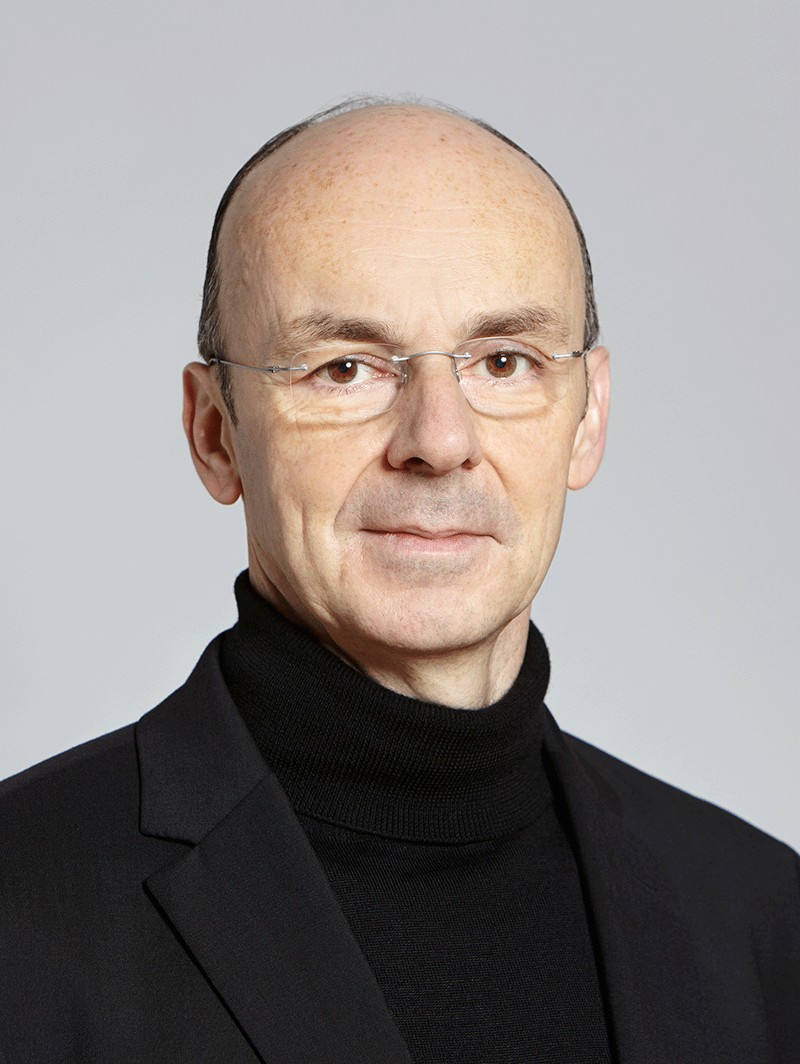
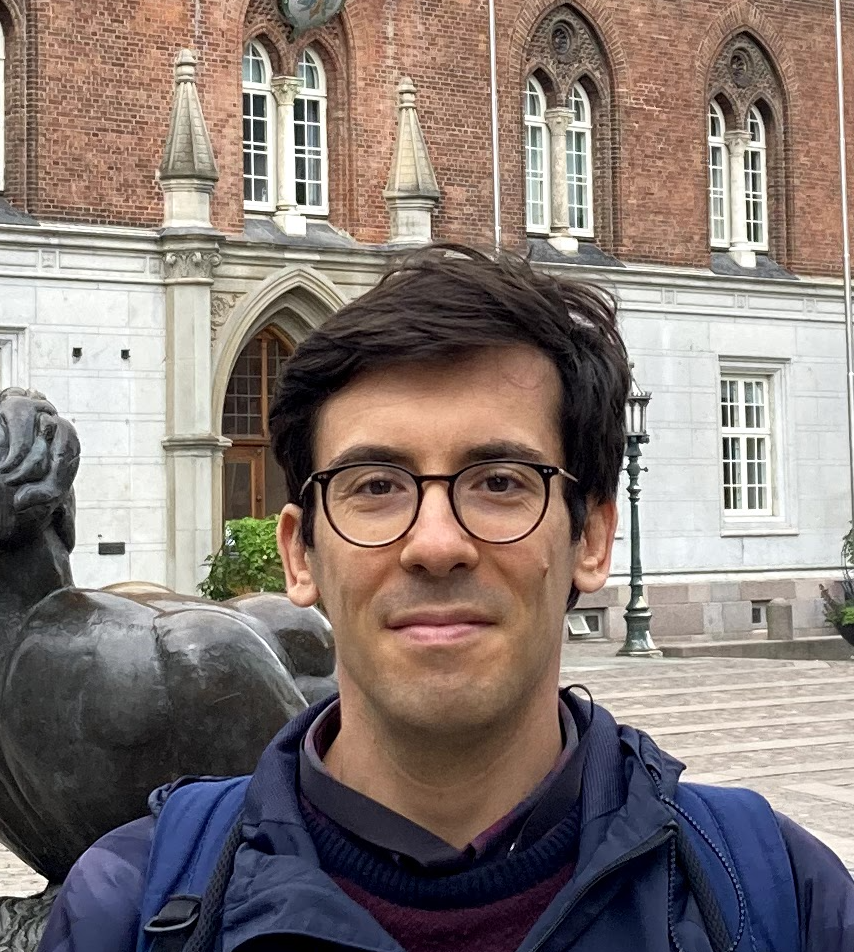
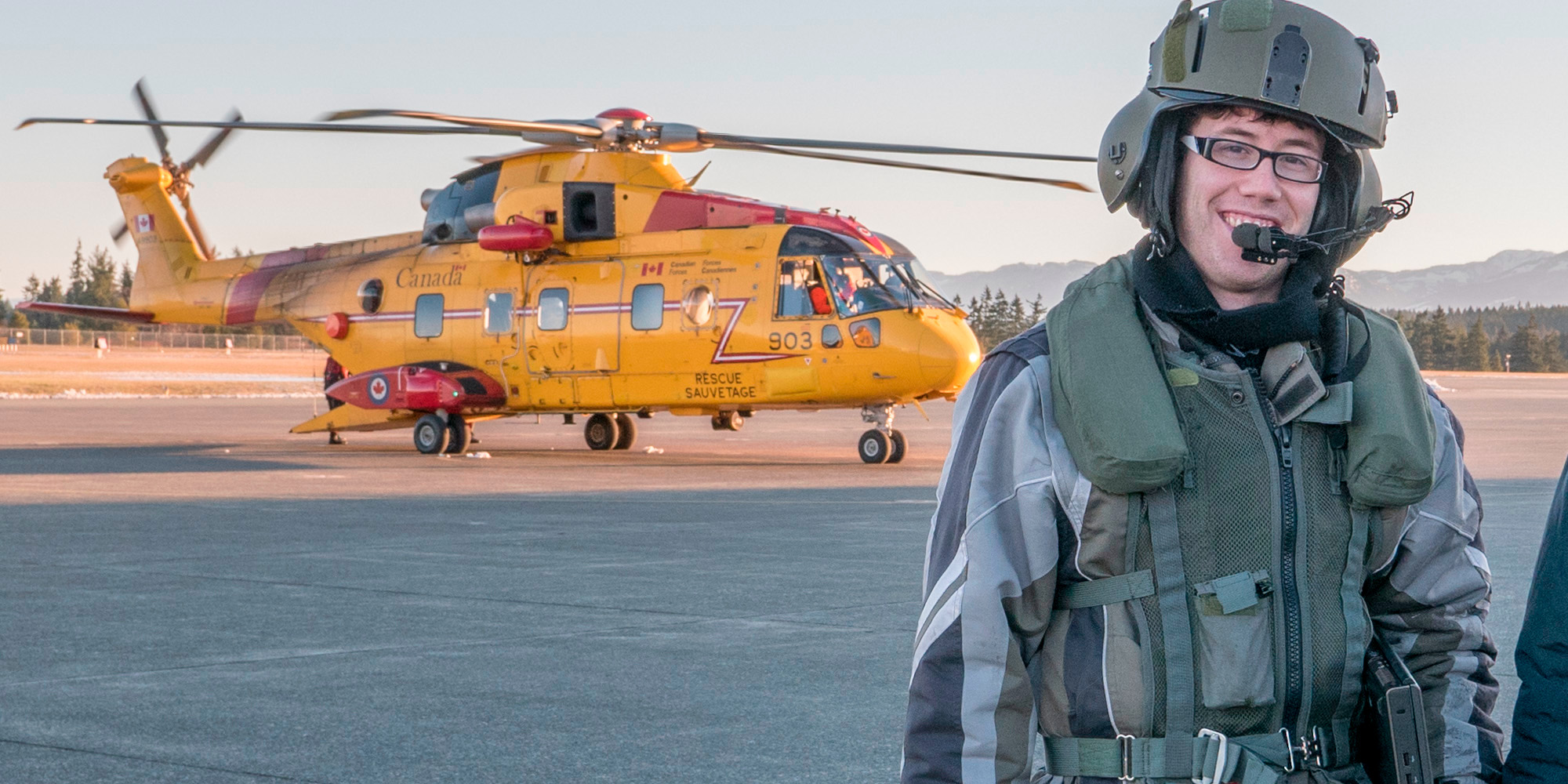
Prof. Olga Sorkine Hornung is a Full Professor of Computer Science at ETH Zürich, leading the Interactive Geometry Lab. She holds a BSc and PhD from Tel Aviv University (2000 and 2006) and conducted postdoctoral research at Technical University Berlin. Her research focuses on computer graphics, geometric modeling, and geometry processing, with applications in shape editing, digital fabrication, and animation. She has received numerous accolades, including the ACM Fellowship (2020), ERC Consolidator Grant (2020), and the Golden Owl Teaching Award (2021). Her work bridges theoretical foundations and practical algorithms, addressing challenges in parameterization, surface compression, and interactive design tools. Her research interests span: Computer Graphics & Visualization Geometric Modeling & Processing 3D Content Creation & Digital Fabrication Garment Design & Simulation Human Motion Analysis & Animation Awards and grants include: 2024: Best Paper Honorable Mention (EUROGRAPHICS) 2023: Member of Swiss Academy of Engineering Sciences (SATW) 2020: ERC Consolidator Grant 2017: Rössler Prize (ETH Zurich) Her lab focuses on developing novel methods for interactive geometry processing, with recent advancements in garment modeling (e.g., AIpparel, Rags2Riches) and motion retargeting systems like WalkTheDog. She actively collaborates on interdisciplinary projects, including biomedical applications and sustainable fashion technology.
Ali H. Sayed is the Dean of the School of Engineering (Faculté des sciences et techniques de l'ingénieur - STI) at École Polytechnique Fédérale de Lausanne (EPFL), Switzerland, where he also directs the Adaptive Systems Laboratory (Laboratoire de systèmes adaptatifs). Previously, he served as an emeritus professor and chair of the Electrical Engineering Department at UCLA. He is a highly cited researcher and a member of the US National Academy of Engineering and the World Academy of Sciences. Sayed served as president of the IEEE Signal Processing Society in 2018 and 2019. Professor Sayed's research focuses on adaptation and learning theories, data and network sciences, statistical inference, multi-agent systems, adaptive networks, and optimization. His work bridges theoretical foundations with practical applications in signal processing, machine learning, and network science. He has made significant contributions to distributed learning algorithms, social learning over networks, and adaptive signal processing techniques that have influenced both academic research and practical implementations. His recent publications demonstrate a strong focus on multi-agent systems, distributed learning, privacy-preserving techniques, and social learning over networks. The research trends show increasing emphasis on federated learning with privacy guarantees, graph-based learning approaches, and the intersection of social dynamics with information processing. His work consistently addresses fundamental theoretical questions while maintaining relevance to practical applications in communication networks, social media analysis, and distributed artificial intelligence systems. Professor Sayed has received numerous prestigious awards throughout his career, including: IEEE Fourier Award (2022) Norbert Wiener Society Award (2020) IEEE Signal Processing Society Education Award (2015) Papoulis Award from the European Association for Signal Processing (2014) Technical Achievement Award from IEEE Signal Processing Society (2012) Terman Award from the American Society for Engineering Education (2005) IEEE Donald G. Fink Prize (1996) Multiple Best Paper Awards from IEEE and EURASIP Sayed has authored or co-authored over 570 publications and six monographs. He has mentored numerous PhD students and researchers in the fields of signal processing and adaptive systems. His editorial leadership includes serving as Editor-in-Chief of IEEE Transactions on Signal Processing (2003-2005) and EURASIP Journal on Advances in Signal Processing (2006-2007), as well as Founding Editor-in-Chief of the Open Access Book Series on Information and Learning Sciences. At EPFL, Professor Sayed leads the Adaptive Systems Laboratory, which focuses on developing theoretical frameworks and practical algorithms for adaptive systems, networked learning, and distributed signal processing. The lab's research encompasses both fundamental theoretical investigations and applications to real-world problems in communications, social networks, and computational biology.
Can Firtina is a Lecturer at ETH Zurich's Department of Information Technology and Electrical Engineering and a Senior Researcher in the SAFARI Research Group. His research focuses on accelerating genome analysis through algorithm-architecture co-design, particularly leveraging hardware-software integration for bioinformatics workloads. He holds a PhD in Electrical and Computer Engineering from ETH Zurich and degrees from Bilkent University. As of Fall 2025, he will join the University of Maryland, College Park (UMD) as an Assistant Professor of Computer Science. Education: PhD in Electrical and Computer Engineering (D-ITET), ETH Zurich MSc in Computer Engineering, Bilkent University BSc in Computer Engineering, Bilkent University Research Interests: His work bridges bioinformatics and computer architecture, emphasizing real-time, accurate, and energy-efficient genome analysis. Key areas include raw nanopore signal processing (e.g., RawHash, Rawsamble), hardware-software co-design for bioinformatics, and scalable metagenomic analysis. His algorithms address noise mitigation and accelerate applications like assembly polishing (Apollo) and alignment remapping (AirLift). Labs & Collaborations: He leads research within the SAFARI Group, collaborating with institutions like NVIDIA, AMD, and Huawei. His contributions span tools like GenASM (approximate string matching) and BLEND (fuzzy seed matching). He also organizes workshops on bioinformatics acceleration and serves on review boards for venues like ISMB and RECOMB. Future Directions: Future work includes end-to-end raw signal analysis without basecalling, reference-free genome assembly, and leveraging emerging hardware for real-time field applications. He will expand these efforts at UMD, hiring students in Fall 2025.
Nikita Kavokine serves as Tenure Track Assistant Professor at École Polytechnique Fédérale de Lausanne (EPFL) within the School of Basic Sciences . His dual appointments span the Institute of Chemical Sciences and Engineering (ISIC) and the School of Chemical Sciences and Engineering (SCGC) , where he leads the Quantum Plumbing Lab (LNQ) and contributes to graduate teaching. Based at Building CH A2 398 in Lausanne, he maintains active research and instructional roles across EPFL's chemistry and chemical engineering programs. His research pioneers quantum nanofluidics and nanoscale transport phenomena , focusing on electron-ion coupling mechanisms in confined geometries. Key investigations include quantum friction in water-carbon interfaces, hydroelectric energy conversion through nanochannels, and plasmon-hydron resonances in two-dimensional materials. His work bridges condensed matter physics, electrochemistry, and fluid dynamics to develop fundamental principles for next-generation nanofluidic devices and quantum sensors. Analysis of his 15 most recent publications (2023-2025) reveals three dominant research thrusts: quantum-enhanced energy conversion (evident in hydroelectric drag and electron cooling studies), non-classical ion transport (including ionic Coulomb blockade and interaction confinement), and emergent quantum hydrodynamics (momentum tunneling, collective modes). These publications consistently integrate advanced numerical methods with nanoscale experimental systems, establishing new paradigms for solid-liquid quantum interactions. Kavokine currently supervises three PhD students: Gispert Peter , Lu Hao , and Rigaux Killian David . His teaching portfolio includes graduate courses in Statistical Mechanics for Chemistry and Nanofluidics , emphasizing theoretical frameworks for many-particle systems and nanoscale fluid dynamics. Research funding supports his laboratory's exploration of quantum effects in nanofluidic channels, though specific grant details are not provided in source materials. The Quantum Plumbing Lab (LNQ) operates at the forefront of nanoscale quantum transport research, utilizing advanced nanofabrication and characterization techniques to probe electron-ion coupling phenomena. The lab's interdisciplinary team combines expertise in quantum physics, electrochemistry, and fluid dynamics to investigate fundamental limits of energy conversion and transport at atomic scales, with particular focus on graphene-based systems and angstrom-scale confinement.
David Atienza is a Professor in the Department of Electrical Engineering at the School of Engineering, Swiss Federal Institute of Technology in Lausanne (EPFL), renowned for pioneering embedded systems education and research in ultra-low power computing. His innovative teaching methods, including using Nintendo DS consoles and smartphones to teach embedded systems, earned him the 2015 EPFL Teaching Award in Electrical Engineering. His research focuses on Embedded Systems , Edge AI , and Wearable Healthcare , with breakthroughs in energy-efficient hardware-software co-design for biomedical applications. Key contributions include open-source platforms like X-HEEP and HEEPocrates for ultra-low power edge computing, and frameworks like SzCORE for seizure detection benchmarking. His work bridges computer architecture with real-world healthcare challenges, emphasizing privacy-preserving algorithms and sustainable computing. Recent publications (2023-2025) reveal a dominant trend toward biomedical edge AI and sustainable computing , with 70% of articles targeting healthcare wearables (seizure detection, cough monitoring) and 30% addressing energy efficiency in data centers and edge devices. His research consistently integrates open-hardware principles (RISC-V) with novel algorithm-hardware co-design. Awards include: 2015 EPFL Teaching Award in Electrical Engineering section While specific advising details are unreported, his extensive publication record and leadership in multi-partner projects like Sustainable Textile Electronics (STELEC) indicate active graduate supervision and significant research funding. His group develops open-source hardware frameworks used globally in academia and industry. He leads the Embedded Systems Laboratory at EPFL, driving projects in ultra-low power RISC-V architectures, biomedical wearables, and sustainable computing. Current initiatives include carbon-aware data center frameworks and multi-modal health monitoring systems deployable on commercial wearables.
Laurent Condat is a Senior Research Scientist at King Abdullah University of Science and Technology (KAUST) in Saudi Arabia, where he conducts research in optimization algorithms and their applications. He is affiliated with the College of Engineering, Department of Computer Science, and has previously held research positions at CNRS in France, working at GREYC in Caen and GIPSA-Lab in Grenoble. Dr. Condat received his PhD in 2006 from Grenoble Institute of Technology, followed by a 2-year postdoc in Munich, Germany. He was recruited as a permanent researcher by CNRS in 2008 and has been on leave from CNRS since November 2019 to work at KAUST. In February 2025, he was promoted to 'chargé de recherche hors classe' (senior research scientist) by CNRS. His research focuses on deterministic and stochastic optimization algorithms, convex relaxations, and applications to machine learning, signal and image processing. His work spans theoretical foundations of optimization methods to practical implementations for distributed and federated learning systems. He has developed several influential algorithms including RandProx, TAMUNA, and LoCoDL that address communication efficiency in distributed optimization. His recent publications demonstrate strong trends in communication-efficient distributed optimization, with particular emphasis on federated learning, compression techniques, and local training methods. His work bridges theoretical optimization with practical machine learning applications, showing consistent innovation in algorithmic design for large-scale problems. Best reviewer award at AISTATS 2025 Meritorious Service Award from Mathematical Programming Stanford's list of world's top 2% most influential scientists Dr. Condat has co-supervised PhD students including Daniele Picone and Julien Baderot. He serves as an Associate Editor for IEEE Transactions on Signal Processing and has presented his work at numerous international conferences including plenary talks at major optimization workshops. His research is supported through KAUST funding and collaborative projects with researchers worldwide.
Saleh Ashkboos is a Ph.D. student in the Computer Science Department at ETH Zurich, advised by Professors Torsten Hoefler and Dan Alistarh. He is also a Research Assistant at the Scalable Parallel Computing Lab and an affiliated doctoral student of the ETH AI Center. His research focuses on accelerating deep neural network training and developing systems for large-scale graph processing. Prior to ETH Zurich, he earned his Master's degree in Computer Science from Sharif University of Technology, advised by Professor Amir Daneshgar. His work has led to notable contributions, including the best paper award at SC22 for 'ProbGraph.' Recent research emphasizes efficient LLM training and quantization techniques, with publications on topics like 4-bit inference, quantization-aware training frameworks, and scalable meteorological modeling. He has interned at Apple and Microsoft, and his work is accessible via Google Scholar and GitHub. Key projects include GPTQ (post-training quantization for transformers), SliceGPT (LLM compression), and ProbGraph (high-performance graph mining). His technical contributions span distributed systems, neural network optimization, and climate-related machine learning.
Feiran Zhao is a Researcher at the Institute of Automatic Control, part of the Department of Mechanical and Process Engineering at ETH Zürich. He holds a B.S. in Control Science and Engineering from Harbin Institute of Technology (2018) and a Ph.D. from Tsinghua University (2024). His research focuses on data-driven control, adaptive control, reinforcement learning, and their applications in engineering systems. Zhao is currently a postdoc under Prof. Florian Dorfler at ETH's Automatic Control Lab. Research interests span topics like policy optimization for LQR systems, quantized feedback control, and model predictive control acceleration. His work bridges machine learning and classical control theory, with applications in robotics, power systems, and aerospace engineering. His publications (2019–2025) explore theoretical foundations of policy gradient methods, convergence analysis, and practical implementations in autonomous systems. Though no awards are explicitly listed, his active research in high-impact areas suggests potential recognition. As part of the Automatic Control Lab, Zhao collaborates on projects involving data-enabled control strategies and real-world system applications. No student advisees are currently listed.
Prof. Dr. Helmut Bölcskei is a Full Professor of Mathematical Information Science at ETH Zurich's Department of Information Technology and Electrical Engineering. He holds a joint affiliation with the Department of Mathematics. His academic journey includes a Dipl.-Ing. and Dr. techn. from Vienna University of Technology, followed by postdoctoral research at Stanford University and industry roles at Iospan Wireless and Celestrius AG. He has been at ETH Zurich since 2002, contributing to applied mathematics, machine learning theory, signal processing, and statistics. Education : 1994: Dipl.-Ing., Vienna University of Technology 1997: Dr. techn., Vienna University of Technology Industry Experience : Co-founder of Iospan Wireless (acquired by Intel) and Celestrius AG His research focuses on applied mathematics , machine learning theory , and data science , with emphasis on neural network approximation, metric entropy, and signal processing. Recent work explores theoretical limits of deep learning and nonlinear system identification. His publications highlight advancements in quantization, compression, and system complexity analysis. Prof. Bölcskei has received numerous accolades, including IEEE Fellow status, the 2010 Vodafone Innovations Award, and the ETH 'Golden Owl' Teaching Award. He served as Editor-in-Chief of the IEEE Transactions on Information Theory (2010–2013) and has held editorial roles in multiple journals. His leadership includes roles on the Board of Governors of the IEEE Information Theory Society and as a delegate for faculty appointments at ETH Zurich. Labs/Teams : Mathematical Information Science Group at ETH Zurich's Department of Information Technology and Electrical Engineering
Prof. Dr. Aurelien Lucchi is an Assistant Professor in the Department of Mathematics and Computer Science at the University of Basel, Faculty of Science. His research group focuses on the intersection of optimization and machine learning, particularly in advancing theoretical understanding and algorithmic design for deep learning systems. His research interests include: Stochastic and non-convex optimization Deep learning theory and generalization Kernel methods and spectral analysis Transformer architectures and training dynamics Batch Normalization and initialization effects Modeling optimization via stochastic differential equations (SDEs) The recent publications (2023–2025) highlight a strong focus on theoretical machine learning, especially in characterizing optimization landscapes, generalization in kernel methods, and the role of noise and adaptive methods in training. There is a clear trend toward using advanced mathematical tools—such as random matrix theory, SDEs, and curvature analysis—to explain phenomena in deep learning. His group actively publishes in top venues including NeurIPS, ICML, ICLR, and AISTATS. Scientific awards and recognitions include: SNF Consolidator Grant (1.7M CHF) Prof. Lucchi leads an active research group with postdoctoral fellows and ongoing projects, including work on quantum machine learning and noise-adaptive optimization. He has secured competitive research funding and mentors early-career researchers. His group has received recent paper acceptances at ICLR 2025, AISTATS 2025 (oral), and NeurIPS 2024, indicating strong momentum in theoretical and algorithmic machine learning. He previously held a scientific research position at ETH Zurich (2014–2021) and earned his PhD from EPFL. The group is currently involved in two major ongoing projects: Designing and Training Hybrid Hierarchical Quantum Neural Networks with Quantum Advantage Noise-Adaptive Optimization Methods and their Robustness Properties
Melih Kandemir is an Associate Professor of Machine Learning at the University of Southern Denmark, Department of Mathematics and Computer Science. He earned his PhD in 2013 from Aalto University under Prof. Samuel Kaski, followed by postdoctoral work at Heidelberg University (with Prof. Fred Hamprecht) and an assistant professorship at Ozyegin University, Turkey. Prior to joining SDU, he led research at Bosch Center for Artificial Intelligence. Education: PhD (Aalto University, 2013), Postdoc (Heidelberg University). Previous Roles: Assistant Professor (Ozyegin University), Research Group Leader (Bosch CAI). His research focuses on Bayesian inference, stochastic process modeling with deep neural networks, and applications to reinforcement learning and continual learning. He leads the SDU Adaptive Intelligence (ADIN) Lab and is an ELLIS Member, reflecting his standing as a top European AI researcher. His work addresses critical challenges in uncertainty quantification, exploration strategies, and theoretically grounded algorithms for decision-making systems. Recent publications highlight expertise in model-based reinforcement learning (e.g., MOMBO for offline RL), PAC-Bayesian bandits, evidential learning for robust classification, and neural stochastic differential equations. His scientific awards include a Best Paper Award (2017) and ELLIS Membership. He also explores interdisciplinary applications of natural sciences to sustainable technology development.
Prof. Dr. Matthias Rosenthal is a Professor of Multiprocessor and Real-Time Systems at the ZHAW School of Engineering, Zurich University of Applied Sciences (ZHAW), where he also serves as Head of the Research/Focus Area Realtime Platforms. He holds a PhD and MSc in Electrical Engineering from ETH Zurich (1993–1997). His research focuses on multiprocessor systems, hybrid multicore architectures, distributed signal processing, embedded GPU computing, and real-time embedded systems. Key projects include In-Flight GNSS Interference Detection, dAIrector (automated multi-camera live production), and novel AFM techniques for industrial quality control. He has led over 15 industry-focused projects, including collaborations with Innosuisse and companies like Harman International. His work emphasizes real-time systems, FPGA-GPU co-design, and embedded AI solutions. Education: PhD (ETH Zurich, 1997), MSc (ETH Zurich, 1993) Awards: CTI Startup Label (2005) Teaching: Lectures on digital systems, real-time computing, and information theory Notable contributions include advancements in embedded machine learning for food waste management, secure boot concepts for Zynq MPSoC, and low-latency wireless video systems. His research bridges theoretical computer engineering with practical industrial applications.
Martin Jaggi is an Associate Professor at EPFL, leading the Machine Learning and Optimization Laboratory (MLO). He holds academic positions within the School of Computer and Communication Sciences (IC), including roles in the SIN, SSC, and EDIC departments. His research focuses on machine learning optimization, federated learning, and large language models. He earned his PhD in Machine Learning and Optimization from ETH Zurich (2011) and a MSc in Mathematics from the same institution. Education: PhD in Machine Learning and Optimization, ETH Zurich (2011) MSc in Mathematics, ETH Zurich Research Interests: Dr. Jaggi's work integrates optimization theory with machine learning applications, emphasizing scalable algorithms and ethical AI. He explores topics like distributed learning systems, privacy-preserving techniques (e.g., federated learning), and model interpretability. His lab develops foundational methods for large language models (LLMs) and their ethical deployment. Teaching & Courses: Optimization for Machine Learning Topics in Machine Learning Systems Advising & Grants: He currently advises 9 PhD students and has supervised 11 past students. His work is supported by grants focusing on federated learning, optimization algorithms, and medical AI applications like Meditron-70b. Collaborations include projects on respiratory disease detection and mental health modeling. Labs & Teams: Academic Director of RCP-GE and oversees MLO lab, which develops open-source tools like FLamby for federated learning benchmarks and Meditron for clinical AI. The lab also advances techniques in distributed optimization and low-precision training.
Andrew Lawrence Price is a Canadian Postdoctoral Researcher currently working at École Polytechnique Fédérale de Lausanne (EPFL) in both the Computer Vision Laboratory (CVLAB) within the School of Computer and Communication Sciences and the Education Services Centre (ESC). He holds a PhD in Spacecraft Robotics from Tohoku University, Japan (2019-2024), an MASc in Flight Research from National Research Council and Carleton University, Canada (2013-2015), and a B.Eng in Aerospace from Carleton University, Canada (2009-2013). Dr. Price's research focuses on the intersection of computer vision, robotics, and space applications. His work addresses critical challenges in spacecraft pose estimation, particularly for resource-constrained systems where computational capacity is limited. He has developed innovative approaches for network quantization in 6D object pose estimation, enabling high-accuracy performance with significantly reduced computational requirements. His research spans both theoretical development and practical implementation, with applications ranging from small satellite operations to asteroid exploration missions like the Hayabusa2 Minerva-II2 deployment. His publication record demonstrates a clear evolution from earlier work in aerospace acoustics and vibration analysis to his current focus on computer vision for space applications. The most recent publications reveal a strong emphasis on solving practical constraints in space missions, particularly addressing bandwidth limitations in spacecraft communications and computational constraints in onboard processing systems. His work bridges multiple disciplines, connecting aerospace engineering with cutting-edge computer vision techniques. Invited Lecturer, SPACEONOVA 2022 AI For Space Workshop Best Presentation Award, CVPR 2021 GP-Mech Exchange Scholarship, Tohoku University 2020 Recipient of the Japan Monbukagakusho MEXT Scholarship, Japan Government 2019 International Institute of Noise Control Engineering: Young Professional Grant, INTERNOISE 2017 Various Departmental and Dean's List Scholarships, Carleton University 2009-2015 As Academic Referent for the EPFL Spacecraft Team (EST), Dr. Price contributes to student-led space projects, providing guidance on technical aspects of spacecraft development. His GitHub repositories demonstrate active engagement with open-source tools for space applications, including the Orbit and Tumble Integrator project. His work spans both academic research and practical implementation, with code repositories showing his commitment to reproducible research and practical tool development for the space community.
Tobias Welti is a Senior Lecturer at the Zurich University of Applied Sciences (ZHAW) School of Engineering, specializing in System on Chip Design and Computer Engineering . He leads the research focus area on System on Chip – Embedded AI and Edge Processing and serves as Deputy Programme Director for Electrical Engineering. Education: CAS in Didactics of Higher Education (PHZH, 2019–2020) BSc in Computer Science (UAS Zurich, 2010–2015) MSc in Chemistry (ETH Zurich, 1998–2003) His research spans System-on-Chip design , FPGA-based AI acceleration , and low-latency wireless video transfer for applications including medical endoscopes. Recent work includes the MAX78002 CNN accelerator and EdgeAI-Trust EU project. Key trends in his publications include heterogeneous computing (FPGA-CPU integration), real-time neural network deployment , and wireless system reliability . These appear in venues like the Embedded World Conference and Embedded Computing Conference (ECC).