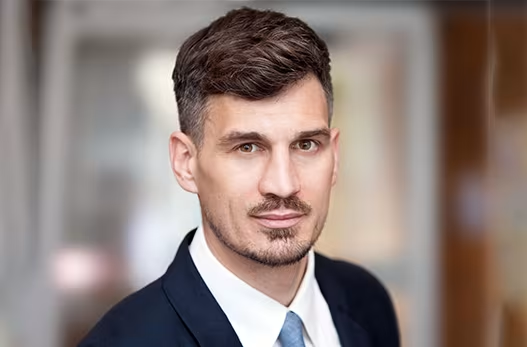
Keith Cuthbertson is a Special Lecturer at Bayes Business School, City, University of London. He holds a BSc in Physics and Mathematics from the University of Sussex and an MA in Economics from the University of Manchester. His professional experience includes roles at H.M. Treasury, Bank of England, National Institute of Economic and Social Research (NIESR), Imperial College London, and visiting positions at the Federal Reserve Bank (Washington), Freie University (Berlin), and University of Bordeaux. His research focuses on investment fund performance, behavioral finance, and risk management. Key areas include: (1) Measurement and persistence of mutual fund performance, (2) Statistical methods to distinguish skill from luck in fund management, (3) Factor models for portfolio optimization, and (4) Market timing strategies in equity and bond funds. His work emphasizes practical applications for investors and regulators. Recent publications (2016–2023) demonstrate a consistent focus on fund performance analytics, with evolving emphasis on factor models, portfolio size effects, nonparametric methods, and sustainability-linked finance. His research frequently combines academic rigor with practitioner-oriented insights. PhD Supervision: Elisa Pazaj (2015–present): Topics in Financial Markets Niall O'Sullivan (2006–2009): Performance of Mutual Funds Consultancy: Extensive work with Centrica, Towers Perrin, RBS, Department of Energy and Climate Change (DECC), and other financial/government institutions. Focuses on applied finance, derivatives, and risk management solutions.
Rasmus Waagepetersen is a Professor in the Department of Mathematical Sciences at Aalborg University, affiliated with The Faculty of Engineering and Science. His research focuses on spatial statistics, quantitative genetics, and statistical methodology for spatial point processes. He leads and participates in interdisciplinary projects such as urbanLab (spatial data analysis for urban planning) and studies on microbiome interactions in agricultural systems. Key research areas include spatial point processes, Markov chain Monte Carlo methods, and statistical inference for complex ecological and biomedical data. His work frequently involves collaborations with environmental and biological scientists, as seen in projects analyzing root microbiota assemblies in legumes and climate data for building simulations. Waagepetersen has contributed to methodological advancements in spatial statistics, including goodness-of-fit tests, likelihood-based inference for log Gaussian Cox processes, and quasi-likelihood approaches for case-control point pattern data. His research has been supported by grants from institutions like the Villum Foundation. Key Projects: urbanLab, Klimadata til fugtsimuleringer, Nod factor signaling in plant microbiota. Grants: Multiple projects funded by the Villum Foundation and Danish research councils. His recent publications address topics such as space-time point processes, microbiome data analysis, and statistical modeling in education. Waagepetersen maintains an active research group and collaborates internationally on both theoretical and applied statistical problems.
Amal Bakchan is an Assistant Professor in the Department of Construction Science at Texas A&M University’s College of Architecture. Her research focuses on water and wastewater infrastructure systems, socio-technical management in extreme environments, and sustainable construction waste practices. She holds a Ph.D. in Civil Engineering from the University of Texas at Austin (2021), an M.Sc. in Engineering Management from the American University of Beirut (2010), and a B.E. in Computer Engineering from Beirut Arab University (2008). Her work addresses infrastructure inequity in underserved rural communities, particularly in the Alabama Black Belt, and explores regionalization strategies for decentralized wastewater systems. She also investigates construction waste management using empirical and BIM-based approaches, emphasizing circular economy principles. Her interdisciplinary methods integrate mixed quantitative and qualitative analyses to understand stakeholder perceptions and community-driven solutions. Recent research trends include analyzing infrastructure resilience during crises (e.g., the pandemic’s impact on water demand) and leveraging data-driven approaches like automated vehicle detection systems for construction planning. Notable projects include studies on Lebanon’s water systems during protracted displacement crises and benchmarking pavement practices in data-scarce regions like Saudi Arabia. Bakchan has no listed scientific awards but maintains an active Google Scholar profile. Her grants and advising activities are not explicitly detailed in the provided information. She is affiliated with Texas A&M’s College of Architecture, contributing to both academic programs and outreach initiatives.
Pierre Kennepohl is a Professor and Associate Dean (Innovation) in the Faculty of Science at the University of Calgary, Department of Chemistry. He holds a PhD in Physical Inorganic Chemistry from Stanford University (2002) and a BSc in Chemistry from Concordia University. His research focuses on electronic structure & bonding, X-ray absorption/emission spectroscopy, molecular electron spin qubits, and data integrity in chemical analysis. He leads initiatives in Energy Innovations for Today and Tomorrow (2013-2021). His recent work spans catalyst design, halogen bonding mechanisms, and spectral analysis tools like SpectraFit. He advises on chemical education through courses like CHEM 201 and contributes to interdisciplinary collaborations. Research highlights include studies on CO2 reduction catalysts, copper-based antimicrobial materials, and computational modeling of reactive intermediates. His articles bridge theoretical insights with experimental validation, emphasizing sustainable chemistry and advanced spectroscopic techniques. He maintains active labs in SB231 (research office) and SB234 (laboratory).
Antonio Mele is a Full Professor of Finance at the Università della Svizzera italiana (USI) and the Swiss Finance Institute (SFI), where he has held a Senior Chair since 2011. He is affiliated with the Faculty of Economic Sciences and the Institute of Finance (IFin) at USI. Additionally, he is a Research Fellow in the Financial Economics program at the Centre for Economic Policy Research (CEPR) in London. Education: PhD in Economics, University of Paris BSc in Economics, LUISS University, Rome Antonio Mele's research spans a wide range of topics in financial economics. His primary areas of expertise include capital market volatility, the interplay between financial markets and the macroeconomy, uncertainty and volatility in financial markets, interest rates and credit markets, and information in securities markets. He also works on econometrics and numerical methods in finance. His recent research interests extend to public debt sustainability, fiscal reforms and financial market behavior, and economic history since World War I. His work is characterized by a strong integration of theoretical modeling, empirical analysis, and practical applications in financial markets. His publications, featured in top journals like the Journal of Financial Economics, Review of Economic Studies, Review of Financial Studies, and Journal of Monetary Economics, reflect a consistent focus on volatility measurement and pricing. Key themes across his 15 most recent works include the development of model-free volatility indices for fixed income markets (such as SRVIX, TYVIX, VXTLT, and Credit VIX), variance swaps, the role of uncertainty in macroeconomic fluctuations, and the design of financial instruments for hedging interest rate and credit risk. His research bridges academic theory and real-world financial innovation. Scientific Awards and Recognition: Research Fellow, Centre for Economic Policy Research (CEPR), London Senior Chair, Swiss Finance Institute (SFI) Member, Group of Economic Advisers, European Securities Markets Authority (ESMA), 2014–2015 Member, Securities and Markets Stakeholder Group, ESMA, 2015–2017 Antonio Mele has had a significant impact beyond academia through his advisory roles and financial innovations. He consulted with central banks and regulatory bodies on capital market volatility, securitization, and credit regulation. He served on ESMA’s advisory bodies between 2014 and 2017. His most notable industry contributions include the co-invention of exchange-traded volatility indices for interest rate swaps, government bonds, and credit markets, adopted by the Chicago Board Options Exchange (Cboe) and S&P Dow Jones Indices. These tools provide real-time measures of uncertainty in fixed income markets and have become standard benchmarks for risk management and trading. He has also authored a major graduate-level textbook on Financial Economics (MIT Press, 2022) and several other books on volatility. Laboratories and Research Teams: Antonio Mele leads research initiatives in financial economics, particularly in the areas of volatility and fixed income markets. He has collaborated extensively with Yoshiki Obayashi on the development of volatility indices and pricing models. His work is associated with the Institute of Finance (IFin) at USI and the Swiss Finance Institute, which serve as hubs for research in finance and macro-finance.
Burcu Sezen is an Associate Professor of Marketing at the School of Management, Universidad de los Andes in Bogotá, Colombia, where she has been a faculty member since June 2018. She holds a PhD in Business Administration from Özyeğin University in Istanbul, Turkey, and previously served as a Visiting Graduate Student at UCLA Anderson School of Management. Her academic journey includes a strong interdisciplinary foundation with degrees in Political Science, European Studies, and an MBA, complemented by a marketing certificate from UCSD. PhD in Business Administration – Özyeğin University, Istanbul, Turkey MBA – Sabancı University, Istanbul, Turkey MA in European Studies – University of Bath & Sciences Po Paris Bachelor in Political Science – Middle East Technical University, Ankara, Turkey Certificate in Marketing – University of California, San Diego (UCSD) Burcu Sezen's research centers on branding, international marketing, and the interface between marketing and finance. She employs quantitative modeling to explore complex brand dynamics, including brand performance, standardization versus adaptation strategies, ethical branding during crises, and the impact of political ideology on global brand equity. Her work is deeply informed by her prior industry experience in brand management at multinational firms like Coca-Cola, Nestlé, and Hızlı Sistem, where she managed diverse global brands. Her recent publications in journals such as the Journal of Business Research and Journal of Marketing Analytics reflect a consistent focus on strategic brand decisions, consumer behavior under crisis, and cross-cultural marketing challenges. Trends in her work show a growing emphasis on ethical and political dimensions of branding, particularly in emerging markets like Latin America. Burcu has actively participated in major academic events including the American Marketing Association (AMA) conferences, Academy of International Business (AIB), and Marketing Science Conference, demonstrating her strong engagement with the global marketing research community. She teaches a range of courses at both undergraduate and graduate levels, including Fundamentals of Marketing and Strategic Brand Management , often in English and Spanish. She is affiliated with the "Markets and Decisions" research group at Universidad de los Andes. While no formal students are listed, her academic role implies mentoring and advisory responsibilities. No scientific awards are explicitly mentioned, but her publication record and international collaborations underscore her scholarly impact.
Dr. James O'Sullivan is a Senior Lecturer in Digital Humanities at University College Cork (UCC), affiliated with the School of English & Digital Humanities and the Department of Digital Humanities. He previously held roles at the University of Sheffield and Pennsylvania State University, and has adjunct and visiting positions at several institutions. His academic roles include serving on UCC's Research & Innovation Committee and the inaugural board of the Future Humanities Institute, where he leads the Digital Cultures, New Media, & Cultural Analytics research cluster. Dr. O'Sullivan's research focuses on digital literature, cultural analytics, and the intersection of technology with literary studies. He has edited major works like The Bloomsbury Handbook to the Digital Humanities and Technology in Irish Literature & Culture , and authored Towards a Digital Poetics . His work explores topics such as electronic literature, digital editing, and the societal impact of AI. He leads high-profile research projects including CASCADE (Horizon Europe MSCA Doctoral Network) and C21 Editions (IRC/AHRC-funded). His peer-reviewed publications span journals like Digital Scholarship in the Humanities and Poetics , addressing topics from authorship attribution to computational stylistics. Dr. O'Sullivan contributes to public policy through roles like Teaching & Learning Policy Advisor for AI at Ireland's Higher Education Authority. He chairs Sample-Studios, Cork's largest artist-led group, and regularly publishes op-eds in outlets like The Guardian and The Irish Times .
Markus Rump, M.Sc., is a Researcher and Research Assistant at Bielefeld University, affiliated with the Faculty of Economics, the Department of Management Science & Business Analytics, and the Chair of Business Administration, specifically in Marketing, under Prof. Dr. Decker. He also holds institutional roles in research data management at the Competence Center for Research Data, Bielefeld IT Service Center (FDM Team), and the Bielefeld Center for Data Science (BiCDaS), reflecting his interdisciplinary engagement in data infrastructure and digital scholarship. Faculty of Economics Department of Management Science & Business Analytics Chair of Business Administration, esp. Marketing Competence Center for Research Data Bielefeld Center for Data Science (BiCDaS) His research spans two primary domains: higher education and marketing. In higher education, he investigates student motivation, academic dropout, dispositional traits (optimism/pessimism), and heterogeneity in learning environments, often in collaboration with Wiebke Esdar and Elke Wild. In marketing, his work focuses on customer experience, branding, voice assistants, and brand selfies, frequently co-authored with Reinhold Decker. These interests reflect a strong interdisciplinary profile bridging psychology, education, and business. His recent publications (2016–2023) show a consistent output in both peer-reviewed journals and conference venues. Themes include the impact of voice assistants on customer experience, motivations behind brand selfies, and structural models analyzing early college dropout. The research employs quantitative methods and surveys, contributing to both theoretical understanding and practical applications in education and marketing. Markus Rump has no listed scientific awards in the provided texts. He is actively involved in research projects such as HeLGA (Heterogeneity-Oriented Teaching), focusing on conditions for successful teaching in diverse student populations. While no formal students or grants are explicitly mentioned, his role in large-scale research suggests collaborative supervision and project-based funding. He contributes significantly to research data management, supporting institutional data governance and digital research practices.
Stephen Vaisey is a Professor of Sociology and Political Science at Duke University, where he also directs the Worldview Lab. His research focuses on the origins and consequences of moral and political beliefs, with a particular emphasis on cultural evolution and applied statistical methodologies. He integrates interdisciplinary approaches to study how cultural dynamics shape societal attitudes and behaviors, emphasizing the interplay between individual motivations and societal structures. His work often employs panel data and sophisticated statistical techniques to disentangle mechanisms of cultural change, including cohort succession and belief network formation. He teaches applied statistics courses through Statistical Horizons and leads the Code Horizons initiative, promoting methodological rigor in social science research. Key themes in his research include the dual-process model of culture in action, the role of moral worldviews in political behavior, and the quantitative measurement of cultural stability and change. His analyses frequently address topics like occupational meanings, vulnerability assumptions, and the impact of education on political orientation. While no specific scientific awards are listed, his contributions to cultural sociology and statistical methodology have been widely recognized through peer-reviewed publications. His advising and grant activities are not detailed here, though his Worldview Lab likely hosts ongoing collaborative research projects. His work bridges theoretical innovation with practical applications in cultural analysis and social policy.
Joshua Rabinowitz is a Professor of Chemistry and Director of the Ludwig Princeton Branch at Princeton University. His research focuses on quantitative analysis of cellular metabolism, leveraging advanced mass spectrometry and computational modeling. Key areas include metabolic regulation in microbes (E. coli, yeast), cancer cell metabolism, viral infection impacts, and biofuel production. His lab has pioneered methods to measure metabolites and fluxes, leading to discoveries like novel cancer metabolites and antiviral strategies via fatty acid inhibition. Notable honors include the NIH Pioneer Award and Agilent Thought Leader Award. Research emphasizes systems-level understanding, with projects combining biological experiments, metabolomics, and computation. Recent work explores metabolic heterogeneity in humans, immunotherapy enhancements through metabolic modulation, and metabolic vulnerabilities in cancers like rhabdomyosarcoma. Collaborations include engineering yeast for biofuel production and developing therapeutics targeting metabolic pathways. Lab Website: Rabinowitz Lab Affiliations: Lewis-Sigler Institute for Integrative Genomics, Princeton University Major contributions include identifying metabolic shifts in viral infections, modeling microbial nutrient responses, and advancing technologies for metabolite quantification. Current efforts aim to integrate metabolomic data with enzyme regulation dynamics to predict metabolic networks across organisms.
Howard Fairbrother is a Professor and Interim Chair in the Department of Chemistry at Johns Hopkins University, with a joint appointment in the Department of Materials Science and Engineering. He leads an active research group at the intersection of environmental chemistry, surface science, and materials chemistry, focusing on nanostructures, nanomaterials, and sustainable technologies. Education: B.A. in Chemistry, Oxford University, 1989 Ph.D. in Chemistry, Northwestern University, 1994 Postdoctoral Research, University of California, Berkeley, 1994–1997 His research spans environmental implications of nanomaterials, electron/ion-induced deposition processes, and sustainable applications such as nutrient delivery systems and microplastic analysis. He employs advanced techniques including XPS, AFM, TEM, SEM, and mass spectrometry. His work is highly collaborative, involving the NSF-funded Center for Sustainable Nanotechnology (CSN), EPA, NIST, and multiple academic institutions. Recent publications (2021–2025) reveal a strong focus on environmental nanotechnology, including micro/nanoplastics, carbon dots, biodegradable nanocomposites, and gas separation membranes. The research integrates materials synthesis, surface characterization, and environmental fate studies, with applications in sustainable agriculture, environmental monitoring, and semiconductor technology. Scientific Awards: Fellow of the American Chemical Society (2011) National Science Foundation CAREER Award (2000) Outstanding Graduate Thesis Award, Northwestern University (1994) Professor Fairbrother advises several graduate students and maintains the JHU Surface Analysis Facility. He has served as Senior Editor for the Journal of Physical Chemistry and held leadership roles in the American Chemical Society’s Colloids and Surface Chemistry Division. His group actively engages in interdisciplinary research, mentoring, and innovation in both environmental and materials sciences. His lab collaborates with researchers across JHU, including the Department of Geography and Environmental Engineering, and external partners such as Mirexus Biotechnologies, the University of Florida, and the University of Maryland. The Fairbrother group emphasizes sustainability, precision materials design, and real-world environmental impact.
Dr. Ahmed Mohammed is an Associate Professor in Supply Chain Management and Programme Director for the MSc Supply Chain Management at the University of Birmingham, Dubai Campus. He is affiliated with the Management Department and brings over 13 years of combined academic and industrial experience from the UK and the Middle East. Educational Background: Ph.D. in Engineering, University of Portsmouth, UK (2017) MSc in Communication Network Planning and Management, University of Portsmouth, UK (2010) Lean Six Sigma – Black Belt (2022) Fellow, Higher Education Academy, UK (2022) Dr. Mohammed's research focuses on the modeling and optimization of supply chains with an emphasis on sustainability and resilience. His work spans areas such as multi-tier supplier selection, circular economy, food waste management, Industry 4.0 integration, and last-mile logistics. He employs advanced methodologies including multi-criteria decision-making (MCDM) techniques like AHP, TOPSIS, and VIKOR, and develops hybrid optimization models for complex supply chain challenges. His recent publications, spanning from 2021 to 2023, reflect a strong trend in resilient and sustainable supply chain network design, pandemic-related disruptions, digital sourcing, and risk modeling under uncertainty. These works appear in high-impact journals such as International Journal of Production Research , Transportation Research Part E , Computers & Industrial Engineering , and Expert Systems with Applications . Scientific Awards and Recognitions: Fellow, Higher Education Academy, UK (2022) Lean Six Sigma Black Belt (2022) Fellow Member, Chartered Institute of Logistics and Transport (CILT) Member, MCDM Society Dr. Mohammed has secured multiple research grants from MOHERI, Oman, including projects on last-mile logistics sustainability, supply chain resilience, and online food waste management. He actively supervises research students and serves as a reviewer for leading journals including International Journal of Production Economics (IJPE) , Transportation Research Part D (TRD) , Omega , and International Journal of Production Research (IJPR) . He is also an external academic program reviewer for logistics-related programs and contributes to the academic community through peer review and collaborative research.
Paul Evans is a Professor in the Department of Materials Science & Engineering at the University of Wisconsin-Madison, College of Engineering. His research focuses on nanoscale materials synthesis, ultrafast dynamics, and advanced X-ray characterization techniques. PhD, Harvard University (2000) MS, Harvard University (1996) BS, Cornell University (1994) Evans investigates solid-phase epitaxy of complex oxides, strain imaging in acoustic devices, and optically driven phase transitions. His work combines experimental and computational approaches, including deep learning for diffraction data analysis. His recent publications highlight breakthroughs in nanoscale crystallization, ultrafast magnetization dynamics, and hybrid magnon-phonon systems. Awards include the Bascom Professorship and Vilas Mid-Career Award. Surface Science and Technology Bascom Professorship (2022) Vilas Associate Award (2019) Polygon Engineering Outstanding Instructor Award (2006) Evans teaches courses in materials structure, advanced X-ray methods, and thesis research. His lab enables scalable synthesis of perovskites and defect-minimized oxide heterostructures.
Maxime Bonelli is an Assistant Professor of Finance at London Business School. He holds dual PhDs in Mathematics (Inria, 2016) and Finance (HEC Paris, 2023). Prior to academia, he worked as a quantitative researcher in asset management for over four years. Research Focus: Corporate Finance, Asset Management, Big Data, Artificial Intelligence, Financial Intermediation, and Firm Behavior. Education: PhD in Mathematics, Inria (2016) PhD in Finance, HEC Paris (2023) His work investigates how technological advancements like Big Data and AI transform financial intermediation and economic structures. He has presented at major conferences including NBER Big Data and Securities Markets, EWFC, WFA, and EFA. Scientific Awards: AMF Best Young Researcher Prize in Economics HEC Paris Foundation Best PhD Thesis Award European Finance Association Doctoral Best Paper Prize SUERF/UniCredit Foundation Research Prize Geneva Institute for Wealth Management (GIWM) Research Award 2024 His publications span journals like the Journal of Financial Economics, Review of Financial Studies, and Financial Times, with ongoing work at prestigious conferences such as AFA, European Economic Association, and FMA European Conference.
Jennifer Chan is a Professor in the Statistics Department at the University of Sydney's Faculty of Science. She earned her PhD from the University of New South Wales in 1997 and previously lectured at the University of Hong Kong before joining her current institution in 2006. Her research integrates statistical and machine learning models with applications in finance and insurance, including volatility modeling, Bayesian methods, and neural network applications. Her interdisciplinary research focuses on: Generalized linear mixed models and multivariate volatility measures Machine learning techniques for financial risk assessment Bayesian robustness and portfolio optimization Time-series analysis of cryptocurrencies and equity markets Recent publications demonstrate strong focus on Bayesian models in finance (42% of last 15 papers), machine learning applications (33%), and actuarial science (25%), with emerging emphasis on neural networks for financial forecasting. Awards & Honors: Second prize, Natural Science Award of China's Ministry of Education (2008) National Drug Strategy Research Scholarship (1994-1996) She supervises doctoral candidates working on machine learning applications in finance and insurance. Her international collaborations include institutions in Israel, Japan, Malaysia, and the United States.