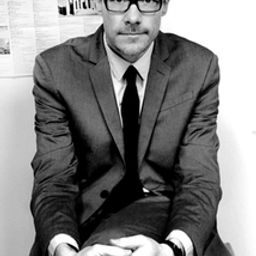
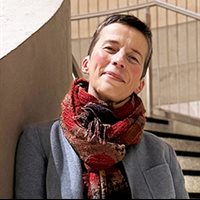
Christophe Bisson is an Associate Professor at SKEMA Business School (Paris campus) specializing in Strategy, Innovation & Entrepreneurship. His research examines augmented anticipatory systems, competitive intelligence, AI governance, and strategic early warning frameworks. He directs the MSc International Strategy and Influence program and leads research at the SKEMA Center for Artificial Intelligence. Bisson holds a PhD in Competitive Intelligence from Aix-Marseille University and a Postgraduate Certificate in AI from the University of Helsinki. His professional experience includes international strategy consulting and academic positions at universities in Turkey and France. Awards & Honors: Inducted into Council of Competitive Intelligence Fellows (2023) SCIP International Academic Award (2017)
Professor Carlo Harvey is a creative technologist at the School of Digital Arts (SODA), Manchester Metropolitan University. His interdisciplinary research merges games , machine learning , virtual production , and cultural heritage reinterpretation . He leads industry collaborations with entities like Jaguar Land Rover and Epic Games, focusing on AI-driven interactive audio, real-time visualization, and accessibility solutions. Award-winning projects : TIGA, Innovate UK, and Epic Games MegaGrant for Accession Industry partnerships : Automotive sector, cultural institutions His research spans human-computer interaction , multisensory virtual environments , and acoustic-visual cross-modal perception . Recent publications address robotic simulations, motion alignment, and haptic feedback systems. Scientific recognition : TIGA Award, Innovate UK Funding, Epic Games MegaGrant Advocacy : Digital inclusion, creative collaboration, social impact of technology
Mika Järvinen serves as Associate Professor in the Department of Energy and Mechanical Engineering at Aalto University, leveraging fundamental sciences—physics, thermodynamics, chemistry, and numerical modeling—to address cross-sector energy challenges. His research spans sustainable bioenergy and inter-linked circular economy systems integrating energy, materials, and environmental considerations across biomass, pulp/paper, metallurgy, and waste-to-energy industries. His expertise centers on sustainable bioenergy and circular economy frameworks, utilizing numerical modeling to optimize combustion engineering and metallurgical processes. By maintaining diverse industrial engagement, he ensures research continuity during economic fluctuations while advancing black liquor spraying technologies and energy-material-environment synergies. This approach enables flexible, physics-based solutions for complex industrial energy conversion problems. Professor Järvinen's 2025 publications reveal a cohesive focus on renewable energy systems operating within planetary boundaries, spanning carbon capture (calcium looping), low-temperature heat engines, and comprehensive textbook development. His work integrates solar, wind, bioenergy, and storage technologies into holistic frameworks that balance technical innovation with ecological constraints, emphasizing system-level sustainability over isolated component optimization. His scientific recognition includes: Best Dissertation Award (2002) from Helsinki University of Technology's Department of Machine Technology for research on black liquor droplet conversion Resonate Award (2015) from Caltech University's Resnick Institute As lead of the Energy Conversion and Systems research group, he directs projects bridging fundamental modeling with industrial applications while developing educational resources for next-generation energy engineers. His laboratory work emphasizes experimental validation of numerical models across combustion, metallurgical, and biomass conversion processes.
Walter W. Powell is the Jacks Family Professor of Education at Stanford University, with courtesy appointments in Sociology, Organizational Behavior, Management Science and Engineering, and Communication. He serves as Faculty Co-Director of the Stanford Center on Philanthropy and Civil Society (PACS), which he co-founded in 2006, and leads the Civic Life of Cities Lab examining civil society organizations across global metropolitan areas. Powell is also an External Faculty member at the Santa Fe Institute and co-directs the CASBS summer institute on Organizations with MIT's Bob Gibbons. His educational background includes a PhD in Sociology from SUNY-Stony Brook (1978), an MA in Sociology from the same institution (1975), and a BA from Florida State University (1971). Powell's research fundamentally explores how ideas and practices transfer across organizational boundaries, with particular emphasis on network structures that enable or constrain knowledge diffusion. His work spans organizational theory, institutional analysis, university-industry relations, economic sociology, and comparative analysis of nonprofit, public, and private institutional forms. Powell's publications reveal consistent focus on network dynamics and institutional evolution, particularly examining how organizations navigate between market, hierarchy, and network governance structures. His research demonstrates how knowledge spillovers operate within biotechnology clusters, how institutional isomorphism shapes organizational fields, and how civil society organizations adapt to technological and economic pressures across different urban contexts. Dean's Award for Excellence in Graduate Teaching (2018-19) Max Weber Award for "Neither Market Nor Hierarchy" Viviana Zelizer Prize for "Network Dynamics and Field Evolution" Administrative Science Quarterly Recognition Member of Swedish Royal Academy of Science Member of The British Academy Member of American Academy of Arts and Sciences Honorary Degrees from Uppsala University, Copenhagen Business School, and Aalto University Powell has made substantial contributions to graduate education, receiving Stanford's highest teaching honor. His leadership of PACS and SCANCOR (1999-2010) demonstrates sustained commitment to advancing organizational research through collaborative initiatives. He supervises postdoctoral fellows and runs annual PhD workshops in Europe, fostering the next generation of organizational scholars. His research has been supported by grants enabling comparative studies of university-industry relations and civil society across multiple national contexts. Through the Civic Life of Cities Lab at PACS, Powell directs comparative research on civil society organizations across seven global cities, examining how these organizations navigate technological change, economic pressures, and political environments. His work bridges theoretical organizational sociology with practical applications in philanthropy, civil society development, and knowledge transfer between academic and commercial sectors.
Rodney Harrison is a Reader in Archaeology, Heritage and Museum Studies at the UCL Institute of Archaeology, University College London. He serves as the founding editor of the Journal of Contemporary Archaeology and has been Vice President of the Association of Critical Heritage Studies since 2012. His research focuses on critical heritage studies, contemporary archaeology, and future-making practices in heritage contexts. Harrison's work challenges traditional boundaries between past, present, and future in heritage discourse, emphasizing how heritage functions as a future-oriented practice. His research spans cultural and natural heritage, exploring connections between heritage conservation and other material legacy management systems, including nuclear waste disposal. Harrison leads the major international 'Heritage Futures' research program funded by the UK Arts and Humanities Research Council. This project represents one of the largest critical, comparative ethnographic studies of heritage practices, examining how different forms of heritage function as distinctive future-making practices across diverse contexts. His scholarly contributions include more than a dozen books and over 60 peer-reviewed articles. Notable publications include Collecting, Ordering, Governing: Museums, Anthropology and Liberal Government (2016), Heritage: Critical Approaches (2013), Reassembling the Collection (2013), Understanding the Politics of Heritage (2011), and The Heritage Reader (2008). Harrison's work consistently engages with critical theory, challenging conventional heritage frameworks and exploring innovative approaches to understanding how material and cultural legacies shape future possibilities. His research has significant implications for heritage policy, conservation practice, and theoretical developments in critical heritage studies.
New Jersey Institute of Technology (NJIT)United States
Steven I-Jy Chien serves as Professor and Director of the Transportation Program within the Department of Civil and Environmental Engineering at the New Jersey Institute of Technology (NJIT). His career spans academia, government, and industry with significant contributions to transportation engineering research and practice. His educational credentials include: Ph.D. in Civil and Environmental Engineering from University of Maryland-College Park (1995) M.S. in Civil and Environmental Engineering from University of Maryland-College Park (1991) B.S. in Civil Engineering from Tamkang University (1983) Professor Chien's research focuses on transportation system resilience, sustainable transit operations, and advanced traffic modeling. His work addresses critical challenges in urban rail networks, demand-responsive transit services, and energy-efficient transportation systems. He employs sophisticated computational methods including genetic algorithms, machine learning, and Bayesian approaches to solve complex transportation problems involving network vulnerability, passenger behavior, and infrastructure optimization under uncertainty. Analysis of his recent publications reveals strong emphasis on transportation resilience against cascading failures, sustainable operations for electric transit systems, and pandemic-responsive aviation scheduling. His research spans diverse geographic contexts including major Chinese metropolitan areas and U.S. transportation networks, demonstrating global applicability of his methodologies. His professional recognition includes: 2024 Keynote Speaker at Union-Tech Lecture, National Taiwan Ocean University 2022 Keynote Speaker at International Conference of Chinese Institute of Transportation 2022 Best Poster Award from New Jersey Department of Transportation Professor Chien has secured research funding from federal agencies including the Federal Highway Administration (FHWA) where he contributed to CORSIM traffic simulation software development. His industry experience with China Engineering Consultants Inc. and Information Dynamic Inc. informs his practical approach to transportation challenges. As Transportation Program Director, he oversees curriculum development and industry partnerships that prepare students for transportation sector careers. He maintains active collaboration with transportation agencies globally, particularly through his leadership in the Transportation Program at NJIT which serves as a hub for innovation in urban mobility solutions.
London School of Economics and Political Science (LSE)United Kingdom
Abby Innes is an Associate Professor of Political Economy at the European Institute, London School of Economics , where she has been a faculty member since 1997. Her academic career includes a Visiting Fellowship at MIT (1995–1997) and a Jean Monet Fellowship at the European University Institute (2001–2002) . She has received multiple teaching awards , including the LSE Teaching Prize and European Institute Departmental Teaching Prize, and currently serves as the Teaching Chair of her institute. Research Interests : Dr. Innes specializes in the political economy of Central Europe , neoliberalism , and materialist utopias . Her work explores state capture , systemic transitions , and comparative capitalism , with a focus on the UK’s neoliberal transformation. Recent research addresses the political economy of the green transition and neoliberal institutional failures . British Academy Mid-Career Fellowship (2017-2018) LSE Teaching Prize (2002) LSE/ASRC Excellence in Education Award (2020) European Institute Departmental Teaching Prize (2011, 2013, 2015) Nominee for LSE Student-Led Teaching Excellence Awards (2014, 2020) Publications : Her 2023 book Late Soviet Britain: Why Materialist Utopias Fail argues that UK neoliberalism parallels Soviet economic dogma, leading to institutional rigidity , democratic erosion , and governance crises . She has published in journals such as The Review of International Political Economy and Comparative Politics , alongside frequent contributions to LSE Blogs and The London Review of Books .
Lucie DE CARVALHO is a Lecturer in British Civilization at the University of Lille, Faculty of Languages, Culture and Societies, Department of English Studies. She is affiliated with ULR 4074 - Center for Studies in Civilizations, Languages and Foreign Literature. Graduated from ENS Cachan Specializes in British Civilization Based at University of Lille (BO.529) Dr. DE CARVALHO's research focuses on contemporary British politics, political discourse studies, British energy policies (particularly nuclear and renewable energy), neoliberalism, historiography of science, and climate governance. Her work demonstrates a consistent engagement with the intersection of political power, energy policy, and media representation in the British context. She has developed a particular expertise in analyzing how the UK state manages controversial technologies like nuclear power within neoliberal frameworks. Her publication record shows a consistent output spanning from 2014 to 2024, with recent work examining twenty-first century UK broadcasting ecology, teaching British history to French students, and contemporary nuclear power policies. The analysis of her articles reveals a strong thematic continuity centered on British governance, energy policy, and the complexities of neoliberal state intervention. Her research employs interdisciplinary approaches drawing from political science, media studies, and science and technology studies. Member of the SAES (Society of Anglicists in Higher Education) Member of CRECIB (Centre for Research on British Civilization) Associate member of the Research Center in British Civilization (CREC) Institute of the Anglophone World, Sorbonne Nouvelle University – Paris 3 Member of the UK Political Studies Association Member of the European Association for the Study of Science and Technology (EASST) Member of UACES Dr. DE CARVALHO has demonstrated sustained research activity across multiple domains related to British studies, with particular emphasis on energy policy and political discourse. Her work bridges academic research with pedagogical practice, as evidenced by publications on teaching British history to French undergraduate students and language learning through television series.
Terry C. Lansdown is an Associate Professor in the School of Social Sciences and Department of Psychology at Heriot-Watt University. His expertise lies in Human Factors, particularly focusing on driver safety, workload management, and attentional distraction in transportation contexts. Prior to his academic role, he worked as a senior researcher at the Transport Research Laboratory, contributing to numerous EU-funded and government-sponsored projects. His research integrates ergonomics principles with real-world applications, addressing issues like automated driving systems, social distractions in vehicles, and occupational health in construction industries. Key research interests include: Driver behavior and road safety Human factors in automated systems Workload and attentional demands in complex tasks Health and safety in small-to-medium enterprises (SMEs) He has led studies on pandemic response strategies, such as the CHARIS project analyzing behavioral adherence during the COVID-19 crisis. Lansdown’s work frequently bridges psychological theory with practical interventions, including text messaging campaigns to improve construction worker safety and experimental designs to evaluate automation failure responses. Collaborations span academic and industrial sectors, with publications addressing topics ranging from UV exposure in outdoor workers to the cognitive impacts of in-vehicle distractions. His contributions align with UN Sustainable Development Goals related to health (SDG 3) and sustainable cities (SDG 11).
Dr. Winnie Yip is a Professor of the Practice of Global Health Policy and Economics at the Harvard T.H. Chan School of Public Health. She serves as Faculty Director of the China Health Partnership and recently concluded her role as Acting Director at Harvard's Fairbank Center for Chinese Studies. Previously, she was a Professor at the University of Oxford and led the Global Health Policy Program. She holds a PhD in Economics from MIT and a BA from UC Berkeley. Her research focuses on systemic healthcare interventions, policy design, and aging populations' impact on health systems. She collaborates closely with governments and international agencies like the World Bank and WHO, advising on reforms in Asia. Her work emphasizes equitable access, health system efficiency, and innovative eldercare solutions. Dr. Yip’s academic leadership includes roles as past President of the International Health Economics Association and editorial positions at journals like Social Science & Medicine . Her grants include funding from NSF, Bill & Melinda Gates Foundation, and EU Commission. Key areas of study include telemedicine, long-term care financing, and healthcare delivery in low-income regions.
Elena Maria Baralis is a Full Professor at the Department of Control and Computer Science (DAUIN) at the Polytechnic University of Turin. She serves as Pro-Rector, member of the Board of Directors (without voting rights), member of the Academic Senate (without voting rights), and coordinator of the University's Permanent Observatory for Monitoring the Academic Sector. She chairs the Control and Computer Engineering Department and previously chaired the Computer Engineering School from October 2012 to October 2018. Her research interests focus on database systems and data mining, specifically explainable AI, bias detection in data analytics, and machine learning algorithms for big data. Her work spans various application domains including predictive maintenance, Industry 4.0, and healthcare. Recent publications demonstrate her expertise in speech processing, bias mitigation, and innovative neural network architectures like Kolmogorov-Arnold Networks. Her research output shows a clear trend toward addressing fairness and explainability in AI systems while exploring novel approaches to speech and language understanding. Professor Baralis has received significant recognition including becoming a Fellow of the Academy of Sciences of Turin in 2017. She has served as Editor-in-Chief for IEEE Internet of Things Journal (2016-2019) and Knowledge and Information Systems (2014-present). She actively mentors doctoral students including Claudio Savelli (researching Machine Unlearning), Eleonora Poeta, Giuseppe Gallipoli, Alkis Koudounas, and others. Her research is supported by numerous projects including AI4CTI (Artificial Intelligence for Cyber Threat Intelligence, 2025-2028), Smart manufacturing driven by Machine Learning in Industry 4.0 (2019-2020), and I-REACT (2016-2019).
Eduardo Araral is an Associate Professor at the Lee Kuan Yew School of Public Policy, National University of Singapore. With over 30 years of experience in academia and government, he holds a PhD in Public Policy from Indiana University-Bloomington under Nobel Laureate Elinor Ostrom. His research focuses on collective action, institutions, and water governance, with publications in Nature Human Behaviour , Public Administration Review , and World Development . He has held fellowships at Stanford University and centers associated with Coase, Ostrom, and Stigler. Research Interests : Collective action, institutional analysis, water governance, digital technologies in public policy, political economy, and socio-ecological systems. Scientific Awards : Ostrom Prize for the Governance of the Commons, Fulbright PhD Scholarship, and Presidential Award for Outstanding Overseas Filipinos. Leadership Roles : Vice Dean for Research, Assistant Dean for Academic Affairs, and Co-Director of the Institute of Water Policy (2016-2022) at LKYSPP. Global Engagement : Advised 20+ international organizations including ADB, World Bank, UNDP, and Fortune 500 companies, while lecturing to 7,000+ government officials across 50+ countries.
Professor Martin Doevenspeck is a distinguished scholar of Political Geography at the University of Bayreuth, where he holds a professorship in the Department of Political Geography within the Faculty of Biology, Chemistry & Earth Sciences. Since 2019, he has served as a Principal Investigator in the Cluster of Excellence "Africa Multiple" and as Spokesperson of the Research Section Mobilities. Previously, he was Managing Director of the Institute of Geography at the University of Bayreuth (2018-2022) and a member of the Executive Board of the Institute of African Studies Bayreuth. Professor Doevenspeck earned his "Diplom" in Geography from the University of Bonn and completed his PhD thesis entitled "Migration in rural Benin – Studies in social geography at an African border" at the University of Bayreuth in 2004. His academic journey includes positions as a Teaching and Research Assistant at the University of Bayreuth (2005-2011), Post-doc at the University of Bonn (2004), and various research and teaching roles focused on African geography and development. At the intersection of migration studies and political geography, Professor Doevenspeck's research focuses on (forced) im/mobilities, conflict, and border studies, with particular emphasis on African contexts. His current work centers on the project "Oil movements: the production and government of petro-(im)mobilities in East Africa" within the Bayreuth Cluster of Excellence "Africa Multiple," where he serves as Spokesperson of the Research Section Mobilities. His research spans West Africa (particularly Benin), Central Africa (Democratic Republic of Congo, Rwanda), and East Africa, examining how borders, conflicts, and resource extraction shape human mobility and territorial control. Analysis of Professor Doevenspeck's recent publications reveals a consistent focus on migration, borders, and conflict in African contexts, with increasing attention to environmental factors and resource extraction. His work demonstrates interdisciplinary approaches combining political geography, migration studies, and African studies. Recent publications particularly emphasize petro-mobilities, terrorism impacts on education, and migration control in West African borderlands, reflecting evolving research interests in the interplay between infrastructure development, security concerns, and human mobility. Professor Doevenspeck has supervised numerous doctoral and master's students, including Jaana M. Janßen, Fabian Liedl, Clemens Romankiewicz, Morgane Anziani-Vente, Muhire Blaise Mwanga, and Daniela Boß. His academic leadership extends to serving as Vice Dean of the Bayreuth International Graduate School of African Studies (BIGSAS) from 2012-2021, where he played a significant role in shaping graduate education in African studies. As a Principal Investigator in the Cluster of Excellence "Africa Multiple," Professor Doevenspeck leads research initiatives examining diverse manifestations of "Africa" across the continent and diaspora. His work involves collaboration with researchers from multiple disciplines and institutions, focusing particularly on mobilities as a key research section within the cluster. This collaborative research environment has produced significant insights into migration patterns, border dynamics, and conflict resolution in African contexts.
Ian Greer is a Research Fellow at Cornell University's School of Industrial and Labour Relations , with a career focused on marketisation , industrial relations , and transnational solidarity . He holds a PhD from Cornell University and has previously studied at Bard College. His work examines labor dynamics in globalised industries , welfare states , and multinational corporations , often through qualitative comparative methods . Education : BSc (Bard College), MSc/PhD (Cornell University) Greer's research spans marketisation of employment services , social movement unionism , and labour policy in crisis situations . His publications include studies on European welfare-to-work schemes , healthcare privatisation , and labour migration . He is associated with the Centre for Employment Relations, Innovation and Change (CERIC) at the University of Leeds. Greer's recent work analyses precarious labor and project-based employment in social services across Slovenia and France. He also contributes to debates on social dumping , work-first welfare states , and activist labor strategies in sectors like healthcare and automotive manufacturing. He has no listed scientific awards. His work often involves collaboration with scholars like Marco Hauptmeier , Charles Umney , and Nathan Lillie , though no formal advisees are named in the provided text. His email is icg2@cornell.edu .
Sakari Melander is a Professor at the Faculty of Law , University of Helsinki, specializing in Criminal Law , with a focus on constitutionalization, Europeanization, and sentencing policies. His work bridges theoretical criminal law with practical legislative and policy challenges. Key research areas include EU criminal law, constitutional constraints on criminal legislation, and general doctrines of criminal law. He has extensive experience in parliamentary legal consultation, providing expert opinions to Finland’s Legislative Committees (e.g., on immigration control, anti-corruption directives, and digital evidence handling). Recent publications address topics like EU corporate sanction policies, constitutionalization of criminal law, and reforms in Finnish sentencing systems. His 2025 article in the New Journal of European Criminal Law explores balancing administrative and criminal sanctions in the EU. Scientific awards include: Hilkka ja Otto Brusiin Foundation Thesis Prize (2001) Magister Bonus – Good Teacher Award (2014) Primustohtori Award (2010) Year’s Teacher (2010) Year’s Opponent (2008) He leads research projects such as Criminal Law Under Pressure: Differentiation and Harmonization (2012-2015) and Assessment of Human Trafficking Sanction Practices (2021-2022), and supervises doctoral theses on criminal law topics.