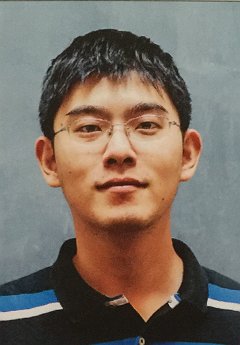
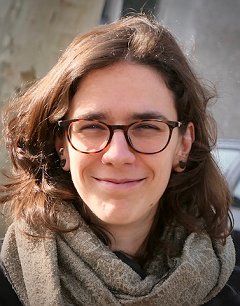
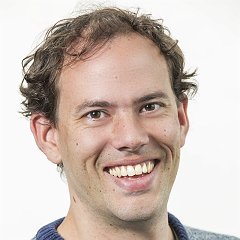
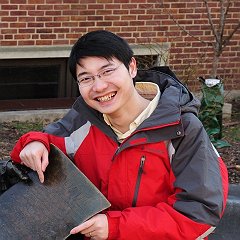
Xiaodi Wu is an Associate Professor in the Department of Computer Science at the University of Maryland, College Park, with affiliations to the Institute for Advanced Computer Studies and the Joint Center for Quantum Information and Computer Science (QuICS). They also serve as an Amazon Visiting Academic at AWS Braket. Education: Ph.D. in Theoretical Computer Science (University of Michigan, 2013); B.S. in Mathematics and Physics (Tsinghua University, 2008). Their research bridges theoretical foundations of quantum computing with practical implementations, focusing on computational models for quantum device programmability and systems for operating quantum machines. Key areas include quantum programming languages, formal verification, and robustness analysis. Recent work includes SimuQ (quantum simulation frameworks) and Qafny (quantum program verification). Publications emphasize verification of quantum compilers, algebraic reasoning, and differentiable quantum languages. Scientific Awards: Sloan Research Fellow, NSF CAREER, AFOSR YIP. Xiaodi Wu has advised numerous students and mentored interns, contributing to quantum complexity theory and cryptographic protocols. They actively participate in organizing committees for conferences like POPL and PLDI.
Tiago Cogumbreiro is an Assistant Professor at the University of Massachusetts Boston, where he has been a faculty member since Fall 2018. His research focuses on advancing the foundations of parallel programming through rigorous quality assurance of languages and runtimes. Dr. Cogumbreiro received his PhD from the University of Lisbon (ULisboa) in March 2015 under Francisco Martins, where he developed techniques to handle barrier deadlocks including the Armus runtime verification tool. His educational background includes a B.Sc. from Universidade dos Açores, followed by research assistant work at Imperial College London (supervised by Nobuko Yoshida) and postdoctoral research at Georgia Tech and Rice University (supervised by Vivek Sarkar). As an expert in formal methods for high-performance computing, Dr. Cogumbreiro's work centers on detecting concurrency errors in parallel programs with special emphasis on GPU systems. His research spans theoretical contributions to deadlock avoidance policies and practical applications of Coq and Why3 for certified algorithms. Recent work demonstrates sophisticated approaches to static analysis of data-races in GPU programming, addressing fundamental challenges in parallel system reliability. His publication pattern reveals a consistent trajectory from foundational work on futures-based deadlock avoidance (2017) through behavioral type systems (2019) to current innovations in GPU program analysis (2023-2024). These contributions form a cohesive research program focused on mathematically rigorous approaches to parallel system correctness. Dr. Cogumbreiro actively contributes to the programming languages community through committee service at major conferences including PLDI (2020 Artifact Evaluation), SPLASH (2025 OOPSLA Review Committee), and PPoPP. His GitHub activity shows ongoing development of formal verification tools, particularly Coq-based projects like gorn-coq and habanero-coq that implement his theoretical contributions.
Delphine Demange is an Associate Professor in Computer Science at University of Rennes, working in the Epicure research group (formerly Celtique) at IRISA (UMR 6074 / Inria). Her research focuses on formal methods for programming languages and compilers, with particular emphasis on compiler verification, program semantics, and language-based security. Her research interests include formal semantics of programming languages, program transformations, compiler verification, static analysis, computer-aided verification, and language-based security. She has made significant contributions to the formal verification of compiler intermediate representations, particularly static single assignment (SSA) form, and has worked extensively on verified compilation techniques. Her publication record shows a consistent focus on formal verification of programming language constructs and compiler components. Recent work (2023-2025) centers on dataflow circuits and solvers, while earlier work (2015-2020) focused on SSA-based optimizations, garbage collection verification, and information-flow security architectures. Her research demonstrates a strong commitment to applying formal methods to practical compiler and language implementation problems. Her scientific awards include the EAPLS Best PhD Dissertation Award in 2012 and the Gilles Kahn PhD Thesis Award in 2013 for her thesis Semantic Foundations of Intermediate Program Representations . She serves on numerous program committees for major programming languages conferences including CC, CGO, OOPSLA, and POPL, and has held leadership roles such as Program Co-Chair for CC 2021 and General Co-Chair for JFLA 2023 and 2024. She is also a member of the CC Steering Committee (2021-2024). Her teaching portfolio includes undergraduate and graduate courses in programming, algorithmics, compilation, and program verification, with a particular focus on trustworthy programming techniques using deductive verification in Why3.
Sebastian Erdweg is a Professor at the Institute of Programming and Software Engineering at Johannes Gutenberg University Mainz (JGU Mainz) in Germany. He actively contributes to the programming languages research community as evidenced by his extensive involvement in major conferences including PLDI, ECOOP, SPLASH, and ICFP. His leadership roles include serving as Workshops Co-Chair for ECOOP and ISSTA 2023, Steering Committee Chair for GPCE, and various program committee positions across multiple conferences. His research primarily focuses on programming language design and implementation, with particular expertise in incremental computation, Datalog-based systems, abstract interpretation, and language workbenches. Erdweg's work bridges theoretical foundations with practical applications in static analysis, compiler construction, and program transformation. His research demonstrates a consistent thread of improving developer productivity through better language design and tooling, with recent work emphasizing efficient incremental program analysis techniques. Erdweg's publication record shows a strong emphasis on Datalog as a foundation for program analysis, with increasing focus on incremental techniques and WebAssembly analysis in recent years. His work combines theoretical rigor with practical implementation, often resulting in open-source tools that advance the state of the art in language engineering. The consistent appearance of Datalog, incremental computation, and abstract interpretation across his publications indicates a cohesive research vision spanning over a decade. As an active member of the programming languages community, Erdweg has served in numerous organizational roles including Workshops Co-Chair for ECOOP and ISSTA 2023, Steering Committee Chair for GPCE, and various program committee positions. His contributions to conference organization demonstrate his standing within the academic community and commitment to advancing research in programming languages and software engineering.
Cormac Flanagan is a Professor in the Department of Computer Science and Engineering at the Baskin School of Engineering, University of California Santa Cruz. His research focuses on programming languages, security, and software verification, with particular expertise in concurrent programming, information flow control, and program analysis. Flanagan's research interests span multiple areas of programming languages and software security. He has made significant contributions to the fields of information flow control, concurrent programming verification, and dynamic analysis techniques. His work on dynamic race detection, particularly the FastTrack algorithm, has been highly influential in the field, earning him a PLDI Most Influential Paper Award. He has also pioneered techniques for secure information flow, including the development of faceted values and secure multi-execution approaches, which earned him a POPL Most Influential Paper Award. His recent publications demonstrate a continued focus on program verification, with particular attention to concurrent software, JavaScript verification, and serverless computing security. Flanagan's work often bridges theoretical foundations with practical implementations, resulting in tools like the Anchor Verifier for concurrent software that provide practical verification solutions for real-world programming challenges. Fellow of the Association for Computing Machinery Alfred P. Sloan Foundation Fellow POPL Most Influential Paper Award for 'Multiple Facets for Dynamic Information Flow' PLDI Most Influential Paper Award for 'FastTrack: Efficient and Precise Dynamic Race Detection' PLDI Most Influential Paper Award for 'Extended Static Checking for Java' ECOOP 2024 Distinguished Paper Award for 'Mover Logic: A Concurrent Program Logic for Reduction and Rely-Guarantee Reasoning' CSF Distinguished Paper Award for 'Transparent IFC Enforcement: Possibility and (In)Efficiency Results' PLDI Distinguished Artifact Award for 'BigFoot: Static Check Placement for Dynamic Race Detection' ECOOP Best Paper Award for 'RedCard: Redundant Check Elimination for Dynamic Race Detectors' ISSTA Distinguished Paper Award for 'Exploiting Purity for Atomicity' UCSC Excellence in Teaching Award Professor Flanagan has advised numerous PhD students who have gone on to successful careers in industry and academia, including positions at Google, Shape Security, and San Jose State University. He serves as Steering Committee Chair for the ACM Conference on Programming Language Design and Implementation (PLDI) and as Associate Editor for ACM Transactions on Programming Languages and Systems (TOPLAS). His research has been supported by various grants from funding agencies, though specific details are not provided in the available information. Flanagan leads research projects including the Anchor Verifier for Concurrent Software, data race detection tools, the RoadRunner dynamic analysis infrastructure, and work on cooperable concurrency. His research group at UC Santa Cruz focuses on developing practical techniques for ensuring software reliability and security, with applications to concurrent programming, web security, and cloud computing environments.
Kangjing Huang is a researcher at Purdue University specializing in programming languages and software engineering. Their work bridges theoretical foundations with practical tool development in program synthesis. Research focuses on program synthesis methodologies , particularly reconciling enumerative and deductive approaches. Key contributions include: Developing library-based synthesis techniques for practical code generation Creating frameworks for efficient search space navigation Integrating formal verification with synthesis pipelines Publication trends show consistent advancement in automated programming systems from 2020-2022, with growing emphasis on real-world applicability through library integration. Awards and teaching activities are not documented in available sources. Huang actively contributes to the programming languages research ecosystem through publications at premier venues including PLDI and SAS, with work centered on making program synthesis more scalable and practical for developer workflows.
Pavlos Petoumenos is a Lecturer (Assistant Professor) in the Department of Computer Science at the University of Manchester and a Research Fellow of the Royal Academy of Engineering. He leads research within the Advanced Processor Technology (APT) group, focusing on compiler optimization and energy-efficient computing. Previously, he worked as a Research Associate and Senior Researcher at the University of Edinburgh under Hugh Leather. His research centers on compilers, runtime systems, and development tools designed to help programmers write fast, energy-efficient programs with minimal effort. With electronic systems consuming 10% of global electricity (projected to reach 20% by 2030), his work addresses the critical challenge of bridging the complexity gap between programmers and modern energy-efficient hardware. Key research areas include compiler optimization, machine learning applications in compilation, code size reduction, and quantum-classical programming integration. His recent publications reveal strong trends in applying machine learning to compiler optimization, particularly through active learning techniques and deep learning models. The research spans multiple domains including function merging, branch fusion, loop transformations, and energy profiling, with significant contributions to quantum programming language design. His work consistently targets real-world applications in multicore processors and interactive mobile environments. Award highlights include: Best Paper Award at CGO 2019 Distinguished Paper Award at ISSTA 2018 Best Paper Award at PACT 2017 Best Paper Award at CGO 2017 Best Paper Award at IISWC 2014 Royal Academy of Engineering Research Fellowship Petoumenos actively contributes to the research community through mentoring PhD students, organizing the biennial International Workshop on Code Optimisation for Multi and Many-Cores (COSMIC), and co-hosting the Compucast podcast where he serves as chief editor. His collaborations span multiple institutions including the University of Edinburgh, University of Lancaster, and University of St Andrews. He has secured significant research impact through tools like BenchPress and F3M that address practical challenges in compiler design and optimization. He leads the Advanced Processor Technology group and contributes to the Compucast podcast, which features interviews with computer science researchers, academic and industry news, and technical discussions. The podcast represents a collaboration between multiple UK universities and serves as an important outreach platform for computer science research.
Xiaokang Qiu serves as Associate Professor in Purdue University's Elmore Family School of Electrical and Computer Engineering, specializing in Programming Languages and Software Engineering with core expertise in program verification, program synthesis, and automated deduction. His research establishes critical bridges between enumerative and deductive synthesis methodologies, developing novel frameworks for verified program generation. Key contributions include string transformation synthesis with concurrency guarantees, bit-vector manipulation optimization via syntax-guided enumeration, and network design automation through comparative learning techniques. This work consistently advances formal verification foundations while addressing practical software engineering challenges. Publication trends from 2017-2025 reveal escalating complexity in synthesis targets—from basic data-structure manipulations to concurrent string operations and network configurations. His approach increasingly integrates machine learning elements with formal methods, demonstrating how query-based learning can drive near-optimal system design while maintaining provable correctness guarantees across diverse computational domains.
D.M. Groenewegen is a researcher at the Computer Science & Engineering department within the School of Electrical Engineering, Mathematics and Computer Science at Delft University of Technology. His work focuses on domain-specific languages, particularly WebDSL , for web application development and academic workflow optimization. Research interests include domain-specific languages (DSL) , web programming , conference management systems , and software engineering . He has contributed to improving the reliability and modularity of DSLs through case studies and runtime evolution. Recent publications explore the use of WebDSL to build systems like Conf Researchr for managing academic conferences, incremental computation in persistent object graphs (e.g., IceDust ), and the integration of validation and UI concerns in web applications. These works highlight trends in DSL design , linguistic abstractions , and software reliability . He collaborates with researchers such as Elmer van Chastelet and Eelco Visser, emphasizing peer-reviewed contributions to conferences like ECOOP and workshops under ACM and Dagstuhl Publishing. His work has been published in venues such as OpenAccess Series in Informatics and PervasiveHealth .
Karine Even-Mendoza is a Lecturer in Systems & Programming Languages at King's College London, working within the Department of Informatics in the Faculty of Natural, Mathematical & Engineering Sciences. Previously, she was a Research Associate at Imperial College London's Department of Computing, where she worked in the Software Reliability Group and Multicore Programming Group. She completed her PhD at King's College London, where she also spent four years working with the Software Systems (SSY) group. Dr. Even-Mendoza's research focuses on the intersection of software testing, verification, and programming languages, with recent work increasingly incorporating machine learning and quantum computing techniques. Her work addresses critical challenges in compiler testing, system simulation validation, and the application of large language models to software engineering problems. She has developed innovative approaches like ReFuzzer for enhancing the validity of LLM-generated test programs and SearchGEM5 for improving the reliability of system simulators through search-based testing. Her publication record demonstrates a strong trajectory in top-tier software engineering venues, with a notable shift toward incorporating large language models and quantum computing in recent years. She has become particularly active in applying AI techniques to traditional software engineering challenges, bridging the gap between classical software verification methods and modern AI approaches. Her work spans both theoretical foundations and practical applications, with implementations like CsmithEdge and GrayC contributing tangible tools to the software testing community. Dr. Even-Mendoza has been actively involved in the software engineering research community, serving on program committees for major conferences including ASE, ISSTA, ECOOP, and SPLASH. She has also contributed to artifact evaluation processes, demonstrating her commitment to research reproducibility and scientific rigor in software engineering.
Lin Chen is an Associate Professor in the Department of Computer Science and Technology at Nanjing University, China, specializing in software engineering and programming languages with applications to AI-integrated systems. His work bridges theoretical foundations and practical tools for software analysis, testing, and ecosystem studies. Education: Ph.D. in Computer Software and Theory, Southeast University (2009) B.S. in Computer Science and Technology, Southeast University (2001) Visiting Scholar at Purdue University (2015-2016) His research spans software testing, programming language design (particularly gradual typing), and AI-enhanced software engineering. Key contributions include empirical studies of Python's dynamic features, mutation testing frameworks for AI systems, and defect prediction models. He investigates how programming language semantics impact software quality and maintenance in open-source ecosystems. Recent publications (2023-2024) reveal strong trends in applying software engineering techniques to AI systems, analyzing Python's typing evolution, and developing practical testing tools. There is significant emphasis on empirical validation, with 60% of recent work focusing on Python ecosystem analysis and 30% on AI/software integration. Scientific Awards: FSE 2016 Distinguished Artifact Award First Prize of Hubei Science and Technology Award (2015) First Prize of Jiangsu Science and Technology Award (2012) First Prize of Jiangsu Science and Technology Award (2007) Professor Chen has advised 14+ graduate students including PhD candidates Hao Ren and Wanwangying Ma, and master's students like Fan Yang and Yuanlei Han. He actively recruits self-motivated PhD and undergraduate researchers for projects in software analysis, testing, and intelligent engineering. His group collaborates with industry partners on tool development for defect prediction and type system analysis. His research team at Nanjing University focuses on four pillars: (1) Software Analysis and Testing for dynamic languages, (2) Technical Debt and Refactoring in evolving systems, (3) AI-driven defect prediction, and (4) Gradual typing semantics for multilingual ecosystems. Current projects include large-model-based test generation and knowledge graph applications for QA system validation.
Earl T. Barr is a Professor of Software Engineering at University College London (UCL), where he heads the System Software Engineering Group and is a member of the Centre for Research on Evolution, Search and Testing (CREST). He received his Ph.D. in Computer Science from the University of California, Davis in 2009. His educational background includes: Ph.D. in Computer Science, 2009, University of California, Davis Barr's research focuses on software engineering, particularly program analysis, automated program repair, and the application of machine learning to code (AI4Code). He is renowned for his work on dual channel analysis, which examines how code combines natural language elements (in identifiers, comments, and stylistic choices) with formal programming language. His research also explores game theory applications to software development processes and how dual channel constraints can improve type inference and code understanding. His recent publications demonstrate a strong trend toward leveraging large language models for code understanding and modification, with particular emphasis on dual channel constraints and natural type inference. His work bridges traditional software engineering techniques with modern AI approaches, showing how machine learning can enhance program analysis and repair while maintaining rigorous theoretical foundations. Notable awards include: ACM SIGSOFT Distinguished Paper Award for Automated Software Transplantation (2015) ACM SIGSOFT Distinguished Paper Award for Learning Natural Coding Conventions (2014) ACM SIGSOFT Distinguished Paper Award for Collecting a Heap of Shapes (2013) Best Paper Award for TrustDavis: A Non-Exploitable Online Reputation System (2005) Barr actively supervises numerous PhD students and postdocs, with current research focusing on AI for code, software security, and program analysis. He collaborates extensively with Santanu Dash of Royal Holloway on dual channel program analysis, and they jointly supervise PhD students through the EPSRC Centre for Doctoral Training in Cyber Security for the Everyday. His work often combines theoretical rigor with practical tool development, resulting in several publicly available research tools that influence both academic research and industry practice. He leads the System Software Engineering Group at UCL, which focuses on developing novel approaches to software engineering challenges at the intersection of human and machine aspects of programming. Current research directions include dual channel analysis for vulnerability detection, game-theoretic approaches to development processes, and AI-assisted software development.
Einar Broch Johnsen is a Professor at the Department of Informatics, University of Oslo, where he has established himself as a leading researcher in formal methods and their application to distributed systems, cloud computing, and digital twins. His work bridges theoretical computer science with practical engineering challenges in complex systems. His research interests span formal methods, distributed and concurrent systems, programming models, digital twins, and robotics. He has made significant contributions to the ABS modeling language for asynchronous distributed systems and the SMOL programming language for digital twins. His approach emphasizes lightweight analysis techniques, type systems, testing, and deductive verification to ensure system reliability. His recent publications reveal a strong focus on applying formal methods to digital twin technology, with particular emphasis on healthcare applications, pandemic modeling, and robotics. His work demonstrates how formal verification techniques can enhance the reliability of AI-driven systems, especially in critical domains like underwater robotics and pandemic response. Johnsen actively contributes to the academic community through leadership roles including co-Editor-in-Chief of Formal Aspects of Computing , membership in IFIP WG2.2, and service on numerous conference program committees. He has chaired major conferences including FM 2015 and DisCoTec 2008. He leads and participates in numerous research projects including Sirius (as strategy director), Envisage (as coordinator), HyVar (as scientific coordinator), and REMARO (as co-initiator). His current projects include DART: Digital Arctic Twins, A Digital Twin for Vaccination Strategies, A Digital Twin of the Oslo Fjord, and NebulOuS: A Meta Operating System for Cloud Computing Continuums. Johnsen teaches courses including IN2031 – Project in Programming, IN2080: Computability and Complexity, and IN5170: Models of Concurrency, mentoring the next generation of computer scientists in formal methods and systems engineering.
Siau-Cheng Khoo is an Associate Professor at the Department of Computer Science, School of Computing, National University of Singapore (NUS). He serves as Co-Director of the Master of Science (Business Analytics) programme at the NUS Business Analytics Centre. His research focuses on program analysis, specification mining, software verification, and aspect-oriented programming. Education: PhD in Computer Science from Yale University (1992). Research Interests: His work spans scalable code analysis, bug signature mining, neural network verification, and software specification discovery. Key methodologies include static/dynamic program analysis, vector abstraction, and discriminative pattern mining for software dependability. Recent Research Trends: Publications emphasize automated verification techniques (especially for neural networks), scalable refactoring detection, and mining-based bug diagnosis. Earlier work pioneered parameterized partial evaluation and functional aspect-oriented programming. Grants & Supervision: vSCA: Scalable Code Analysis (AcRF Tier 1, 2014–2017, $130,000) Bug Signature Discovery (AcRF Tier 1, 2012–2015) Supervised 7 PhD and 6 MSc graduates; currently advising 1 PhD candidate.
Jean Pichon-Pharabod is a Tenure Track Assistant Professor at Department of Computer Science, Aarhus University , focusing on bridging programming language theory with industrial systems programming in areas like relaxed memory concurrency and formal verification. His work includes developing robust verification tools for WebAssembly and virtual machine security . Research Interests : Relaxed memory models, separation logic, capability safety, systems programming, and memory-safe execution environments. Scientific Awards : Amazon ARC Award (2024), Google ASPIRE Awards (2021-2023), AUFF Starting Grant. Key Contributions : Verified WebAssembly compilation, mechanised memory models, concurrency in ARM/RISC-V, and separation logic frameworks. Students : Zongyuan Liu, Maxime Legoupil, June Rousseau.