Bor Gregorcic serves as an Associate Professor (Docent) and University Lecturer in Physics Education at Uppsala University's Department of Physics and Astronomy. His academic work bridges theoretical frameworks in science education with practical applications of educational technology. Gregorcic's research program spans several interconnected domains: Physics education research focusing on conceptual understanding in mechanics and statistical mechanics Embodiment and multimodal approaches to science learning Educational technology applications including interactive whiteboards and digital learning environments Emerging applications of artificial intelligence in physics education contexts Teacher professional development and pedagogical content knowledge His recent publication trajectory (2023-2025) reveals a significant pivot toward AI applications in physics education, with multiple studies examining ChatGPT's performance in interpreting physics concepts, visual representations, and kinematics graphs. This represents an evolution from his earlier foundational work on embodiment in science education and multimodal learning, where he explored conceptual blending, gesture studies, and the use of digital tools like Algodoo. His research consistently addresses how students develop conceptual understanding through various representational forms. Gregorcic has been recognized with the 'Excellent Teacher' award at Uppsala University, highlighting his commitment to pedagogical excellence. He maintains active research collaborations with Giulia Polverini, Elias Euler, Trevor Volkwyn, Ebba Koerfer, and other international scholars. His work appears predominantly in leading physics education research journals including Physical Review Physics Education Research, European Journal of Physics, and Physics Education, demonstrating significant impact in the field.
Kim Hammar is a postdoctoral researcher at KTH Royal Institute of Technology, with affiliations at the University of Melbourne (2025-2028) and Imperial College London. He works under Prof. Tansu Alpcan and Prof. Emil Lupu, focusing on the intersection of game theory, control theory, and large-scale systems for networking and security applications. Previously, he completed his Ph.D. at KTH under Prof. Rolf Stadler and Prof. Pontus Johnson. His research spans cybersecurity, networked systems, and adaptive control mechanisms. Key contributions include applying optimal stopping reinforcement learning conjectural online learning causal modeling to intrusion response and network security. His 2025-2024 publications highlight advancements in automated security through game-theoretic and control-theoretic approaches, with a focus on dynamic environments. Kim received the VR International Postdoctoral Fellowship in 2025. He has served as an assistant for Computer Networks (EP111U) Computer Systems (EP121U) at KTH.
Malena Janson is a Lecturer at the Department of Child and Youth Studies , Stockholm University , specializing in children's culture and moving image media. Her work spans teaching, research, and public engagement across multiple disciplines. Swedish Film Institute network member for film educational research Steering group member of BIN Norden (Nordic children's culture network) Co-editor on multiple children's culture anthologies Research Focus : Historical and contemporary children's film/TV aesthetics Child figure functions in moving images Child-animal relationships in media Narrative liminality and phantasmagoria Norm criticism in visual culture Adaptation and transmediality Recent Publications address Swedish children's cinema history, Bergman film analysis, and media's role in shaping democratic citizenship. Articles since 2022 explore posthumanist narratives and eco-activism in children's television. Teaching Materials developed for Swedish Film Institute include guides for films like Heartstone , Your Name , and Matilda , emphasizing aesthetic learning and critical thinking.
Pär Sundström is a Professor in the Department of Historical, Philosophical and Religious Studies at Umeå University, Sweden, where he serves as head of the philosophy subject. He teaches courses for teacher candidates and students in philosophy and cognitive science programs from his office in Humanisthuset, HUM.J.111, Umeå. His research centers on philosophy of mind, exploring consciousness, perception (particularly color and secondary qualities), concepts and their acquisition, and cognitive development. Sundström argues sensory qualities are not constituents of consciousness, investigates cognition-perception interdependence, and critically assesses physicalist explanations of consciousness through works like 'Colour and consciousness' (2007) and 'How physicalists can—And cannot—Explain...' (2018). Analysis of his 2018-2022 publications reveals sustained engagement with transparency of experience, representationalism, and mind-body problem debates. His work consistently challenges established views like the phenomenal concept strategy while examining conceptual empiricism and sensory concept acquisition across diverse philosophical frameworks. Sundström secured research funding for 'How are we able to think about things?' (2020-2022) and 'Thought and experience: An investigation into concept empiricism' (2007-2010). He actively mentors students in philosophy and cognitive science, contributing to Umeå University's academic community through teaching and research leadership.
Charlotta Widmark is a Senior Lecturer/Associate Professor at Uppsala University's Department of Cultural Anthropology and Ethnology. She holds a Ph.D. in Cultural Anthropology and serves as Director of Studies at the Advanced and Research Level in her department. Her work focuses on identity, power, and social change in Latin America, particularly Bolivia and Peru, with emphases on indigenous peoples, urbanization, gender, and multiculturalism. Education: Ph.D. in Cultural Anthropology (dissertation: To Make Do in the City: Social Identities and Cultural Transformations among Aymara Speakers in La Paz , 2003) Research Interests: Latin American democratization processes and indigenous-state relations Social inequality and urban transformation in Andean cities Gender equality challenges in multicultural policies Urban anthropology and spatialized cultural change Development anthropology and policy implementation Recent Research Projects: "Social inequality, Spatialized Cultural Transformations and Life Trajectories" (2019): Re-study of La Paz's urban outskirts Interdisciplinary research node "The good city – Urbanism and social change" (2012-2015) Teaching: Economic anthropology, anthropology and religion, academic writing at undergraduate level Advanced courses: Ethnography and Anthropology in Practice Key Themes in Publications: Urban spatial dynamics and heritage in global cities (Rome, Istanbul, London) Gender-political tensions in Bolivian multiculturalism Ethnographic methodologies in development contexts Labs/Teams: Led interdisciplinary urban studies initiatives including the "The good city" research node analyzing urban space and social change in European cities.
Nicolò Dell'Unto serves as Professor of Archaeology at Lund University's Department of Archaeology and Ancient History within the Faculty of Humanities and Theology. His research pioneers digital methodologies for archaeological analysis, specializing in 3D visualization, spatial technology, and virtual reality applications that transform how we perceive and investigate the past. Based at Helgonavägen 3 in Lund (Room LUX:A122), he directs the Digital Archaeology Laboratory (DARKLab) and oversees undergraduate/postgraduate digital archaeology programs. His educational background includes: Archaeology studies at University of Rome, La Sapienza PhD in Technology and Management of Cultural Heritage from IMT Lucca, Italy Postdoctoral fellowship at University of California Merced Dell'Unto's research focuses on how laser scanners, photogrammetry, GIS, and virtual reality technologies fundamentally reshape archaeological practice. His work bridges technical innovation with theoretical frameworks in landscape archaeology, emphasizing practical field applications while addressing methodological challenges in data interpretation. Key themes include digital documentation standards, 3D data management, and the cognitive impact of visualization tools on archaeological reasoning. His publication trends reveal a shift toward AI integration in archaeological data interpretation, infrastructure development for 3D data sharing, and cross-disciplinary collaborations examining Mediterranean connectivity. Recent works emphasize practical frameworks for implementing digital tools in fieldwork while addressing sustainability challenges in digital heritage preservation. Award highlights: Einar Hansen Prize for Humanities (2017) Royal Physiographic Society of Lund election (2024) Best Paper Award (2014) Highly Cited Research recognition (2017) Dell'Unto supervises PhD and master's students while leading major projects including RE-OSTRAKON (3D artifact scanning), TETRARCHs (data reuse), and AIR (Archaeological Interactive Report). His DARKLab serves as Sweden's national infrastructure for digital archaeology, collaborating with institutions like University of Oslo's Museum of Cultural History where he holds a visiting professorship since 2019. He actively shapes digital archaeology policy as Domain Specialist for Swedish National Data Service, Board Member for Statens historiska museer, and Open Science Champion at Lund University, driving national standards for archaeological data management and open science practices.
Gerardo Schneider is a Full Professor in Computer Science at the University of Gothenburg, Sweden, and holds a joint appointment at Chalmers University of Technology. He serves as Head of the Data Science and Artificial Intelligence (DSAI) Division and has previously led the Formal Methods Division and acted as Director of Graduate Studies. University of Gothenburg: 2009–present Chalmers University of Technology: 2009–present Uppsala University: 2002–2003 University of Oslo: 2005–2009 His research focuses on formal methods for software engineering, including contract specification and analysis , privacy policy formalization , model checking , and runtime verification . He works on verification of real-time systems, embedded systems (e.g., smart Java cards), and blockchain-based smart contracts. Key projects include: X-LEGAL (2020–2023): Smart Legal Contracts (Swedish Research Council) PolUser (2016–2019): User-Controlled Privacy Policies (Swedish Research Council) ARVI (2014–2018): Runtime Verification Beyond Monitoring (ICT COST Action) ReMU (2013–2017): Reliable Multilingual Digital Communication (Swedish Research Council) He has supervised numerous PhD and Master’s students in formal methods, blockchain security, and privacy compliance. His tools include SPeeDI (Polygonal Hybrid Systems Verification), CLAN (Contract Normative Conflict Detection), and AnaCon (Controlled Natural Language Analysis).
Joacim Hansson is a Professor of Library and Information Science at Linnaeus University, Sweden. He teaches at doctoral and master's levels in Library and Information Science and the Digital Humanities program. His research focuses on Knowledge Organization (classification research), Document Studies (digital representation of cultural heritage), and Library Research (institutional identity of libraries). He is affiliated with the Centre for Digital Humanities and the Critical Knowledge Organization Research Group. He serves on editorial boards for journals like Journal of Librarianship and Information Science and is a Senior Associate Fellow at the International Institute of Hermeneutics. His work explores the intersection of classification systems, cultural heritage, and political influences on libraries. He has led projects such as 'Cultivating Information, Organizing Culture' and contributes to initiatives like EUniWell (European University for Well-Being). His publications analyze topics like bibliographic classification's societal role, public libraries in political turmoil, and Jewish library systems' philosophical foundations. He has authored books including Dewey och de svenska biblioteken and De ordnade böckernas folk . His research underscores libraries' democratic roles and the ethical dimensions of information organization. Education: Holds a PhD in Library and Information Science from Gothenburg University (1999) and a licentiate in library studies (1998). His doctoral work examined Swedish library classification systems' societal discourses. Grants and Projects: Leads the 'Cultivating Information' project and contributes to the ReSource graduate school on digital source criticism. Collaborates internationally on classification and cultural heritage digitization.
Fredrik Sandin is a Professor in the Department of Computer Science, Electrical and Space Engineering at Luleå University of Technology, where he leads the Machine Learning research group with approximately thirty members. His work focuses on neuromorphic technologies and the intersection of machine learning with computational physics to solve challenging real-world interaction problems. He coordinates the 'Teknisk fysik och elektroteknik' program at LTU and has been instrumental in establishing neuromorphic research activities at the university. Luleå University of Technology, Department of Computer Science, Electrical and Space Engineering Member of WASP (Wallenberg AI, Autonomous Systems and Software Program) and ELLIS (European Laboratory for Learning and Intelligent Systems) Coordinator of Neuromorphic Innovation Platform Sweden with KTH, Lund University, Uppsala University, FOI, ABB, Ericsson, and SAAB Fredrik earned his PhD in Physics from Luleå University of Technology in 2007, with thesis work focusing on dense states of matter in neutron stars. His academic journey began with an MSc diploma work in ATLAS at CERN in 2001, followed by postdoctoral research in computational physics at IFPA in Belgium (2008-2009) and brain-like computing at EISLAB with Prof. Jerker Delsing (2010-2011). Professor Sandin's research interests center around neuromorphic technologies, particularly neuromorphic computing and spiking neural networks. He investigates sensor/detector and intelligent systems co-design where constraints like energy, power, latency, and dynamic range challenge conventional digital approaches. His work spans mixed-signal neuromorphic circuits, algorithms, and systems, as well as machine learning projects involving industrial data and collaboration. He has been a key figure in establishing neuromorphic research at LTU, supported by The Kempe Foundations, particularly through the 2014 Gunnar Öquist Fellowship. His recent publications demonstrate a strong interdisciplinary focus spanning quantum phase transitions, particle physics detector optimization, renewable energy materials, and the integration of large language models into control systems. This diverse portfolio reflects his approach connecting machine learning with fundamental physics and practical engineering applications, particularly in neuromorphic computing and intelligent systems design, with emphasis on solving real-world problems through co-design of hardware and algorithms. Gunnar Öquist Fellowship Award and 3 MSEK grant from The Kempe Foundations ISSP award for an Original Work in Theoretical Physics (signed by Prof. 't Hooft and Prof. Zichichi) New-Talents award for original work in theoretical physics at the International School of Subnuclear Physics in Erice Professor Sandin has supervised numerous PhD students working on topics ranging from neuromorphic TinyML to materials for neuromorphic computing, privacy-preserving machine learning at the edge, and intelligent fault diagnosis. He has secured substantial research funding from various sources including Vinnova, ÅForsk, Kempe Foundations, WASP-WISE, and EU programs like ECSEL JU Arrowhead Tools and ITEA3 AutoDC. His current major projects include the Neuromorphic Innovation Platform Sweden and several initiatives focused on neuromorphic condition monitoring and computing, with total funding exceeding 30 MSEK in the past five years. He leads the Machine Learning group at LTU, which collaborates extensively with industry partners including ABB, Ericsson, SAAB, SKF, and RISE. The group is active in developing neuromorphic technologies for wireless sensor networks, condition monitoring systems, and next-generation intelligent systems that address energy, power, and latency constraints that challenge conventional digital approaches.
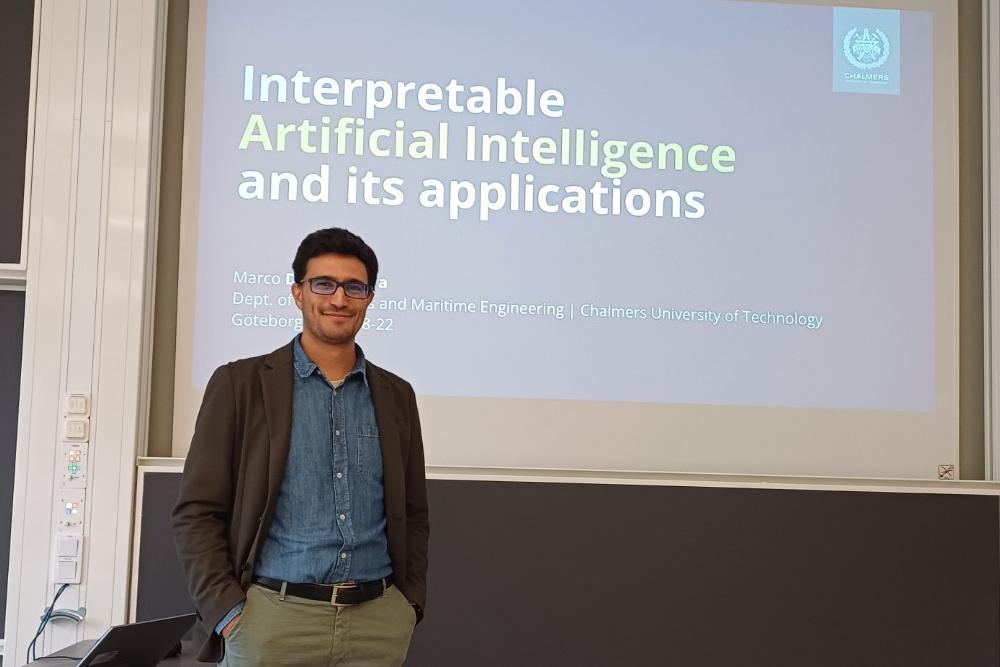
Marco L. Della Vedova is a Senior Lecturer in Applied Artificial Intelligence at Chalmers University of Technology, Sweden. He works in the Vehicle Engineering and Autonomous Systems division within the Department of Mechanics and Maritime Sciences, as part of Prof. Mattias Wahde's research group. Since 2025, he has served as Director of the Data Science and AI master's programme (MPDSC) at Chalmers, where he teaches courses including Introduction to Artificial Intelligence and Digitalization in Sports. Dr. Della Vedova earned his academic foundation at the University of Pavia, Italy, where he completed his BSc (2006), MSc (2009), and PhD (2013) in Computer Engineering. His doctoral research focused on "Real-Time Physical Systems and Electric Load Scheduling" under Prof. Tullio Facchinetti. During his PhD studies, he spent a year at U.C. Berkeley hosted by Prof. Francesco Borrelli at the Model Based Predictive and Distributed Control Lab. His research spans multiple AI domains with a strong emphasis on interpretability. Dr. Della Vedova develops interpretable methods for conversational AI, naturalness evaluation of forests using canopy height models, and geospatial applications. His work bridges theoretical AI with practical societal benefits, particularly in environmental monitoring, transportation systems, and orienteering. He has previously contributed to cloud computing, hate speech detection, and cyber-physical energy systems, demonstrating his interdisciplinary approach to AI research. Dr. Della Vedova's publication record reveals a consistent trajectory of impactful research across multiple domains of artificial intelligence. His recent work shows a strong focus on interpretability in AI systems, with significant contributions to natural language processing, geospatial analysis, and causal inference. The research demonstrates both theoretical depth and practical applications, particularly in environmental monitoring and social media analysis. His methodology often combines traditional machine learning approaches with novel interpretability techniques, creating bridges between complex AI systems and human understanding. Dr. Della Vedova has received several prestigious recognitions for his work: Best PhD thesis award from the Order of the Engineers of Bergamo (2013) Italian champion of Il Cervellone (2012) Top Italian performer in IEEEXtreme 6.0 programming competition (148th overall globally, 2012) Premio Arturo Schena award from Fondazione Credito Valtellinese (2010) With over 50 students supervised through bachelor's and master's theses, Dr. Della Vedova has established himself as a dedicated mentor in the AI community. His current PhD students include Minerva Suvanto working on interpretable NLP and Vivien Lacorre developing AI for railway infrastructure inspection. His supervision spans diverse topics from forest naturalness evaluation to hate speech detection and transportation optimization. Beyond formal supervision, he actively contributes to educational initiatives including serving as Director of Chalmers' Data Science and AI master's program and developing innovative teaching methods that connect theoretical concepts with real-world applications. Dr. Della Vedova is deeply embedded in both academic and professional communities. He leads the Applied Artificial Intelligence research group at Chalmers while maintaining strong connections with European research networks through projects like the ERASMUS+ EUrienteering initiative. His interdisciplinary approach is reflected in collaborations across computer science, environmental science, and social sciences. Notably, he applies his AI expertise to orienteering both as a researcher developing localization methods and as a licensed Event Advisor for the International Orienteering Federation, demonstrating how his professional and personal interests converge in innovative ways.
Karl Palmskog is a Lecturer at KTH Royal Institute of Technology in the Division of Theoretical Computer Science and the STEP research group. His work focuses on program verification and proof engineering, with particular emphasis on developing techniques and tools based on proof assistants for constructing functionally correct and secure software systems. Palmskog received his Ph.D. in Computer Science in 2014 from KTH, advised by Mads Dam, and his M.Sc. in Computer Science and Engineering from KTH in 2007. Prior to his current position, he was a postdoc at The University of Texas at Austin and University of Illinois at Urbana-Champaign. His research interests span programming languages, software engineering, and formal verification, with a particular focus on developing techniques and tools based on proof assistants. He is an avid user of the Coq proof assistant for both proving and programming, often complemented by OCaml, and also utilizes HOL4 and other ML family dialects. His work bridges theoretical foundations with practical applications, particularly in the domains of blockchain systems, distributed systems, and automotive software verification. Analysis of his recent publications reveals a strong focus on Coq-based verification, with significant contributions to proof engineering tools and methodologies. His work includes developing tools for regression proving, change impact analysis, mutation testing for Coq projects, and lemma name suggestion using deep learning. There's also a growing trend toward applying formal methods to real-world systems like blockchain protocols and automotive software. Palmskog has been involved in several research projects, including Coq-community Proof Engineering and Distributed Components. His past projects include Trustfull (SSF), Model-based Event Driven Scalable Programming for the Mobile Cloud (NSF), Highly Adaptable and Trustworthy Software (EU FP7), and 4WARD Future Internet (EU FP7). As an educator, Palmskog has served as examiner, course responsible, teacher, and assistant for various courses including Algorithms, Data Structures and Complexity; Degree Projects; Game Theory; Parallel and Distributed Computing; and Programming Paradigms. His work on Chip, a Coq formalization of change impact analysis, demonstrates his commitment to creating practical, certified tools that bridge formal methods with software engineering practice.
Tobias Dalberg is a Senior Lecturer at Uppsala University's Department of Pedagogy, Didactics and Educational Sociology, with research focusing on sociology of education, social stratification, and higher education policy. His work examines gender differentiation in course selection, curricular blind spots, and historical transformations in academic disciplines. Contact: tobias.dalberg@edu.uu.se | Personal Website Research: Utilizes graph theory, natural language processing, and geometric data analysis for educational pathway studies Current research areas include: Gendered patterns in major selection and course enrollment Educational policy analysis (1950-2020) Academic field institutionalization processes Disciplinary legitimacy struggles (1935-1980) Recent publications (2021-2024) reveal trends in: Higher education marketization and gender segregation Curriculum structure impacts on student trajectories Disciplinary evolution in social sciences and humanities Assessment consistency in educational evaluation As member of international research collaborations, Dalberg works with networks studying educational stratification and transnational academic markets. His methodological contributions include applications of network analysis for studying epidemic spread in educational contexts.
Yvonne Hallesson is an Associate Professor and Senior Lecturer in Swedish at Uppsala University's Department of Nordic Languages, where she serves as Director of Studies for postgraduate education. Her research centers on subject literacy, focusing on students' reading and writing development through school texts across disciplines. Her academic qualifications include: Associate Professor of Swedish, Uppsala University (2021) Senior Lecturer in Swedish Language, Uppsala University (2019–present) Senior Lecturer in Didactics with focus on Swedish, Uppsala University (2016–2019) PhD in Language Didactics, Stockholm University (2015) Licentiate in Educational Science, Stockholm University (2011) Master of Education in Swedish and English, Stockholm University of Education (1999) Hallesson investigates the relationship between language and learning, particularly how students develop subject-specific literacy through text work in social sciences and other disciplines. Her research examines reading comprehension strategies, writing development, and the integration of national minority languages in educational contexts. She analyzes how text properties affect learning across different school subjects and student demographics. Her recent publications reveal consistent focus on subject literacy development, with particular attention to reading comprehension in social sciences and representation of national minority languages in textbooks. Her work demonstrates strong methodological emphasis on discourse analysis and classroom-based research, often involving collaborative teacher-researcher partnerships to bridge theory and practice. Hallesson supervises doctoral students including Jim Stefansson (main supervisor) and Linnea Wenell (assistant supervisor), and mentors numerous graduate students. She has secured significant research funding from the Swedish Research Council for projects including "Läsmetoder under lupp" (2022) and the current "Building subject knowledge in text" (2025-2027). She actively contributes to academic governance as board member of the Department of Nordic Languages and the research network SMDI, and coordinates Uppsala University's subject didactic network for Swedish and Swedish as a second language. She also represents the Swedish Teachers' Association in the Language Care Group.
Hamed Nemati is an Assistant Professor at the Division of Network and Systems Engineering under the School of Electrical Engineering and Computer Science at KTH Royal Institute of Technology in Stockholm, Sweden. He was previously a Visiting Assistant Professor at Stanford University and a Research Group Leader at the Helmholtz Center for Information Security (CISPA) , where he also worked as a PostDoc and Research Fellow. Education : PhD in Computer Science from KTH Royal Institute of Technology Research Interests : Security of systems software, formal methods and program logics, interactive theorem proving, machine code analysis, applied machine learning Current Projects : Systematic verification of multi-language security protocols, hardware-software co-design for Spectre mitigation, capability-based access control models Scientific Awards : WASP (Wallenberg AI, Autonomous Systems and Software Program) faculty member Teaching Activities : Formal Methods in Security (Fall 2020-2023) at CISPA/Saarland University Digital Forensics and Incident Response (EP2780) (Fall 2024) at KTH
Maria Nilsson is a Lecturer in Language Didactics at Stockholm University's Department of Subject Didactics, specializing in English language education for younger students (grades F-3 and 4-6). With a PhD in language didactics defended in 2020, she has established herself as a researcher in primary language education, foreign language anxiety, and classroom interaction dynamics. Her research interests include: Ways to promote oral classroom interaction Teaching in knowledge-heterogeneous classrooms Literature didactics, particularly picturebook read-alouds Teacher education and VFU (school-based education) Collaboration between school and academia Foreign language anxiety and sense of agency among young learners Numerous presentations at international conferences (Krakow, Oxford, Portland, Rio de Janeiro, Shanghai, Groningen, Copenhagen, Vienna, Kristiansand, Växjö, Bolzano, Vasa) demonstrate her active participation in the global language education research community. Her work consistently addresses the challenges of teaching English in primary schools, with particular attention to anxiety, learner engagement, and effective classroom practices. Her recent publications (2019-2024) reveal a strong focus on: The potential of picturebooks to enhance engagement and language learning The challenges of teaching in heterogeneous language classrooms The complex relationship between foreign language anxiety and classroom participation How young learners perceive their agency in language learning contexts Maria Nilsson has made significant contributions to understanding how to create engaging and effective language learning environments for young students. Her work bridges theory and practice, drawing from her extensive background as a primary school teacher (grades 4-9 in Swedish, English, and Spanish) before transitioning to academia. She has previously held a post-doc position at Uppsala University working on interactive reading aloud of multimodal authentic literature and has taught in various teacher education contexts including Lärarlyftet, övningsskoleprojektet, and mentor training programs.