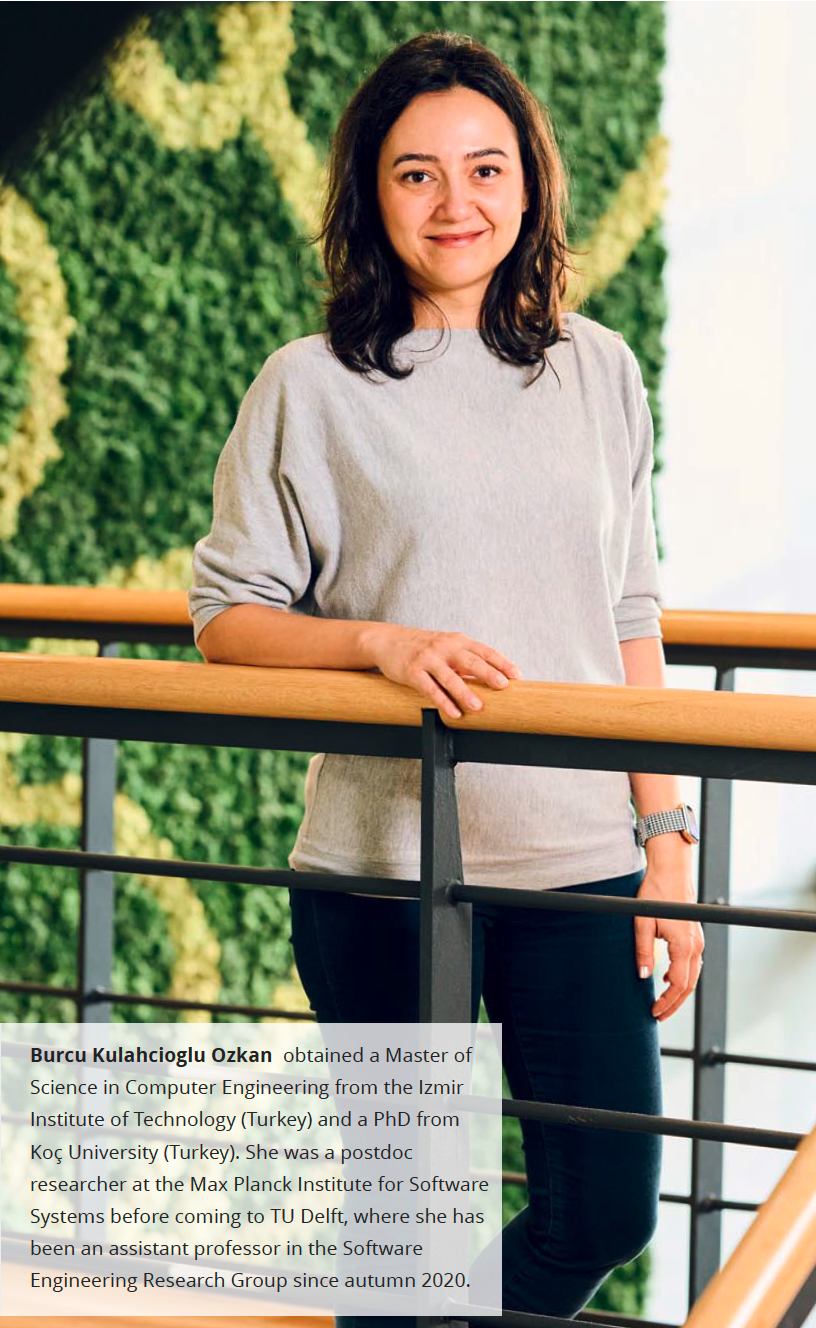
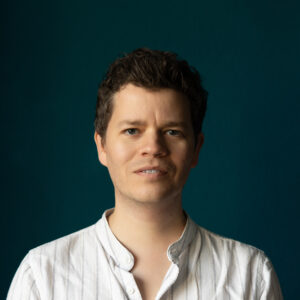
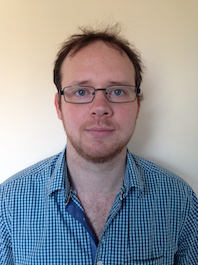
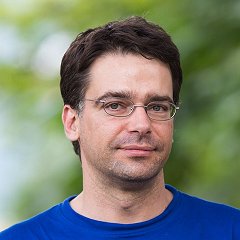
Burcu Kulahcioglu Ozkan is an Assistant Professor and Delft Technology Fellow at the Delft University of Technology (TU Delft) Software Engineering Research Group (SERG). Her research bridges formal methods with software engineering to enhance the reliability of concurrent and distributed systems , with applications in blockchain systems and graph databases . Recipient of Amazon Research Award (2022) and Stellar Academic Research Grant (2023) Founder of the FORSE Lab , focusing on lightweight formal methods for software engineering Co-PI of Ripple’s UBRI program at TU Delft, targeting blockchain testing Co-leader of the TU Delft-JetBrains AI4SE collaboration track Her research spans model checking , debugging , and fuzz testing , addressing challenges in event interleavings and network faults in distributed systems. She has received multiple best paper awards , including OOPSLA’23 Distinguished Paper and ICGT’25 Best Software Science Paper . She serves on program committees for major conferences like ICSE’26 , CAV’25 , and ECOOP’25 , and has delivered invited talks at VLDB Summer School (2025), Sabanci University (2024), and Dagstuhl Seminars (2023).
Przemysław Pawełczak is an Associate Professor at Delft University of Technology within the Embedded and Networked Systems Group. He leads the Sustainable Systems Lab , focusing on battery-free and energy-efficient computing systems. PhD from TU Delft (2009) on Opportunistic Spectrum Access MSc from Wrocław University of Science and Technology (2004) His research centers on Internet of Things sustainability , with emphasis on eliminating batteries and reducing environmental impact. This includes hardware-software co-design for intermittent computing, wireless communication optimization, and quantum network protocols. 2022: DIPS framework for debugging battery-free systems 2022: Protean platform for heterogeneous battery-free computing 2021: BFree Python-based sensor prototyping 2019-2022: Quantum Internet Alliance contributions Key research trends include intermittent execution models , energy-harvesting hardware , and quantum communication protocols . His work spans from theoretical foundations to practical implementations in real-world systems. Scientific recognition includes: Dutch Research Council Veni 2012 grant He has supervised multiple PhD students and postdocs, including: Current: James Scott Broadhead, Jasper de Winkel Graduated: Amjad Yousef Majid (now TU Delft postdoc), Qingzhi Liu (Wageningen University lecturer) Leading projects include: Towards Energy Autonomous Systems for IoT (2016–Now) Quantum Internet Alliance (2019–2022) Low-Energy Visible Light IoT Systems (2019–2021) He coordinates the Sustainable Systems Lab and contributes to academic service through editorial roles and conference committees.
Çağatay Edemen is an Assistant Professor in the Department of Electrical and Electronics Engineering at Özyeğin University's Faculty of Engineering since 2013. His research spans communication theory, optical wireless systems, and next-generation mobile networks with significant contributions to international standards. Education: PhD in Electrical Engineering, Işık University (2014) Master's in Electrical Engineering, Işık University (2006) Bachelor's in Electrical Engineering, Marmara University (2003) Dr. Edemen's research focuses on information-theoretic aspects of multi-user cooperative communication and visible light communication (VLC) applications . His work bridges theoretical analysis with practical implementations, particularly in optical wireless systems for underwater, terrestrial, and vehicular environments. Recent projects explore reconfigurable intelligent surfaces (RIS) for underwater acoustic communication and VLC for electric vehicle charging infrastructure. His publication portfolio shows strong emphasis on optical wireless communication (35%), multi-user cooperative systems (30%), and 5G/6G mobile technologies (25%), with growing interest in underwater and vehicular applications. The most cited works include his IEEE WCNC 2008 Best Paper Award-winning research on three-user cooperative channels. Awards: IEEE WCNC Best Paper Award (2008) IEEE SIU Communication Society Best Paper Award (2024) IEEE Senior Member (2022) MEVICO Silver Award (2013) Dr. Edemen has secured multiple TÜBİTAK and European research grants totaling over $2M, including projects on UAV-based optical wireless backhaul and underwater VLC networks. He currently supervises 7 graduate students across PhD and MS programs, with research focusing on RIS performance, optical channel modeling, and vehicular networking. As executive director of OKATEM (Centre of Excellence in Optical Wireless Communication Technologies), he leads an international research team developing next-generation communication systems for terrestrial, non-terrestrial, and underwater environments. His CT&T Research Group actively collaborates with NYU Abu Dhabi and industry partners on optical wireless communication standards development, with recent patents pending in electric vehicle communication systems and accident notification technologies.
Professor Jacob O. Wobbrock is affiliated with the University of Washington , where he holds a position in the Information School and a courtesy role in the Paul G. Allen School of Computer Science & Engineering . He co-founded the DUB Group and MHCI+D degree , and serves as Interim Director of the MHCI+D program. As director of the ACE Lab and Founding Co-Director Emeritus of the CREATE Center , he leads research in human-computer interaction (HCI) and accessible computing . Education : B.S. in Symbolic Systems (1998), M.S. in Computer Science (2000), Ph.D. in Human-Computer Interaction (2006) Research Focus : Input techniques, performance modeling, mobile and accessible computing, VR, and gesture recognition Awards : ACM Fellow (2021), CHI Academy (2019), NSF CAREER (2010), ICMI/ASSETS/UIST Lasting Impact Awards His 15 most recent articles (2023-2025) explore AI-powered accessibility solutions, tactile 3D modeling, mobile reading adaptations, gesture recognition for motor impairments, and screen reader integration. These works span human-computer interaction , artificial intelligence , biomedical data analysis , and inclusive design in both academic and industry contexts. Scientific honors include the SIGCHI Social Impact Award and AMiner Most Influential Scholar rankings. As an entrepreneur , he co-founded AnswerDash (acquired by CloudEngage) and has contributed to patents and expert witness cases. His teaching and advising have produced doctoral graduates now at institutions like Harvard and CMU, though specific student names are not listed in this profile.
Erwin Laure serves as Director of the Max Planck Computing and Data Facility (MPCDF) and Honorary Professor at the Technical University of Munich (TUM). Previously, he was Professor and Director at KTH Stockholm's PDC Center for High Performance Computing. He holds a PhD from the University of Vienna and brings over 25 years of expertise in High Performance Computing. Educational Background: PhD, University of Vienna His research focuses on parallel and distributed systems , exascale architectures , and computer architecture , with emphasis on programming environments , compilers , and runtime systems for large-scale applications. His work drives European initiatives including EuroHPC and BioExcel Centre of Excellence. Prof. Laure leads MPCDF and participates in major projects: ongoing efforts include SEANERGYS (EuroHPC), PlasmaPEPS, and OpenCUBE; completed projects encompass Time-X, DEEP SEA, and REGALE (all EuroHPC). He teaches core courses in parallel programming, computer architecture, and virtualization across multiple semesters at TUM.
Kim Mens is a Professor at Université catholique de Louvain (UCLouvain), affiliated with the Louvain School of Engineering (EPL), the Institute of Information and Communication Technologies, Electronics and Applied Mathematics (ICTEAM), and specifically the Pôle en ingénierie informatique (INGI). His research spans multiple areas of computer science with a particular focus on context-oriented programming, software engineering, and programming education. Professor Mens' research interests center around context-oriented programming, software evolution, and programming education. His work explores how software systems can dynamically adapt to changing contexts, with applications in self-adaptive systems, feature-based programming, and context-aware applications. In programming education, he investigates how to improve student learning through better feedback mechanisms, pattern mining in student code, and explicit instructional strategies. His recent publications (2022-2025) demonstrate a strong focus on both theoretical and practical aspects of context-oriented systems. His work spans software testing for adaptive systems, program query languages, automated feedback for programming education, and context-aware programming frameworks. His research shows a clear progression from foundational work in context-oriented programming to practical applications in software engineering and education, with increasing integration of AI techniques like BERT for educational applications. Professor Mens actively collaborates with researchers across Europe, particularly in Belgium, the Netherlands, and other European countries. His work appears in top software engineering and programming conferences and journals, demonstrating the significance and impact of his contributions to the field. His current research trajectory suggests continued innovation at the intersection of programming languages, software engineering, and computer science education.
Annie Liu is a Professor of Computer Science at Stony Brook University. Her research spans programming languages, algorithms, and distributed systems, with a focus on formal methods and system assurance. She earned her Ph.D. and M.S. from Cornell University, M.Eng. from Tsinghua University, and B.S. from Peking University, all in Computer Science. Research highlights: Distributed algorithms, logic programming, program analysis, security, and domain-specific language design. Recent publications integrate logic rules with AI, blockchain consensus, and incremental computation. Awards include the SUNY Chancellor's Award for Excellence in Scholarship and a Best Student Paper Award. Teaches courses in programming, algorithms, and distributed systems (e.g., CSE 526, CSE 626). Leads the Design and Analysis Research Laboratory, focusing on optimizing compilers, real-time systems, and big data analysis.
Hassan Sartaj serves as a Postdoctoral Fellow within the Department of Engineering Complex Software Systems at Simula Research Laboratory. His research bridges advanced software engineering methodologies with critical healthcare applications, focusing on medical device safety and reliability through innovative digital twin frameworks. His research profile centers on AI-driven software engineering for healthcare systems , with core expertise in digital twin creation , uncertainty-aware simulation , and LLM-enhanced testing . Key contributions include developing meta-learning approaches for medical device digital twins (MeDeT) and quantum extreme learning machines for practical software testing. His work consistently addresses real-world challenges in healthcare IoT, particularly in medicine dispensers and cancer registry systems, emphasizing safety-critical validation. Analysis of his 15 most recent publications reveals a dominant trend toward integrating foundation models with cyber-physical systems engineering . Over 70% of his 2024-2025 output explores LLMs for uncertainty identification in self-adaptive robotics, differential testing of medical rule engines, and environment simulation for digital twins. This reflects a strategic pivot toward leveraging generative AI for validating safety-critical healthcare software, with strong emphasis on practical DevOps implementation in evolving healthcare applications.
Laura Titolo is a Principal Research Scientist at Code Metal, where she applies formal methods to enhance the reliability of code transpilation for edge computing applications. Previously, she served as a Lead Research Scientist at NASA Langley Research Center, contributing to the NASA Formal Methods team in the Safety-Critical Avionics Systems Branch. She holds a Ph.D. in Computer Science from the University of Udine, Italy, where she also earned her BSc and MSc with full honors. Ph.D. in Computer Science, University of Udine, Italy (2014) MSc in Computer Science, University of Udine, Italy (2010) BSc in Computer Science, University of Udine, Italy (2008) Her research centers on formal methods, static analysis, abstract interpretation, and computational logic, with a focus on verifying floating-point programs and safety-critical systems. She has developed key tools such as PRECiSA for round-off error analysis and ReFlow for extracting verified floating-point C code from formal specifications. Her work ensures robustness in numerical computations essential for avionics and autonomous systems. The 15 most recent publications reflect a strong trend in formal verification of numerical software, particularly floating-point arithmetic in safety-critical domains like avionics. Her work integrates abstract interpretation, theorem proving (PVS), and static analysis to detect and correct numerical instabilities, ensure control flow correctness, and generate formally verified code. Applications span air traffic algorithms, geofencing, and autonomous flight monitoring. Scientific awards include: NASA Group Achievement Award (2021) for verifying the Compact Position Reporting Algorithm Laura Titolo actively contributes to the academic community through program committee roles and leadership. She has served as Program Co-Chair for SOAP 2022, General Chair for NFM 2025, and PC member for numerous conferences including POPL, CPP, VMCAI, SAS, and PLDI. She mentors junior researchers and collaborates extensively with teams at NASA and academic institutions. Her current work at Code Metal extends formal methods to transpiled code in edge computing, ensuring correctness in distributed and resource-constrained environments. She leads and contributes to several research projects: PRECiSA: Static analyzer for floating-point round-off errors with PVS proof certificates ReFlow: Tool for extracting floating-point C code from PVS real-number specifications VSCode-PRECiSA: Integration of PRECiSA into Visual Studio Code FRET Proof Framework: PVS formalization of FRETish requirements FPRoCK: Solver for mixed real and floating-point constraints
Benjamin Kaminski is a Professor at Saarland University and a Lecturer at University College London, where he contributes to the field of computer science with a strong emphasis on formal verification and logic. He is currently the Head of the Examination Board for the B.Sc. in Computer Science (English) program at Saarland University and actively supervises PhD, Master’s, and Bachelor’s students in research projects related to logic and verification. His research centers on the quantitative aspects of formal program verification , particularly in probabilistic and quantum programs. Key interests include weakest-precondition reasoning, expected runtimes, incorrectness logic, and the integration of machine learning with formal methods. He advocates for explainable verification and explores non-classical models such as weighted programming. His recent publications reflect a consistent focus on probabilistic semantics , runtime analysis , and deductive verification of programs, utilizing formal logic and mathematical structures to ensure correctness and efficiency. These works span high-impact venues such as POPL, LICS, and JACM. Ackermann Award for outstanding dissertations 2020 Distinguished Paper at POPL 2021 Best Paper Award at LOPSTR 2020 EATCS Best Paper Award at ESOP 2016 Borchers Badge for doctoral distinction 2019 Best scientific production award at Université Paris-Saclay 2022 Benjamin Kaminski has advised numerous students at various levels, including current PhD candidates Tobias Gürtler, Lena Verscht, Anran Wang, and Linpeng Zhang. He has served on program committees for top conferences such as POPL, CAV, LICS, and ICALP, and has reviewed for prestigious journals including Journal of the ACM and TOPLAS . He has also evaluated research proposals for the Israel Science Foundation and Czech Science Foundation, highlighting his role in shaping global research agendas. His editorial work includes contributions to Foundations of Programming and Software Systems (2019). He is actively involved in the formal methods research community, contributing to workshops and symposia on static analysis, dependable software engineering, and quantitative evaluation of systems. His leadership in organizing and reviewing for major conferences underscores his influence in theoretical computer science.
Willard Rafnsson is an Associate Professor in the Department of Computer Science at the IT University of Copenhagen (ITU), where he conducts research in language-based security, programming-language theory, and formal methods. He is a member of the Center for Information Security and Trust (CISAT), the Programming, Logic and Semantics (PLS) group, and the Software Quality Research (SQUARE) group. He has held visiting and postdoctoral positions at Carnegie Mellon University and the Max Planck Institute for Software Systems. His research focuses on enabling developers to build trustworthy software through program analysis, transformation, and information-flow control. He has led and contributed to multiple funded projects in cybersecurity, including static analysis for JavaScript, privacy risk modeling, and secure software education. His recent publications span top venues in security and programming languages, demonstrating a consistent focus on formal techniques for enforcing security policies and quantifying privacy risks. Willard Rafnsson has served on program committees for IEEE SecDev, NordSec, FORTE, POST, and FCS, and regularly peer-reviews for CCS, S&P, CSF, NDSS, and other leading journals and conferences. He teaches courses in operating systems, program verification, and information security, and has developed educational materials for public cybersecurity awareness. PhD: Chalmers University, supervised by Andrei Sabelfeld Postdoc: Max Planck Institute for Software Systems (Deepak Garg), Carnegie Mellon University (Limin Jia, Lujo Bauer) Visiting Researcher: Carnegie Mellon University (Stephanie Balzer, 2022) He actively supervises student projects in areas such as binary analysis, vulnerability fixing, formal verification, and privacy risk visualization, many of which have led to publications. He is also involved in public outreach, having participated in media interviews and educational videos on cybersecurity topics.
Daniel Neider is a Professor in the Department of Computer Science at TU Dortmund University, where he leads research on Verification and Formal Guarantees of Machine Learning. He is also affiliated with the Center for Trustworthy Data Science and Security at the University Alliance Ruhr and has previously held a research group leader position at the Max Planck Institute for Software Systems, Kaiserslautern. He teaches courses at both TU Dortmund and RPTU Kaiserslautern and is a principal investigator in multiple research projects. Research Interests: Daniel Neider's research lies at the intersection of machine learning and formal methods, with a focus on ensuring the safety, reliability, and trustworthiness of AI systems. His work combines symbolic reasoning from logic with inductive techniques from machine learning to develop automated tools for verification, synthesis, and explainability. Key areas include the verification of learning systems (e.g., robustness of neural networks), explainability of AI decisions, learning-based synthesis of reactive systems, specification learning, and the integration of automata learning into reinforcement learning. His theoretical work extends into automata theory, game theory, and logic. Publication Trends: His recent publications show a strong emphasis on neuro-symbolic methods, temporal logic inference, robustness certification of neural networks, and learning-based verification. He frequently publishes in top venues such as AAAI, IJCAI, TACAS, FMCAD, and CAV, reflecting his leadership in both AI and formal methods communities. Scientific Awards: No specific awards are mentioned in the provided text. Advising and Grants: Daniel Neider supervises numerous Master's and Bachelor's students and advises PhD candidates, particularly on topics combining formal methods with AI. He is a principal investigator in several funded projects, including the DFG-funded Temporal Logic Sketching and the DAAD-supported LeaRNNify , which explore specification assistance and the synergy between grammatical inference and neural network learning. Labs and Teams: He leads a research group focused on building practical tools for trustworthy AI. The group has developed influential software such as ICE, Horn-ICE, libalf, and QUGA, which are used for invariant synthesis, program verification, automata learning, and verification of deep autoencoders. These tools are publicly available on GitHub and Bitbucket, and some are accessible via web demos.
Giles Reger is a Senior Lecturer in the School of Computer Science at the University of Manchester , affiliated with the Formal Methods Group . His academic journey includes a BA in Computer Science from the University of Cambridge (2009), an MSc in Advanced Computer Science (University of Manchester, 2010) with the Highest Achiever of the Year Award , and a PhD (University of Manchester, 2014) on runtime verification. Research Interests: Theorem Proving (via Vampire system) and Runtime Verification (via MarQ and VyPR tools). Collaborations: Projects with University of Oxford, ARM, AWS, CERN, and SnT Luxembourg. Recent Work: Giles' publications span 2019-2016, focusing on Vampire's higher-order reasoning, symmetry avoidance in finite model finding, neural guidance in theorem proving, and runtime verification for Python web services (VyPR2). Trends include integrating machine learning with formal methods and advancing logic-based verification tools. Scientific Awards: Highest Achiever of the Year Award (MSc, University of Manchester, 2010) Vampire's multiple trophies at CASC and SMT-COMP competitions Advising: Supervises PhD students Michael Rawson, Ahmed Bhayat, and Joshua Dawes. Labs/Teams: Contributes to the Vampire team and the VyPR project.
Sam Tobin-Hochstadt is an Assistant Professor at the School of Informatics & Computing, Indiana University, with a focus on programming languages and systems. He is affiliated with the Department of Computer Science and actively contributes to the Racket and JavaScript language ecosystems. Research: Design and implementation of programming systems, particularly languages enabling software evolution (e.g., Racket, Typed Racket, JavaScript). Teaching: Courses like C211, P632, and honors sections of CS 2510. Collaborations: Mozilla Research, Sun Labs Programming Language Research Group. His research spans gradual typing , DSL implementation , compiler design , and parallel programming , with recent work on build systems and probabilistic programming. While specific scientific awards aren't listed, his contributions to PLDI, POPL, and other program committees highlight his field prominence. He mentors Ph.D. students at Indiana University and has organized academic events like IFL 2014. Personal interests include Ultimate and outdoor activities, alongside his wife Katie Edmonds' post-doc work in chemistry.
Walter Binder is a Professor at the University of Lugano, Switzerland, specializing in performance analysis and optimization of Java-based and parallel systems. He has actively contributed to academic committees in conferences such as GPCE, CGO, and ‹Programming›, focusing on virtual machine efficiency, compiler design, and benchmarking methodologies. His research centers on performance profiling tools for the Java Virtual Machine (JVM), including the development of the P3 profiler suite for parallel applications and the Renaissance benchmark suite. Key areas of interest include concurrency, synchronization, dynamic compilation, and multi-language program analysis, with applications in big data processing and stream computing frameworks. Recent publications highlight trends in compiler-level event profiling, AST interpreter optimization, and SQL-to-stream benchmark generation. These works span subfields like SIMD vectorization, task granularity analysis, and native-image startup performance, emphasizing platform independence and low overhead. Notable tools and methodologies developed by Binder have been instrumental in advancing JVM-based parallel computing research. His contributions extend to automated large-scale analysis of public code repositories and performance coaching for fork/join applications.