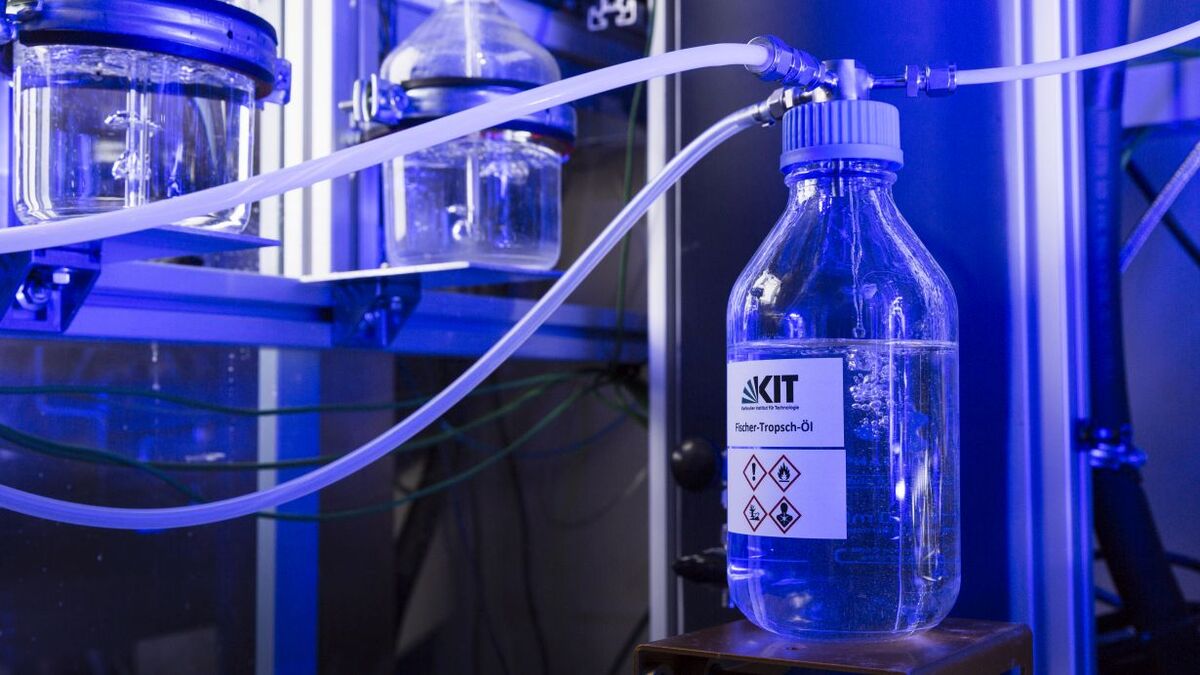
Prof. Jörg Sauer is the head of the Institute for Catalysis Research and Technology (IKFT) at Karlsruhe Institute of Technology (KIT). His research focuses on developing resource- and energy-efficient processes for renewable synthetic fuels, aiming to enable CO2-neutral mobility and climate-friendly chemical industry supply chains. Active in Power-to-X research for CO2 utilization Spokesperson for Helmholtz program MTET Collaborates with automotive, energy, and chemical industries His team combines experimental methods with process simulations to create next-generation catalytic systems for applications like diesel engines, aviation fuels, and chemical intermediates. Current projects include reFuels (funded by Baden-Württemberg government) and bioliq (64M€ investment for straw-based hydrocarbon production). As spokesperson for KIT's Reaction Engineering Division at DECHEMA, he drives cross-industry research partnerships in Europe, Canada, and the USA. The institute's work targets future green refinery concepts and sustainable diesel additives (OMEs) that reduce emissions trade-offs.
Thomas Banchoff is Director of the Berkley Center for Religion, Peace, and World Affairs and serves as Vice President for Global Engagement at Georgetown University, where he holds a professorship in both the Department of Government and the Walsh School of Foreign Service. His leadership combines academic scholarship with practical global engagement initiatives that address critical contemporary challenges. Georgetown University: Professor, Department of Government and Walsh School of Foreign Service Berkley Center: Director University Administration: Vice President for Global Engagement Banchoff earned his B.A. from Yale University (1986), M.A. from the University of Bonn (1988), and Ph.D. in Politics from Princeton University (1993). His scholarly development was enriched by prestigious fellowships including Harvard's James Bryant Conant Post-Doctoral Fellowship (1997-1998) and a Humboldt Fellowship at the University of Bonn (2000-2001). His research focuses on ethical and religious dimensions of global politics, with particular expertise in Catholic Social Teaching's application to contemporary challenges. Banchoff's scholarly trajectory evolved from European politics (evidenced by early works like The German Problem Transformed ) to contemporary analyses of religion's role in global governance. His current work emphasizes Pope Francis's "culture of encounter" concept across international relations, education, and interfaith dialogue. Recent scholarship increasingly addresses democratic erosion, AI ethics from religious perspectives, and Jesuit higher education's contribution to global citizenship. Analysis of his publication history reveals thematic progression toward practical applications of religious perspectives to global challenges. His recent work demonstrates engagement with urgent issues including democratic backsliding (as seen in his moderation of the 2025 IAJU Assembly panel on Nicaragua and Lebanon), AI ethics, and interfaith collaboration in conflict zones. DAAD Prize for Distinguished Scholarship in German studies (2003) Banchoff directs the IAJU Global Citizenship Fellows Program, which engages over 2,000 students across 60+ institutions in 20+ countries. His leadership extends to significant initiatives including Catholic Social Teaching and the Global Future of Development, Faith and the Global Agenda, and Religious Pluralism in World Affairs. Upcoming engagements include "Nostra Aetate at 60" (September 2025) and "Pope Francis: A Legacy of Human Fraternity" (August 2025), reflecting the continued relevance of his work at the intersection of religion, politics, and global challenges.
Mohammad Hamdaqa is an Associate Professor in the Department of Computer Engineering and Software Engineering at Polytechnique Montréal, where he leads the Laboratory of Software and Emerging Technologies. His academic journey includes a Ph.D. in Electrical and Computer Engineering from the University of Waterloo (2016), a Master's in Electrical and Computer Engineering from Concordia University, an MBA from the New York Institute of Technology, and a Bachelor's in Computer Engineering from Jordan University of Science and Technology. His research focuses on the intersection of software engineering and emerging technologies, particularly examining how software engineering approaches can be adapted for complex new platforms like cloud computing and blockchain. His work spans model-driven software engineering, cloud application architecture, smart contract development, and infrastructure as code. He investigates both how traditional software engineering practices can evolve to address the challenges of modern distributed systems and how emerging technologies can transform software development processes themselves. Analysis of his recent publications reveals a strong emphasis on blockchain technologies (particularly smart contracts), cloud-native applications, and the application of AI to software engineering tasks. His work shows a consistent thread of empirical research combined with practical tool development, with increasing focus on sustainability aspects of software systems in recent years. Much of his research bridges theoretical foundations with practical implementation concerns. Professor Hamdaqa serves as a thesis supervisor for multiple graduate students, with recent completed Master's theses focusing on smart contract auditing, prompt engineering for OCL generation, model-driven epidemiology, and security practices in infrastructure as code. He actively recruits students for research projects in his laboratory. He is a member of both the IEEE Computer Society and the Association for Computing Machinery (ACM), has served on program committees for major software engineering conferences, and is on the editorial board of Service Transaction on Internet of Thing. His laboratory, the Laboratory of Software and Emerging Technologies, serves as the hub for his research activities in blockchain, cloud computing, and model-driven engineering.
Daniel Shanahan is an Associate Professor at the Bienen School of Music , Northwestern University , where he coordinates the Music Theory and Cognition program and directs the Music Cognition Lab. He holds a PhD from the University of Dublin, Trinity College. His research integrates music-analytic, computational, and experimental methodologies to investigate cognitive and communicative constraints in music. Key themes include corpus studies, music and emotion, oral transmission of musical traditions, computational analysis of jazz and folk music , and the application of machine learning and generative AI to musicology. Shanahan has served as co-editor of Empirical Musicology Review (2016–2022) and sits on editorial boards of multiple journals. His work appears in Music Perception , The Journal of New Music Research , Musicae Scientiae , and Frontiers in Psychology , with chapters in Routledge Companions and the Oxford Handbook of Music and Corpus Studies . Recent projects include an NSF grant studying sound's impact on learning (2023) and co-editing the Oxford Handbook . He currently serves as treasurer for the Society for Music Perception and Cognition . Mentorship Award (Society for Music Perception and Cognition, 2024) Outstanding Multi-Author Collection Award (Society for Music Theory, 2023) Distinguished Scholar Award (Ohio State University) Rising Faculty Research & Undergraduate Teaching Awards (Louisiana State University) His publications demonstrate expertise in music cognition, computational analysis, emotional expression, and oral/embodied transmission , with trends showing interdisciplinary applications of AI and cross-cultural studies. Shanahan's mentorship emphasizes student well-being, empathetic guidance, and fostering academic potential . He has hosted global open lab meetings during the pandemic and cultivated mentees who now contribute to service roles in academic committees.
Professor Vinayak Dixit serves as the IAG Chair of Risk in Smart Cities and Director of the Research Centre for Integrated Transport Innovation (rCITI) at the University of New South Wales (UNSW), within the School of Civil and Environmental Engineering. With a distinguished career spanning academia and research leadership, Professor Dixit has established himself as a leading expert in transportation risk analysis and smart city infrastructure. Professor Dixit's research focuses on studying risk in transportation infrastructure systems, with particular emphasis on highway safety, travel time uncertainty, and resilience against natural and man-made disasters. His work integrates cutting-edge approaches including quantum computing applications for transportation network optimization, analysis of connected and automated vehicles, and development of models for transportation resilience. His research interests span multiple disciplines, bridging civil engineering, transportation science, risk analysis, and computational methods. Professor Dixit has secured significant research funding from prestigious organizations including the United States National Science Foundation, Federal Highway Administration, and the Strategic Highway Research Program of the Transportation Research Board. His leadership extends to directing the Research Centre for Integrated Transport Innovation (rCITI), where he oversees a comprehensive research program addressing critical transportation challenges in smart cities through multiple focus areas including Connected Mobility Services, Deep Data and Digitization, Engineering Smart Cities & Logistics, Human-Centred And Automated Systems Design, and Integrated Infrastructure Strategic Planning. Professor Dixit previously served as the Associate Director of Research for the Gulf Coast Centre for Evacuation and Transportation Resiliency at Louisiana State University, where he founded the Driving Simulator Laboratory in collaboration with other faculty members. This demonstrates his longstanding commitment to innovative research infrastructure development and interdisciplinary collaboration across engineering, economics, computer science, and urban planning to address complex transportation challenges in the 21st century.
Professor Jagmohan S. Raju serves as the Joseph J. Aresty Professor of Marketing at the University of Pennsylvania's Wharton School, where he also directs the Wharton Co-Sponsorship of the Indian School of Business. An internationally renowned pricing expert, he has taught extensively across Wharton's MBA, EMBA, and Executive Education programs and previously served as Vice Dean of Executive Education for six years. His academic credentials include a PhD in Business, MS in Operations Research, and MA in Economics from Stanford University, complemented by an MBA from the Indian Institute of Management Ahmedabad and a BTech in Electrical Engineering from the Indian Institute of Technology Delhi. Raju's research focuses on pricing strategy , retailing dynamics , and competitive positioning , with significant contributions to understanding private labels, coupon economics, and strategic channel management. His work bridges theoretical rigor with practical applications, frequently addressing real-world challenges in product launches and market competition through game-theoretic and empirical approaches. Recent publications reveal evolving expertise in digital-era retail challenges, particularly showrooming behavior, omnichannel competition, and the strategic implications of network neutrality. His scholarship consistently addresses the intersection of consumer psychology and corporate strategy across diverse sectors including pharmaceuticals, entertainment, and consumer goods. Fellow, INFORMS Society for Marketing Science (2017) Multiple Excellence in Teaching Awards (2012, 2011, 2009) Miller-Sherrerd MBA Core Course Teaching Award (2006) President of INFORMS Society for Marketing Science (2004) Marketing Professor of the Year at UCLA (1992) As an educator, Raju directs flagship executive programs including the General Management Program and Owner/President/CEO Program, while consulting for industry leaders like Johnson & Johnson, Medtronic, and Warner Home Video on pricing architecture and new product launches. His research grants and industry projects frequently examine category management dynamics and the strategic value of customer heterogeneity. He spearheads the Wharton-Indian School of Business partnership, fostering academic exchange and executive development initiatives that leverage his deep expertise in India's business landscape and global market dynamics.
Dr Brandon M Grainger is an Eaton Faculty Fellow and Associate Professor of Electrical and Computer Engineering at the University of Pittsburgh’s Swanson School of Engineering, where he also directs the Electric Power Technologies Laboratory, serves as Associate Director of the Energy GRID Institute, and co-directs Pitt AMPED. A key architect of Pitt’s electric power program since 2008, he focuses on advanced power conversion, high-voltage electronics, wide-band-gap semiconductors, and aerospace power systems. Education PhD, Electrical Engineering (Power Conversion), University of Pittsburgh, 2014 MS, Electrical Engineering, University of Pittsburgh, 2011 BS, Mechanical Engineering & Minor in Electrical Engineering, University of Pittsburgh, 2007 Executive Education Certificate, Tepper School of Business, Carnegie Mellon University, 2019 Research Focus Dr Grainger’s work lies at the intersection of power electronics, high-voltage engineering, and sustainable energy systems. He specializes in medium- and high-voltage power electronics (HVDC, STATCOM), resonant converters, and ultra-high-power-density designs leveraging SiC and GaN semiconductors. His investigations extend to electric-vehicle traction drives, solid-state transformers, optimized magnetics for aerospace applications, and resilient microgrids. He and his students routinely collaborate with NASA JPL, Johns Hopkins APL, Honeywell Aerospace, and the Naval Research Laboratory, leveraging Pitt’s NSF SHREC center to push the boundaries of power conversion in space and defense systems. Selected Research Themes High-frequency, high-density DC/DC converters for satellite power systems Radiation-tolerant GaN converters and point-of-load power stages Medium-voltage testbed development (13.8 kV, 5 MVA) Rare-earth-free permanent-magnet machine topologies Model-predictive control of multi-phase drives and microgrids Honors & Awards 2024 IEEE Region 2 Outstanding Educator Award 2024 Pitt STRIVE Outstanding DEI Service Award 2019 ESWP Engineer of the Year 2019 ASEE 2nd Place Best Paper Award 2019 SRI Undergraduate Best Mentor Award Richard K. Mellon Endowed Graduate Fellowship National Academies of Science & Engineering Ambassador Senior Member, IEEE Grants & Industry Partnerships Dr Grainger’s research has been continuously funded by federal agencies and industry partners including NASA JPL, Johns Hopkins APL, Honeywell Aerospace, the Naval Research Laboratory, Eaton, and the National Science Foundation through the SHREC Center. These awards support graduate students and post-docs working on next-generation power systems for aerospace, naval, and terrestrial applications. Laboratories & Teams Director, Electric Power Technologies Laboratory (EPTL) Associate Director, Energy GRID Institute Co-Director, Pitt AMPED (Advanced Multimodal Power and Energy Development) Faculty Affiliate, NSF SHREC Center
Michael Ferdman is an Associate Professor in the Department of Computer Science at Stony Brook University, where he leads research in computer architecture and systems. His office is located in Room 343 at Stony Brook, NY 11794-2424, and he can be contacted via phone (631-632-8449) or email. Ferdman directs the Computer Architecture and Systems Laboratory (compas.cs.stonybrook.edu), focusing on next-generation server infrastructure. Ferdman's research spans the entire computing stack with emphasis on: FPGA integration for server environments (Intel HARP, Microsoft Catapult) Machine learning accelerators for convolutional neural networks Server systems optimization in the post-Moore era Network processing and software-defined networking Programming models for emerging memory technologies (HBM, 3D XPoint) Reconfigurable hardware and high-level synthesis His work addresses both performance and security challenges in modern computing infrastructure. Analysis of his 15 most recent publications (2022-2025) reveals consistent focus on: Hardware acceleration techniques (FPGAs, specialized processors) Memory hierarchy optimization and cache management Security vulnerabilities in web applications and systems Post-Moore computing architectures Parallel processing and distributed systems His research shows strong emphasis on practical implementations bridging hardware and software layers. Awards recognizing his contributions include: Graduate Teaching Award (2014) Best Paper Award at ASPLOS XVII Best Paper Finalist at HPCA XVII Three IEEE Micro Top Picks selections (2009, 2012) He teaches advanced courses including CSE 502, CSE 602, and CSE 506 at Stony Brook University.
Nicholas Ng-A-Fook is a Full Professor in the Faculty of Education at the University of Ottawa, where he has served as former Associate Dean of Graduate Studies and Director of Teacher Education and Indigenous Teacher Education Programs. His work is deeply engaged with the Truth and Reconciliation Commission's 94 Calls to Action, working in partnership with Indigenous communities and school boards to disrupt colonialism, systemic racisms, and inequalities in educational curricula. Dr. Ng-A-Fook's educational background includes a Ph.D. in Curriculum and Instruction from Louisiana State University (2006), an M.A. in Education (Multicultural Education) from York University (2001), a Graduate Diploma in Education (Secondary Science and History) from the University of Western Sydney (1998), and a B.A. in Classical Studies from the University of Ottawa (1996). His research interests span Curriculum Studies, History of Education (particularly oral history), Life-writing research (autobiography and narrative inquiry), Critical Youth Studies (focusing on first-generation immigrant and Indigenous youth), Community-based research, and Contemporary perspectives in philosophy, science and technology including AI, genomic education, and anti-racist science education. Dr. Ng-A-Fook approaches his work as a curriculum theorist who draws on life writing research methodologies to co-create culturally responsive, relevant, and relational curriculum with educators. Dr. Ng-A-Fook's publications reveal a strong focus on reconciliation education, decolonizing curriculum, and addressing systemic racism in educational contexts. His work increasingly engages with digital technologies and artificial intelligence from a critical, decolonial perspective, examining how these technologies intersect with historical and ongoing colonial structures. His research shows a clear evolution toward more interdisciplinary work connecting curriculum studies with Indigenous knowledge systems, technology studies, and social justice movements. Among his notable honors are the 2024 Coutts Prize, the Ted T. Aoki Distinguished Service Award (2018), and the R.W.B. Jackson Award for an outstanding article in the Canadian Journal of Education. He also serves as Director of the EdCan Network and was Past-President of the Canadian Society for the Study of Education. As a supervisor, Dr. Ng-A-Fook currently mentors several graduate students including Melissa Daoust, Lisa Ambaye, Bahareh Samsamiardekani, and Madelaine McCracken. He created the FooknConversation podcast to address educational challenges with colleagues, community activists, artists, education leaders, teachers, and politicians, and maintains the Canadian Curriculum Theory Project website as a resource for his research.
Christopher Ferrie is an Associate Professor at the University of Technology Sydney (UTS), where he is affiliated with the Faculty of Engineering and Information Technology and the Centre for Quantum Software and Information (QSI). His academic career spans quantum information science, machine learning, and scientific education, with a strong emphasis on both theoretical research and public engagement through science communication. Full-time faculty member at UTS Active researcher in quantum information science Director of the Centre for Quantum Software and Information Author of numerous scientific publications and popular science books Dr. Ferrie earned his PhD in Applied Mathematics from the Institute for Quantum Computing and University of Waterloo in Canada in 2012. His doctoral work focused on quantum information and laid the foundation for his subsequent research career in quantum computing and related fields. Dr. Ferrie's research interests span several interconnected domains within quantum information science. His primary focus is on quantum estimation and control, with particular emphasis on applying machine learning techniques to solve statistical problems in quantum information science. He investigates how quantum systems can be characterized, controlled, and optimized for practical applications. His work bridges theoretical quantum physics with practical implementations, exploring how quantum phenomena can be harnessed for computational advantage. Recent research directions include quantum machine learning, quantum neural networks, and quantum optimization algorithms, with applications ranging from quantum state tomography to solving combinatorial optimization problems. Analysis of Dr. Ferrie's recent publications reveals a strong focus on practical quantum computing challenges. His work consistently addresses the intersection of quantum information theory and machine learning, with particular emphasis on making quantum algorithms more efficient, interpretable, and robust against noise. A significant portion of his recent research explores variational quantum algorithms and their optimization, reflecting the current priorities in near-term quantum computing. His publications also demonstrate growing interest in quantum machine learning applications and the development of techniques for quantum error mitigation and characterization. Dr. Ferrie has secured multiple research grants supporting his work in quantum computing and related fields. His funded projects span quantum control, quantum probability, quantum machine learning, and statistical decision theory, reflecting the breadth of his research program. While specific major awards aren't detailed in the available information, his sustained funding and publication record indicate significant recognition within the quantum information science community. Dr. Ferrie is actively involved in research supervision and teaching, with current funding supporting multiple PhD students and postdoctoral researchers. His teaching responsibilities include courses on quantum computing, where he introduces students to the fundamentals of quantum information processing. His research group at the Centre for Quantum Software and Information focuses on developing novel quantum algorithms and exploring the practical implementation challenges of quantum computing. The Centre for Quantum Software and Information at UTS serves as the primary research environment for Dr. Ferrie's work. This center brings together researchers working on various aspects of quantum computing, from hardware development to algorithm design and applications. Dr. Ferrie's team within the center focuses specifically on quantum software development, quantum algorithm design, and the application of machine learning techniques to quantum information problems. The collaborative environment enables interdisciplinary research that bridges theoretical quantum physics with practical computing applications.
Jeff Linderoth is the Harvey D. Spangler Professor in the Department of Industrial and Systems Engineering at the University of Wisconsin-Madison. His research focuses on large-scale numerical optimization, mixed-integer nonlinear programming, and stochastic programming, with applications in energy systems, global routing, and industrial processes. Education: BS in General Engineering (highest honors) from University of Illinois at Urbana-Champaign, MS in Operations Research from Georgia Institute of Technology, PhD in Industrial Engineering from Georgia Institute of Technology. Linderoth's work addresses theoretical and applied challenges in optimization, including developing algorithms for mixed-integer programming, analyzing knapsack polytopes, and creating tools like the Minotaur optimization toolkit. His recent publications explore integer programming techniques for subspace clustering, complementarity constraints, and customized coverage instrumentation. Selected trends in his research include advancements in stochastic programming, orbital branching for symmetric integer programs, and congestion analysis in power systems. His group contributes to optimization software and data-driven libraries like MIPLIB. Scientific Award: Harvey D. Spangler Professor.
Marjo Yliperttula is a Professor at the Department of Pharmaceutical Biosciences, Faculty of Pharmacy, University of Helsinki. She serves as a supervisor in the Doctoral Programmes in Biomedicine, Drug Research, and Materials Research and Nanosciences, with expertise in biomaterials and pharmaceutical technology. Her research focuses on nanofibrillated cellulose (NFC) hydrogels for wound healing and drug delivery, extracellular vesicle (EV) engineering for therapeutic applications, and freeze-drying technologies for biomaterial preservation. Key contributions include NFC-based wound dressings that enhance platelet-rich plasma release (2024), Raman spectroscopy methods for monitoring freeze-drying-induced mutarotation (2024), and tandem chromatography techniques for high-purity EV isolation (2023). Her work bridges pharmaceutical sciences with regenerative medicine, emphasizing translational applications in chronic wound treatment and targeted drug delivery. Recent publications (2022-2025) reveal three dominant trends: (1) Optimization of NFC hydrogels for controlled drug release and tissue regeneration, (2) Advanced characterization of EV phenotypes under hypoxic conditions for improved therapeutic efficacy, and (3) Development of analytical methods (Raman spectroscopy, chromatography) to address manufacturing challenges in biopharmaceuticals. These themes reflect her group's commitment to solving critical problems in biomaterial stability, EV-based delivery, and precision wound care. Professor Yliperttula has supervised 10 doctoral theses, including recent work on NFC for skin substitutes (Elle Koivunotko), freeze-drying of hydrogels (Arto Merivaara), and mesenchymal stromal cells for wound healing (Jasmi Snirvi). She currently leads the Academy of Finland-funded GeneCellNa project (2024-2026) on gene/cell/nanotherapy for chronic diseases and a Finnish Red Cross project (2023-2024) on NFC for blood products, with cumulative project funding spanning 18 initiatives since 2005. She heads the Biopharmaceuticals Group within the Drug Research Program, fostering collaborations across pharmaceutical biosciences, materials science, and clinical medicine to advance next-generation therapeutic platforms.
Albert Atserias is a Professor in the Department of Computer Science at the Universitat Politècnica de Catalunya (UPC), affiliated with the Faculty of Informatics of Barcelona (FIB) and the ALBCOM research group (Algorithms, Bioinformatics, Complexity, and Formal Methods). He is also associated with the Institut de Matemàtiques de la UPC-BarcelonaTech. His research is central to theoretical computer science, with a strong emphasis on logic and complexity. Atserias's research interests span Computational Complexity, Logic in Computer Science, Finite Model Theory, Proof Complexity, and Constraint Satisfaction Problems . His work explores the fundamental limits of computation, the expressive power of logical languages over finite structures, and the complexity of proving mathematical statements. He investigates the algebraic and combinatorial properties of proof systems, the limits of efficient algorithms for constraint solving, and the theoretical foundations of databases. His research often bridges logic, algebra, and combinatorics to provide deep insights into computational phenomena. The trends in his recent publications show a sustained focus on the logical and algebraic underpinnings of computational problems. Key themes include the consistency and complexity of database queries , the power and limitations of proof systems (like resolution and sum-of-squares), and the expressive power of homomorphism counts in graph theory. His work on the hardness of automating resolution and the development of circular proof systems are particularly significant contributions to proof complexity. The 2024 PODS Best Paper Award for work on relational consistency underscores the impact and timeliness of his research. Among his notable scientific awards are the prestigious ICREA Acadèmia , the PODS 2024 Best Paper Award , the Premi Extraordinari de Doctorat (Extraordinary Doctoral Prize), and the Kleene Award for Best Student Paper . These accolades reflect both the excellence of his early work and his continued leadership in the field. Atserias has been a principal investigator on numerous competitive research projects, including funding from the European Research Council (ERC) and the Spanish Ministry of Science. He has advised doctoral students, such as Toni Hakoniemi, whose thesis on proof complexity he supervised. His extensive collaborative network includes leading researchers like Phokion Kolaitis, Anuj Dawar, and Victor Dalmau. He has also served on the scientific committees of major conferences, contributing to the academic community. He is a core member of the ALBCOM research group , a leading team at UPC focused on theoretical aspects of computer science, which provides a vibrant environment for research in algorithms, complexity, and formal methods. His work is also connected to the broader Institut de Matemàtiques de la UPC, fostering interdisciplinary collaboration between computer science and mathematics.
Dr. Frederick Li is an Associate Professor in the Department of Computer Science at Durham University, UK. He holds editorial roles as Associate Editor of Frontiers in Education (Digital Education) and Editorial Board Member of Virtual Reality & Intelligent Hardware. His research focuses on Computer Graphics, Machine Learning, Geometric Modelling, Collaborative Virtual Environments, Visual Aesthetics, and Educational Technologies. He earned his B.A. (Hons) and M.Phil. from The Hong Kong Polytechnic University and his Ph.D. in Computer Graphics from City University of Hong Kong. Prior roles include Assistant Professor at HK PolyU and project manager of a Hong Kong Government ITF-funded project. **Education**: B.A. (Computing Studies) and M.Phil. from HK PolyU; Ph.D. in Computer Graphics (CityU Hong Kong). **Research Interests**: His work spans mesh saliency detection, human-object interaction recognition, cloud modeling, face beautification, and educational technology. Recent achievements include awards for papers (e.g., Best Paper at ITiCSE 2014) and recognition such as EPSRC Peer Review College membership. He leads Durham's Undergraduate Board of Examiners and has been an external examiner at Northumbria University. **Awards**: Best Paper (ACM ITiCSE 2014), Outstanding Paper (ICALT 2013), EPSRC Peer Review College (2024), Outstanding BMVC 2024 Reviewer. **Grants & Labs**: His research is supported by grants from EPSRC and others. He collaborates with the Centre for Vision and Visual Cognition, VIViD, and AIHS group at Durham.
Nancy L. Rose is the Charles P. Kindleberger Professor of Applied Economics in the Department of Economics at the Massachusetts Institute of Technology (MIT). She previously served as Economics Department Head at MIT from 2017-2020, and as Deputy Assistant Attorney General for Economic Analysis in the Antitrust Division of the U.S. Department of Justice from 2014-2016. She was also director of the National Bureau of Economic Research (NBER) research program in Industrial Organization from 1991 until 2014. Her educational background includes a Ph.D. in Economics from MIT and an A.B. in Economics and Government from Harvard University. Professor Rose's research focuses on industrial organization, competition policy, and the economics of regulation. Her work spans analyses of antitrust law and economics, economic regulation, firm behavior in transportation and energy markets, labor rent-sharing, and determinants of executive pay. She has edited the volume "Economic Regulation and Its Reform: What Have We Learned?" which examines regulatory landscapes across eight industries. Her recent publications demonstrate a continued focus on merger guidelines, antitrust enforcement in digital markets, and competition policy across various sectors including airline markets, energy markets, and labor markets. Fellow of the American Academy of Arts and Sciences (2018) Distinguished Fellow of the Industrial Organization Society (2018) Carolyn Shaw Bell Award from the American Economic Association (2020) Margaret MacVicar Faculty Fellow at MIT (2012) Multiple MIT Undergraduate Economics Association Teaching Awards (2000, 2004, 2011) Professor Rose currently serves as President of the Industrial Organization Society and Vice President of the Western Economics Association International. She has previously served as Vice President of the American Economic Association and has held editorial positions at the American Economic Review and Journal of Industrial Economics. She also serves on advisory boards for the American Antitrust Institute, the Hamilton Project, and the CEPR's Research and Policy Network for Competition Policy. She has served as an independent director for Charles River Associates, Sentinel Investments, and the Whitehead Institute for Biomedical Research, and in those roles has chaired board governance and finance committees.