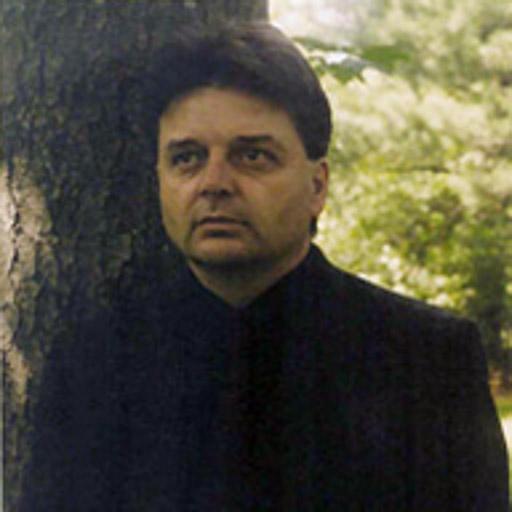
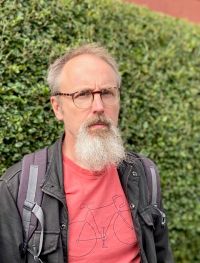
Casey O'Callaghan is a Professor of Philosophy and Director of the Philosophy-Neuroscience-Psychology (PNP) Program at Washington University. He holds a PhD from Princeton University and has authored over 50 publications. His research focuses on philosophical questions about perception, particularly auditory perception and multisensory integration. Key themes include the nature of perceptual objects, crossmodal interactions, and how perception shapes understanding of reality. Recent work emphasizes speech perception and multisensory consciousness, culminating in his 2019 monograph A Multisensory Philosophy of Perception . He co-edited Sounds and Perception: New Philosophical Essays (2010) and has published widely in journals like Philosophical Quarterly . His research bridges philosophy of mind, metaphysics, and cognitive science, addressing topics like perceptual constancy, sensory modality taxonomy, and multisensory evidence integration. Education: PhD in Philosophy from Princeton University. Research Interests: Philosophy of Mind, Perception, Metaphysics, Auditory Perception, Multisensory Integration, Speech Perception, Sensory Modality Taxonomy, Perceptual Justification, and Crossmodal Binding. Professional Activities: Director of PNP Program, Editor of Sounds and Perception , and frequent contributor to interdisciplinary discussions on perception and consciousness.
Sherrilyn Roush is a Professor in the Department of Philosophy at University of California, Los Angeles (UCLA) , with a PhD in Philosophy from Harvard University (1999). She holds dual B.S. and B.A. degrees with highest distinction from Pennsylvania State University (1988). Her work spans Epistemology , Formal Epistemology , Scientific Method , and Bayesian Reasoning . Harvard University, PhD in Philosophy (1999) University of California, Los Angeles, Department of Philosophy Research interests include the epistemic value of knowledge, probabilistic reasoning in legal contexts, and the distinction between knowledge and understanding. She has extensively analyzed the role of statistical evidence in judicial verdicts, simulation methods in science, and epistemic self-doubt through a Bayesian framework. Her publications cover topics like the epistemic superiority of experiments over simulations, epistemic injustice in testimonial contexts, and evolutionary stable strategies for knowledge. While she has not been explicitly linked to scientific awards or formal student mentoring in the provided texts, her work intersects with medical epistemology through collaborations on self-knowledge in illness .
J.D. Trout is the John and Mae Calamos Endowed Chair in Philosophy at Illinois Institute of Technology (Illinois Tech). He previously held positions at Loyola University Chicago, including roles as a Professor of Philosophy and Psychology. Trout’s research focuses on the philosophy of science, epistemology, cognitive science, and science policy. He has visiting appointments at institutions such as the University of Chicago and the University of Helsinki. His work explores the foundations and practical implications of scientific inquiry, blending philosophical analysis with insights from psychology and history of science. Trout earned his Ph.D. in Philosophy and Cognitive Science from Cornell University in 1988. His academic journey includes a Mellon Postdoctoral Fellowship at Bryn Mawr College and NSF-funded research. He has authored influential books like Wondrous Truths and All Talked Out , which examine scientific realism and the role of empathy in societal decision-making. His research interests span judgment and decision-making, speech perception, and the intersection of science and public policy. Trout has received notable awards, including the Sujack Award for Master Researcher (2017) and the Lewis College Excellence in Teaching Award (2020). He actively engages with media and public discourse, contributing to outlets like Psychology Today and Slate . Trout’s academic contributions include over 50 peer-reviewed articles and edited volumes, reflecting his interdisciplinary approach to philosophy. His work bridges theoretical philosophy with empirical research, emphasizing the practical relevance of epistemological and scientific inquiry.
Martin Jönsson serves as Head of Department at Lund University's Department of Philosophy within the Faculty of Humanities and Theology since 2022, having previously served as Director of Studies from 2015 to 2021. He holds the academic rank of Associate Professor and Senior Lecturer in Theoretical Philosophy, with his research spanning Philosophy of Language, Epistemology, and Cognitive Psychology. His research interests focus on implicit bias, semantic compositionality, reliabilism, and prejudice, with particular emphasis on developing interventions against implicit bias. Jönsson completed the Swedish Research Council-funded project 'The Epistemology of Implicit Bias Interventions' in 2022 and coordinated the 'Post Hoc Interventions' theme at the Pufendorf Institute. His recent publication trends reveal a strong focus on philosophical approaches to bias mitigation, with multiple 2024-2025 articles examining post-hoc interventions in grant review processes, ranking systems, and prejudice reduction strategies. His work bridges theoretical philosophy with practical applications in social justice contexts. As an academic leader, Jönsson supervises four doctoral students (Andreas, Hubert, Max, and Niklas) and a Marie Curie postdoctoral fellow (Mark), while contributing to multiple research projects including 'Cognitive Epistemology' and 'Fair and Square: An Interdisciplinary Study of Algorithmic Discrimination in Healthcare.' He actively participates in the Information Quality Research Group (LUIQ) and CogComlab, contributing to Lund University's Profile Area on Human Rights. His teaching portfolio includes Philosophy of Language, Formal Logic, Central Problems in 20th Century Philosophy, and One World, One Language courses.
Fred Adams is a prominent Professor specializing in Philosophy of Cognitive Science and Epistemology, with significant contributions to debates on extended cognition, mental representation, and knowledge theories. His career spans over four decades with continuous scholarly output. His educational foundation includes a 1982 dissertation on Goal-Directed Systems from The University of Wisconsin - Madison, establishing his early focus on cybernetic models of teleological behavior. This philosophical grounding evolved into interdisciplinary work bridging cognitive science and philosophy. Adams' research centers on critical examinations of extended cognition frameworks (notably in The Bounds of Cognition with Kenneth Aizawa), truth-tracking epistemology, and semantic theories of mental content. His work consistently challenges prevailing theories while developing nuanced alternatives, particularly regarding how cognitive systems interface with environmental information. Recent publications demonstrate sustained engagement with foundational epistemological problems through modal analyses of knowledge conditions. Analysis of his 15 most recent publications reveals consistent focus on epistemic justification frameworks, with growing emphasis on interdisciplinary cognitive science applications. His work shows particular expertise in adapting Nozick's tracking theory to contemporary challenges while maintaining philosophical rigor. Notable scholarly contributions include: Critical analysis of extended cognition hypotheses Development of fact-tracking knowledge models Refinements to causal theories of mental representation Interdisciplinary bridges between philosophy and cognitive neuroscience His advising and collaborative work shows strong mentorship patterns through co-authored publications with emerging scholars, particularly in consciousness studies and epistemology. While specific grant details aren't documented in the source text, his sustained publication record across multiple academic presses indicates successful research funding support throughout his career. Adams maintains active laboratory engagement through theoretical cognitive modeling, particularly in the philosophy-cognitive science interface, with ongoing collaborations examining neural correlates of semantic processing and epistemic justification frameworks.
Prof Sanford Goldberg is a Professorial Fellow in Philosophy at the School of Philosophical, Anthropological & Film Studies, University of St Andrews. His research focuses on epistemology, particularly testimonial reliability, normative expectations, and reliabilism, with a strong emphasis on epistemic entitlement and the Swamping Problem. Research Interests : Epistemology, Normative Epistemology, Epistemic Entitlement, Testimonial Reliability, Reliabilism, Swamping Problem Supervised Students : Isabella Bartoli, Katharina Bernhard, Amiya Hashkes Publications from 2015-2024 reveal a sustained exploration of testimonial norms, epistemic entitlement, and the intersection of epistemology with social expectations. Recent works address the Swamping Problem via process reliabilism and revisit unpossessed evidence limitations. Email : scg25@st-andrews.ac.uk
Steven Luper is a Professor in the Department of Philosophy at Trinity University , specializing in Epistemology, Ethics, Metaphysics, and Philosophy of Medicine . His work explores the nature of knowledge, skepticism, and the philosophical implications of mortality, including posthumous harm and definitions of death. Philosophy of Death Epistemology Ethics Mortality and Immortality Medical Ethics Research trends in his publications include knowledge closure , desire satisfaction post-mortem , and ethical frameworks for euthanasia . His articles often intersect existential questions with cognitive science and bioethical debates . Notable works : Death (2017) - Analyzing mortality detection and philosophical implications The AMA on Euthanasia (2016) - Ethical guidelines for end-of-life practices Philosophical Perspectives (2018) - Knowledge theory and relativism
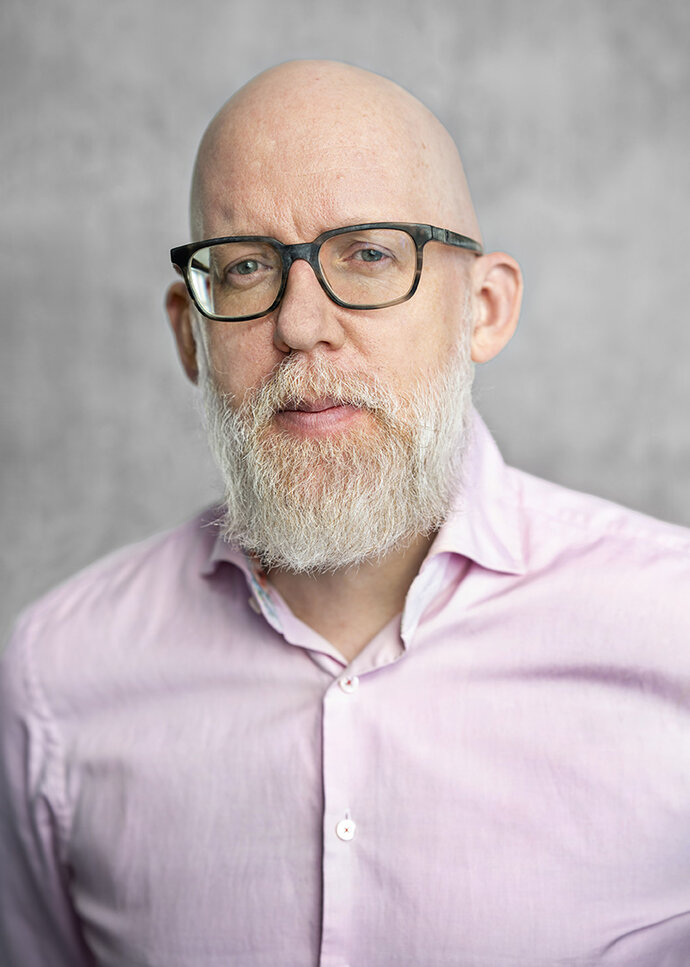
Jennifer Mulnix is a Professor of Philosophy at the University of Massachusetts Dartmouth, where she also serves as Chair of the Philosophy Department. She is the President of the American Association of Philosophy Teachers and holds a PhD from the University of Iowa (2006), along with a MA (2004) and BA (1999) from the University of Nebraska-Omaha and University of Iowa. Her research focuses on Epistemology, Philosophy of Mind, Philosophy of Happiness, and Philosophical Pedagogy, with significant contributions to Applied Ethics and the History of Early Modern Philosophy. She has authored/co-authored influential books like Happy Lives, Good Lives and Theories of Happiness , exploring happiness's normative value and its intersection with well-being and public policy. Mulnix has been recognized with the Manning Prize for teaching excellence (2022). Her work bridges philosophical theory with practical education, emphasizing critical thinking and learner-centered approaches. She also engages with Buddhist philosophy and metaphysics, enriching interdisciplinary dialogues. Beyond academia, she enjoys art, sports, and global travel. Education: PhD in Philosophy, University of Iowa, 2006 MA in Philosophy, University of Iowa, 2004 BA in Philosophy, University of Nebraska-Omaha, 1999 Research Interests: Her work examines happiness’s philosophical dimensions, including its relationship to ethics, political philosophy, and metaphysics. She critiques semantic externalism’s challenges to self-knowledge and defends reliabilism against epistemic skepticism. Her pedagogical research advocates for active learning strategies in philosophy education. Recent projects explore how nations promote happiness via public policy and the ethical implications of happiness measurement. Awards & Recognition: 2022 Manning Prize for Teaching Excellence Advocacy & Leadership: As AAPT President, she promotes philosophy education innovations. Her grants and collaborations focus on enhancing critical thinking through creative pedagogy. She leads discussions on integrating happiness studies into curricula and ethical frameworks for healthcare professions.
Blake Roeber is the Michael P. Grace II Associate Professor of Philosophy at the University of Notre Dame, specializing in epistemology, philosophy of language, and metaphysics. He holds a Ph.D. from Rutgers University. His research focuses on the intersection of traditional epistemology with contemporary issues like political polarization and fake news, exploring how belief formation processes impact societal discourse. Recent work examines rational action, identity-protective cognition, and the value of knowledge in democratic societies. Roeber's publications primarily engage with debates in social epistemology and pragmatic encroachment, demonstrating consistent interest in how epistemological frameworks can address real-world challenges. His 2024 monograph Political Humility analyzes epistemic limitations in partisan environments.
Murray Clarke is a Professor of Philosophy at Concordia University, serving twice as Department Chair and Graduate Program Director. He maintains active academic collaborations as a Visiting Scholar at Rutgers University and Western University, focusing on interdisciplinary research bridging philosophy with cognitive science. Education: Ph.D., University of Western Ontario M.A., Dalhousie University Hons. B.A., University of Western Ontario Research Interests: Clarke's work centers on Contemporary Epistemology and Experimental Epistemology , with significant contributions to Tracking Theories of Knowledge and analyses of empirical psychology's impact on epistemological frameworks. His investigations extend to Philosophy of Mind , Philosophy of Psychology , and Cognitive Science , examining rationality , natural inferential capacities , concept formation , and cognitive architecture , while maintaining strong engagement with History and Philosophy of Science . Publication Trends: His recent articles (2010-2024) demonstrate sustained focus on resolving epistemic paradoxes like the backward clock problem through tracking theories, with increasing collaboration (notably with F. Adams and J.A. Barker). Work appears consistently in top philosophy journals including Logos and Episteme and Synthese , reflecting deep integration of cognitive science methodologies into traditional epistemological inquiry. Scientific Awards: Honourable Mention for the William James Prize of the American Psychological Association (2005) Grants and Mentorship: Funded by SSHRC and FQRSC grants, Clarke has delivered 94 international presentations. As former Graduate Program Director and instructor of advanced seminars (PHIL 463/634, PHIL 465/643), he actively mentors graduate students despite no publicly listed advisees. His book Reconstructing Reason and Representation (MIT Press, 2004/2022) remains influential. Research Collaborations: Clark is a core member of the FQRSC-funded Groupe de recherche interuniversitaire sur la normativite (GRIN), led by Professor Aude Bandini at Université de Montréal, facilitating cross-institutional research on normative frameworks in philosophy and cognitive science.
Sanford Goldberg is the Chester D. Tripp Professor in the Humanities at Northwestern University's Department of Philosophy. His work spans Epistemology, Philosophy of Language, and Philosophy of Mind, with a focus on social epistemology, testimony, and speech act theory. He holds a PhD from Columbia University (1995). His research explores topics such as the norms governing assertion, epistemic justification, and the role of social practices in knowledge acquisition. Key works include Anti-Individualism (2007), Relying on Others (2010), and Conversational Pressure (2020). His recent articles address epistemic luck, normative expectations, and the ethics of belief in social contexts. Goldberg's contributions emphasize the distributed nature of epistemic responsibility and the interplay between linguistic norms and epistemic practices. His work bridges traditional epistemology with social and applied dimensions, influencing debates on testimony, epistemic dependence, and group knowledge.
Professor Jack Lyons holds the established Chair of Logic and Rhetoric in the Department of Philosophy at the University of Glasgow. His research integrates epistemology, philosophy of mind, and cognitive science, with a special focus on process reliabilism and the epistemological implications of cognitive architecture. Current Position: Chair of Logic and Rhetoric, University of Glasgow Location: 69 Oakfield Ave, Glasgow Phone: x3706 ORCID: 0000-0003-3012-5827 Research Interests: Lyons works at the intersection of epistemology and cognitive science, defending a version of process reliabilism and investigating how empirical findings can constrain epistemological theory. His interests include the nature of epistemic justification, evidence, perceptual and non-inferential justification, the internalism/externalism debate, and epistemic defeat. In philosophy of mind, he examines cognitive architecture, modularity, mental representation, perceptual experience, and the cognition/perception boundary. Recent Publication Trends: From 2024–2025, Lyons has published on the epistemology of psychedelic experience and the relationship between perception and firsthand knowledge, demonstrating a sustained focus on how non-standard perceptual states challenge traditional epistemic theories. His 2022–2019 output centers on refining reliabilist responses to the generality problem, the structure of epistemic defeat, and the evidential role of perceptual experience. Scientific Awards & Fellowships Cambridge Faculty Fellowship, Wolfson College (2017–2018) J. William Fulbright College of Arts and Sciences’ Master Researcher Award (2014–2015) Multiple University of Arkansas research and teaching grants (2004–2015) NEH Summer Seminar participant, Brown University (2000) Doctoral Supervision & Editorial Service Lyons currently supervises doctoral projects on epistemic pitfalls of cognitive integration and metaphor, isomorphism, and representational content. He has served as Editor of Philosophical Topics (2014–present), Review Editor for Frontiers in Psychology , Associate Editor for Episteme (2011–2016), and co-editor of special issues for Philosophical Issues and Pacific Philosophical Quarterly . He has organized international conferences on epistemology and cognition.
Professor Bruce Freed is a faculty member at the Department of Philosophy within Talbot College at the University of Western Ontario. He holds the rank of Professor since 1970 and is based in Room 415. His academic journey includes a B.A. from Kenyon College (1955-59), studies at Oxford University (1959-61), and a Ph.D. from the University of California, Berkeley (1961-65). His research focuses on philosophy of language, mind, epistemology, and American pragmatism, with notable influences from Searle, Dretske, Quine, and Davidson. He has collaborated with Z. Lu on projects exploring natural realism and perceptual theories. Education highlights include a Fulbright Scholarship to Oxford and teaching roles at San Jose State University (1964-65) and the University of Wisconsin (1965-70). Courses taught span graduate topics like Wittgenstein, epistemology, and pragmatism, as well as undergraduate courses in critical thinking and philosophy of education. His publications include monographs like Education and the Limits of Authority (1976) and co-edited volumes on philosophical logic. Recent talks address themes in perception, empathy, and Deweyan consequentialism. Though no awards are explicitly listed, his extensive publication record and teaching history reflect significant contributions to analytic philosophy. Current projects include co-authored works on natural realism and ecological psychology. He advises no listed students but has mentored through graduate seminars and undergraduate counseling roles.
Anne Meylan is a Full Professor of Theoretical Philosophy at the University of Zurich, where she has been serving since February 2024. Prior to this promotion, she held an Assistant Professor with Tenure-Track position at the same institution from August 2018 to January 2024. She leads the Zurich Epistemology Group on Rationality (ZEGRA) and previously held an SNSF Professorship at the University of Basel (2015-2018) focusing on the research project 'Cognitive Irrationality.' Dr. Meylan earned her Doctorate in Philosophy from the University of Geneva (2003-2009) and holds MA degrees in both Philosophy and History from the University of Neuchâtel (2003). Her academic journey includes postdoctoral research at the University of Toronto, University of Lund, and University of Copenhagen, as well as teaching positions at the Universities of Geneva, Fribourg, and Neuchâtel. Professor Meylan's research spans several interconnected areas in philosophy. Her primary focus lies in epistemology, where she investigates fundamental questions about knowledge, belief, and justification. She has made significant contributions to understanding ignorance, suspension of judgment, and doxastic responsibility. Her work in metaethics explores the normative dimensions of belief and knowledge. Additionally, she examines the ethics of persuasion, philosophy of emotions, and the intersection of philosophy with psychiatry. Her recent publications reveal a consistent focus on the normative aspects of epistemic states and attitudes. Meylan's work often bridges traditional epistemological concerns with practical ethical implications, particularly in how we ought to manage our beliefs and judgments. She has developed nuanced accounts of ignorance, suspension of judgment, and doxastic responsibility that challenge conventional views in the field. Her research demonstrates a sophisticated integration of virtue epistemology, evidentialism, and pragmatic considerations. Swiss National Science Foundation (SNSF) Professorship (2015-2018) Research project 'Cognitive Irrationality' at University of Basel Co-editor of 'Beyond evidence in epistemology' (2023) Dr. Meylan supervises several doctoral students and postdoctoral researchers, including Alexander Belak, Miloud Belkoniene, Benoit Guilielmo, Léna Mudry, and Sebastian Schmidt. Her mentorship extends to guiding early-career philosophers in developing their research in epistemology and related fields. She teaches courses across various philosophical domains including Metaphysics, Epistemology, Philosophy of Antiquity, Modern Philosophy, and Philosophy of the 19th and 20th Centuries. She is an active member of the philosophical community, contributing to leading journals such as Erkenntnis, Philosophy and Phenomenological Research, and Grazer Philosophische Studien, and participating in scholarly discourse through the Zurich Epistemology Group on Rationality (ZEGRA).
Peter Graham is a Professor in the Department of Philosophy at the University of California, Riverside. He earned his PhD from Stanford University Department of Philosophy in 2000 and is an active member of the APA Western Division. His academic career spans over two decades with significant contributions to epistemology and related fields. Graham specializes in epistemology and cognitive science, with particular expertise in epistemology of testimony, proper function reliabilism, and the intersection of philosophy of psychology, philosophy of biology, and philosophy of language. His research explores how testimony functions as a source of knowledge, arguing that testimonial knowledge can be a species of perceptual (non-inferential) knowledge. He has developed the view that epistemic warrant comes in grades, with the first grade consisting in the normal functioning of the belief-forming process when it has forming true beliefs reliably as an etiological function. An analysis of Graham's 15 most recent publications reveals a consistent focus on epistemological questions surrounding testimony, perception, and assertion. His work frequently engages with contemporary debates in social epistemology, particularly concerning the normativity of assertion and the reliability of testimonial transmission. Graham often collaborates with Nikolaj Jang Lee Linding Pedersen, producing significant joint work on entitlement, epistemic norms, and the structure of defeat. His methodological approach combines rigorous philosophical analysis with insights from cognitive science and evolutionary biology. Graham has made substantial editorial contributions to the field, co-editing major works including Epistemic Entitlement (2020) and The Routledge Handbook of Social Epistemology (2019). His publications span diverse formats from monographs to journal articles, demonstrating both depth and breadth in his scholarly output. His work regularly appears in top philosophy journals such as Synthese, Philosophy and Phenomenological Research, and Inquiry. While specific information about his advising and grant activities is limited in the provided materials, Graham's extensive publication record and editorial work suggest significant engagement with the philosophical community. His research program demonstrates continuity with his dissertation work on testimony while expanding into new areas including the normativity of assertion and the epistemology of deception detection. Graham maintains active scholarly engagement through PhilPapers where he serves as an editor for testimony-related content. His research continues to evolve, with recent work addressing cutting-edge topics such as the implications of radical cognitive enhancement for epistemology and the relationship between deception detection research and epistemological theory.


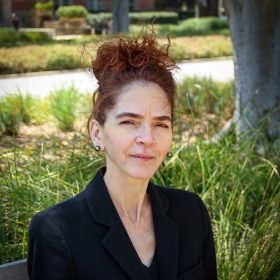


/prod01/production-cdn-pxl/media/umassdartmouth/profiles/arts-and-sciences/JWMulnix-pic-290X193.jpg)