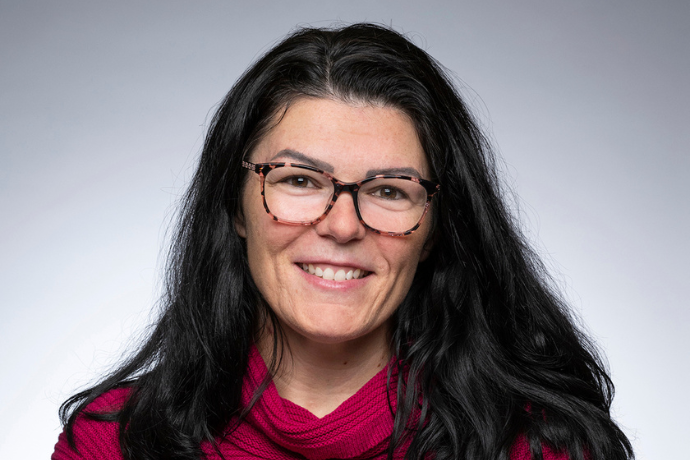
Helena P. Osana is a Professor in the Department of Education at Concordia University and currently serves as a Visiting Professor at the University of Wisconsin-Madison while on sabbatical. She holds the Concordia University Research Chair in Mathematical Cognition and Instruction and focuses on children’s mathematical thinking, instructional interventions, and professional development for teachers. Ph.D. in Educational Psychology (University of Wisconsin-Madison, 1998) M.A. in Mathematics and Science Education (University of British Columbia, 1989) B.Sc. in Mathematics and Statistics (McGill University, 1986) Her research explores how children interpret mathematical representations (e.g., manipulatives, diagrams) and how instructional strategies can enhance conceptual understanding in areas like fractions, place value, and number sense. She emphasizes the role of analogical reasoning, symbolization, and the integration of conceptual and procedural knowledge in learning mathematics. The trends in her recent publications highlight empirical studies on manipulatives, contextual effects on problem-solving, dual representation, and relational thinking in elementary and secondary students. Her work often involves classroom-based interventions and collaborations with teachers to bridge cognitive theory and pedagogical practice. Scientific Awards and Grants : Concordia University Research Chair in Mathematical Cognition and Instruction SSHRC Grant: Fostering conceptual understanding of number and place value with manipulatives SSHRC Grant: Instructional factors affecting integrated mathematical knowledge in second-graders SSHRC Grant: Improving children’s understanding of mathematical equivalence Dr. Osana advises graduate students in the Department of Education and leads the Mathematics Teaching and Learning Lab (MTLL) , which investigates classroom-based strategies to support children’s mathematical thinking from preschool to eighth grade. Her findings inform professional development programs for teachers, particularly in early mathematics education.