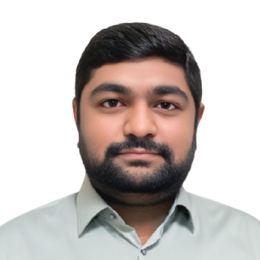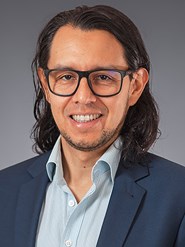
Esteban Guerrero Rosero is an Associate Professor in Social-Aware Artificial Intelligence at the Department of Computer Science, Umeå University (Sweden). His work bridges multi-agent systems , knowledge representation , and neuro-symbolic methods to develop trustworthy hybrid intelligence systems. He has co-led multidisciplinary projects in Sweden and Finland, focusing on AI applications in health , economics , and sports . Education: Ph.D. in Computer Science, Umeå University M.Sc. in Computer Science, Malmö University B.Eng. in Electronics and Telecommunications, University of Cauca (Colombia) His research emphasizes software agents and non-monotonic reasoning to model human activities in domains like health informatics and ambient intelligence . By integrating argumentation frameworks and neuro-symbolic approaches , he develops systems that adapt to social and behavioral contexts, with applications in digital coaching and behavior change interventions . Recent publications highlight trends in value-based decision-making , financial robo-advisors , and AI regulations , reflecting his focus on trustworthy AI and ethical reasoning . His work often involves cross-disciplinary collaboration , particularly in healthcare and personalized systems. Guerrero Rosero has led the Formal Methods for Trustworthy Hybrid Intelligence research group since 2019. He is involved in projects like STAR-C (2018–2024), Socially Intelligent Autonomous Systems (2017–2019), and NTC - Nordic Telemedicine Center (2015–2018), aiming to create AI systems that support human activities in complex social contexts.
Johanna Björklund is an Associate Professor at the Department of Computing Science , Umeå University, specializing in Formal Language Theory , Machine Learning , and Semantic Parsing of Multimodal Data . Her research focuses on translating complex media (e.g., videos with audio/subtitles) into graph-based semantic representations for algorithmic processing. Current projects include WARA Media & Language (2024–2026) and AI-Driven Contextual Communication (2021–2023). Key research areas: tree automata , graph transduction , contextual advertising , and computational linguistics . Her recent publications highlight advances in tree-to-graph transduction , multimodal semantic analysis , and privacy-preserving advertising . She has secured significant grants, including SEK 12 million (2021) and 4 million SEK (2020), for AI and deep learning initiatives. Grants: SEK 12 million (2021) for AI projects. 4 million SEK (2020) for Deep Learning methods. Scientific Awards: Lead researcher in multiple EU-funded projects. Recognized for contributions to formal languages and machine learning . She collaborates with teams in semantic analysis , tree automata , and multimodal AI , emphasizing practical applications like visual analytics and advertising systems .
Daniel Varro is a Professor and Head of Unit at the Department of Computer Science (IDA) of Linköping University, Sweden. He leads the Software and Systems (SAS) department, focusing on AI, software engineering, and cyber-physical systems. His research is supported by major grants like the Vinnova 5.6 million SEK project for AI-generated software quality assurance. Affiliation: Department of Computer Science (IDA), Linköping University Department: Software and Systems (SAS) Research Focus: Model-based systems, large language models for code analysis, reinforcement learning, and cyber-physical safety verification. His recent work includes empirical studies on machine learning notebooks, infrastructure code smells, and data leakage in large language models. He collaborates extensively within the Wallenberg Autonomous Systems Program (WASP) and trains doctoral students in software engineering.
Sebastian Dalleiger is an Assistant Professor at the Division of Theoretical Computer Science, Kungliga Tekniska Högskolan (KTH Royal Institute of Technology). His research focuses on theoretical foundations of machine learning, data mining, and graph theory, with particular expertise in matrix factorization, pattern discovery, and hypergraph analysis. Current affiliation: KTH Royal Institute of Technology Department: Theoretical Computer Science Email: sdall@kth.se His recent work explores federated learning architectures, non-negative matrix factorization, and structural analysis of stochastic block models across multiple graphs. He develops algorithms combining proximal optimization with privacy-preserving techniques, addressing challenges in distributed data analysis. Publications demonstrate interdisciplinary applications in network science, information theory, and computational geometry. Key contributions include novel frameworks for Ollivier-Ricci curvature in hypergraphs and sequential false discovery control for pattern mining.
Praveen Kumar Donta is an Associate Professor (Docent) and Senior Lecturer at the Department of Computer and Systems Sciences, Stockholm University, Sweden. His research focuses on distributed computing continuum systems, learning-driven approaches for IoT and edge computing, and intelligent data protocols. He leads the Distributed Immersive Participation research group which investigates how humans and things can be more connected and exchange information in real and virtual societies. Education: Ph.D. in Computer Science & Engineering from Indian Institute of Technology (Indian School of Mines), Dhanbad (2021) Visiting Ph.D. Fellow at Mobile&Cloud Lab, University of Tartu, Estonia (2019-2020) Master in Technology from JNTUA, Ananthapur (2014) Bachelor in Technology from JNTUA, Ananthapur (2012) Dr. Donta's research centers on distributed computing continuum systems that integrate cloud, edge, and IoT devices to deliver scalable and low-latency computing resources. His work explores learning techniques in IoT, AI/ML for computing systems, cognition and causality in computing systems, and cyber-physical continuum applications. He investigates how human body analogies can inform the design of more resilient and efficient distributed systems, as well as developing frameworks for privacy enforcement, equilibrium in computing continuum systems, and energy-efficient user interactions with smart environments. His research has significant applications in smart city management, satellite services, and intelligent transportation systems. Dr. Donta's publication record demonstrates a strong focus on the intersection of distributed systems, machine learning, and privacy-preserving technologies. His recent work shows an increasing emphasis on human-inspired approaches to distributed computing, with particular attention to making these systems more interpretable, efficient, and adaptable. His research spans theoretical foundations of computing continuum systems to practical implementations in areas like satellite services, smart environments, and anomaly detection. Scientific Awards and Recognition: IEEE Senior Member ACM Professional Member Dr. Donta serves as an editorial board member for several prestigious journals including IEEE Internet of Things Journal, Computing (Springer), Transactions on Emerging Telecommunications Technologies (Wiley), Measurement, and Computer Communications (Elsevier). He actively mentors the next generation of researchers, currently supervising PhD student Alfreds Lapkovskis and co-supervising Shubham Vaishnav. His research is supported by projects such as the Heterogeneous Computing Continuum for a Sustainable Smart City Management (HCSCM), which aims to develop scalable, secure solutions for urban environments by integrating IoT, edge, and cloud computing. As part of the Distributed Immersive Participation research group, Dr. Donta collaborates with researchers across disciplines to explore how technological advances enable humans and things to be more connected. The group focuses on application areas such as culture, transport, intelligent vehicles and e-health, developing solutions that enhance participation in both real and virtual societies.
Dr. Rickard Karlsson works as a Lecturer at Linköping University's Department for Swedish as a Second Language, Rhetoric and Language Support (SAROS) under the Department of Culture and Society (IKOS). His teaching focuses on Swedish language didactics, grammar, and assessment of learner languages, with supervision across academic levels. PhD in Languages and Cultures of Europe Upper Secondary School Teacher in Swedish as a Second Language Research spans empirical analysis of adult language acquisition , historical linguistics , and multilingualism ideologies . Google Scholar publications reveal interdisciplinary contributions to particle filter algorithms and automotive sensor systems from 2001-2025. Notable collaborations include Fredrik Gustafsson and Per-Johan Nordlund. Recent publications (2025-2016) merge automotive engineering and historical Linguistics, covering tire diagnostics, cultural exchange patterns, and vibration-based navigation. This dual expertise reflects his transition from technical research to language education, maintaining academic connections across disciplines.
Mattias Dahl is a Professor at the Faculty of Engineering, Blekinge Institute of Technology, affiliated with the Department of Mathematics and Natural Sciences since 1993. His research spans systems engineering, applied mathematics, and their applications in simulation, optimization, and modeling of technical systems, particularly in intelligent transport systems (ITS) through collaborations with Swedish Transport Agency and Administration. He has developed measurement systems using drones and satellites, focusing on area-wide change analyses and commercialization of research outputs. Education: B.Eng. in Electrical Engineering, Chalmers University M.Eng. in Computer Engineering, Luleå University of Technology Licentiate in Telecommunication Theory, Lund University of Technology PhD in Applied Signal Processing, Blekinge Institute of Technology (2000) His research emphasizes optimization of technical systems, self-learning methods, and artificial intelligence, with industry collaborations resulting in patents in mobile communication and computer vision. Recent work includes AI-driven weed seed reduction, railway capacity optimization (KAJT), and charging station allocation for EVs. He has contributed to projects like ADAS and Combating Reindeer Poaching with Drones, while also reviewing grants for international journals. Key scientific awards include the Teknikbrostiftelsen scholarship and Vinnova verification funds. His 15 most recent publications focus on radar interference mitigation, traffic data analysis, drone calibration, and charging infrastructure optimization.
Erik Schaffernicht serves as a Senior Lecturer in the Department of Natural Sciences and Technology at Örebro University's School of Science and Technology. His research is primarily conducted through the Center for Applied Autonomous Sensor Systems (AASS) where he leads work in the Adaptive and Interpretable Learning Systems and Robot Navigation and Perception research groups. Dr. Schaffernicht's research spans multiple areas in robotics and artificial intelligence, with particular expertise in sensor systems, behavior trees, and gas distribution mapping. His work bridges theoretical computer science with practical applications in autonomous systems, environmental monitoring, and human-robot interaction. His research often involves developing novel algorithms for robot perception, control, and decision-making in complex environments. His recent publications demonstrate a strong focus on behavior trees for robot control, gas distribution mapping techniques, and applications of machine learning in robotics. The research shows increasing sophistication in using deep learning approaches for environmental sensing and robot navigation, with applications ranging from industrial safety to healthcare monitoring. Dr. Schaffernicht maintains an active research agenda with numerous publications in top robotics and AI venues, including IEEE Robotics and Automation Letters, Robotics and Autonomous Systems, and various IEEE conference proceedings. His work shows consistent collaboration with researchers across Europe, particularly with the AASS research center at Örebro University. His research projects include both ongoing work on automatic cognitive screening tests using eye-tracking technology and completed projects such as AIR (Action and Intention Recognition), RAISE (Robotic System for Air Quality Assessment), and SmokeBot (Mobile Robots for Disaster Site Inspection).
Håkan Nilsson is a Senior Lecturer/Associate Professor at the Department of Psychology, Uppsala University, specializing in Perception and Cognition. His research focuses on cognitive psychology, decision making, and probability judgment with significant contributions to understanding human reasoning under uncertainty. His primary research interests include: Cognitive biases in probability judgment, particularly the conjunction fallacy How people interpret odds in sports betting contexts Mathematical modeling of decision processes (configural weighted average model) The relationship between numerical ability and decision quality Development of debiasing techniques for probabilistic reasoning Analysis of his recent publications reveals consistent focus on understanding probability judgment mechanisms. His work demonstrates that even numerically skilled individuals remain susceptible to decision paradoxes, suggesting deep-rooted cognitive processes. Notable research areas include how betting odds are converted to probability estimates and why combo bets appear more attractive despite lower probabilities. His scientific contributions encompass: Development of the configural weighted average model for probability judgment Studies on the relationship between numerical ability and susceptibility to decision paradoxes Research on the cognitive substrate of subjective probability Exploration of how monetary incentives affect probability assessment Nilsson has maintained extensive collaborations with Peter Juslin, Anders Winman, and Patric Andersson. His work appears in leading journals including Psychological Review, Journal of Experimental Psychology, and Cognition, demonstrating significant impact in cognitive and decision sciences.
Oleg Kochukhov is a Professor in the Department of Physics and Astronomy at Uppsala University, Sweden, specializing in Astronomy and Space Physics. His research focuses on stellar magnetic fields, stellar atmospheres, and advanced imaging techniques for studying distant celestial objects. Kochukhov maintains an active research program with numerous recent publications in leading astrophysics journals and collaborates with international research teams on major observational projects. Dr. Kochukhov received his physics education at Simferopol University in Crimea, Ukraine, before obtaining his PhD in Astrophysics from Uppsala University. Following his doctoral studies, he conducted postdoctoral research at Vienna University and NORDITA (Nordic Institute for Theoretical Physics) before returning to Uppsala University as faculty. Professor Kochukhov's primary research interests center on magnetic fields and associated phenomena on stellar surfaces. His expertise includes the physics of stellar atmospheres, stellar evolution processes, and computational methods for indirect imaging of remote astronomical objects. He has made significant contributions to the development and application of Doppler imaging and Zeeman-Doppler imaging techniques, which allow astronomers to map stellar surface features and magnetic field topologies despite the stars' great distances. His work frequently focuses on chemically peculiar stars, particularly Ap/Bp stars, and the relationship between magnetic fields and stellar evolution. Analysis of Kochukhov's recent publications reveals a consistent focus on advancing magnetic field measurement techniques, particularly probabilistic approaches to Zeeman-Doppler imaging. His research spans multiple stellar types, from cool M dwarfs to hot Bp stars, with particular attention to chemical abundance patterns and magnetic field topology. He actively utilizes data from space missions like PLATO and ground-based instruments including CRIRES+, demonstrating the interdisciplinary nature of modern astrophysical research. While specific scientific awards are not detailed in the available information, Professor Kochukhov's extensive publication record in high-impact journals and leadership roles in major research projects indicate significant recognition within the astrophysics community. His collaborations with researchers across Europe and beyond demonstrate his standing as an influential figure in stellar magnetism research. Professor Kochukhov's research program involves both observational work using advanced spectroscopic and spectropolarimetric techniques and theoretical modeling of stellar magnetic phenomena. His involvement in major projects like the PLATO mission suggests successful grant acquisition and leadership in large-scale international collaborations. The breadth of his work, spanning from stellar surface imaging to exoplanet atmosphere studies, demonstrates the interconnected nature of modern astrophysical research.