Caroline Verzat is an Associate Professor in the Department of Strategy, Entrepreneurship and Organization (SHO) at ESCP Business School (Paris, France). She holds a PhD in Sociology of Organizations from Paris IX-Dauphine and an HDR in Entrepreneurship. With over 20 years of academic and professional experience, her work bridges action research, entrepreneurial mindset development, and educational innovation. Education: Ecole Normale Supérieure (Alumni) ESSEC Business School PhD in Sociology of Organizations (Paris IX-Dauphine) Habilitation à Diriger des Recherches (HDR) in Entrepreneurship Research Focus: Action research integrating theory and practice Entrepreneurial mindset across life stages Educational system transformation for emancipatory learning Emotional dynamics in innovation teams Recent publication trends emphasize AI applications in qualitative research, sustainability education, and emotional dimensions of entrepreneurship. Key Contributions: Co-editor of Entreprendre et Innover (franco-anglophone entrepreneurship journal) Founder of FA2L (active pedagogy initiative) Developed LiveMentor platform for entrepreneurial coaching Her work addresses systemic educational challenges while fostering resilience and sustainability in entrepreneurial ecosystems.
Liao Lizi is an Assistant Professor and Lee Kong Chian Fellow at Singapore Management University's School of Computing and Information Systems. She received her Ph.D. from the National University of Singapore under Professor Tat-Seng Chua. Her research explores the intersection of Machine Learning, Natural Language Processing, and Multimedia, focusing on developing conversational AI systems. Key areas include: Proactive conversational agents that anticipate user needs Multimodal conversational search and recommendation systems Task-oriented dialogue frameworks Human-machine collaborative systems Emotional support and empathetic response generation Her publications demonstrate a strong focus on advancing conversational AI through novel architectures for dialogue planning, multimodal understanding, and knowledge-enhanced generation. Recent work shows increasing emphasis on LLM optimization, financial reasoning benchmarks, and emotional intelligence in dialogue systems. Scientific Awards: Lee Kong Chian Fellowship Google South Asia & Southeast Asia Research Awards 2023 She leads the CoAgent Lab and advises multiple PhD students including recipients of the SMU Presidential Doctoral Fellowship. Current teaching includes Visual Analytics for Business Intelligence (IS428) and Text Analytics and Application (ISSS609).
Jake Madden is an Adjunct Associate Professor at Southern Cross University’s Faculty of Education, with over three decades of experience as an educational leader in Australian and international schools. He holds a Doctorate in Education (ACU) and has served as Group Head of Schools for Aoba Education Group in Tokyo, focusing on transformative strategies for school improvement and teacher capacity building. Education: Doctor of Education (Australian Catholic University), Master of Education (ACU), Bachelor of Education (Edith Cowan University), Diploma of Education (Armidale College of Advanced Education) Research Interests: Jake’s work centers on educational leadership , school improvement , and teacher-as-researcher models. His recent publications explore instructional coaching cultures , AI-driven assessment reform , and collaborative school cultures , reflecting a commitment to modernizing educational practices and fostering global mindedness. Scientific Awards: Outstanding Contribution to Education Award (GESS Dubai)
Dr. David Gilani serves as Head of Access and Participation at Middlesex University, where he leads student engagement initiatives and alumni relations within the School of Education & Student Experience. He holds a PhD in student belonging from the University of York and founded the Student Publication Association (2012). Gilani also chairs AHEP’s Student Experience and Engagement Network, promoting cross-institutional collaboration in UK higher education. His research focuses on student belonging , retention strategies , and equity in higher education . Gilani investigates how universities can foster inclusive environments through evidence-based interventions like agentic belonging workshops and peer-support systems. His meta-analytical work on student communications establishes best practices for institutional engagement. Key research trends from his recent publications include: Innovative methodologies for measuring belonging without researcher interference Critical analysis of deficit models in underrepresented student support Quasi-experimental validation of social belonging interventions Systematic reviews of belonging's relationship with retention Gilani actively translates research into policy through Wonkhe commentaries and institutional consultations. He maintains ORCID (0000-0003-1099-7118) tracking extensive research outputs with over 1,100 views.
Associate Professor Anna Fletcher serves as the inaugural Associate Dean Industry Cooperation at Federation University Australia’s Institute of Education, Arts and Community. She specializes in classroom assessment strategies that promote student agency, voice, and self-regulated learning, with international collaborations in Scandinavia and regional Australian education initiatives. 2020 Australian Awards for University Teaching (AAUT) Citation 2017 Federation University Vice-Chancellor’s Early Career Award 2015 Charles Sturt University Teaching Excellence Award Her research spans student-centered assessment frameworks, vocational education partnerships (e.g., the “Possible Me” project), and multidisciplinary school development. Recent publications focus on assessment systems, metacognition, and 21st-century skills. She supervises PhD students and contributes to professional associations like AARE. Grants include projects on ethical reasoning, physical literacy, and World of Work integration funded by The Menzies Foundation, Latrobe Health Assembly, and Latrobe Valley Authority. She engages in keynote presentations and community research, emphasizing regional educational transformation.
Ziyi Huang is a machine learning researcher at Bell Labs and an Adjunct Professor in the Biomedical Engineering department at Stevens Institute of Technology. They hold a doctoral degree and completed postdoctoral training at Columbia University under Professor Christine Hendon. Their research focuses on developing trustworthy AI systems for healthcare, machine learning theory, and decision-making under data imperfections. Education: Ph.D. and postdoctoral studies in Electrical Engineering at Columbia University, advised by Prof. Christine Hendon. Research Interests: Huang’s work emphasizes robust, reliable AI for healthcare applications, including proactive medical dialogue systems, medical image analysis, and uncertainty quantification in deep learning. They also explore methods to handle noisy or incomplete data in real-world scenarios. Grant Contributions: Served as Site-PI for NIH R21 and R01 grant submissions, securing over $283K in doctoral fellowships/grants. Awards include the Machine Learning and Systems Rising Star fellowship. Collaboration Opportunities: Actively seeks research partnerships to advance AI-driven healthcare solutions.
Assoc. Prof. Dr. Irina Liubertė holds a PhD from ISM University of Management and Economics and teaches research methods in Global Leadership and Executive programs. Her work bridges academia and industry: 13 years in pharmaceutical market research before transitioning to academia, with internships at Warwick Business School and Cass Business School. She actively participates in international conferences like Academy of Management and EGOS Colloquium. PhD: ISM University (2019) Master’s: Not explicitly stated Undergraduate: Not explicitly stated Research focuses on organizational communication dynamics, particularly silence/secrecy management, entrepreneurial communication (pitching, opportunity narratives), and human-robot interaction. Key projects include: GUESSS survey on student entrepreneurship (2021) RCL-funded research on proactive behaviors and socio-economic context (2020-2022) Human-robot collaboration studies with international teams Publications span 2017–2025, emphasizing qualitative methodologies and organizational change. Notable collaborations involve scholars from UK (Warwick, Cass), Germany, and Portugal. Her work addresses contemporary challenges like automation’s impact on work meaning and inclusive communication practices.
Tingjian Ge is an academic researcher with a focus on database systems, graph stream processing, and uncertain data management. His work spans theoretical foundations and practical implementations in data science, with a career trajectory showing increasing specialization in real-time network analytics and secure data processing. PhD from Brown University (2009) Active in top-tier venues: ICDE, KDD, VLDB, WWW Research Interests include: Approximate query processing under resource constraints Graph stream modeling and edge shedding techniques Security and privacy in data systems Temporal network analysis and predictive modeling Optimization of multi-core and cloud-based query execution Scientific Contributions demonstrate expertise in: Developing sketch data structures for graph streams Creating fairness-aware prediction frameworks Advancing differential privacy mechanisms Designing efficient temporal subgraph algorithms
Dr. Matthias Kraus is a Researcher at the Chair of Human-Centered Artificial Intelligence , part of the Institute of Computer Science under the Faculty of Applied Computer Science at the University of Augsburg . His work bridges Conversational AI , Spoken Dialogue Systems , and Human-Computer Trust , with a focus on proactive interaction and multimodal user modeling. His research explores trust modeling in mixed-initiative systems, socially-aware reinforcement learning for dialogue agents, and responsible personalization in human-robot cooperation. He has published extensively on multi-user chatbots , proactive tutoring , and trust dynamics in collaborative environments. Key article trends include dialogue act annotation , household robotics , and ethics in conversational interfaces . His team develops user-centered AI for healthcare, education, and industry, as seen in projects like KodiLL and MindBot .
Dr. Sarah Rachut is a Scientific Associate at the Technical University of Munich (TUM), working at the Chair of Digital Law and Security under Prof. Dr. Dirk Heckmann. She serves as Managing Director of the TUM Center for Digital Public Services research institute and is affiliated with the TUM School of Social Sciences and Technology in the Department of Governance. Her work bridges legal scholarship with practical digital governance solutions, focusing on fundamental constitutional issues in digital contexts. Dr. Rachut studied law with a European and international focus at the University of Passau and completed her legal traineeship at the Higher Regional Court of Munich. She earned her doctorate with a dissertation titled "Realization of Fundamental Rights in Digital Contexts," which received the Science Prize of the Society for Data Protection and Data Security in November 2024. She is also a member of the German Society for Law and Informatics (DGRI) and an associate member of the eSports Law Research Center at the University of Augsburg. Her research centers on e-government, e-health, and e-education law, with particular emphasis on how constitutional rights can be realized in digital environments. Dr. Rachut challenges the misconception that law hinders digitalization, arguing instead that legal frameworks enable balanced technological advancement that respects fundamental rights. She advocates for moving from application-based administration toward proactive government services that automatically recognize citizens' legitimate claims without requiring burdensome documentation. Dr. Rachut's extensive publication record demonstrates deep expertise in AI regulation, digital administrative procedures, and electronic examination systems. Her work uniquely combines theoretical legal scholarship with practical implementation experience, as evidenced by her pivotal role in developing Bavaria's Fernprüfungserprobungsverordnung (BayFEV) during the pandemic, which became a national model for legally secure remote examinations. Young Leader in Gov Tech Award by Handelsblatt and Possible (2024) Science Prize of the Society for Data Protection and Data Security (2024) Second place in Young Scientist of the Year award (2025) Talent in BayFiD program (Bavaria's Women in Digital Professions) (2020) Scholarship holder at Graduate School of Bavarian Research Institute for Digital Transformation (2022) As Managing Director of the TUM Center for Digital Public Services, Dr. Rachut mentors students and leads research initiatives focused on digital transformation in government. She has successfully guided student teams to multiple awards in the "Digital Future Challenge" competition. Her leadership extends to shaping policy through expert opinions for legislative bodies including the German Bundestag and various state parliaments, where she has advised on the Bavarian Digital Law and other key digital governance frameworks. Dr. Rachut plays a key role in the TUM Center for Digital Public Services, which serves as an interdisciplinary hub for digital government research. She also serves as spokesperson for the "E-Government Law" working group of the National E-Government Competence Center (NEGZ) and co-edits the journal "Ordnung der Wissenschaft" since October 2024.
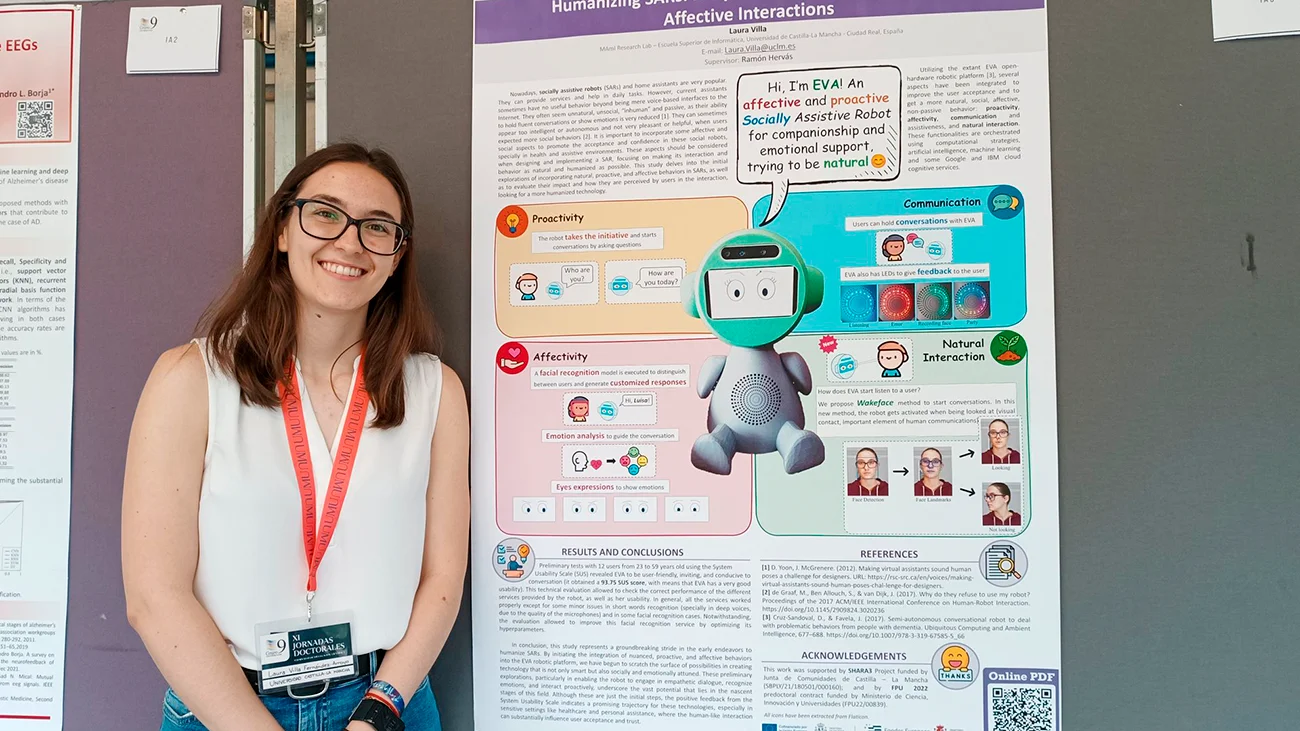
Laura Villa is a researcher at the University of Castilla-La Mancha (UCLM), affiliated with the Department of Information Technologies and Systems under the Higher School of Informatics. She holds an FPU scholarship from the Ministry of Universities and a PIF research grant. Her work focuses on human-robot interaction, affective computing, and assistive technologies for elderly care and autism support. Laura’s research integrates robotics, artificial intelligence, and augmented reality to create proactive and emotionally intelligent systems. Key achievements include winning the Best Scientific Communication Award at the 2024 XI Doctoral Conference for her work on 'Humanizing SARs: Early Endeavors in Proactive and Affective Interactions.' Prior recognition includes the 2022 Turing Machine Award for her final project. Her research trajectory includes developing the SHARA platform for robot interaction simulation and AutismAR Discovery, an AR tool for children with autism in Panama. Her publications span topics like synthetic motion generation, comparative analysis of large language models, and empathy in conversational agents. Laura has actively participated in initiatives such as the International Day of Women and Girls in Science, emphasizing inclusivity in tech. She collaborates across disciplines, leveraging IoT and cybersecurity solutions (e.g., SAcRe) for identification systems. Her work bridges theoretical advancements with real-world applications in healthcare and education.
Professor Markus Vogt holds the Chair of Christian Social Ethics at the Faculty of Catholic Theology, Ludwig Maximilian University of Munich, a position he has occupied since April 2007. Previously, from October 1998 to March 2007, he held a similar professorship at the Philosophical and Theological College of the Salesians of Don Bosco in Benediktbeuern. He served as dean of the Faculty of Catholic Theology from 2015 to 2017 and has been dean of research since 2024. His academic journey includes studies in theology and philosophy in Munich, Jerusalem, and Lucerne, and significant involvement with the German Federal Government's Advisory Council on the Environment from 1992-1995. Prof. Vogt's research interests span the social-philosophical and theological foundations of ethics, with particular focus on environmental ethics, political ethics, peace ethics, and business ethics. His work engages deeply with the 'unfinished project of modernity,' examining normative implications within contemporary social contexts. He has made significant contributions to understanding sustainability as a social principle of Christian ethics, particularly in relation to the Anthropocene. His publications reveal a strong emphasis on environmental challenges, justice theories, and ethical responses to global crises. The most recent works show increasing engagement with digitalization ethics, postcolonial perspectives on sustainable development, and proactive approaches to tolerance in conflict resolution. His scholarship bridges theological reflection with practical ethical guidance for contemporary societal challenges. Scheffel Prize Humanism Today Prize Economy and Society Award of the papal foundation "Centesimus Annus Pro Pontifice" (2017) State Medal for Outstanding Services to the Environment (2018) LMU Teaching Innovation Prize (2020, 2023) Prof. Vogt has supervised numerous doctoral and habilitation projects, particularly in areas of environmental ethics, sustainability, political theology, and social justice. His leadership extends to significant research initiatives including the Rachel Carson Center for Environment and Society, where he co-founded the structured doctoral program 'Environment and Society,' and the Munich Center for Sustainability where he serves on the Board. He has received multiple research grants supporting projects on environmental humanities, climate change ethics, and sustainable development. His institutional affiliations demonstrate deep engagement with both academic and church-based initiatives, including leadership roles in the European Forum for the Study of Religion and the Environment, the Scientific Advisory Board of the Center for Ethical Education in the Armed Forces, and the Conference of European Bishops' Conferences (Environment Sector).
Dane Leigh Gogoshin is a Visiting Assistant Professor of Philosophy at the Information School, University of Wisconsin-Madison (2024–2026). Previously, they were a researcher with the RADAR Group at the University of Helsinki (2020–2024). They hold a PhD in Philosophy from the University of Helsinki. Their primary research focuses on normative ethics and the ethics of technology, particularly AI and social robotics, alongside interests in moral psychology, philosophy of action (responsibility and agency), and social/political philosophy. Teaching experience includes courses in logic, ethics, philosophy fundamentals, and data ethics. In 2025–2026, they will teach a self-designed course on moral responsibility. Their work bridges philosophical theory with applied ethics in technology, emphasizing accountability frameworks, human-robot interaction, and ethical design principles. Recent publications explore themes like AI governance, healthcare robot ethics, and moral agency in technological systems. Their research highlights tensions between human responsibility and emerging technologies, advocating for proactive ethical frameworks. Current affiliations include the University of Wisconsin-Madison’s Information School and prior involvement with the RADAR Group. No formal grants or awards are explicitly listed in the provided materials.
Keri Pearlson is a Senior Lecturer and Principal Research Scientist at the MIT Sloan School of Management. She previously served as Executive Director of the Cybersecurity at MIT Sloan (CAMS) Research Consortium. Her academic affiliations include MIT Sloan, with research focusing on cybersecurity resilience, AI security risks, board governance, and organizational culture. Pearlson holds a DBA in MIS from Harvard Business School, an MS in industrial engineering, and a BS in mathematics from Stanford University. Education: Doctorate (DBA) from Harvard Business School, MS/BS from Stanford. Industry Roles: Founder of KP Partners and IT Leaders’ Forum, former positions at Gartner, CSC, and AT&T. Research Interests: Cybersecurity governance, AI-driven risks, supply chain resilience, and SME cybersecurity. Her work emphasizes cybersecurity culture, board-level oversight, and strategic resilience. Publications appear in Harvard Business Review and MIT Sloan Management Review . She is a recipient of the “2014 National SIM Leader of the Year” award. Pearlson designs executive education programs on cybersecurity governance for boards and leaders, addressing managerial and organizational challenges in cybersecurity. Her executive courses cover holistic cybersecurity strategies, including governance frameworks, legal compliance, and cultural transformation. She collaborates with CAMS to advance managerial approaches to cybersecurity, distinguishing it as a strategic priority.
Robin Cohen is a Professor in the Department of Computer Science at the David R. Cheriton School of Computer Science, University of Waterloo. His research focuses on artificial intelligence, multiagent systems, trust and reputation models, user modeling, and the social implications of technology. He has held leadership roles including Associate Dean (Research) in the Faculty of Mathematics and Director of the BBA/BCS Program. Cohen has a Ph.D. (1983) and M.Sc. (1977) in Computer Science from the University of Toronto, and a B.A. in Mathematics (1975) from McGill University. His research spans trust modeling in electronic marketplaces, ethical AI, healthcare AI applications, and misinformation management. Notable contributions include frameworks for adjustable autonomy in multiagent systems and trust-based mechanisms to promote honesty in e-commerce. He has advised over 40 graduate students and supervised numerous undergraduate research assistants, contributing to a vibrant academic community. Recent work emphasizes AI ethics, healthcare innovations (e.g., CPR optimization via machine learning), and combating misinformation through multiagent trust systems. His awards include the 2023 CAN-CS Lifetime Achievement Award and the 2018 CAIAC Lifetime Achievement Award, reflecting his impactful career in AI research and education. Current research includes proactive hate speech detection using graph transformers and exploring ethical AI frameworks for autonomous vehicles. He maintains active collaborations in health informatics, social network analysis, and AI-driven educational technologies.