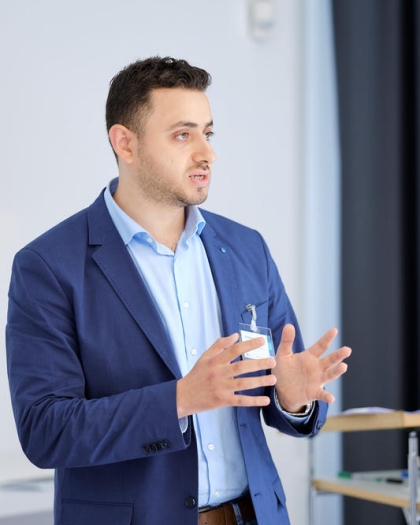
Daniel M. Roy is a Full Professor at the University of Toronto, with cross-appointments in the Department of Computer Science, Department of Statistical Sciences, and Department of Electrical and Computer Engineering. He serves as Research Director at the Vector Institute and holds the CIFAR Canada AI Chair. Research Focus: Foundational principles of prediction, inference, and decision-making under uncertainty across machine learning, statistics, mathematical logic, applied probability, and computer science. Scientific Contributions: Key work in learning theory, statistical network analysis, probabilistic programming, and information-theoretic frameworks for generalization. Awards: ICML 2024 Best Paper Award for "Information Complexity of Stochastic Convex Optimization" and promotion to Full Professor in 2024. Student Advising: Actively mentors Ph.D. candidates and postdoctoral researchers with strong quantitative backgrounds, particularly at the intersection of machine learning, statistics, and computer science. Email: daniel.roy@utoronto.ca
Johan Gustav Bellika is a Professor at the Department of Clinical Medicine, UiT The Arctic University of Norway, based in Tromsø. His work bridges clinical medicine with health informatics, focusing on practical applications that improve healthcare delivery and patient outcomes. Current Position: Professor, Department of Clinical Medicine Institution: UiT The Arctic University of Norway Location: Tromsø, Norway Contact: johan.gustav.bellika@uit.no Professor Bellika's research spans several critical areas in modern healthcare. His primary focus is on health informatics with particular emphasis on medical data privacy, electronic health records, and the application of artificial intelligence in clinical settings. He has made significant contributions to understanding chronic pain management through technology, primary care research networks, and patient-centered care models. His work often involves large population studies such as the Tromsø Study, examining how digital health tools impact healthcare utilization and patient outcomes. His research demonstrates a consistent thread connecting technological innovation with practical clinical applications. Bellika has been instrumental in developing privacy-preserving architectures for healthcare data analysis, which enable researchers to gain insights from sensitive health information without compromising patient privacy. His work on federated learning frameworks represents cutting-edge approaches to analyzing medical data while maintaining strict privacy controls. Health Informatics and Medical Data Privacy Chronic Pain Management through Technology Primary Care Research Networks (PraksisNett) Electronic Health Records and Clinical Decision Support Patient-Centered Digital Health Solutions Federated Learning Applications in Healthcare Professor Bellika's publication record shows a strong trend toward interdisciplinary research that combines clinical medicine, computer science, and public health. His recent work increasingly focuses on the intersection of artificial intelligence and healthcare, particularly how machine learning can be applied to chronic conditions while maintaining rigorous privacy standards. The geographical scope of his research extends across Norway with particular emphasis on Northern Norwegian populations, providing valuable insights into healthcare delivery in Arctic and remote regions. His collaborative approach is evident through numerous co-authored publications with researchers across multiple institutions and disciplines. While specific awards aren't detailed in the available information, his extensive publication record in reputable journals suggests recognition within his field. Professor Bellika has been actively involved in several major research initiatives including the Tromsø Study and PraksisNett, Norway's nationwide practice-based research network. His work on privacy-preserving architectures for healthcare data has significant implications for how medical research can be conducted while respecting patient confidentiality. He appears to be particularly focused on translating research findings into practical tools for clinicians, as evidenced by his work on audit and feedback systems for antibiotic prescribing.
Michael Riegler is a Researcher at the AI Department, Simula Research Laboratory , focusing on interdisciplinary applications of Artificial Intelligence in healthcare, sports analytics, and multimedia systems. His work bridges Machine Learning , AI Alignment , and Applied AI across clinical and real-world domains. Key Affiliations: Simula Research Laboratory (AI Department Head) Research Themes: Explainable AI in medicine, multimodal data analysis, and AI-driven health monitoring Research Interests include: Developing AI/ML algorithms for medical imaging (e.g., polyp detection, embryo analysis) Addressing missing data challenges in healthcare through novel imputation techniques Creating multimodal virtual avatars for investigative interview training Designing edge AI systems for sports analytics and sustainable fishing Recent Publications highlight collaborations with institutions in Norway and globally, with a focus on: Medical Applications: Polyp segmentation, ECG analysis, and explainable models for disease detection Sports Analytics: Athlete performance prediction and soccer video processing Data Infrastructure: Lifelogging datasets (ScopeSense), semantic representation frameworks Labs & Teams include leadership in Simula’s AI Department and participation in projects like Medico Multimedia Task , ImageCLEF , and MediaEval workshops. His work emphasizes responsible AI innovation in public sectors and privacy-preserving systems for edge environments.
Molly Maleckar is a Research Professor at the Computational Physiology Department of Simula Research Laboratory , Oslo, Norway. Her work bridges computational modeling, cardiac electrophysiology, and biomedical applications, with a focus on arrhythmia mechanisms, fibrosis modeling, and machine learning integration in cardiac risk prediction. Research Interests include: Computational Cardiology Ion Channel Dynamics Machine Learning in Medicine Excitable Tissue Modeling Cardiac Fibrosis Analysis Biomedical Simulation Scientific Contributions span 15+ publications (2018-2024) addressing atrial fibrillation, calcium handling, and AI-driven ECG analysis. Key collaborative projects involve patient-specific ventricular modeling and educational initiatives like the Simula Summer School in Computational Physiology .
Staal A. Vinterbo is a Professor at the Department of Information Security and Communication Technology within the Faculty of Information Technology and Electrical Engineering at the Norwegian University of Science and Technology (NTNU). His research focuses on privacy-preserving technologies, cryptography, and their intersections with machine learning, bioinformatics, and medical informatics. He has contributed to advancements in differential privacy, data anonymization, and secure computational methods.
Ali Ramezani-Kebrya is an Associate Professor with tenure in the Department of Informatics at the University of Oslo (UiO), where he leads research in machine learning theory. He holds dual Principal Investigator roles at the Norwegian Center for Knowledge-driven Machine Learning (Integreat) and SFI Visual Intelligence, and is an active member of the European Laboratory for Learning and Intelligent Systems (ELLIS) Society. His service includes Area Chair positions for NeurIPS and AISTATS, and Action Editor for Transactions on Machine Learning Research. His research focuses on theoretical foundations of deep learning with emphasis on understanding input data distribution encoding in neural network layers. Key themes include minimizing statistical risk under resource constraints, addressing distribution shifts in distributed settings, and developing practical tools for robust federated learning. Current applications span emotion recognition, marine data analysis, and neuroscience, reflecting his commitment to real-world machine learning challenges as evidenced by his FRIPRO-funded Machine Learning in Real World (MLReal) project. Recent publication trends reveal three dominant threads: (1) label/covariate shift mitigation in distributed systems through entropy regularization and density ratio estimation; (2) communication-efficient optimization via layer-wise quantization and adaptive compression techniques achieving 150% speedups; and (3) robustness guarantees against tailored attacks and distribution shifts. These works consistently bridge theoretical bounds with empirical validation across domains from GAN training to federated settings. Scientific recognition includes: FRIPRO Grant for Early Career Scientists (2025) for MLReal project SFI Visual Intelligence Spotlight Publication award (2023) for federated learning work He actively mentors 11 graduate students across Oslo and Tromsø universities, with recent PhD placements at Apple and NVIDIA. Current grant portfolio features the FRIPRO Early Career award and leadership roles in two major Norwegian research centers. His lab maintains strong industry collaborations through Vector Institute and EPFL, with recent hiring for PhD and postdoc positions in physics-informed machine learning.
Zhiyuan Wu is a Doctoral Research Fellow at the University of Oslo , affiliated with the Digital Signal Processing and Image Analysis research group under the Faculty of Mathematics and Natural Sciences . Education: Bachelor’s degree in Communication Systems and Information Technology from Lanzhou University, China Master’s degree from the Technical University of Munich, School of CIT Research Focus: Zhiyuan Wu specializes in machine learning, with particular emphasis on probabilistic graphical models, information theory, and tackling real-world challenges such as distributional shifts and privacy concerns. His work explores entropy regularization techniques to address label shift in distributed learning systems, aiming to improve model robustness and data privacy across diverse domains like medical applications. Publications & Research Trends: His recent publication at the International Conference on Learning Representations highlights a novel approach to mitigating label shift through entropy regularization. This aligns with his broader research goals of enhancing the adaptability and interpretability of machine learning models in dynamic, privacy-sensitive environments. Labs & Teams: He is actively involved with the Digital Signal Processing and Image Analysis (DSB) research group, contributing to collaborative projects that bridge theoretical advancements with practical implementations in machine learning.
Joao Carlos Amaro Ferreira is a Professor at the Faculty of Logistics, Molde University College (HiMolde), Norway. He holds PhDs in Computer Engineering and Industrial Engineering from the Technical University of Lisbon and the University of Minho, respectively. His research focuses on Artificial Intelligence (AI) applications in healthcare, energy, transportation, IoT, blockchain, and smart cities. He has led over 40 projects, including 6 as Principal Investigator, and contributed to international conferences like OAIR and INTSYS. He served as IEEE CIS President (2016-2018) and is an IEEE Senior Member since 2015. His academic contributions span AI-driven solutions for public sector informatics, healthcare data quality, and cybersecurity. He actively participates in European projects such as e-Hospital4Future and explores blockchain applications in supply chains and medical records. Ferreira leads the ABC-AI research group, emphasizing ethical and applied AI. His work bridges academia and industry through projects like gamification systems for eco-driving and AI in fisheries traceability. Recent publications highlight AI's role in cardiovascular disease detection, emergency department optimization, and blockchain-enhanced healthcare interoperability. He collaborates internationally, co-editing journals like Applied Sciences , and has authored patents in edge computing for maritime monitoring.
Amirhosein Taherkordi is a Professor in the Networks and Distributed Systems group at the Department of Informatics, University of Oslo, Norway. His research focuses on resource-efficiency, scalability, adaptability, dependability, mobility and data-intensiveness of distributed systems for emerging computing technologies including Internet of Things (IoT), Fog/Edge/Cloud Computing, and Cyber-Physical Systems (CPS). Dr. Taherkordi received his Ph.D. from the Informatics Department at the University of Oslo under the supervision of Prof. Frank Eliassen, with his thesis titled "Programming Wireless Sensor Networks: From Static to Adaptive Models." He holds an M.Sc. in Information Technology Engineering (Software Engineering) from University of Science and Technology and a B.Sc. in Computer Engineering from Sharif University of Technology. His research spans multiple domains of distributed systems with emphasis on practical applications. He investigates energy efficiency in wireless sensor networks, communication optimization in IoT systems, and adaptive resource allocation in edge computing environments. His work addresses critical challenges in network traffic classification, federated learning for vehicular networks, and data processing across heterogeneous platforms. Analysis of his recent publications reveals a strong trajectory toward communication-efficient federated learning techniques for vehicular networks, energy-aware protocols for IoT data collection, and advanced machine learning approaches for network traffic analysis. His research consistently focuses on optimizing resource usage while maintaining system performance and privacy in distributed architectures. Dr. Taherkordi actively contributes to several research initiatives including the CPS Lab at UiO for Cyber Physical Systems, DILUTE: Fluid Service Abstraction for Large-Scale Cloud IoT Systems, and the Gemini Centre on IoT at UiO. His work bridges theoretical advances with practical implementations in transportation systems, environmental monitoring, and industrial automation.
Thor Inge Fossen is a Professor of Navigation and Marine Craft Control at the Department of Engineering Cybernetics, Faculty of Information Technology and Electrical Engineering at the Norwegian University of Science and Technology (NTNU). He is a key scientist at the Norwegian Centre for Embodied AI (NCEI) and internationally recognized for his work in navigation systems, guidance systems, and control of marine vessels, aircraft, and drones. Professor Fossen holds a PhD in Engineering Cybernetics and an MSc in Marine Technology. His academic journey has led him to become a Fellow of AAIA, IEEE, and IFAC, reflecting his significant contributions to the field. His research spans several critical areas in marine and aerospace systems: Marine craft hydrodynamics and motion control Navigation, guidance, and control systems for marine craft, aircraft, and drones Cybersecurity of autonomous vehicles Sea-state estimation and wave analysis Attitude control and estimation Fossen's marine craft model, which is widely used in the industry Professor Fossen's publication record demonstrates a strong focus on adaptive control systems, particularly Line-of-Sight (LOS) guidance laws, with numerous papers on 3D path following for marine and aerial vehicles. His recent work (2023-2025) shows increasing integration of machine learning techniques with traditional control systems, particularly in areas like constrained control allocation using deep neural networks. There's also a growing emphasis on cybersecurity aspects of autonomous vehicle guidance systems. His scientific recognition includes: Fellow of the American Institute of Aeronautics and Astronautics (AAIA) Fellow of the Institute of Electrical and Electronics Engineers (IEEE) Fellow of the International Federation of Automatic Control (IFAC) Professor Fossen has been actively involved in advising graduate students, with numerous PhD and MSc graduates. He has led significant research projects including the Marine Systems Simulator (MSS) and the Python Vehicle Simulator, which are widely used tools in the field. His current appointments include being a Study Program Coordinator for the Master's program in Cybernetics and Robotics at NTNU and a Key Scientist at the Norwegian Centre for Embodied AI. He leads research teams focused on embodied AI applications for marine systems, with particular emphasis on safe and secure autonomous operations in complex maritime environments. His work bridges theoretical control systems with practical marine applications, making significant contributions to both academic research and industry implementation.
Raghavendra Ramachandra is a Professor at the Department of Information Security and Communication Technology (IIK) , within the Faculty of Information Technology and Electrical Engineering at the Norwegian University of Science and Technology (NTNU) in Gjøvik. His research focuses on biometric systems, particularly in face, fingerprint, and finger vein recognition, with emphasis on presentation attack detection, morphing attack detection, and deep learning applications. Current research projects include: SALT (2022-2026) : Developing privacy-preserving facial biometric authentication systems. OffPAD (2022-2025) : Creating cryptographic tools and presentation attack detection for fingerprint biometrics. SWAN (2015-2020) : Developing biometric countermeasures against presentation attacks. His recent publications demonstrate technical expertise in: Face morphing attack detection using vision transformers and point cloud networks Image fusion techniques for multispectral biometrics GAN-based synthetic data generation for security evaluation Explainable AI approaches for biometric verification Professor Ramachandra also supervises PhD and Master’s students, and has extensive experience in leading national and EU research initiatives.
Frank Reichert is a Professor of Mobile Systems at the University of Agder (UiA), affiliated with the Department of Information and Communication Technology under the Faculty of Engineering & Science. He served as UiA's Rector (2016-2019) and Dean of Engineering & Science (2007-2015). With over 30 years in fixed/wireless communication systems, he has led national initiatives like the SFI Offshore Mechatronics Center (200 MNOK budget) and established UiA's Mechatronics Innovation Lab. His industry experience includes roles at Ericsson (1995-2005) and founding Ericsson Cyberlab Singapore (1999). Education : PhD in Electrical Engineering from RWTH Aachen University (Germany). Early career included research at the Royal Institute of Technology (Sweden) and Televerket Radio (Sweden). Research Interests : Focus on mobile communication, e-learning innovation, IoT-driven telehealth, and lifelong learning. His work bridges academia and industry, emphasizing user-centric design, rapid prototyping, and future education technologies. Projects include multi-touch collaborative learning systems, AI-assisted educational tools, and digital health twin architectures. Grants & Leadership : Managed EU projects (e.g., FP4-ACTS OnTheMove, PRO-COM) and served on steering boards for Norwegian and EU research bodies. Current roles include advisor to UiA's strategic initiatives and contributor to national bullying/harassment prevention (UHRMOT). Labs & Teams : Co-founded the Mechatronics Innovation Lab, leading projects in VR rehabilitation solutions and smart healthcare systems. Active in research groups like Multimedia and e-Learning, and ReSex (Research in Sexology).
Mohammad Khalil is an Associate Professor of AI and Education at the University of Bergen's Centre for the Science of Learning & Technology (SLATE), affiliated with the Faculty of Psychology. He holds a Master's in Information Security and a PhD (cum laude) from Graz University of Technology. His research focuses on responsible data usage in education, learning analytics, and AI ethics. Affiliations: SLATE, TeLEd research group, Society for Learning Analytics Research (SoLAR) Leadership roles: WorkPackage Leader in AI LEARN Centre, Guest Editor for multiple special issues Grants: Over NOK 25M in funding from Equinor, Trond Mohn, Erasmus+, and others Research interests include privacy-preserving AI, ethical learning analytics frameworks, and human-centered design in educational technology. Notable contributions include over 80 peer-reviewed articles, 6 book chapters, and editorial roles at journals like British Journal of Educational Technology. Awards: 2024 Meltzers Award, multiple best paper awards, and recognition for contributions to MOOC research. Teaching includes courses on Generative AI, Machine Learning, and AI in Education at both undergraduate and PhD levels. Active in international conferences as keynote speaker and workshop organizer.
Tor-Morten Grønli serves as Professor at the Department of Technology, School of Economics, Innovation and Technology, Kristiania University College (Norway). He is also a Visiting Research Scholar at Copenhagen Business School's Department of Information Technology Management and an affiliate of the Center of Business Data Analytics (cbsDBA). Education PhD in Computer Science from Brunel University, London (2011) Master of Technology (with distinction) from Brunel University, London (2007) Research Focus Grønli leads research in context-aware systems, mobile/pervasive computing, and Internet of Things (IoT). He founded/directs the Mobile Technology Lab at Kristiania and has co-authored 70+ publications. Core expertise includes: IoT architecture and applications Machine learning for transport systems Mobile computing frameworks Blockchain-security integration Edge-cloud computing paradigms Publication Trends Recent works (2023-2025) demonstrate strong focus on converging IoT, blockchain, and AI technologies, particularly for intelligent transport and healthcare systems. Dominant themes include federated learning implementations, privacy-preserving architectures, and sustainable edge computing solutions, with increasing emphasis on real-world applications in medical diagnostics and public infrastructure. Professional Activities Founder/Director of Mobile Technology Lab General Chair: Norwegian Conference on ICT Co-organizer: International Conference on Mobile Web Editorial Board: International Journal of Pervasive Computing, Journal of Online Information Review, Computers & Electrical Engineering TPC Member for IEEE BigData, Percom, HICSS, COMPSAC Guest Editor for special issues in Future Generation Computer Systems
Pedro Lind is a Professor at Oslo Metropolitan University's Faculty of Technology, Art and Design, where he serves in the Department of Information Technology with a focus on Artificial Intelligence. His academic appointments include active participation in research groups for Applied Artificial Intelligence and Mathematical Modeling. Dr. Lind's research spans interdisciplinary domains including: Biomedical AI applications (EEG classification, ECG analysis, eye tracking) Stochastic processes and complex systems modeling Trustworthy machine learning for security/privacy Physics-inspired computational methods Renewable energy statistics and modeling His recent publications demonstrate strong focus on developing novel AI methodologies for medical diagnostics (2024-2025), particularly using generative models and interpretable AI approaches for physiological data analysis. He leads significant research initiatives including the AI-Mind project developing diagnostic tools for dementia. Additional projects include international technology transfer collaborations with Czech Republic institutions. Dr. Lind maintains active research teams and labs focused on computational neuroscience and applied AI.