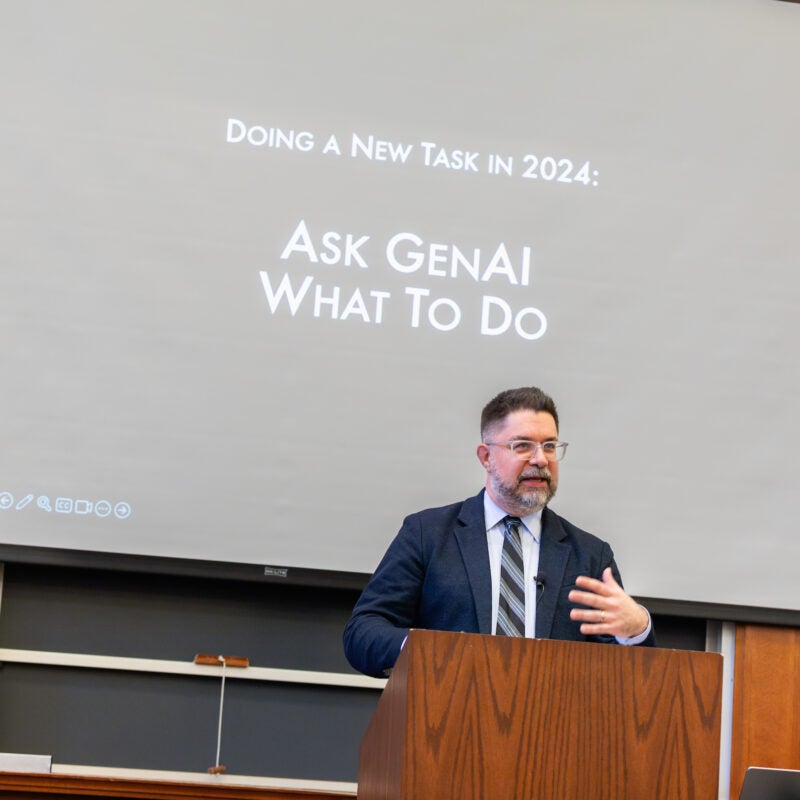
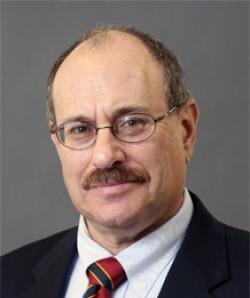
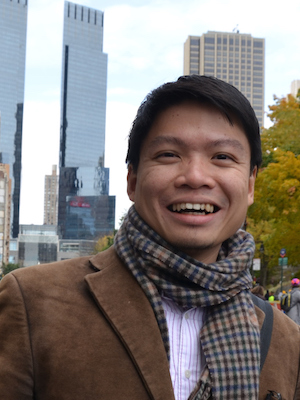
Christopher T. Bavitz is the WilmerHale Clinical Professor of Law and Vice Dean for Experiential and Clinical Education at Harvard Law School. He serves as Managing Director of the Cyberlaw Clinic at the Berkman Klein Center for Internet & Society and is a Faculty Co-Director of the Center. His expertise spans intellectual property, media law, AI governance, and technology policy. Bavitz teaches courses like Music & Digital Media and Counseling and Legal Strategy in the Digital Age . His research focuses on algorithmic fairness, intermediary liability, and regulatory frameworks for emerging technologies. Bavitz holds a B.A. from Tufts University and a J.D. from the University of Michigan Law School. Before joining HLS, he was Senior Director of Legal Affairs at EMI Music and practiced litigation at Sonnenschein Nath & Rosenthal. Key initiatives include work on the Lumen Database for transparency in content takedowns, the AGTech Forum for state attorneys general, and policy analysis on AI ethics, facial recognition, and algorithmic risk assessment tools. He advises on startup legal strategy, digital finance, and generative AI accountability.
Emma Dauterman serves as an Assistant Professor in the Department of Computer Science within Stanford University's School of Engineering. Her current teaching responsibilities include foundational and advanced courses in computer security and privacy systems. Her research focuses on computer and network security with emphasis on privacy-preserving architectures and secure system design . Key domains include cryptographic protocols, vulnerability mitigation, and privacy-enhancing technologies for modern computing environments. This work bridges theoretical security models with practical implementation challenges in networked systems. While no recent publications are listed in the available data, her course offerings indicate active research in privacy systems and advanced security frameworks. Teaching responsibilities demonstrate expertise across core security principles and cutting-edge research applications. As a faculty advisor for CS 499/499P Advanced Reading and Research, she mentors graduate students in independent security research projects. No major grants or external funding sources are specified in the current profile. No laboratory affiliations or research teams are explicitly mentioned, though her course specialization suggests involvement in Stanford's security research ecosystem.
Sai Praneeth Karimireddy is an Assistant Professor in the Thomas Lord Department of Computer Science at the University of Southern California (USC), with a courtesy appointment in the Ming Hsieh Department of Electrical and Computer Engineering. He previously held an SNSF postdoctoral fellowship at UC Berkeley under Michael I. Jordan and earned his PhD at EPFL advised by Martin Jaggi. He co-leads the Federated Learning and Data Quality working group at MONAI (NVIDIA) and collaborates with researchers at Apple Research. His research lies at the intersection of optimization, machine learning, statistics, and economics, with a strong focus on federated learning, privacy-preserving machine learning, data valuation, and AI for healthcare. He investigates how data quality, privacy, and incentives shape collaborative ML systems, especially in high-stakes domains like medicine. His work has been deployed at companies such as Meta, Google, OpenAI, and Owkin. His recent publications span top-tier venues including NeurIPS, ICML, ICLR, and JMLR, with influential contributions such as the SCAFFOLD algorithm for federated learning. His research shows a consistent trend toward building robust, private, and incentive-compatible collaborative learning systems, with increasing emphasis on real-world deployment in healthcare and decentralized data markets. 2023 SNSF Mobility Fellowship 2022 Patrick Denantes Memorial Prize for best thesis in computer science 2022 EPFL thesis distinction (top 8%) 2021 Chorafas Foundation Prize for exceptional applied research Capitol One Fellow (2025) He is actively mentoring PhD students and leads a research group focused on foundational and applied challenges in federated and privacy-preserving ML. He teaches graduate courses at USC, including CSCI 599 on Optimization for Machine Learning and CSCI 699 on Privacy-Preserving Machine Learning. He serves as an area chair for ICLR 2025 and co-organizes major workshops on incentives in data sharing and federated learning. His lab collaborates with institutions like NVIDIA, Apple, and Argonne National Laboratory, and he is building a research program centered on sustainable, equitable, and trustworthy AI ecosystems.
Benjamin Recht is a Professor in the Department of Electrical Engineering and Computer Sciences and Department of Statistics at the University of California, Berkeley. Previously, he was an Assistant Professor in the Department of Computer Sciences at the University of Wisconsin-Madison. Recht received his BS in mathematics from the University of Chicago and his MS and PhD from the MIT Media Laboratory, followed by a postdoctoral fellowship at Caltech's Center for the Mathematics of Information. His research interests span Machine Learning, Optimization, Control Theory, and Statistics , with a focus on both theoretical foundations and practical applications. Recht's work addresses fundamental questions in reproducibility, generalization, and robustness of machine learning systems, while also developing novel methods for control, computer vision, and data analysis. Recht's recent publications reveal a strong focus on reproducibility in machine learning , with papers like "The Mechanics of Frictionless Reproducibility" (2024), alongside continued contributions to statistical learning theory ("Interpolating Classifiers Make Few Mistakes", 2023) and computer vision ("Plenoxels", 2022; "K-planes", 2023). His work increasingly addresses societal implications of AI , including papers on systemic harm detection and post-deployment evaluation. NSF Career Award Alfred P. Sloan Research Fellowship 2012 SIAM/MOS Lagrange Prize in Continuous Optimization Presidential Early Career Award for Scientists and Engineers 2014 Jamon Prize 2015 William O. Baker Award for Initiatives in Research 2017 and 2020 NeurIPS Test of Time Awards Recht has advised numerous PhD students who have gone on to faculty positions at top universities and research roles at leading technology companies. His work on optimization algorithms has been widely influential, including the development of methods like HOGWILD! for parallel stochastic gradient descent. He co-founded the Conference on Learning for Decision and Control and has served on editorial boards for the Journal of Machine Learning Research and Mathematical Programming. His research group spans both theoretical and applied work, with connections to healthcare (adaptive medication tapering), computer vision (radiance fields), and social impact (systemic harm detection in deployed systems).
Niina Zuber is a Research Coordinator at the Bavarian Institute for Digital Transformation (bidt), focusing on ethical software design, agile development processes, and the intersection of digital technologies with democratic systems. Her work emphasizes integrating ethical principles into technical systems through frameworks like EDAP (Ethical Deliberation for Agile Processes). PhD in Ethics and Software Development (LMU Munich) Former roles: Research Consultant (Cognostics AG), LMU Munich, Center for Digitalization Bavaria (ZD.B) Key projects: EDAP, ReCREATIV, AI Gender Bias Dialogue Her research spans: ethical requirements management, value-sensitive design, AI's impact on creativity, facial recognition regulation, and digital responsibility frameworks. She regularly contributes to academic publications and public discourse on digital ethics. Scientific Contributions: Co-developed EDAP framework for ethical agile software processes Investigated ethical challenges in large language models (Vox ChatGPT) Explored gender bias in AI systems Studied generative AI's impact on creative industries Contributed to regulatory discussions on facial recognition Zuber collaborates across disciplines, connecting philosophy with technical implementation through projects like EDAP and publications in journals such as Philosophy & Technology and Informatics Spectrum.
Maryellen L. Giger, Ph.D. is the A.N. Pritzker Distinguished Service Professor of Radiology, Committee on Medical Physics, and the College at the University of Chicago. She serves as Vice-Chair of Radiology (Basic Science Research) and was the immediate past Director of the CAMPEP-accredited Graduate Programs in Medical Physics/Chair of the Committee on Medical Physics. Her career spans over 30 years of pioneering research in computer-aided diagnosis, machine learning, and deep learning applications in medical imaging. Dr. Giger's research focuses on computational image-based analyses for cancer risk assessment, diagnosis, prognosis, and response to therapy, particularly in breast cancer, lung cancer, prostate cancer, lupus, bone diseases, and more recently, COVID-19. Her work has evolved from developing computer-aided diagnosis systems to utilizing 'virtual biopsies' in imaging genomics association studies for discovery. She has made significant contributions to quantitative imaging, radiomics, and AI applications in medical imaging, with emphasis on translating research into clinical practice. Her publication record shows a clear trajectory from foundational work in computer vision for medical imaging to cutting-edge AI and deep learning applications. The recent publications demonstrate her leadership in large-scale collaborative efforts like the Medical Imaging and Data Resource Center (MIDRC), focus on health equity through AI analysis, and expansion into diverse applications including gynecological imaging, lung cancer screening, and trauma assessment. Her work consistently bridges technical innovation with clinical relevance. Dr. Giger has received numerous prestigious honors including membership in the National Academy of Engineering, the William D. Coolidge Gold Medal (the highest award from AAPM), and being named one of the 50 most impactful medical physicists in the last 50 years. She is a Fellow of multiple professional societies including AAPM, AIMBE, SPIE, SBMR, and IEEE. Her 2019 TIME magazine recognition for QuantX, the first FDA-cleared machine-learning-driven system for cancer diagnosis, highlights her translational impact. As an educator and mentor, Dr. Giger has guided over 100 graduate students, residents, and medical students throughout her career. She has secured substantial research funding including NIH R01 grants and serves as contact PI for the NIH NIBIB-funded & ARPA-H-funded Medical Imaging and Data Resource Center (MIDRC). Her leadership extends to former presidencies of the American Association of Physicists in Medicine and SPIE, and she was the inaugural Editor-in-Chief of the SPIE Journal of Medical Imaging. Dr. Giger co-founded Quantitative Insights, Inc. through the University of Chicago's New Venture Challenge, which developed QuantX - the first FDA-cleared AI system for cancer diagnosis. She leads the Medical Imaging and Data Resource Center (MIDRC), a critical resource for AI development in medical imaging that received the 2023 DataWorks Prize. Her research laboratory bridges engineering, physics, and clinical medicine to develop and validate quantitative imaging biomarkers and AI tools for precision medicine.
Emily Laidlaw serves as Associate Professor and Canada Research Chair in Cybersecurity Law at the University of Calgary's Faculty of Law, where she also holds appointments as Co-Director of the Canadian Network on Information and Security and Ethics Advisor to Calgary’s City Council. Her academic credentials include a PhD (2012) and LLM (2007) from the London School of Economics and Political Science, a JD (2002) from the University of Saskatchewan, and a BA in Communications (1998) from Linfield University. Dr. Laidlaw's research critically examines the intersection of digital technologies and fundamental rights, with primary focus on cybersecurity law, online harms regulation, platform accountability, privacy protections, and freedom of expression in networked environments. Her influential book Regulating Speech in Cyberspace (Cambridge University Press, 2015) established foundational frameworks for analyzing corporate responsibility in digital governance, while her ongoing work addresses emerging challenges in intimate image abuse legislation and cross-border data flows. Her publication record reveals consistent scholarly engagement with intermediary liability doctrines and digital tort reform across Canadian, UK, and European contexts, demonstrating particular expertise in developing legal mechanisms for addressing online defamation and non-consensual intimate imagery. Recent work increasingly examines the role of technology mindfulness in shaping privacy tort evolution and content moderation systems. Recognition for her impactful scholarship includes: Peak Scholar award from the University of Calgary (2018) Dr. Laidlaw directs significant research initiatives including an SSHRC Insight Grant on developing digital privacy torts, a MINDS Grant for the Canadian Network on Information and Security, and participation as co-investigator in the SSHRC Partnership Grant for Human-Centric Cybersecurity. She recently co-chaired the federal government's expert advisory panel on online safety legislation. Her institutional affiliations include leadership roles in the Institute for Security, Privacy and Information Assurance, membership on the Council of Canadian Academies Expert Panel on Public Safety in the Digital Age, and editorial positions with the European Journal of Law and Technology and International Cybersecurity Law Review.
Prof. Dr.-Ing. Maria Francesca Spadea serves as Director of the Institute of Biomedical Engineering (IBT) at Karlsruhe Institute of Technology (KIT), part of the Helmholtz Association. Her leadership role includes overseeing research initiatives, teaching activities, and administrative responsibilities within the institute. Located in space 512, she maintains regular consultation hours on Wednesdays from 10:30-11:30 am by appointment. Professor Spadea's research spans several cutting-edge areas in biomedical engineering, with particular focus on medical image processing, artificial intelligence applications in healthcare, and radiomics. Her work bridges computational techniques with clinical applications, emphasizing practical solutions for medical imaging challenges. She has pioneered approaches in federated learning for medical image translation, particularly in CT/MRI synthesis for radiation therapy applications. Her research also extends to cancer cell analysis, vascular biomechanics, and medical robotics, demonstrating a broad yet cohesive research portfolio that addresses critical challenges in modern healthcare. Analysis of Professor Spadea's recent publications reveals a strong emphasis on AI-driven medical imaging solutions, particularly in the translation between different imaging modalities (like MRI-to-CT) using federated learning approaches that preserve patient privacy. Her work demonstrates growing specialization in radiation therapy applications, with multiple publications addressing synthetic CT generation for treatment planning. There's also a clear trajectory toward multi-institutional collaboration, as evidenced by her involvement in projects spanning multiple research centers across Europe. Professor Spadea actively mentors numerous students, including M. Krohmer Zabaleta, N. Skupien, and M. Destito, who have completed bachelor's and master's theses under her supervision. Her research group appears well-integrated within the broader Institute of Biomedical Engineering, collaborating extensively with colleagues like P. Zaffino and C.B. Raggio on multiple projects. The group maintains strong connections with clinical partners, as evidenced by publications addressing real-world medical challenges in radiation therapy, cardiology, and neurosurgery. The research activities of Professor Spadea's team are centered within the Institute of Biomedical Engineering at KIT, with particular focus on medical imaging processing and AI applications. Her laboratory appears to specialize in developing computational tools for medical image analysis, with recent work emphasizing privacy-preserving federated learning frameworks that enable multi-institutional collaboration without sharing sensitive patient data. The team maintains active collaborations with clinical departments, particularly in radiation oncology, as evidenced by numerous publications addressing CT synthesis for radiation therapy planning.
Dr. Jason Bennett Thatcher is a Professor at Temple University in the Department of Management Information Systems at the Fox School of Business. He holds additional faculty appointments at the Technical University of Munich, Information Technology University-Copenhagen, and Hong Kong Polytechnic University. His research bridges human behavior and information technology, focusing on cybersecurity, strategic alignment, and digital innovation. 20-year track record in top FT50 journals Top 35 active IS researcher by productivity Senior Editor roles at MIS Quarterly , Information Systems Research , and Journal of the AIS Research spans three pathways: strategic IT decisions (firm performance, governance), IT workforce management (job satisfaction, turnover), and post-adoption IT innovation (technostress, IT identity). 2022 publications emphasize digital commerce, social media ethics, and technostress mitigation. Awards include: Clemson's 2008 Undergraduate Teaching Award KPMG Foundation Circle of Compadres Top Associate Editor recognition by Information Systems Research Multiple productivity rankings Teaching spans undergraduate to Ph.D. levels with global mentorship experience. Editorial leadership roles include Senior Editor positions and former editorial board memberships. Productivity metrics highlight 12,000+ Google Scholar citations and consistent publication in FT50 journals since 2002.
Priya L. Donti is an Assistant Professor at MIT's Department of Electrical Engineering and Computer Science (EECS) and Laboratory for Information and Decision Systems (LIDS). She co-founded and chairs Climate Change AI , a global nonprofit focusing on climate-AI intersections. Education: Ph.D. in Computer Science & Engineering & Public Policy, Carnegie Mellon University (advised by Zico Kolter and Inês Azevedo) Undergraduate in Computer Science & Math, Harvey Mudd College Research Focus: Machine learning for high-renewables power grids, incorporating physics and constraints into deep learning. Key areas include robust optimization, control systems, and climate-AI alignment. Article Trends: 2024-2022 works emphasize climate mitigation through AI (keywords: environmental science, AI ethics, policy modeling), while 2019-2021 studies focus on grid stability (power engineering, optimization) and hybrid AI-logic systems (symbolic reasoning, constraint handling). Scientific Recognition: MIT Technology Review 35 Innovators Under 35 (2021) Vox Future Perfect 50 (2023) Schmidt Sciences AI2050 Early Career Fellowship ACM SIGEnergy Doctoral Dissertation Award (2022) Best paper/poster awards at ACM e-Energy 2021 and PECI 2019 Her group at MIT develops physics-informed ML for power grids, with funding from NSF, DOE, and Center for Climate and Energy Decision Making. She actively advises prospective students through MIT EECS applications.
Rasheed Hussain is an Associate Professor of Intelligent Network Security at the Smart Internet Lab and Bristol Digital Futures Institute (BDFI), School of Electrical, Electronic and Mechanical Engineering at the University of Bristol, UK. Previously, he served as a Senior Lecturer at the same institution from December 2021 to July 2025. He has held academic positions at Innopolis University, Russia, where he served as Associate Professor and Director of the Institute of Information Security and Cyber-Physical Systems, and as a guest researcher at the University of Amsterdam, Netherlands. His educational background includes a PhD in Computer Engineering from Hanyang University, South Korea (2011-2015), an MS in Computer Engineering from the same institution (2008-2010), and a B.Sc in Computer Software Engineering from the University of Engineering and Technology, Peshawar, Pakistan (2003-2007). Hussain's research focuses on network and cybersecurity, particularly future network security including 6G, the role of Digital Twins in future networks and systems security, and Responsible AI including fairness, trustworthiness, and explainability. His work spans information security, privacy, applied cryptography, vehicular networks, Internet of Things, Content-Centric Networking, cloud computing, API security, and blockchain applications. Senior member of IEEE Member of ACM ACM Distinguished Speaker Editorial board member for IEEE Communications Surveys & Tutorials, IEEE Access, and other journals His recent publications demonstrate a strong focus on the intersection of AI, networking, and security, with particular emphasis on Digital Twins, blockchain applications, federated learning, and 6G security. His research shows a clear trajectory toward addressing security challenges in emerging network architectures while incorporating responsible AI principles. Scientific Recognition: ACM Distinguished Speaker Netherlands University Teaching Qualification (Basis Kwalificatie Onderwijs, BKO) Hussain serves as a reviewer for major IEEE transactions, Springer and Elsevier journals, and participates in technical program committees for conferences including IEEE VTC, IEEE VNC, IEEE Globecom, and IEEE ICC. He is also certified as a trainer for the Instructional Skills Workshop (ISW) and contributes to the ESRC Centre for Sociodigital Futures (CenSoF) at the University of Bristol. His laboratory work centers around the Networks and Blockchain Lab, which focuses on security solutions for next-generation networks, with particular emphasis on Digital Twins security, blockchain applications, and AI-driven network security solutions. His current projects involve developing secure frameworks for future networks, trustworthy AI models, and privacy-preserving federated learning approaches.
Maxwell J. Mehlman serves as Distinguished University Professor and Arthur E. Petersilge Professor of Law at Case Western Reserve University School of Law, where he also co-directs the Law-Medicine Center. Additionally, he holds a professorship in the Department of Bioethics at the Case Western Reserve University School of Medicine. His dual appointments bridge the critical intersection of law, medicine, and ethics. Dr. Mehlman earned his Juris Doctor from Yale Law School in 1975 and holds two bachelor's degrees—one in Political Science from Reed College (1970) and another in Philosophy, Politics and Economics from Oxford University (1972), where he studied as a Rhodes Scholar. Before joining the Case Western Reserve faculty in 1984, he practiced law with Arnold & Porter in Washington, D.C., specializing in federal regulation of health care and medical technology. Mehlman's research spans the complex terrain where medical practice, legal frameworks, and ethical considerations converge. His work focuses particularly on genetic engineering, biomedical enhancement, patient-physician relationships, military bioethics, and the legal implications of medical practice guidelines. He explores how emerging biotechnologies challenge existing social structures and ethical norms, with particular attention to issues of equality, justice, and individual rights in the era of human enhancement. His publications reveal a consistent focus on the societal implications of biomedical advances, particularly in genetic engineering and human enhancement. Mehlman's scholarship demonstrates how legal frameworks struggle to keep pace with rapid scientific developments, often creating ethical dilemmas that require innovative policy solutions. His work on medical malpractice guidelines shows his interest in practical applications of bioethics in healthcare delivery systems. Co-author of Access to the Genome: The Challenge to Equality Co-editor with Tom Murray of the Encyclopedia of Ethical, Legal and Policy Issues in Biotechnology Co-author of Genetics: Ethics, Law and Policy , the first casebook on genetics and law Mehlman has dedicated his career to examining the governance challenges posed by emerging biomedical technologies. His research on DIY gene editing, military bioethics, and performance enhancement in sports demonstrates his commitment to addressing ethical questions before they become widespread societal problems. His work bridges theoretical ethical frameworks with practical legal applications, making significant contributions to both academic discourse and policy development in bioethics.
Craig Jones is an Assistant Professor of Computer Science at Johns Hopkins University's Whiting School of Engineering. He is affiliated with the Malone Center for Engineering in Healthcare and contributes to the Precision Medicine Analytics Platform's Imaging and Data Science Subcommittees. BSc in Computer Science and Mathematics from Simon Fraser University MSc in Medical Biophysics from the University of Western Ontario PhD in Physics from the University of British Columbia His research focuses on applying artificial intelligence and neural networks to medical image processing, particularly for MRI, CT, optical coherence tomography (OCT), and ultrasound datasets. Key areas include 2D/3D image processing, anomaly detection, segmentation, and uncertainty quantification, with clinical applications in neurosurgery, ophthalmology, and oncology. Projects span robotic imaging, neuroendoscopic guidance, and cancer boundary detection. Recent publications highlight advancements in vision-language models for 3D medical imaging, automated segmentation of venous malformations, and AI-guided neurosurgical tools. Articles emphasize multimodal data fusion, self-supervised learning, and federated learning for rare cancer analytics. He received a $310,000 Department of Defense grant in 2022 to develop AI-guided treatments for venous malformations. His work bridges clinical imaging domains and computer vision as a member of the Radiology AI Lab (RAIL), a collaborative effort across Johns Hopkins Hospital, the Whiting School of Engineering, and the Applied Physics Laboratory.
Novi Quadrianto is a Professor of Machine Learning at the School of Engineering and Informatics, University of Sussex, where he joined as a Lecturer in February 2014. He is currently a Principal Investigator on three active EU grants: BayesianGDPR (ERC), TANGO (EU Horizon RIA), and Act.AI (ERC Proof of Concept). He also holds an Adjunct Professor position in Data Science at Monash University, Indonesia, and serves as Strategic Lab co-Leader of the BCAM Severo Ochoa Strategic Lab on Trustworthy Machine Learning in Bilbao, Spain. His educational background includes a PhD in Machine Learning from the Australian National University (2012) and a BEng in Electrical and Electronics Engineering from Nanyang Technological University, Singapore. During his PhD, he conducted research at multiple international institutions including HIIT-Finland, Yahoo! Research-US, University of Alberta-Canada, Fraunhofer IAIS-Germany, and IST Austria. From 2012-2014, he was a Newton International Fellow of the Royal Society at the University of Cambridge. Professor Quadrianto directs the Predictive Analytics Lab (PAL) since 2017, which focuses on "Responsible AI" research developing AI models that embed fairness, accountability, transparency, and trustworthiness. His research spans algorithmic fairness, federated learning, and computer vision, with applications in sustainable development, healthcare, and finance. His work has been funded by prestigious organizations including the European Research Council, EPSRC, and HM Treasury. His publications reveal a strong focus on addressing challenges in AI fairness, robustness, and privacy, particularly in dynamic environments and heterogeneous data settings. Recent work explores performative prediction, diversity-driven learning, and efficient vision transformer inference, demonstrating his leadership in cutting-edge machine learning research. European Research Council ERC Proof of Concept Grant (2023) Guarantor Researcher for BCAM Severo Ochoa Excellence Accreditation (2023) European Lab for Learning and Intelligent Systems (ELLIS) Scholar/Fellow (2020) European Research Council ERC Starting Grant (2019) Newton International Fellowship (2012) Microsoft Research Asia Fellowship (2009) Professor Quadrianto currently supervises six PhD students and five postdoctoral researchers. He has served as Action Editor for Transactions on Machine Learning Research since 2022 and as Associate Editor for IEEE Transactions on Pattern Analysis and Machine Intelligence since 2016. He has also been an Area Chair for major conferences including NeurIPS, ICML, and AAAI. His PAL laboratory hosts a team of 15 members focused on inter-disciplinary AI research with domain experts across various sectors. The PAL Lab operates three innovation strands: AI for Sustainable Development (supporting UN SDGs), AI for Healthcare (transforming health outcomes), and AI for Finance (personalized loan decision-making). The lab also leads initiatives in Diversity & Inclusion in AI and offers Pro-Bono Office Hours to organizations seeking guidance on machine learning aspects.
Anson Kahng is an Assistant Professor in the Department of Computer Science and the Goergen Institute of Data Science at the University of Rochester. He previously held postdoctoral positions at the University of Toronto and completed his PhD at Carnegie Mellon University under the supervision of Ariel Procaccia, focusing on computational social choice. PhD, Computer Science, Carnegie Mellon University Undergraduate degree, Computer Science, Harvard College His research explores the intersection of computer science and democracy, developing frameworks like virtual democracy and liquid democracy while analyzing fairness in participatory budgeting and voting systems. He combines theoretical analysis with empirical methods, emphasizing interdisciplinary collaboration. Recent work includes advancements in ranked choice voting optimization, fairness metrics for elections, and structural analysis in cryo-electron tomography. He has published in top venues such as IJCAI, AAAI, NeurIPS, and ACM Transactions on Economics and Computation. NeurIPS 2019 Spotlight Presentation (top 2.5% of submissions) Kahng advises PhD students Alina Chadwick and Joe Saber, and has mentored multiple undergraduate researchers. He teaches courses on algorithmic game theory and computational statistics at the University of Rochester.