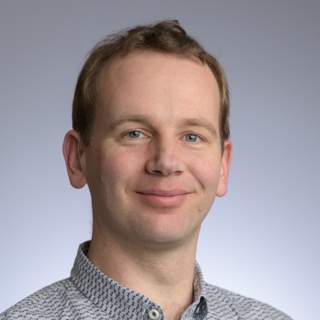
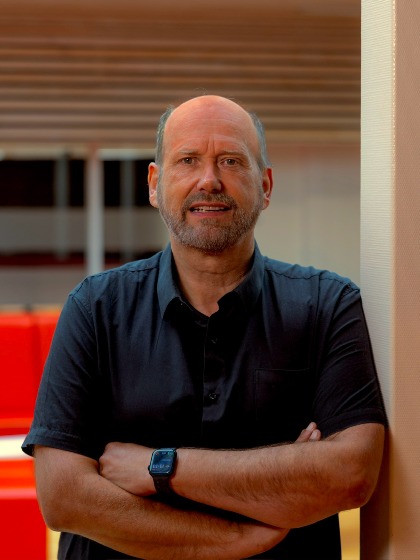
Vincent Groenhuis is a postdoctoral researcher at the Robotics and Mechatronics (EEMCS-EE-RAM) group , University of Twente. He holds a BSc, MSc, and PhD in Computer Science, Embedded Systems, and Medical Robotics respectively, all cum laude. His work focuses on image-guided medical robotics for bladder cancer diagnosis (Next-gen In-Vivo project) and MRI/ultrasound-guided breast biopsy (Sunram/MURAB projects), alongside innovations in pneumatic and electric stepper motors with two patents spun into companies. Education : BSc Computer Science (cum laude), MSc Embedded Systems (cum laude), PhD Medical Robotics (cum laude) Key Collaborations : Hamlyn Surgical Robot Challenge, European Robotic Forum, ICRA, BioRob, IROS His research integrates 3D-printed actuators with MRI safety protocols, enabling compact, reconfigurable systems for endovascular interventions and biopsy procedures. Article trends emphasize sensorless positioning , pneumatic computation , and multi-axis motor design . Awards include Best Video (Sunram 4, Hamlyn 2017) and Best Design (Sunram 3, Hamlyn 2016) . Supervised student projects span ultrasound needle steering , auto-rewind spool holders , and emergency disengagement mechanisms .
Willemijn H.M. Remmerswaal serves as a Postdoctoral Researcher at Eindhoven University of Technology within the Faculty of Chemical Engineering and Chemistry, specifically affiliated with the Molecular Materials and Nanosystems research group. Her work contributes to UN Sustainable Development Goals related to clean energy and climate action. Her research focuses on advancing perovskite solar cell technology, with particular expertise in surface passivation strategies , defect analysis in metal-halide perovskites , and energy loss mechanisms . Her work bridges materials science and renewable energy engineering, with strong emphasis on improving photovoltaic efficiency and stability. Analysis of her recent publications reveals a consistent focus on overcoming efficiency limitations in perovskite photovoltaics through innovative material engineering approaches. Her research spans fundamental defect physics to practical device implementation, with particular attention to narrow-bandgap materials and tandem solar cell configurations. Her collaborative research network spans multiple international institutions, with significant contributions to high-impact journals including Nature Communications, Nature Energy, and the Journal of Physical Chemistry Letters. Dr. Remmerswaal previously completed her Master's thesis on 'Flexible and printable 0-3 piezoelectric composites for sensor applications' in 2020 and her Bachelor's thesis on 'Heterogeneity of Plasmon Shift of Single Metal Nanoparticles in Response to Polyelectrolyte Layer Assembly' in 2016, establishing her foundation in materials characterization and device physics.
Institute for Atomic and Molecular PhysicsNetherlands
Erik Garnett is a Professor of Nanoscale Photovoltaics at the University of Amsterdam and Group Leader of the Nanoscale Solar Cells research group at AMOLF. His research integrates nanophotonics with nanomaterials to advance solar cell technology, LEDs, and light-driven chemical reactions. He holds a PhD from UC Berkeley and postdoctoral experience at Stanford University in photonics and plasmonics. Garnett pioneered studies on light-matter interactions in nanoscale solar cells using advanced nano-characterization techniques. His work produced patents and led to applications in sustainable energy materials. Education: BS in Chemistry (University of Illinois), PhD in Chemistry (UC Berkeley), Postdoc at Stanford University (Photonics/Plasmonics). Research focuses on nanophotonic engineering, halide perovskites, and energy materials. Key contributions include directional emission control, plasmonic hotspots, and perovskite quantum dot intermittency analysis. He received the KNCV Gold Medal (2022) for top Dutch chemists under 40. Grants and collaborations: His lab develops self-optimized catalysts, transparent electrodes, and nanophotonic lenses. His patents address perovskite synthesis and optoelectronic applications. He collaborates with institutions on projects like 3D photovoltaics and plasmonic nanoreactors. Labs/Teams: Leads the Nanoscale Solar Cells group at AMOLF, part of the LMPV (Light Matters Physics) division. Active in the Amsterdam nanophotonics and materials community.
Dr. Rudy Folkersma is a Professor of Polymer Science at the University of Groningen (Faculty of Science and Engineering) and holds an additional position as Professor of Applied Science (Circular Plastics) at NHL Stenden University of Applied Sciences. He is affiliated with the Zernike Institute for Advanced Materials, specifically the Macromolecular Chemistry & New Polymeric Materials department. His research focuses on sustainable materials, including biodegradable polymers, composite materials, and innovative applications in additive manufacturing and self-healing systems. Key research interests include polymer synthesis, bio-based materials, chemical recycling, and the development of environmentally friendly materials for industrial applications. His work bridges fundamental polymer science with practical engineering solutions, emphasizing circular economy principles. Recent publications highlight advancements in self-healing hydrogels, microwave-assisted polymer recycling, and 3D-printable repairable resins. Collaborations involve interdisciplinary teams addressing challenges in material functionality, sustainability, and scalability. Folkersma’s contributions have been published in journals like ACS Applied Materials and Interfaces , Journal of the American Chemical Society , and Green Chemistry . His expertise extends to biomaterials, composites, and polymeric membranes, with a strong emphasis on industrial relevance and environmental impact. Current projects focus on bio-based polymers, thermoreversible cross-linking systems, and sustainable manufacturing techniques.
Amsterdam University of Applied SciencesNetherlands
Marcel van der Horst is a Senior Lecturer at the Faculty of Technology (TU Delft). He holds a PhD in Systematic Design of EMI-Resilient Negative-Feedback Amplifiers from TU Delft (2012). His research focuses on sensor technology, printable electronics, and systematic design methods for instrumentation systems. Key areas include quantum magnetometry, water quality monitoring, and traffic measurement infrastructure. Research highlights include developing low-cost fluorometers for fecal contamination detection in drinking water, creating high-performance instrumentation amplifiers, and smart sub-tile systems for traffic analysis. His work integrates engineering principles with practical applications in environmental and civil infrastructure domains. Education: PhD in Systematic Design of EMI-Resilient Negative-Feedback Amplifiers (TU Delft, 2012) Awards: Docent van het jaar Afdeling Elektrotechniek (2015) Collaborations: Active in Nepal-Europe research ecosystems, EMC/ESD events, and international sensor networks Recent activities include organizing conferences on electromagnetic compatibility and hosting academic visitors to advance interdisciplinary research initiatives.
Professor Katja Loos is a distinguished academic at the University of Groningen, where she serves as Professor of Polymer Science and Applied Chemistry within the Faculty of Science and Engineering. She leads the Macromolecular Chemistry & New Polymeric Materials research group at the Zernike Institute for Advanced Materials, focusing on sustainable polymer development and green chemistry solutions. Her research group maintains strong collaborations with NHL Stenden University of Applied Sciences and other international institutions. Loos' research interests center on the synthesis and characterization of novel macromolecules, with particular emphasis on developing sustainable, eco-efficient production methods for polymeric materials. Her work spans enzymatic polymerization techniques, biobased materials, biodegradable plastics, recyclable polymers, and sustainable manufacturing processes. A significant portion of her recent work focuses on creating sustainable alternatives to conventional plastics, including biobased polyesters, starch-based materials, and vitrimer networks with dynamic covalent bonds. Her recent publications demonstrate a clear trend toward environmentally friendly polymer solutions, with emphasis on biobased feedstocks, recyclable materials, and sustainable manufacturing. The research spans fundamental polymer chemistry to applied technologies including water remediation membranes, wearable electronics, energy storage materials, and 3D printable sustainable polymers. Her group has pioneered work on enzymatic synthesis of furan-based polymers, starch modification for improved properties, and recyclable bioplastic membranes for oil-water separation. Professor Loos has received numerous prestigious awards recognizing her scientific excellence and contributions to sustainable chemistry: IUPAC 2021 Distinguished Women in Chemistry award NWO Team Science Award (2022) with the HyBRit research group Research Award of the Alexander von Humboldt Foundation Fellowship for Innovation of Teaching Royal Decoration from the University of Groningen She has successfully secured substantial research funding, including more than EUR 6 million for sustainable plastic development projects. Professor Loos has supervised over 15 PhD students whose work spans enzymatic polymerization, biobased materials, starch modification, and advanced polymer architectures. Her research group, HyBRit, focuses on creating sustainable polymer solutions with closed-loop life cycles, recently developing a recyclable bioplastic membrane that can remove oil from water and be depolymerized for reuse. The Loos research group operates within the Zernike Institute for Advanced Materials, maintaining strong connections with the Green Chemistry Ecosystem of North Netherlands. They collaborate extensively with both academic and industrial partners to translate fundamental polymer science into practical sustainable solutions for real-world environmental challenges.