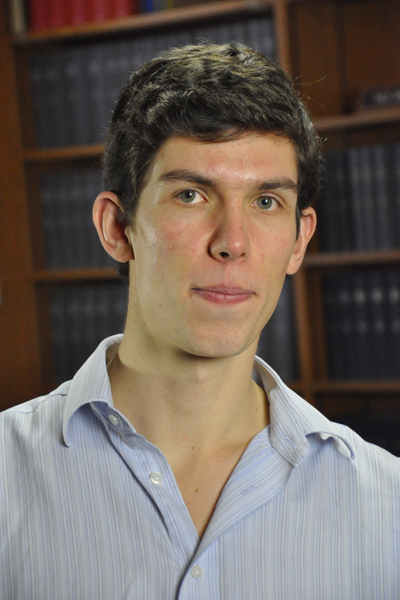
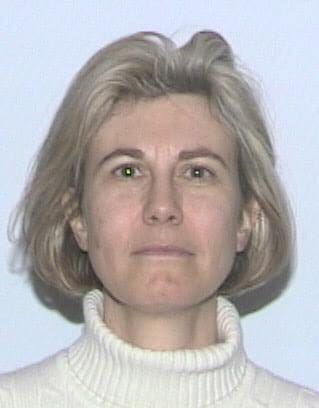
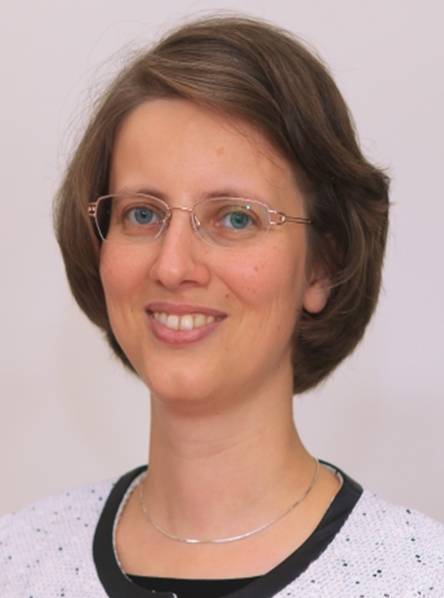
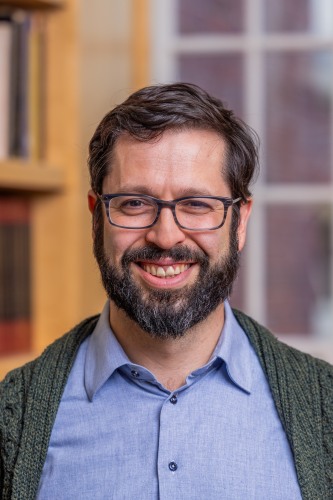
Chantal David is a Professor in the Department of Mathematics and Statistics at Concordia University. Her research focuses on number theory and its intersections with mathematical statistics. Formal Affiliation: Concordia University, Department of Mathematics and Statistics Email: chantal.david@concordia.ca Office: Library Building, LB 927.09 Research Interests revolve around Number Theory , particularly: L-functions and their non-vanishing properties Elliptic curves over finite fields and function fields Statistics of group structures and root numbers Connections to random matrix theory and metaplectic functions Extremal primes and Frobenius distributions Drinfeld modules and supersingular reductions Article Trends show a focus on cubic and quartic L-functions, non-vanishing phenomena, and statistical properties of elliptic curves over finite fields. Recent work explores metaplectic theta functions, extreme value distributions, and one-level density analysis. Labs & Teams : She is affiliated with the Montreal Number Theory Group (CICMA) .
Sug Woo Shin is a Professor of Mathematics at the University of California, Berkeley ( Math Genealogy , MathSciNet Profile ). His research focuses on Number Theory and Automorphic Forms, with significant contributions to the Langlands Program, Shimura varieties, and cohomology of arithmetic spaces. Editorial roles: Astérisque , Manuscripta Mathematica , Journal of the Korean Mathematical Society Recent research explores cohomological properties of locally symmetric spaces, tempered A-packets for classical groups, and modularity of symplectic Galois representations Collaborators include Ana Caraiani, Mark Kisin, Arno Kret, and Peter Scholze He has supervised PhD theses on topics like affine Deligne-Lusztig varieties, specialization maps in Scholze's category of diamonds, and statistical properties of automorphic representations. Teaching includes graduate courses on Number Theory (254A/254B), undergraduate Linear Algebra (110), and Calculus (1A), as well as seminars on global Langlands reciprocity and p-adic cohomology theories. Co-organized conferences include the BIRS workshop on Langlands programs (2025), PRIMA algebraic number theory sessions (2022), and KAST Symposium on automorphic forms (2021). His work appears in journals like Annals of Mathematics, Duke Mathematical Journal, and Compositio Mathematica.
James Maynard is a Professor of Number Theory at the University of Oxford , holding a Title IV Professorship equivalent to a UK chair or US full professor. He has held prestigious positions including Membership at the Institute for Advanced Study (Princeton, 2017), Research Membership at MSRI (Berkeley, 2017), and a Clay Research Fellowship (2015-2018). His research focuses on analytic number theory , particularly prime numbers and sieve methods , with groundbreaking work on prime gaps and Diophantine approximation. EDUCATION DPhil in Mathematics (2009-2013), Balliol College, Oxford Part III Mathematics (2008-2009), Queens’ College, Cambridge BA Mathematics (2005-2008), Queens’ College, Cambridge Maynard’s research explores the structure of prime numbers, including prime distribution , digital properties of primes , and norm form representations . His work has revolutionized understanding of bounded prime gaps and extremal prime spacing using advanced sieve techniques and probabilistic methods. Maynard’s publications (15 most recent) span analytic number theory , prime distribution , and Diophantine approximation . Key subfields include Bounded Gaps Between Primes , Digital Restrictions in Primes , Probabilistic Methods in Number Theory , and Algorithmic Sieve Optimization . Scientific Awards Fields Medal (2022) Cole Prize in Number Theory (2020) ERC Starting Grant (€1.5m, 2020-2025) Compositio Prize (2019) Wolfson Merit Award (2017) EMS Prize (2016) Erdős $10,000 Problem Prize (2016) Clay Research Fellowship (2015-2018) Whitehead Prize (2015) Ramanujan Prize (2014) Maynard has advised no explicitly named students but collaborates extensively in number theory. His grants include the ERC Starting Grant (2020-2025) and Wolfson Merit Award (2018-2023) . He has contributed to collaborative projects like the Polymath group and served as a Summer Consultant at GCHQ/Heilbronn Institute (2008-2012).
Caterina Consani is a Professor of Mathematics at Johns Hopkins University's Krieger School of Arts & Sciences. She holds a PhD from the University of Chicago (1996) and a Dottore di Ricerca in Matematica from the Universities of Genoa and Turin (1993). Her research focuses on arithmetic geometry, non-commutative geometry, and the development of absolute geometry over the 'absolute point.' She has contributed to foundational work on the BC-system, the Arithmetic Site, and the Scaling Site, linking number theory with geometric frameworks. Education: PhD in Mathematics, University of Chicago (1996); Dottore di Ricerca in Matematica, Universities of Genoa & Turin (1993). Prior to Johns Hopkins, she taught at MIT (1996–1999) and the University of Toronto (1999–2005). Research Interests: Arithmetic geometry, non-commutative geometry, absolute geometry in characteristic one, connections to number theory and the Riemann Hypothesis. Collaborations include work with Alain Connes on adele class spaces and non-commutative algebraic geometry. Awards: Fellow of the American Mathematical Society (2024); 2025 Best Paper AOFA Award (Annals of Functional Analysis). Editorial roles include the Journal of Number Theory and Journal of Noncommutative Geometry. Teaching: Offers advanced courses in algebraic geometry and number theory, including topics like étale cohomology and the yoga of weights in 'Weil II.' Grants: Supported by the Simons Foundation. Organized major conferences such as the JAMI Conference on Riemann-Roch in Characteristic One (2019).
Jaclyn Lang is the Selma Lee Bloch Brown Assistant Professor of Mathematics at Temple University. Her research centers on algebraic number theory, focusing on modular forms, Galois representations, elliptic curves, motives, and p-adic methods. Education: Ph.D. in Mathematics, UCLA (2016), advised by Haruzo Hida Part III of the Mathematical Tripos, University of Cambridge (2010), supervised by Tom Fisher MA in Mathematics, Bryn Mawr College (2009), supervised by Helen Grundman Research Interests: She works on advanced problems in number theory, including the Eisenstein ideal, pseudorepresentations, and arithmetic geometry of elliptic curves. Her work often bridges algebraic geometry and automorphic forms using p-adic techniques. Scientific Awards: Churchill Scholarship (2009–2010) Clare Booth Luce Scholarship (2007–2009) NSF Graduate Research Fellowship (2010–2015) Charles E. and Sue K. Young Graduate Student Award (2015) NSF Mathematical Sciences Postdoctoral Research Fellowship (2016–2020) AWM Travel Grant (2023) Fulbright U.S. Student Program Grant (2016) Simons Travel Support for Mathematicians (2023–2028) Grants: She has received NSF Standard Grant DMS-331117 (2023–2026) and participated in programs like the Park City Math Institute and Women in Numbers Europe (WINE3).
Tanja Eisner is a Professor at the University of Leipzig , affiliated with the Institute of Mathematics. Her work bridges functional analysis and operator theory with dynamical systems and ergodic theory . Research Interests : Functional analysis and operator theory Dynamical systems and ergodic theory Applications to number theory and additive combinatorics Recent Publications (15 most recent): Her articles focus on ergodic theorems, stability of operators, and connections between dynamics and number theory, with keywords spanning Mathematics , Operator Theory , Dynamical Systems , and Harmonic Analysis . Notable subfields include multiple recurrence , nilsystems , automatic sequences , and Wiener's lemma . Teaching & Collaboration : Organized miniworkshops on operator-theoretic aspects of ergodic theory in Leipzig, Wuppertal, Kiel, Feldkirch, and Tübingen Co-authored books with Bálint Farkas, Markus Haase, and Rainer Nagel Co-organized seminars like the Internet Seminar on Ergodic Theorems
Tanja Lange is a Full Professor at the Department of Mathematics and Computer Science at Technische Universiteit Eindhoven. She chairs the Coding Theory and Cryptology group and serves as scientific director of the Eindhoven Institute for the Protection of Systems and Information (Ei/Ψ). Additionally, she holds a visiting professor position at Academia Sinica, Taiwan. Research & Teaching Her research focuses on cryptography and number theory , with leadership in post-quantum cryptography (including code-based, lattice-based, hash-based, and isogeny-based systems). She has taught courses like Introduction to Cryptology and Selected Areas in Cryptology at TU/e, covering quantum algorithms, cryptographic protocols, and mathematical foundations. Key Contributions Co-author of 5 recent publications (2023-2025) on differential addition chains, ROLLO-I analysis, CSIDH fault injection, and KpqC evaluations Recipient of the Best Master Lecturer 2016 award Active in NIST Post-Quantum Cryptography competition (e.g., NTRU Prime) Affiliated with the Center for Quantum Materials and Technology Eindhoven Contact MetaForum 5.062, TU/e Email: tanja@hyperelliptic.org (primary) | t.lange@tue.nl (TU/e)
Lawrence C. Washington is a Professor of Mathematics at the University of Maryland, College Park . His office is located in Mathematics Building 1105, and he can be reached at lcw@math.umd.edu . Teaching & Courses: In Spring 2023 he is teaching Cryptography 456 (TuTh 11:00–12:15) and co-organising the Algebra Seminar (MW 2–3). Office hours are held Tuesdays 1:30–2:30 and Thursdays 10:00–10:50. Research Interests: His work centres on number theory , with particular emphasis on cyclotomic fields , elliptic curves , cryptology , and Iwasawa theory . He has made extensive contributions to the study of p-adic L-functions , class groups , heuristics for class numbers , and the arithmetic of elliptic curves, often bridging deep theoretical questions with computational investigations. Textbooks & Scholarly Output: Washington is the author of several widely-used textbooks: Introduction to Cryptography with Coding Theory (3rd ed.) Introduction to Cyclotomic Fields Elliptic Curves: Number Theory and Cryptography An Introduction to Number Theory with Cryptography (2nd ed.) Elementary Number Theory Recent Publication Trends: Over the past five years his papers have focused on heuristics for Iwasawa invariants , anti-cyclotomic extensions , class groups of real cyclotomic fields , and analytic estimates for sums of prime powers . The work is characterised by a synthesis of algebraic, analytic, and computational techniques, frequently yielding explicit examples and numerical data that inform broader conjectures in algebraic number theory. Extracurricular Interests: Outside mathematics, Washington enjoys running and playing the bassoon , and he maintains a light-hearted page devoted to his favourite intersection in Chevy Chase, MD. Advising & Grants: While the provided text does not enumerate individual students or specific grants, his extensive publication record and long-standing professorship indicate ongoing supervision of graduate research and participation in funded projects in number theory and cryptography.
Ghaith Hiary is a Professor and Vice Chair for Graduate Recruitment in the Department of Mathematics at The Ohio State University. He holds a PhD from the University of Minnesota (2008). His research focuses on computational and analytic number theory, with emphasis on the Riemann zeta function, L-functions, random matrix theory, and asymptotic analysis. Hiary's work bridges theoretical mathematics and high-performance computation. He develops efficient algorithms (e.g., amortized-complexity methods) to evaluate zeta functions at extreme heights (e.g., near t=10 28 ), implemented in C++/Mathematica. His research uses random matrix models to study zeta-function moments and employs techniques like van der Corput estimates and hybrid methods for explicit bounds. His publications demonstrate consistent focus on zeta-function computations, factorization algorithms, and arithmetic biases. Recent work (2022-2025) explores invariant measures, Lehman's method generalizations, and sign changes in random multiplicative functions, maintaining strong ties to analytic and probabilistic number theory. Hiary shares code and datasets via GitHub, including implementations of T 1/3 algorithms for zeta computations. He collaborates with institutions like the University of Waterloo and maintains numerical databases of zeta zeros.
Roman Feiman is the Thomas J. and Alice M. Tisch Assistant Professor of Cognitive, Linguistic, and Psychological Sciences and an Assistant Professor of Linguistics at Brown University. He directs the Brown Language and Thought Lab, focusing on how humans combine words into meaningful sentences and develop logical reasoning abilities. His research integrates methods from cognitive developmental psychology, psycholinguistics, and formal semantics. Feiman holds a PhD in Psychology from Harvard University (2015), followed by postdoctoral training at Harvard and UC San Diego. His work explores the cognitive systems underlying language and thought, including negation comprehension, quantifier scope, and the development of exact equality concepts. He teaches courses such as Language Processing in Humans and Machines and Logic in Language and Thought . His research interests span cognitive development, linguistic pragmatics, and the language of thought hypothesis. Notable findings include studies on children’s understanding of negation and how logical principles shape early language acquisition. Feiman has been recognized with the 2023 Henry Merritt Wriston Fellowship. His lab investigates topics like word referencing, semantic development, and the interplay between language and nonverbal reasoning. Recent work examines how neural networks might model human cognitive processes, bridging AI and psychological theory.
Giorgis Petridis is an Associate Professor at the University of Georgia, specializing in arithmetic combinatorics, a field rooted in combinatorial number theory with modern extensions into discrete analysis and finite field geometry. Born in Athens, Greece, he earned his PhD from the University of Cambridge under Tim Gowers and held a Visiting Assistant Professor position at the University of Rochester. He serves as an editor for Combinatorial Theory and is affiliated with the Number Theory and Arithmetic Geometry group, particularly its additive combinatorics and discrete analysis subgroup. Doctor of Philosophy (2011), University of Cambridge Certificate of Advanced Studies in Mathematics (2002), St John’s College, Cambridge BA (Hons) in Mathematics (2001), St John’s College, Cambridge His research focuses on additive combinatorics, exploring sumset estimates, polynomial configurations in prime lattices, and geometric incidence problems over finite fields. He investigates combinatorial geometry, including pinned distance problems and bisector arrangements, while also contributing to exponential sum bounds and expander graph theory. His work bridges theoretical mathematics with applications in pseudorandomness and discrete geometry. Recent publications highlight trends in finite field analysis, with 6 of 15 articles addressing arithmetic structures in prime-order fields. Key keywords include Combinatorics , Number Theory , and Finite Fields , with sub-fields spanning polynomial configurations, energy bounds, and geometric combinatorics. Scientific awards include the Creative Research Medal (2024) from the University of Georgia for mid-career research impact. Grants from the Simons Foundation (MPS-TSM-00007816) and multiple NSF DMS Awards (2054214, 1723016, 1500984, 1804049) support his work on discrete analysis and conferences. He co-advises five PhD students and has supervised multiple Master’s theses on topics like point-plane incidences and additive energy. Outreach includes leading high school math teams, organizing discrete analysis sessions, and contributing to public science communication guides.
Ben Green is the Waynflete Professor of Pure Mathematics at the University of Oxford and a Fellow of Magdalen College. His work spans additive combinatorics, analytic number theory, harmonic analysis, ergodic theory, discrete geometry, and group theory, with a focus on interdisciplinary approaches. Research Interests: Additive combinatorics and its applications to primes Analytic number theory (prime distribution, L-functions) Harmonic analysis (Fourier methods, spectral theory) Ergodic theory and its combinatorial applications Discrete geometry (ordinary lines, convex structures) Group theory (approximate groups, expansion) Article Trends: His recent work emphasizes multiplicative functions, Ramsey-type problems in number theory, expansion in finite groups, and extremal set theory. Themes include prime gaps, arithmetic progressions, and interactions between analysis and algebra. Scientific Awards: Clay Research Award (2004) Ostrowski Prize (2005) Whitehead Prize (2005) Leverhulme Prize (2007) European Mathematical Society Prize (2008) Royal Society Fellow (2010) Sylvester Medal (2014) Senior Whitehead Prize (2019) Advising: Ben has supervised numerous D.Phil students across additive combinatorics, analytic number theory, and related fields. Past students hold postdoctoral and academic positions globally.
Chan Song Heng is an Associate Professor in the Division of Mathematical Sciences at the School of Physical and Mathematical Sciences, Nanyang Technological University (NTU), Singapore. He has been affiliated with NTU since 2007. His academic journey includes a B.Sc. (Hons) in Mathematics from the National University of Singapore (2001) and a Ph.D. in Mathematics from the University of Illinois at Urbana-Champaign (2005). His research focuses on advanced mathematical topics such as partition theory, q-series, mock theta functions, and number theory. Recent work includes studies on identities analogous to Jacobi, Fermat-Wilson theorems, and applications of Rogers-Fine identities. His publications explore combinatorial, analytic, and algebraic aspects of these fields, with notable contributions to modular forms, theta functions, and partition congruences. Dr. Chan’s articles often intersect with classical problems in mathematics, blending historical insights with modern analytical techniques. Notable themes include exploring identities through modular forms, analyzing partition statistics (ranks/cranks), and studying mock theta functions. Despite his prolific output, no specific scientific awards or student advisees are listed in the provided materials.
Jonas Bergström is a Professor in the Department of Mathematics at Stockholm University specializing in Algebra, Geometry, Topology, and Combinatorics. His research focuses on arithmetic geometry, moduli spaces, Siegel modular forms, and number theory, with extensive collaborations across international institutions including KTH Royal Institute of Technology. His research interests span algebraic geometry, topology, combinatorics, and number theory, with particular emphasis on moduli spaces of curves, abelian varieties, Siegel modular forms, and arithmetic geometry. Bergström's work bridges theoretical mathematics with computational approaches, often developing algorithms for complex mathematical structures. His research group actively explores commutative and homological algebra, complex and real algebraic geometry, arithmetic geometry, homotopy theory, and Ramsey theory. The most recent publications reveal a strong focus on cohomology of moduli spaces, Siegel modular forms, abelian varieties over finite fields, and L-functions. His work demonstrates a consistent pattern of combining algebraic geometry with number theory, particularly investigating arithmetic properties of algebraic varieties and developing computational methods for modular forms. The research shows increasing emphasis on algorithmic approaches and connections to theoretical physics through moduli space cohomology. Bergström has supervised several PhD students including Sjoerd de Vries (current), Stefano Marseglia, and Olof Bergvall (with Prof. Carel Faber). He currently mentors postdoctoral researchers Séverin Philip and Thomas Wennink, while former postdocs include Angelina Zheng, Valentijn Karemaker, Oliver Leigh, and Alex Samuel Bamunoba. His research is supported through collaborations with major mathematical networks including the Nordic number theory network and joint seminars with KTH. He is affiliated with the Algebra and Geometry Seminar (KTH and SU) and maintains active research connections through multiple collaborative projects, including joint work with Gerard van der Geer and Carel Faber on Hecke operators and Siegel modular forms. Bergström also contributes to open mathematical research through GitHub repositories containing computational results on cohomology of moduli spaces.
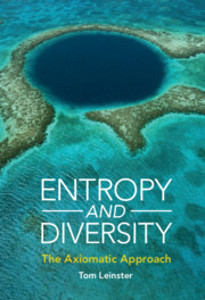
Tom Leinster is a mathematician at the University of Edinburgh, specializing in category theory, metric geometry, and their applications to areas such as algebra, topology, and mathematical biology. His research focuses on the concept of magnitude, a measure for metric spaces and enriched categories, as well as entropy and diversity. He has authored influential books including *Basic Category Theory* and *Entropy and Diversity: The Axiomatic Approach*. Leinster's work bridges foundational mathematics with interdisciplinary applications, emphasizing the interplay between abstract structures and concrete problems. His research interests span category theory, metric geometry, algebraic topology, and mathematical biology. Key contributions include foundational work on magnitude and its connections to geometric measure theory, entropy characterization, and categorical frameworks for diversity measurement. Leinster also engages in mathematical education and ethics, advocating for responsible research practices. Notable publications include recent advancements in magnitude homology of Euclidean sets, extremal magnitude in metric spaces, and entropy modulo primes. His work often highlights interdisciplinary applications, such as biodiversity quantification and information-theoretic foundations.