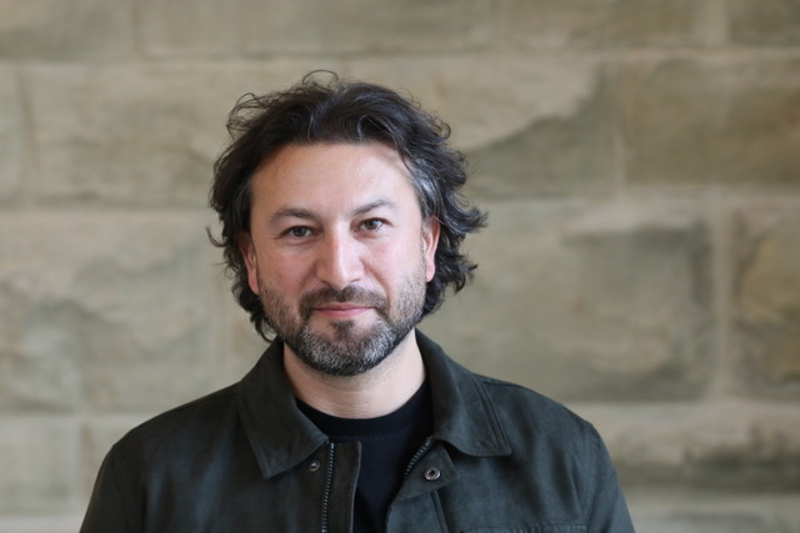
Anthony Masure is an Associate Professor at Geneva University of Art and Design (HEAD – Genève) , part of the University of Applied Sciences and Arts Western Switzerland (HES-SO) . His work bridges Artificial Intelligence , Blockchain , and Digital Humanities through critical design lenses. He explores tensions between creative automation and human agency , questioning how machine learning and smart technologies reshape authorship, value systems, and ecological practices in design. Key research areas: AI ethics , NFT implications , post-digital design , and technological accountability Projects like "Design et machine learning : l'automatisation au pouvoir?" (2021-2023) and "Post digital Graphic Design" (2019-2022) demonstrate his focus on critical technological engagements Advocates for open access and non-traditional research formats through initiatives like HEAD-Publishing His recent articles analyze generative AI in design, NFT governance , and circular design frameworks. Collaborations with researchers like Guillaume Helleu and Yves Citton emphasize socio-technical implications. Current projects include "L'organisation autonome automatisée (OAA)" (2024), exploring future enterprise models under climate constraints.
Mais T. Al-Khateeb is an Assistant Professor at Florida State University (FSU), specializing in rhetoric and transnational feminist studies. Her work addresses contemporary rhetorical theory, focusing on refugees, embodiment, and geopolitical crises. She holds a PhD in Rhetoric and Professional Communication from New Mexico State University (NMSU) and a BA from Al al-Bayt University. Dr. Al-Khateeb’s research explores refugee screening rhetorics and their material impacts on mobility, as well as transnational feminist solidarity movements. Her current monograph-in-progress critically examines refugee encounters through biometric and medical screening practices. Her publications span Peitho , Rhetoric Society Quarterly , and edited volumes like Transitions and Disruptions . Awards include FSU’s First-Year Assistant Professor Award (2023) and a CSGS Research Fellowship (2020). She co-edits (Re)Mobilizing Solidarity in/and Transnational Feminist Rhetorics and contributes to projects on health rhetoric and disability studies. Dr. Al-Khateeb’s pedagogical efforts include designing layered curricula for multilingual students, addressing language minority challenges in higher education.
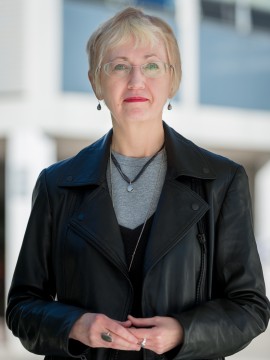
Nicole Allen is an Associate Professor in the Department of Communication Studies at Utah State University. She holds a B.A. in Political Science and History from the University of Montana, an M.A. in Political Science from the same university, and a Ph.D. in Communication Studies from the University of Nebraska. Her research focuses on transnational protest rhetoric, politics of time-temporality, postcolonialism, and critical materialism. She regularly teaches courses such as Intercultural Communication (CMST 3330), Globalization and Discourse (CMST 3730), and Social Influence Seminar (CMST 6400). Dr. Allen’s recent work explores neocolonial practices in digital communication, historical discourses on scientific racism, and the nonhuman turn in cultural studies. Her 2023 paper in Communication and Critical/Cultural Studies critiques self-seduction narratives through social media translation practices. Earlier publications analyze Daesh’s use of time in national identity construction and the rhetorical strategies of transnational protest movements like Pussy Riot. Her research emphasizes interdisciplinary approaches, blending rhetorical criticism with postcolonial and materialist frameworks. While no formal awards are listed, her work contributes to critical dialogues in communication and cultural studies. No specific grants or advising details are provided in the text, though her courses suggest engagement with global communication dynamics and social influence theories.
Jason Crider is an Assistant Professor in the English Department at Texas A&M University. He specializes in digital rhetoric, disability studies, and environmental communication. His work examines the intersection of mixed-reality technologies, prosthetic media, and ecological discourse through a posthumanist lens. Crider holds a PhD from the University of Florida and has published extensively on augmented reality (AR) rhetorics, mobile media, and media ecology. His research explores how emerging technologies reshape human-environment relationships and bodily experiences. His publications analyze topics like AR's algorithmic persuasion mechanisms, Pokémon Go's ecological representations, and Disney's memorial tourism through AR. His writing frequently addresses ethical implications of digital media in disability and environmental contexts. Crider's research areas include digital humanities, critical AI studies, technical writing, and medical rhetoric. He has contributed to journals like Computers and Composition, ISLE, and Kairos, focusing on media's role in shaping contemporary cultural narratives.
Anders E. Johansson is an Associate Professor in Literary Studies at Mid Sweden University , affiliated with the Department of Humanities and Social Sciences . His work bridges literary theory, feminist critique, and cultural studies, often interrogating neoliberalism, postmodernism, and the Anthropocene. His research interests include: Literary responses to neoliberal governance Feminist and poststructuralist analysis of cultural norms Ecocritical approaches to literature Philosophical undercurrents in Swedish poetry Interdisciplinary collaborations with gender studies His recent publications explore topics like Derrida’s Geschlecht III, ecological ethics in literature, and the political implications of irony in Swedish avant-garde music. He has contributed to edited volumes on sustainability, feminist pedagogy, and Swedish cultural identity. Notable collaborations include co-authorship with Siv Fahlgren and Kari Nygren , as well as editorial work for Makadam Förlag and Routledge . He actively participates in conferences on ecocriticism, normalization processes, and interdisciplinary research.
Alister Wedderburn is a Senior Lecturer in Political and International Studies at the University of Glasgow, part of the College of Social Sciences. His research focuses on critical and post-structuralist IR theories, visual and literary cultures in global politics, everyday politics, and colonial exploration histories. He holds a PhD from King's College London (2017), following BA and MA degrees from the University of Cambridge and King's College London. Prior to joining Glasgow in 2020, he was a John Vincent Postdoctoral Research Fellow at the Australian National University. Education: BA in English Literature (University of Cambridge, 2008) MA in War Studies (King's College London, 2012) PhD in International Relations (King's College London, 2017) His research interests emphasize interdisciplinary approaches to global politics, blending critical theory with analyses of visual art, humor, and colonial narratives. Recent work explores early modern Arctic exploration's role in constructing Enlightenment-era conceptions of 'Man,' and the political potential of 'silliness' as counter-discourse in IR. He has published in journals like European Journal of International Relations , Millennium , and International Feminist Journal of Politics . Wedderburn has secured grants including the University of Glasgow College of Social Sciences Research Fund (2021), a Universitas 21 award (2020), and the John Vincent Fellowship (2017–2019). He currently supervises two PhD students exploring climate-related sovereignty and whiteness in refugee discourse. His teaching includes courses on IR theory, visual global politics, and international relations concepts at the honors and master's levels. Professional activities include convening the British International Studies Association's Emotions Working Group (2021–2024), reflecting his engagement with affective dimensions in global politics.
Nathaniel Rivers is a Professor of English at Saint Louis University's College of Arts and Sciences. His research reimagines rhetoric beyond traditional human-centric models, focusing on nonhuman actors and ecological systems. He explores how persuasion occurs through material and discursive interactions in environments, technology, and public discourse. Education: Ph.D. in English, Purdue University (2009) M.A. in English, Purdue University (2005) B.A. in English and Psychology, University of Southern Indiana (2003) Research Interests: Professor Rivers investigates new materialist frameworks to analyze ecological rhetorics, technology's role in communication, and the ethical implications of nonhuman agency. He critiques anthropocentric assumptions in rhetoric, advocating for inclusive systems that account for material and environmental interactions. His work bridges rhetoric with philosophy, environmental studies, and cognitive science. Publications & Media: His work includes co-editing Thinking with Bruno Latour in Rhetoric and Composition and authoring influential articles on ecological pedagogy, public rhetoric, and posthumanist ethics. Recent publications explore climate rhetorics, digital publics, and the ethics of nonhuman mattering. Awards: Innovative Teaching Fellowship (2012) for developing a New Media Science Writing course. Advising & Grants: While no formal students are listed, his collaborative projects highlight mentorship in interdisciplinary teams. He has secured institutional support for pedagogical innovation, emphasizing hands-on, technology-focused teaching. Labs/Teams: Active in rhetoric and composition research networks, particularly those exploring materialist and ecological turns in humanities disciplines.
Matthew Flisfeder is an Associate Professor in the Cultural Studies program at the University of Winnipeg, where he teaches critical theory, rhetoric, and digital culture. His research interrogates the intersections of ideology, media, and contemporary capitalism through frameworks derived from Lacanian psychoanalysis and Hegelian dialectics. His academic credentials include: PhD (2010) from the Joint Graduate Programme in Communication and Culture (Toronto Metropolitan University and York University) MA (2005) from the same program Honours BA (2003) in Fine Arts Cultural Studies and Communication Studies (York University) Flisfeder's scholarship centers on critical analyses of digital culture, particularly the ideological operations of social media platforms and algorithmic systems. He develops concepts like 'algorithmic desire' and the 'hysterical sublime' to critique posthumanist and new materialist theories, arguing for renewed dialectical humanism to address climate crisis and AI-driven displacement of agency. His work frequently engages Slavoj Žižek's theories while examining populist rhetoric, antisemitism, and cyberpunk aesthetics in contemporary media. His publication trajectory reveals three dominant trends: (1) Systematic application of Žižekian/Lacanian frameworks to digital culture since 2017; (2) Increasing focus on the 'hysterical sublime' as a critical tool against posthumanism (2021-2025); (3) Expansion into antisemitism studies and Jewish question analyses within socialist theory (2023-2024). This evolution demonstrates his commitment to adapting critical theory for emergent capitalist contradictions in the Capitalocene era. Flisfeder is the author of four major monographs: Algorithmic Desire: Toward a New Structuralist Theory of Social Media (2021), Postmodern Theory and Blade Runner (2017), The Symbolic, the Sublime, and Slavoj Žižek’s Theory of Film (2012), and co-editor of Žižek and Media Studies: A Reader (2014). His current project 'The Hysterical Sublime' extends this work through dialectical humanism to confront anthropogenic climate change and technological displacement of human agency.
Gisèle Baxter is a Sessional Lecturer (Continuing) in the Department of English Language and Literatures at the University of British Columbia's Faculty of Arts. She has taught at UBC since 1997 after moving from Nova Scotia, specializing in literary and cultural studies across multiple periods and genres. Her research interests span a wide spectrum of literary fields including Gothic studies, Victorian literature, Modernism (particularly British and Irish), science/speculative fiction and fantasy, dystopian/post-apocalyptic narratives, children's literature, and rhetoric and composition including technical/professional communication. Baxter's scholarly work demonstrates a consistent engagement with gender studies, film adaptation, and the intersections between literature and cultural phenomena. Baxter's recent publications and conference presentations reveal a strong focus on Gothic science fiction, particularly examining gender representations in films like Blade Runner 2049 and Ex Machina. Her work often explores the Gothic heroine archetype, Bluebeard narratives, and dystopian literature, as evidenced by her co-edited volume Blast, Corrupt, Dismantle, Erase: Contemporary North American Dystopian Literature (2014) and her book chapter 'Bluebeard's Women Fight Back' (2019). Ian Fairclough Teaching Prize (2019-20 and 2002-03) SSHRC Postdoctoral Fellowship (1992-94) SSHRC Doctoral Fellowship (1989-90) Izaak Walton Killam Memorial Scholarship (1988-90) Baxter has supervised numerous undergraduate honors theses at UBC, with topics spanning Gothic literature, children's literature, science fiction, and film studies. She has also served as faculty sponsor for multiple Student Directed Seminars on topics including zombies in literature, Gothic literature, science fiction, and chick lit. Her pedagogical contributions include developing online courses and technical writing workshops, particularly for the Master of Food Science program.
Tim Flanagan is a Lecturer in the School of Humanities, Arts and Social Sciences at Murdoch University, affiliated with the College of Law, Arts and Social Sciences. His research focuses on philosophical aesthetics, critical metaphysics, and the history of ideas, particularly exploring post-Kantian thought and the rethinking of ontology through logology following Barbara Cassin. He holds a PhD from the University of Dundee and a BA (Hons) from the University of Queensland. His work examines classical philosophical problems such as the mind-body relationship and the organization of matter, recontextualizing them through contemporary frameworks. His 2021 book Baroque Naturalism in Benjamin and Deleuze: The Art of Least Distances analyses how Baroque sensibilities inform modern ontological inquiry. Current research engages with Cassin's logological approach to ontology, emphasizing linguistic and conceptual boundaries. Flanagan has published widely on topics including liminal diasporas, the intersection of technology and humanities, architectural theory, and ethical testimony in environmental contexts. His scholarship bridges philosophy with cultural studies, art history, and ecological thought. Despite no explicitly listed awards, his contributions reflect sustained engagement with interdisciplinary debates. No grant information or student advisement records are provided in the source materials. His academic output demonstrates a commitment to reimagining traditional philosophical questions through innovative methodological frameworks.
Patrice Rankine is a Professor in the Department of Classics and The College at the University of Chicago. He holds a Ph.D. from Yale University (1998) and a BA from Brooklyn College (magna cum laude). His research explores the intersection of classical antiquity with race, performance, and modern literature, particularly in African American contexts. He has held administrative roles, including Dean of the School of Arts & Sciences at the University of Richmond, and received the Excellence in Teaching Award at Purdue University. His work bridges ancient and modern, examining how classical texts shape contemporary racial discourse and theatrical performance. Key projects include Theater and Crisis: Myth, Memory, and Racial Reckoning in America (2024) and Aristotle and Black Drama (2013). He co-edited The Oxford Handbook of Greek Drama in the Americas (2015) and leads research on slavery’s global legacy, including organizing an international symposium on 'Transhistorical and Interdisciplinary Approaches to Slavery.' Education: Ph.D. in Classical Languages, Yale University (1998) B.A. in Ancient Greek, Brooklyn College (magna cum laude) Research Interests: Classical reception, race and performance, African American literature, theater studies, slavery studies. Rankine’s recent articles analyze classical themes in modern theater, Black poetry, and posthuman perspectives on Roman texts. He advocates for diversity in classical education and has contributed to grants like the Enhancing Research collaboration at Purdue University. His future projects include Slavery and the Book (Harvard UP), exploring slavery’s cultural imprint through literature. Awards: Excellence in Teaching Award, Purdue University (School of Languages and Cultures) Grants & Leadership: Led an international symposium on slavery research; contributed to NEH initiatives. His work emphasizes public scholarship, connecting classical studies to contemporary social issues. Labs/Teams: Collaborates on interdisciplinary projects like the Classical Reception and Modern World Poetry volume and the Critical Ancient World Studies initiative.
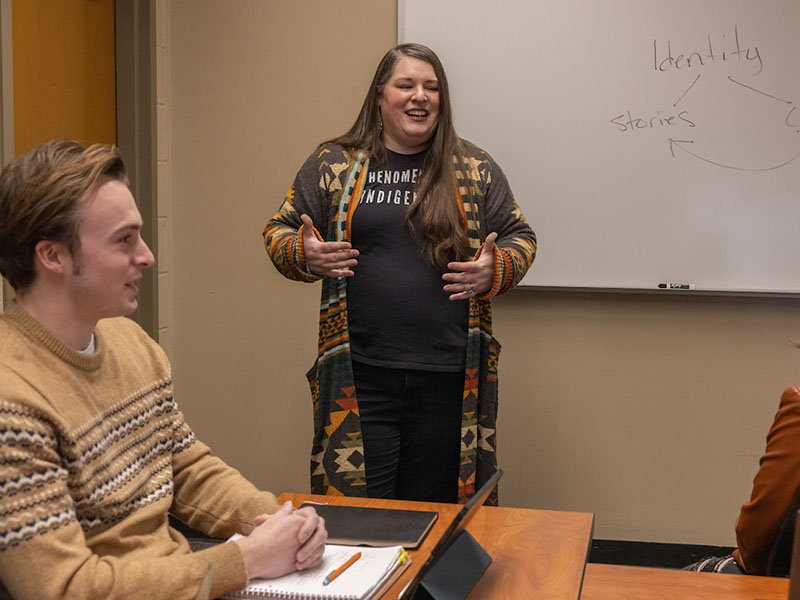
Emily Legg is an Associate Professor in the Department of English at Miami University, College of Arts and Science. A citizen of the Cherokee Nation, she integrates Indigenous epistemologies into her research and teaching, focusing on decolonizing methodologies, storytelling, and intercultural rhetorics. She is deeply committed to relational, reciprocal, and community-based pedagogy. Her research centers on Indigenous rhetorical practices, particularly Cherokee storytelling as a decolonial and materialist research method. She applies these methodologies to archival recovery, digital writing, and professional communication. Her work challenges hierarchical academic structures and promotes inclusivity, equity, and cultural recognition in writing studies. She teaches courses such as Digital Rhetorics, Visual Rhetorics, Intercultural Rhetorics, and Professional Writing at both undergraduate and graduate levels. Emily Legg's publications reflect a strong trajectory in Indigenous and cultural rhetorics, with a focus on historical recovery, decolonial theory, and interdisciplinary collaboration. Her recent and forthcoming works engage with Cherokee educational history, posthuman praxis, and Indigenous UX design, demonstrating a consistent commitment to centering Indigenous voices in rhetoric and composition. Ph.D., English, Purdue University, 2016 M.A., Rhetoric and Composition, Purdue University, 2011 B.A., Literary and Cultural Studies, University of Oklahoma, 2005 She has published in leading journals such as College Composition and Communication and Composition Studies , and her book Stories of our Living Ephemera is forthcoming with Utah State Press. She collaborates with scholars like Adam Strantz and Patricia Sullivan on projects that bridge technical communication and Indigenous knowledge systems. Emily is also developing future research on Cherokee women writers, matriarchal practices, and traditional crafts as rhetorical acts. Emily Legg advises students in rhetoric and composition and fosters inclusive classroom environments where students co-construct knowledge. While no formal list of advisees is provided, her mentorship is evident in her pedagogical philosophy and collaborative scholarship. She is actively involved in curriculum development that centers marginalized voices and promotes participatory learning. She is affiliated with research communities focused on Indigenous methodologies and digital rhetorics, and her work contributes to broader conversations in composition studies, technical communication, and decolonial scholarship. Though not explicitly mentioned, her projects imply engagement with community-based research teams and interdisciplinary networks.
Charles Barbour is a Professor at the School of Humanities & Communication Arts, Western Sydney University. His research focuses on contemporary political theory, intellectual history, Marxism, and the philosophy of technology. He supervises HDR candidates in areas such as Marx and Marxism, political theology, and critical theory. Doctor of Philosophy, University of British Columbia Hegelianism, ethics, and the societal impacts of technology are central to Barbour's scholarly work. His publications often examine intersections between political thought, philosophical critique, and historical analysis, with particular attention to Young Hegelian thinkers like Bruno Bauer and Arnold Ruge. Recent articles analyze topics such as technological regulation, Marx's ethical vision, and the role of political theology in modern discourse. His work contributes to debates on democracy, secularism, and the challenges of AI in society. Barbour participates in academic networks including the American Political Science Association, International Political Science Association, and Australasian Society for Continental Philosophy. He also contributes commentary on technology and society to public media platforms.
Prof. Dr. Wolfgang Struck holds the Professorship for Modern German Literature at the University of Erfurt within the Faculty of Philosophy. He serves as spokesperson for the research group Cultural Techniques of Collecting and is a Senate member. His research spans German literature from 18th century to present Historical geography and cartography Environmental humanities and Anthropocene Postcolonial and media studies Recent publications focus on maritime research (DFG project Fallen from the World ), colonial memory in media, and cultural techniques of documentation. He co-edited volumes on spatialization, oceanic globalization, and intercultural film analysis. As a founding member of the Erfurt Laboratory for Empirical Research , he contributes to interdisciplinary methodologies combining literary analysis with historical and scientific approaches.
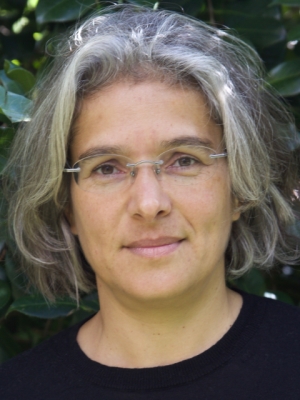
Nadia Mazouz is a Full Professor at the Department of Humanities, Social and Political Sciences of ETH Zürich . Her work focuses on Kantian consent theories of morality applied to contemporary cultural, social, and political challenges, including environmental ethics, medical resource allocation, and the morality of war technologies. Current research projects: trolley problem, numbers problem in ethics, AI ethics under polarization, cosmopolitanism critiques, and climate justice. Previously held professorship at the University of Marburg (2017-2021) after completing her Habilitation (2016) at ETH Zürich. Educational Background : Diploma in Physics (Technical University of Berlin) Diploma in Philosophy (Technical University of Berlin, Free University of Berlin, Humboldt University, Leipzig University) Dr. rer. nat. (1999, Fritz Haber Institute & Free University of Berlin) Dr. phil. (2003, University of Stuttgart) Research Expertise : Develops non-prescriptive deliberative moral frameworks that accommodate societal pluralism through context-dependent justification standards. Methodologically combines theory of reasons with rhetorical analysis , addressing unique challenges in: Posthuman ethics (AI, future generations) Resource allocation dilemmas International conflict resolution Digital transformation impacts on democracy Teaching Portfolio : Philosophy and Ethics of Technology Contemporary Social Philosophy Research Colloquium for Master/PhD students