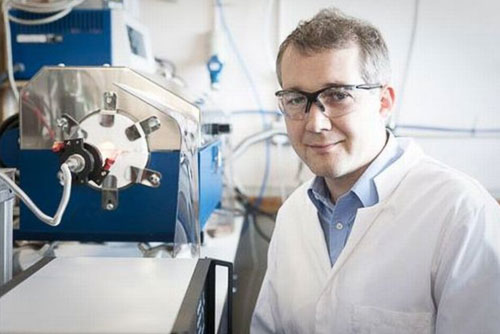
Chester Simocko is an Assistant Professor in Chemistry at San José State University, specializing in precision polymer synthesis and nanostructured materials. His laboratory focuses on metathesis polymerization techniques for creating functional block copolymers and surface-grafted polymer brushes. He teaches courses including Organic Chemistry, Physical Chemistry of Polymers, and laboratory modules, with an emphasis on practical synthetic methodologies. Research explores structure-property relationships in complex polymeric systems, with applications in nanotechnology and materials engineering. Key research themes: Design of stimuli-responsive polymer architectures Self-assembly mechanisms in multicomponent brush systems Sustainable polymerization processes using ionic media Publications demonstrate consistent focus on metathesis chemistry innovations and nanoscale characterization, with recent work advancing thermoresponsive micelle systems and e-waste upcycling methods.
Daniel Shun Chung Yang is a Professor in the Department of Biochemistry & Biomedical Sciences at McMaster University, with an extensive scholarly record spanning five decades from 1975 to 2024. His academic career demonstrates remarkable longevity and consistent research productivity, with teaching assignments scheduled through 2025 indicating his current active status at the institution. Dr. Yang's research program centers on protein structure and function, with particular emphasis on antifreeze proteins and their molecular interactions with ice. His work bridges structural biology, biochemistry, and biophysics, employing techniques including X-ray crystallography, computational modeling, and protein engineering. The scholarly trajectory reveals evolution from foundational structural studies to more complex investigations of protein-ice recognition mechanisms and applications in cryoprotection. Analysis of his publication history shows consistent contributions to understanding how antifreeze proteins recognize and bind to ice crystals through specific surface motifs, with significant work on type III antifreeze proteins from fish species. His research has expanded into related areas including potassium channel structure, protein engineering for stability enhancement, and more recently, applications in stem cell biology and materials science. As an educator, Dr. Yang has taught core biochemistry courses including Protein Structure and Enzyme Function (BIOCHEM 2BB3), Proteins and Nucleic Acids (BIOCHEM 3G03), and Research and Experimental Design (HTHSCI 3V03) across multiple academic years from 2017 through 2025, demonstrating his ongoing commitment to undergraduate and graduate education at McMaster University.
Professor Ian Kinloch is a Professor of Materials Science at the University of Manchester, leading the Advanced Nanostructures Group within the Department of Materials and the National Graphene Institute. He holds an EPSRC Challenging Engineering Fellowship and EPSRC/RAEng Research Fellowship. His research focuses on nanomaterials, composites, and energy storage, particularly graphene-based materials. He is Head of Research for the School of Natural Sciences and Deputy Theme Leader in the Henry Royce Institute for Advanced Materials. Education: BSc (Hons) in Physics from the University of Durham, PhD in Materials Science from the University of Cambridge. Professional roles include Deputy Work-package Leader of the Composites Theme in the Graphene Flagship. Research interests emphasize nanomaterial synthesis, processing, and applications in composites and energy transition. Key projects include the Graphene Flagship and Royal Academy of Engineering Research Chair in Carbon Materials. Notable awards include the Morgan Advanced Materials/Royal Academy of Engineering Research Chair (2018). His publications span over 250 articles, focusing on graphene composites, MXenes, thermoelectric materials, and structural health monitoring. Collaborations involve institutions worldwide, addressing sustainable materials and advanced manufacturing challenges.
Keqing Huang is a Postdoctoral Fellow at the Australian National University's College of Engineering, specializing in perovskite solar cell research. He investigates high-performance solar cells, flexible perovskite devices, and effects of external stimuli like radiation on device physics. Huang earned his B.S. and M.S. from Central South University and PhD from ANU. His research focuses on enhancing efficiency and stability of perovskite photovoltaics through interface engineering, novel material compositions, and scalable fabrication techniques. Recent work addresses challenges in commercialization, including humidity tolerance during manufacturing and radiation resistance for space applications. Huang's publications demonstrate consistent innovation in device architecture, particularly through interface modification strategies and additive engineering. His work spans fundamental material studies to large-scale module development. Awards include: Excellent Master's Thesis of Hunan Province Excellent Poster Award at The 7th Conference on New Generation Solar Cells He collaborates with research teams at ANU's Engineering Building and contributes to advancing renewable energy technologies through materials innovation.
Yujia Qing is an Associate Professor of Organic Chemistry at the University of Oxford, affiliated with Lady Margaret Hall. Her research explores single-molecule chemistry, particularly polymer behavior under nanopore confinement, and engineering protein nanoreactors for vectorial catalysis. BSc in Chemistry, University of Sheffield (2012) MSc in Pharmacology, University of Oxford (2014) DPhil in Chemical Biology, University of Oxford (completed under Prof. Hagan Bayley) Her work leverages engineered protein nanopores as nanoreactors to monitor bond-making and breaking events in real time, enabling innovations like mobile molecules for biopolymer movement and sequence analysis. This bridges single-molecule chemistry , nanopore technology , and synthetic biology . Recent publications highlight advancements in bioorthogonal chemistry , post-translational modification detection , and nanopore-based sensing . Key themes include real-time reaction monitoring , directional molecular control , and enzyme-free analytical methods . Scientific Awards : Reaxys PhD Prize (2019) Dream Chemistry Award (2019) Glasstone Research Fellowship in Science (2020) She has held postdoctoral and fellowship roles at the University of Oxford, contributing to chemical biology and nanopore applications .
John Chaput is a Professor in the Department of Chemistry at the University of California, Irvine. His research focuses on chemical biology, synthetic nucleic acids, and biomolecular engineering. He leads efforts to design novel genetic polymers like XNA (xeno-nucleic acid) and TNA (threose nucleic acid), exploring their applications in diagnostics, therapeutics, and synthetic biology. Chaput’s work emphasizes functional nucleic acid engineering, including the development of XNAzymes for gene silencing and diagnostic systems. His lab employs directed evolution, microfluidics, and structural biology techniques to enhance polymerase efficiency and nucleic acid stability. Key areas of innovation include the REVEALR diagnostic platform for rapid pathogen detection, advances in TNA polymerase evolution, and the synthesis of stable nucleic acid analogs resistant to biological degradation. Chaput’s research bridges organic chemistry, enzymology, and molecular biology, with implications for drug delivery, genetic engineering, and understanding fundamental replication mechanisms. His contributions span over 150 peer-reviewed publications, with recent work highlighting nucleic acid therapeutics, cross-species genetic systems, and the structural basis of DNA replication. Chaput collaborates with industry partners to translate lab discoveries into clinical diagnostics and therapies.
Prof. J.A. (Ton) Loontjens is a Professor in the Faculty of Science and Engineering at the University of Groningen, affiliated with the Polymer Science department within the Zernike Institute for Advanced Materials. He also serves as a Principal Scientist at DSM Research in Geleen, Netherlands. His work focuses on materials science, coatings, and films, with a particular emphasis on antimicrobial surfaces, biomaterials, and polymer chemistry. He holds a prominent role in advancing functional polymers for medical and industrial applications. Research interests include polymerization mechanisms, polycondensation processes, and the development of bioactive coatings to combat bacterial adhesion. His contributions have led to innovations in antimicrobial materials, drug delivery systems, and surface engineering. Loontjens has published extensively in peer-reviewed journals such as Langmuir and European Polymer Journal , with notable works on hyperbranched emulsifiers and antimicrobial PDMS coatings. He has been granted multiple patents for inventions like dopamine-functionalized polymers and biocidal coatings for medical devices. These technologies aim to enhance infection prevention and material durability in biomedical contexts. His research often bridges fundamental polymer science with applied materials engineering, addressing real-world challenges in healthcare and industry.
Fei Ye is a Researcher at the Royal Institute of Technology (KTH) in the Department of Physics of Light and Matter. Their work focuses on nanocomposite materials for environmental applications, including corrosion prevention, water treatment, and antifouling coatings. Ye teaches courses such as 'Colloids and Colloidal Principles for Industrial Applications,' 'Nanomaterials for Sustainable Energy and Environment,' and others. They have authored numerous publications since 2012, emphasizing photocatalytic systems, nanomaterial synthesis, and sustainable technologies. Research interests include developing advanced materials for biomedical applications, solar energy systems, and eco-friendly coatings. Key areas involve chitosan-based nanocomposites, zero-valent metal catalysts, and electrocatalysts for water splitting. Their work bridges material science, environmental engineering, and green chemistry, with applications in energy storage and pollution control. Publications analyze topics like photothermal materials for solar absorbers, biofouling prevention using PEGylated coatings, and multifunctional nanoparticles for imaging. While awards are not explicitly listed, their contributions span over a decade with impactful research in interdisciplinary fields.
Rao Tummala is a Distinguished and Endowed Pettit Chair Professor at Georgia Tech's College of Engineering, with joint appointments in Electrical and Computer Engineering and Materials Science and Engineering. He founded and directs the NSF-funded Microsystems Packaging Research Center (PRC), focusing on System-on-Package (SOP) innovations as the 'Second Law of Electronics.' The center involves 200 students, 15 faculty, and 40 global companies. Research interests span advanced packaging technologies, including: Glass-based RF modules for 5G/6G applications Polymer dielectrics for high-density interconnects Embedded power passives and 3D integration Nanocopper sintering for heterogeneous integration Millimeter-wave antenna-in-package designs Awards and honors include: National Academy of Engineering membership IEEE Third Millennium and David Sarnoff Awards ASM International Materials Achievement Award Distinguished Faculty Award from Georgia Tech
Ting Yang Nilsson is a Researcher in Applied Chemistry at Chalmers University of Technology. She received her PhD in polymer technology from KTH, Stockholm (2012), followed by postdoctoral research at Linköping University focusing on organic electronics using cellulose and lignin. Previously, she served as an Assistant Professor at Linköping University and held roles as Senior Researcher and Project Manager at RISE (2016–2024), leading projects on cellulose-based materials and graphene coatings. Her research emphasizes sustainable materials, including graphene-based coatings for recycling biofibers and scalable circular polymers. Key projects include developing bio-based fiber composites for 3D printing and thermal management applications. She leads projects funded by VINNOVA and collaborates with industry partners like TenuTec AB. Publications span biomaterials, polymer chemistry, and nanotechnology. Her work bridges academic and industrial innovation, addressing environmental sustainability through advanced material science.
Dr. Nuno Reis is a Reader in Chemical Engineering at the University of Bath, specializing in microfluidic diagnostics and bioprocess engineering. His lab develops scalable systems for cell therapy manufacturing and advanced diagnostic tools, with active research across biomedical engineering, sustainable materials, and point-of-care diagnostics. Research Interests: Focuses on microfluidic device development for medical diagnostics, intensification of gas-liquid systems, continuous crystallization using oscillatory flow reactors, and scalable bioreactor designs for cell therapy production. Current projects include red blood cell manufacturing from immortalized cell lines and therapeutic extracellular vesicle production. Publications: Reis's recent work demonstrates innovations in microfluidic diagnostics, cell culture platforms, and sustainable biomaterials. Articles showcase applications in cancer detection, blood analysis, and electrochemical sensing, reflecting interdisciplinary approaches combining engineering, biology, and materials science. Research Projects: Leads multiple funded initiatives including: Manufacturing in Hospital: BioMed 4.0 (EPSRC) Exosome-based diagnostic module for early cancer detection (Cancer Research UK) Smartphone 'fingerprinting' of SARS-CoV-2 antibodies (EU Horizon 2020) Facilities: Heads research within the Centre for Bioengineering & Biomedical Technologies (CBio) and Reaction and Catalysis Engineering unit (RaCE).
Dr. Lucian Amerigo Lucia serves as a Full Professor in the Department of Forest Biomaterials and Chemistry at North Carolina State University. He also holds faculty positions in the programs of Fiber & Polymer Science and Environmental Sciences. Additionally, he maintains international appointments as Professor at South China University of Technology and Federal University of Amazonas in Brazil, and as Honorary Distinguished Professor at Qilu University of Technology in China. Professor, NC State University (Current) Professor, South China University of Technology (2003-Present) Professor, Federal University of Amazonas (2006-Present) Honorary Distinguished Professor, Qilu University of Technology (2014-2021) Dr. Lucia received his Ph.D. in organic chemistry from the University of Florida, where he researched modeling photoinduced charge separation states of novel Rhenium (I)-based organometallic ensembles as a first-order approximation of photosynthesis. He began his professional career as an Assistant Professor at the Institute of Paper Science and Technology at the Georgia Institute of Technology, examining the mechanism of singlet oxygen's chemistry with lignin & cellulose. Dr. Lucia's research focuses on green chemistry of renewable polymers, with particular emphasis on the chemical modification of cellulosics for biomedical applications. His laboratory, The Laboratory of Soft Materials & Green Chemistry, probes fundamental materials science topics in this area. He has co-founded and co-edits the open-access international research journal BioResources , dedicated to original research on lignocellulosic materials. His recent publications span topics including sustainable packaging, nanocellulosic materials, bio-based barrier layers, and chemical analyses of polymer surface abrasion. His work shows a strong trend toward developing sustainable, biodegradable alternatives to conventional materials, with applications in food packaging, biomedical devices, and environmental remediation. Fulbright Scholar (Brazil) Dr. Lucia teaches courses including Forest Biomaterials Chemistry (WPS 723), From Papyrus to Plasma Screens: Paper & Society (PSE 220), Green Chemistry (PSE/CH 335), and the FB Graduate Student Seminar Series (WPS 590/790) at NCSU, while also teaching Wood Chemistry and Green Chemistry at Qilu University of Technology in China. His laboratory, The Laboratory of Soft Materials & Green Chemistry, brings together interdisciplinary researchers working at the intersection of chemistry, materials science, and sustainability. The lab has developed several innovative approaches for modifying cellulose and other renewable polymers for advanced applications.
Professor Davide Deganello is a Professor in Mechanical Engineering at Swansea University and Deputy Director of the Welsh Centre for Printing and Coating (WCPC), a globally recognized center for printing and plastic electronics research. He is also co-director of CAPTURE, Swansea's Energy Storage Center of Excellence, and Co-Lead for Engineering for the upcoming REF2029 assessment. His research focuses on functional materials and printing technologies, advancing applications in printed electronics, energy storage, biomedical devices, and advanced manufacturing. He has secured significant funding from UK Research Councils and industrial partners, leading to patents and impactful collaborations. Key research interests include rheology, material formulation, and computational fluid dynamics (CFD) modeling to optimize printing processes from roll-to-roll to additive manufacturing. His work bridges academic innovation with industrial applications, such as sustainable supercapacitor materials, biodegradable bone grafts, and smart textiles. Professor Deganello is actively engaged in postgraduate supervision and contributes to academic leadership roles, including membership and Chairmanship of the Institute of Physics Printing and Graphic Science Group. His research has been recognized through successful REF Impact Case Studies (2014 and 2021) and collaborations with industry to enhance recyclability and sustainability of materials.
Dr. Subashani Maniam is a Senior Lecturer in the School of Science at RMIT University. Her research focuses on organic synthetic chemistry, particularly energy storage materials and bioactive compounds with therapeutic applications. She holds a PhD in Supramolecular Chemistry from the Australian National University (2008) and has held postdoctoral positions at the University of Melbourne, CSIRO, and Monash University. Her work includes developing organic materials for redox flow batteries and exploring supercritical CO₂ for sustainable processes. Education: PhD (2008, ANU), Postdoc (2008-2011, Melbourne/CSIRO), Monash University collaboration (2011-2016). Awards: 2016 Victoria Fellowship, 2021 Green Chemistry Hot Article, 2019 Women Researchers' Network Poster Prize. Research interests include synthesizing organic materials for energy storage, hydrogen storage, fluorescent labels for cancer metabolites, and drug discovery targeting neurodegenerative diseases. She is involved in collaborative projects on recycling via supercritical CO₂ and sustainable energy solutions. Her teaching spans advanced chemistry theory and laboratory courses, including coordination of CHEM1040 and CHEM1041.
Alexander A. Shestopalov is an Associate Professor of Chemical Engineering at the University of Rochester's Hajim School of Engineering & Applied Sciences, and a Scientist at the Laboratory for Laser Energetics. He holds a PhD in Physical Chemistry from Duke University (2009) and earlier degrees from Moscow State University and the Zelinsky Institute. His research focuses on interfacial engineering, nanostructured materials, and advanced manufacturing techniques. Education: PhD (2009, Duke University), PhD (2004, Zelinsky Institute), M.S. (2002, Moscow State University). Professional roles include Director of Graduate Studies in Chemical Engineering and secondary appointments in Materials Science and Chemistry. Research interests emphasize materials and surface chemistry combined with manufacturing innovations, such as monomolecular deposition, polymeric materials for micro/nano devices, and anisotropic colloids. Experimental methods include organic chemistry, patterning techniques, and advanced material characterization. Recent publications (2020–2023) highlight work on silicon nitride membranes for biomedical applications, laser-induced damage mechanisms, and shape-memory polymer technologies. Awards include the Hobbs Endowment (2009) and Burroughs Welcome Fellowship (2007). Teaching includes Thermodynamics II, Surface Analysis, and Biointerfaces. Collaborators include Professors McGrath, Anthamatten, and Rothberg. Advised over 15 graduate and postdoctoral researchers since 2010.